
Why do textbook worked examples feel effortless while blank homework problems freeze your brain? Jumping straight from passive solutions to cold problem solving triggers Means-Ends Analysis overload in novice working memory. Renkl and Atkinson's Backward Fading protocol bridges this chasm by progressively removing steps from last to first until blind solving becomes automatic.
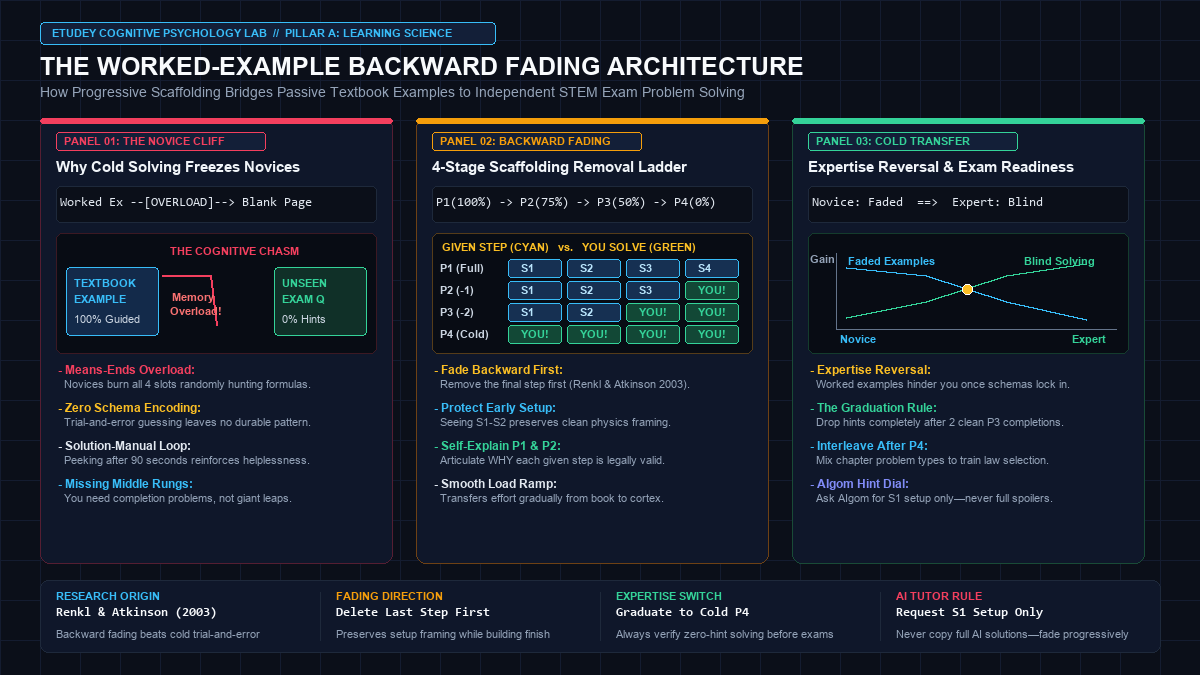
Figure 1.0: How Backward Fading replaces the sudden novice cognitive cliff with a smooth 4-stage scaffolding ladder, graduating into zero-hint blind exam solving.
1. The Homework Freeze: "It Made Total Sense in the Textbook!"
Every STEM undergraduate has experienced this infuriating disconnect. You sit in lecture or read Example 5.2 in your Thermodynamics, Signals & Systems, or Linear Algebra textbook. Every single line flows cleanly: "Set up the control volume, apply energy balance, substitute ideal gas enthalpy, integrate—boom, exact answer!" You feel confident. You close the example and flip to Problem 5.14 at the back of the chapter.
You stare at the blank page. Your mind goes completely empty. Which boundary condition comes first? Should you use nodal analysis or Thévenin reduction? After ninety seconds of panicked formula flipping, you give up and peek at the solution manual or paste the prompt into an AI chat for the full answer. The cycle repeats all semester—right until the midterm exam removes your solution manual permanently.
Why does understanding a worked example fail so spectacularly to prepare you for an unseen problem? Cognitive Load Theory reveals that jumping straight from a 100% solved example to a 0%-hint blank page is an unbridgeable cognitive cliff for a novice brain.
2. Why Cold Trial-and-Error Fails Novices (Sweller & Cooper, 1985)
In 1985, cognitive psychologists John Sweller and Graham Cooper ran a classic series of algebra and physics experiments. One group of beginners spent an hour grinding through unassisted homework problems from scratch. A second group spent the exact same time studying pairs of fully worked examples followed by isomorphic practice problems. On a surprise transfer test featuring unseen problems, the worked-example group crushed the cold-solving group in both speed and accuracy.
Why? Because when a beginner faces an unfamiliar 5-step engineering derivation with zero guidance, they default to Means-Ends Analysis—working backward from the desired target variable while randomly rifling through their formula sheet searching for any equation that contains matching letters. As we examined in our Cognitive Load Theory Guide, human working memory holds only 4 novel chunks. Means-Ends guessing consumes 100% of those four slots on temporary algebraic trial-and-error, leaving zero bandwidth to encode the underlying problem-solving schema. Even if you stumble onto the right numerical answer after 25 minutes, you cannot replicate it on tomorrow's quiz!
3. The Bridge: Renkl & Atkinson's Backward Fading Protocol
If pure worked examples breed passive fluency, and pure blind solving overloads novice working memory, what sits cleanly in between? In 2003, researchers Alexander Renkl and Robert K. Atkinson discovered the exact optimal bridge: Backward-Faded Completion Problems.
Instead of jumping from 100% scaffolding down to 0% in one leap, you solve a structured sequence of four twin problems—progressively deleting solution steps from the last step backward to the first step:
| Fading Stage | Scaffold Shown | What YOU Execute Blind | Primary Cognitive Goal |
|---|---|---|---|
| Problem 1 (Full Example) | S1 + S2 + S3 + S4 | Active Self-Explanation ("Why?") | Encode clean 4-step physical architecture without overload. |
| Problem 2 (Fade Tail) | S1 + S2 + S3 | Execute Step 4 (Final Solve + Units) | Build closing confidence while seeing proper setup & core math. |
| Problem 3 (Fade Core + Tail) | S1 + S2 Setup Only | Execute Steps 3 & 4 Blind | Practice heavy algebraic execution without initial framing panic. |
| Problem 4 (Cold Transfer) | 0% Hints (Blank Page) | Full S1 → S4 Solo Derivation | Verify exam-hall independence & trigger graduation. |
Why Backward Fading Beats Forward Fading
Students frequently ask: "Why delete the last step first instead of deleting Step 1 first?" Think about the anatomy of a hard engineering problem. Step 1 (choosing the right coordinate system, drawing the Free Body Diagram, or picking the proper Laplace boundary condition) is cognitively the hardest, highest-leverage framing move—and if you make a subtle error in Step 1, Steps 2, 3, and 4 collapse into garbage! By keeping Steps 1 and 2 visible during Problem 2 and Problem 3, your brain absorbs clean framing patterns repeatedly while gradually taking ownership of the derivation tail. By Problem 4, the Step 1 framing schema is already wired into long-term memory, so solo cold solving clicks smoothly.
"Fading worked solution steps backward—from the final calculation back toward the initial problem setup—produces significantly higher near and far transfer performance than either unassisted problem solving or forward fading." — Dr. Alexander Renkl & Dr. Robert K. Atkinson, Educational Psychologist (2003)
4. How to DIY Backward Fading Using Any Textbook or Solution Manual
Most university textbooks do not print pre-faded completion problems—they only give you fully solved examples and totally blank exercises. Fortunately, you can manufacture your own Backward Fading ladder in ten seconds using an index card (or a sticky cover sheet on PDFs):
- Pick 3 Solved Examples + 1 Unsolved Homework Twin: Choose four problems testing the exact same underlying theorem (for example, four Mohr's Circle principal stress calculations or four Op-Amp nodal circuits).
- Run Problem 1 with Self-Explanation: Read all steps, pausing after every single line to speak aloud why that law applies (using our Rubber Duck Self-Explanation Protocol).
- Cover the Bottom Third on Problem 2: Place an index card over the final substitution and algebraic simplification. Read Steps 1–3, then execute Step 4 completely blind on Handwriting Studio before lifting the card.
- Cover the Bottom Two-Thirds on Problem 3: Leave only the initial diagram and governing law exposed. Perform all intermediate algebra and final dimensional verification blind.
- Execute Problem 4 Totally Cold: Close the book and solve an unsolved end-of-chapter problem from scratch. If you nail Problem 4 cleanly without peeking, you have officially bridged the chasm!
5. The Expertise Reversal Switch: Know When to Burn the Training Wheels
Scaffolding is medicine—and like any medicine, overdosing after you heal causes side effects. Cognitive Load Theory calls this the Expertise Reversal Effect. Once you have cleanly solved two consecutive Problem-4 cold transfers, continuing to stare at worked examples or faded hints actually slows down and degrades learning! Why? Because forcing an already-automated schema to cross-check external hints injects redundant extraneous load (just like the redundancy trap in our Split-Attention Effect Guide).
The moment Stage 4 clicks, immediately graduate to cold interleaved practice—mixing three or four different chapter problem types together (using our 2-Phase Interleaving Engine) so your brain practices recognizing which theorem to pull on exam day without chapter-heading spoilers.
6. Running Backward Fading Effortlessly Inside Etudey
Traditional AI chatbots accidentally sabotage learning by dumping full 100% spoiler solutions the instant you ask for help—trapping students permanently at Stage 1. Use Etudey's workspace to enforce disciplined backward fading instead:
- Use AIgom Step-by-Step Tutor as a Fading Dial: Explicitly prompt AIgom: "Give me ONLY Step 1 setup and Step 2 governing law—do NOT solve Steps 3 and 4 so I can finish blind!" You get instant Stage-3 completion scaffolding on any homework problem.
- Complete Faded Steps in Handwriting Studio: Sketch diagrams and write out faded tails freehand before revealing verification checkpoints.
- Archive Clean Problem Schemas in Interactive Notes & Flashcards: Log your Stage-1 framing triggers and track every chapter's progression from Fading to Cold Tested on Etudey Kanban.
Frequently Asked Questions
Why do I understand every example in class yet freeze on homework assignments?
Following a professor's worked example requires zero search load because every strategic decision is made for you. When you jump directly to a blank homework problem as a novice, working memory gets flooded by Means-Ends Analysis—randomly hunting for formulas—leaving no capacity to recall or execute the derivation. Backward Fading bridges this exact gap cleanly.
How many faded completion problems should I do before attempting a cold problem?
For most multi-step STEM problem archetypes, a rapid 4-problem sequence (1 full self-explained example, 1 late-step faded problem, 1 mid-to-late faded problem, and 1 cold transfer problem) is optimal. If you stumble on Problem 4, step back for one extra Stage-3 faded problem rather than restarting from Stage 1.
Doesn't studying worked examples violate active recall?
Only if you read worked examples passively and stop there! Cognitive science distinguishes between initial schema acquisition (where novices learn far faster from self-explained worked examples and faded completion problems) and subsequent schema automation and retrieval (where cold active recall and timed testing dominate). Backward Fading seamlessly links both phases.
Does Backward Fading work for coding and Data Structures & Algorithms too?
Absolutely. In CS courses, Stage 1 is reading a clean algorithm implementation while explaining every invariant aloud; Stage 2 is deleting the final return/cleanup block and rewriting it blind; Stage 3 is keeping only the function signature and loop skeleton while coding the core logic; Stage 4 is writing the full algorithm on a blank editor.
What is the Expertise Reversal Effect in studying?
The Expertise Reversal Effect is the empirically proven finding that instructional scaffolding (like detailed worked examples and step-by-step hints) dramatically helps beginners acquire new schemas, yet actively impedes learning for intermediate and advanced students who already possess the schema and need unassisted blind problem solving instead.
Bridge the Gap from Textbook Examples to Exam Mastery
Stop spoiling entire homework problems with raw solution dumps. Ask AIgom for Step-1 setup hints only, finish faded derivations in Handwriting Studio, and graduate to cold exam solving.