
Why does flipping your eyes back and forth between a circuit schematic on page 214 and its equations on page 215 exhaust your brain within twenty minutes? Cognitive Load Theory calls this the Split-Attention Effect—extraneous visual search consumes your four-slot working memory, starving deep comprehension until you physically integrate math directly onto the diagram.
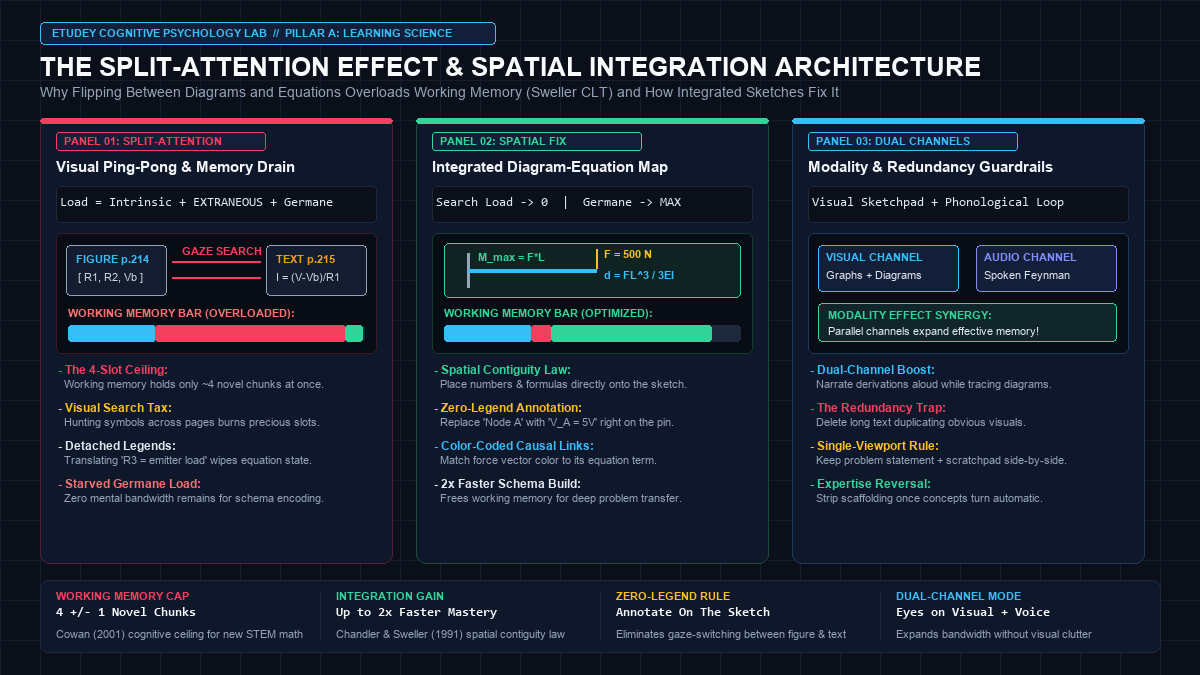
Figure 1.0: How detached textbook figures and legends saturate working memory with extraneous visual search—and how Spatial Integration and Dual-Channel Modality restore deep learning bandwidth.
1. The Hidden Reason 20 Minutes of Textbook Reading Feels Like a Marathon
Picture a familiar late-night hostel study session. You sit down fresh after dinner to tackle a single worked example in Analog Electronics, Fluid Mechanics, or Organic Chemistry. The circuit schematic or Free Body Diagram sits neatly at the top of Page 214. The problem statement sits in the middle. The resistor values sit inside a footnote table, and the actual nodal equations spill over onto Page 215.
Your eyes begin a frantic ping-pong dance: look at the equation \( I_1 = (V_{in} - V_A)/R_3 \), flip back a page to locate \( R_3 \), hold "\( R_3 = 4.7\text{ k}\Omega \)" inside your head, flip forward, realize you forgot which junction was labeled Node A, flip back again, squint at a tiny legend key, and flip forward a third time. Within twenty-five minutes, your forehead aches, your eyes glaze over, and you conclude—falsely—that you are "bad at circuits" or "too tired to focus."
You are not bad at engineering. You are experiencing a rigorously documented neurological bottleneck known in educational psychology as the Split-Attention Effect.
2. The Neuroscience of Split Attention (Sweller's Cognitive Load Theory)
In the late 1980s and 1990s, educational psychologist John Sweller and colleague Paul Chandler ran landmark experiments on electrical engineering apprentices and mathematics students. They discovered that human Working Memory—the mental scratchpad where you manipulate unfamiliar concepts—is shockingly small. As Nelson Cowan's (2001) seminal research confirmed, an average adult can actively juggle only 4 ± 1 novel information chunks simultaneously, and those traces decay within 15 to 20 seconds unless actively rehearsed.
As explored in our foundational Cognitive Load Theory Guide, every study task consumes three competing buckets of working memory:
- Intrinsic Load (Necessary Difficulty): The inherent conceptual complexity of the subject itself—such as grasping how negative feedback stabilizes an op-amp or how shear stress transforms on Mohr's Circle.
- Extraneous Load (Wasted Mental Friction): Cognitive effort wasted purely on poor layout, flipping pages, hunting for detached symbol legends, or Alt-Tabbing between six browser windows.
- Germane Load (Actual Learning): The leftover mental energy your brain uses to wire permanent long-term schemas inside your cortex.
Here is the brutal equation of human cognition: when a textbook forces you to visually search between two mutually dependent sources of information—a diagram that makes no sense without the equations, and equations that make no sense without the diagram—Extraneous Load explodes to 70%+ of your four-slot capacity. You burn almost all your glucose on temporary eye-hand bookkeeping, leaving practically zero Germane bandwidth to actually learn the physics!
"When learners must mentally integrate disparate sources of mutually referring information, the resulting extraneous cognitive load severely impedes schema acquisition. Physically integrating text and diagrams eliminates visual search and dramatically accelerates problem-solving transfer." — Paul Chandler & John Sweller, Cognition and Instruction (1991)
3. The 4 Most Toxic Split-Attention Traps in College STEM
Modern university students actually suffer worse split attention than 1990s textbook learners because digital study setups multiply detached windows. Audit your current workflow against these four common traps:
| Split-Attention Scenario | Extraneous Memory Tax | Classic Student Symptom | Spatial Integration Fix |
|---|---|---|---|
| Page-Split Textbook Figures | Holding node IDs across page flips | Mental fatigue after 2 worked examples | Redraw sketch once; write given values & equations directly on branches. |
| Detached Symbol Legends | Translating "Point C = yield" repeatedly | Mixing up variables mid-derivation | Kill footnotes; label physical meaning + SI units right next to each point. |
| Alt-Tabbing PDFs & Videos | Full viewport wipe on every window switch | Rewinding YouTube lectures 5 times | Lock diagram + derivation inside one unified split-screen canvas. |
| Formula Sheet vs. Problem Text | Mapping abstract letters to new geometry | Plugging diameter into radius slot | Embed small geometric boundary icons beside every formula card. |
4. The Spatial Integration Protocol: 4 Rules to Reclaim Your Working Memory
You cannot rewrite poorly formatted university textbooks—and professors will never stop projecting split-attention PowerPoints in lecture halls. However, you have 100% control over how you reconstruct information inside your own workspace. Apply these four evidence-backed rules whenever tackling visual STEM material:
Rule 1: Enforce the Zero-Legend Annotation Rule
Never copy a textbook's detached letter legend ("A = Compressor Inlet, B = Turbine Exhaust, C = Condenser") into your notebook. Instead, sketch the T-s diagram or circuit diagram slightly larger than normal—giving yourself generous whitespace—and write the exact physical state, temperature, pressure, or voltage directly onto the node itself (`T1 = 300 K, P1 = 100 kPa`). When your eye lands on Node 1, all relevant parameters enter working memory as a single integrated chunk rather than three separate visual lookups.
Rule 2: Anchor Equations Directly to Geometry
In Chandler & Sweller's original electrical engineering experiments, students who studied wiring schematics with step-by-step test equations embedded directly beside the exact terminals solved transfer problems nearly twice as fast—with dramatically higher accuracy—than students who read the exact same text printed below the diagram. When solving a cantilever beam or Kirchhoff circuit on Etudey Handwriting Studio, draw a crisp callout arrow from the fixed wall directly to the moment equation \( M_{wall} = -F \cdot L \), and from the summing junction directly to the KCL balance \( I_{in} + I_f = 0 \).
Rule 3: Color-Code Causal Links (Not Decoration)
Random pastel highlighting does nothing. Functional color-coding slashes visual search time to near zero. Pick three consistent functional colors across your semester:
- Cyan / Blue: Known given inputs and boundary conditions (both on the diagram and inside the equation).
- Amber / Gold: Intermediate unknown variables you are solving for.
- Rose / Red: Reaction forces, sign inversions, or classic exam unit traps.
When your eye sees an amber arrow on a Free Body Diagram and an amber term inside \( \sum M = 0 \), the spatial connection fires instantaneously without conscious translation.
Rule 4: Combine Visual Diagrams with Spoken Audio (The Modality Effect)
Working memory actually consists of two semi-independent channels (as detailed in our Dual-Coding Theory Guide): the Visuospatial Sketchpad (eyes processing diagrams and equations) and the Phonological Loop (ears processing spoken words). Reading dense explanatory paragraphs while staring at a complex schematic jams two streams through the visual channel simultaneously.
To expand total working memory capacity, offload explanations onto your auditory channel: trace your integrated diagram with a stylus while explaining each causal link out loud using the Feynman Technique. Eyes track geometry; voice narrates causality—zero visual traffic jam.
5. Two Critical Caveats: The Redundancy & Expertise Reversal Effects
Cognitive Load Theory is nuanced. Blindly cramming too much text onto a diagram can backfire if you violate two companion laws:
- The Redundancy Effect: Only integrate information that is strictly necessary to understand the diagram. If a diagram of blood flow through the heart already has crystal-clear arrows showing flow from the left atrium to the left ventricle, writing a full sentence "Blood flows from the left atrium into the left ventricle" directly on top of the arrow creates visual clutter that actually degrades recall. Keep inline labels telegraphic: symbols, units, and terse 3-word physical laws.
- The Expertise Reversal Effect: Scaffolding that rescues a beginner slows down an expert. Once you have solved 25 nodal circuits and Kirchhoff's laws feel automatic, strip the inline equation prompts off your sketches and practice cold retrieval using a Reverse Question Bank.
6. Eliminating Split Attention Inside the Etudey Workspace
Most students accidentally manufacture split attention on their laptops by scattering lecture PDFs, formula sheets, and scratchpad paper across disconnected apps. Structure your Etudey workspace to enforce zero-friction spatial integration:
- Annotate Directly Over Sketches in Handwriting Studio: Draw oversized circuit schematics, state-space phase portraits, or structural beams on an infinite canvas and pin color-coded equations directly beside each node.
- Keep Visuals & Derivations Unified in Etudey Interactive Notes: Embed your integrated formula diagrams right next to your Reverse Question Bank prompts—eliminating multi-tab PDF hunting.
- Unpack Complex Multi-Variable Steps with AIgom Problem Solver: When a textbook jumps three algebraic lines across a page break, ask AIgom to display the missing intermediate bridge in one clean view.
- Lock Clean Spaced Review via Flashcards & Kanban: Test integrated diagram-recall cards regularly without overwhelming your daily deep-work quota.
Frequently Asked Questions
What is the Split-Attention Effect in Cognitive Load Theory?
The Split-Attention Effect occurs when a learner must constantly shift their gaze between two or more spatially or temporally separated sources of information—such as a textbook diagram on one page and its explanatory equations on another—that cannot be understood in isolation. This visual search wastes limited working memory capacity on extraneous load, impairing comprehension and long-term retention.
How does spatial integration improve math and engineering problem solving?
Physically embedding known values, SI units, boundary conditions, and governing equations directly onto the relevant parts of a diagram eliminates gaze-switching and symbol translation. Research by Chandler and Sweller demonstrated that integrated worked examples free up working memory for germane schema construction, enabling faster learning and higher transfer exam scores.
Is using dual monitors bad for split attention while studying?
Dual monitors actually reduce temporal split attention compared to Alt-Tabbing on a single laptop screen—provided you place closely linked items (such as a circuit diagram and its scratchpad equations) adjacent to each other near the inner screen seam rather than scanning across wide distances, and keep distracting messaging apps completely closed.
When should you NOT integrate text directly onto a diagram?
Avoid embedding text onto a diagram when the diagram is already completely self-explanatory on its own. Adding prose that merely repeats obvious visual arrows triggers the Redundancy Effect, forcing your brain to process duplicate visual streams and needlessly increasing extraneous cognitive load.
Why do engineering textbooks still separate figures from equations if it hurts learning?
Traditional academic publishing prioritizes print typesetting efficiency, uniform margins, and automatic float placement (such as LaTeX moving figures to the top of the next page) rather than human working-memory ergonomics. Because publishers optimize for page count instead of cognitive load, top students manually re-integrate diagrams and equations in their own notebooks.
Stop Burning Working Memory on Page Flips
Sketch oversized engineering diagrams, anchor color-coded equations directly onto nodes in Handwriting Studio, and organize unified visual notes inside Etudey—completely free for students.