
Desirable difficulty—coined by UCLA cognitive psychologists Robert and Elizabeth Bjork—proves that study conditions which feel slower and harder during practice generate dramatically stronger long-term exam retention. By letting short-term retrieval strength fade slightly before forcing active recall, your brain wires permanent storage strength instead of falling for passive fluency illusions.
Every college student has lived through this exact betrayal. Two nights before your Signals & Systems or Organic Chemistry midterm, you sit at your hostel desk, rewatch a crystal-clear lecture at 1.5× speed, highlight every key equation in neon yellow, and work through twelve nearly identical textbook problems from Section 4.2 in a row. By problem ten, your pen glides across the page effortlessly. You close your notebook feeling invincible—only to freeze cold thirty-six hours later when Question 2 on the exam twists the setup slightly without telling you which chapter it came from.
Why did a study session that felt so productive collapse on test day? Because human intuition misreads effortless speed during study as proof of deep learning. Decades of memory research by Robert and Elizabeth Bjork reveal the exact opposite law of cognition: current performance during a study session is a notoriously unreliable indicator of durable long-term learning. Conditions that make studying feel frictionless inflate your confidence while leaving memory traces paper-thin, whereas carefully calibrated friction—desirable difficulty—temporarily lowers your practice speed while doubling what survives until finals.
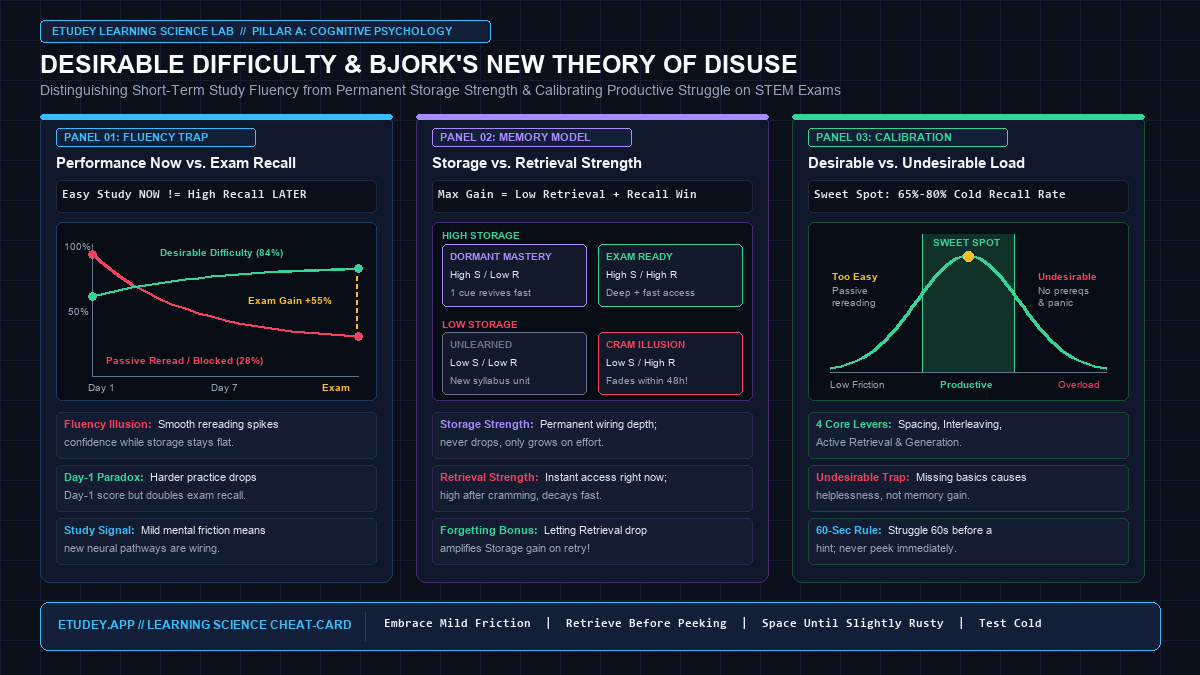
1. Bjork's New Theory of Disuse: Storage Strength vs. Retrieval Strength
To understand why easy studying fails—and why a little forgetting actually helps you remember—you need the two-variable memory model introduced by Robert and Elizabeth Bjork in their New Theory of Disuse. Every concept, derivation, or reaction mechanism in your brain possesses two completely independent scores:
- Storage Strength (\(S\)): How deeply interconnected and permanently wired a concept is inside your long-term knowledge network. Storage strength builds slowly through effortful mental processing and—critically—never decreases once formed (which is why your old childhood phone number or bicycle balance snaps back instantly after a single reminder).
- Retrieval Strength (\(R\)): How quickly and effortlessly a concept comes to mind right this second. Retrieval strength spikes immediately after rereading a page, watching a YouTube tutorial, or cramming before a 9 AM quiz—and decays rapidly within 24 to 72 hours.
Here is the counterintuitive mathematical engine at the heart of Bjork's model: the gain in permanent Storage Strength (\(\Delta S\)) from a successful recall event is inversely proportional to your current Retrieval Strength (\(R\)).
Pause and let that sink in. When you reread a highlighted Thermodynamics formula ten seconds after seeing it, your Retrieval Strength is already near 100%. Because your brain does zero work to pull it out of memory, your Storage Strength gain (\(\Delta S\)) is essentially zero. You burned precious study hours reinforcing a temporary illusion. Conversely, when you wait three days until that derivation feels slightly rusty (Retrieval Strength has dropped to 40%), force yourself to reconstruct it on blank scratch paper, and succeed, your brain treats that struggle as an urgent survival signal—triggering a massive jump in permanent Storage Strength.
The Four Quadrants of Student Memory
Every topic on your semester syllabus currently sits in one of four states shown in Panel 2 of Figure 1:
- Low \(S\) / High \(R\) (The Cramming Illusion): Freshly highlighted lecture slides or a solved example you just watched. Feels silky smooth tonight; evaporates before your morning exam.
- High \(S\) / Low \(R\) (Dormant Mastery): Calculus integration tricks or circuit laws you mastered last semester but haven't touched in three months. Feels rusty cold, yet one 5-minute retrieval refresh restores peak exam speed.
- High \(S\) / High \(R\) (Exam Ready): The target zone—deeply wired conceptual understanding paired with fast, cold-start retrieval under time pressure.
- Low \(S\) / Low \(R\) (Unlearned): Brand-new chapters where jumping straight into brutal problems causes panic rather than desirable difficulty.
2. The Metacognitive Trap: Why Students Vote Against What Works
If desirable difficulty works so well, why do 80% of university students still default to passive rereading and massed cramming? In a famous 2008 study by Nate Kornell and Robert Bjork, participants studied complex visual categories under either blocked practice (grouping identical examples together—feeling smooth and easy) or interleaved practice (mixing different categories unpredictably—feeling clunky and frustrating).
On the final transfer test, interleaved learners crushed blocked learners. Yet when researchers asked participants which method they thought helped them learn better, 78% voted for the losing blocked method—even after seeing their own scores! Because smooth processing triggers a neurological shortcut called processing fluency, your brain misinterprets lack of friction as mastery. Mastering Metacognition for Students begins the moment you flip that internal compass: treat mild cognitive strain not as a sign that you are "bad at math," but as the unmistakable sensation of Storage Strength being forged.
The 60-Second Struggle Timer: Whenever you hit a wall on a homework problem or derivation, ban yourself from peeking at the solution key or AI chat for sixty full seconds. Force your brain to write down known boundary conditions, draw a free-body or circuit schematic, and attempt one concrete first step—even if it fails. That deliberate retrieval attempt primes your neural schema to absorb the eventual correction twice as deeply.
3. The Four Proven Levers of Desirable Difficulty in STEM
You do not need gimmicky tricks to inject desirable difficulty into college coursework. Cognitive psychology has repeatedly validated four high-yield levers that fit straight into an engineering or science week:
- Spaced Retrieval (Letting Yourself Almost Forget): Instead of hammering 30 Control Systems problems on Sunday night, solve 10 today, 10 three days later, and 10 next Tuesday. Deliberately letting Retrieval Strength decay slightly between sessions turns every review into high-yield Storage Strength construction.
- Interleaved Problem Mixing: Real exams never put a neat label above Question 4 saying "Use Integration by Parts (Section 7.1)." Mixing problem types from three different chapters forces your brain to practice method selection—the exact skill tested on finals. Dive deeper into mixed problem sets in The Science of Interleaving for STEM Students.
- Closed-Book Generation Before Reading: Attempting to sketch a proof, predict a circuit's frequency response, or recall a biochemical pathway before opening the textbook exploits the Generation Effect, wiring stronger memory cues even when your initial guess is partially wrong.
- Contextual Variation: Solving problems only with clean textbook numbers creates brittle memory tied to familiar surface cues. Vary boundary conditions, flip which variable is unknown, or explain the underlying physics aloud in plain English without looking at symbols—combining desirable friction with Active Recall.
4. When Difficulty Turns Undesirable: Calibrating the Sweet Spot
Here is the nuance many productivity blogs get dangerously wrong: not all difficulty is desirable. Robert Bjork deliberately included the adjective desirable because plenty of hardships simply waste time and shatter confidence.
Difficulty becomes undesirable whenever a learner lacks the prerequisite schemas required to successfully bridge the gap—or when the friction comes from irrelevant noise (illegible lecture scans, cluttered notation, or sleep-deprived stress) rather than meaningful retrieval. Throwing a first-year student with weak partial-derivative foundations straight into an unguided Navier-Stokes derivation does not produce desirable difficulty; it triggers working-memory collapse and learned helplessness.
Use the 65%–80% Cold Recall Calibration Rule to stay locked inside the productive Goldilocks zone shown in Panel 3 of Figure 1:
- Above 90% effortless accuracy: Too easy. Your Retrieval Strength is already maxed out—increase spacing intervals, close the textbook, or mix in problems from two chapters ago.
- 65%–80% cold-start accuracy (with mild strain): The exact desirable sweet spot. You remember enough structure to wrestle meaningfully, yet stumble often enough to trigger deep error-correction encoding.
- Below 45% accuracy (total blank-outs): Undesirable overload. Step back temporarily to scaffolded worked examples or prerequisite drills before re-introducing cold retrieval.
5. Habit-by-Habit Audit: Replacing Fluency Traps with Desirable Friction
Compare your current weekly study routines against Bjork's Storage-vs.-Retrieval framework to spot where your hours are leaking:
| Common Student Habit | Immediate Feel (Fluency) | Long-Term Storage Gain | Desirable Difficulty Upgrade |
|---|---|---|---|
| Rewatching lectures at 1.5× speed | Very high (feels effortless) | Very low (passive recognition) | Pause every 8 minutes; summarize the core derivation on blank paper before pressing play. |
| Blocked chapter-by-chapter drilling | High by problem #5 | Low transfer on mixed exams | Build a shuffled 6-problem mini-set pulling 2 problems each from 3 recent units. |
| Color-coded rereading & highlighting | High aesthetic satisfaction | Near zero (\(\Delta S \approx 0\)) | Convert every heading into a closed-book question card; test cold 48 hours later. |
| Peeking at solutions after 10 seconds | Fast, zero frustration | Low ("oh yeah, I knew that!" trap) | Run the 60-Second Struggle Timer and ask for a single conceptual hint—never the full answer. |
| Single-night marathon cramming | High Retrieval Strength at 2 AM | Severe 48-hour collapse | Split the same 4 hours into four 60-minute blocks spaced across Days 1, 3, 7, and 14. |
| Blind guessing without prerequisites | Painful & demoralizing | Low (undesirable overload) | Audit missing base concepts first, solve one guided twin example, then test cold. |
6. Engineering Desirable Difficulty Into Your Etudey Workflow
Knowing the theory is half the battle; building friction into tired weeknight study sessions requires tooling that makes productive struggle automatic instead of relying on willpower:
- Socratic Scaffolding Instead of Instant Spoilers: When you get stuck after your 60-second struggle window, avoid chatbots that dump the complete worked solution immediately (destroying the learning signal). Use Etudey AIgom Tutor to get a targeted, Socratic nudge that keeps your brain inside the 65%–80% desirable zone.
- Blank-Canvas Cold Derivations: Close your textbook PDF and reconstruct free-body diagrams, circuit transforms, or proof steps cold inside Etudey Handwriting Studio, then overlay your official notes only after committing an attempt.
- Question-First Note Storage: Toggle passive transcripts into active recall prompts inside Etudey Notes so every revisit tests Retrieval Strength instead of encouraging smooth rereading.
- Spaced Return Columns: Schedule deliberate "Rusty Return" reviews (Day 3 and Day 10 cards) across your Study Kanban Board so you automatically revisit units right when Retrieval Strength dips—capturing maximum Storage Strength per minute spent.
Frequently Asked Questions
Does desirable difficulty mean studying should always feel miserable?
No—it means studying should feel moderately effortful, not chaotic or hopeless. Productive friction feels like lifting a challenging weight you can control for 8–10 clean reps (65%–80% cold recall success). If you are staring blankly with zero foothold for ten minutes, you have crossed into undesirable difficulty and need a brief worked-example scaffold.
Why do I feel like I am forgetting more when I space my study sessions?
Because you actually are allowing short-term Retrieval Strength to decay between sessions—and that slight rustiness is the exact biological trigger that powers stronger re-encoding! Students who cram feel sharper on Day 1, while spaced learners feel slightly clumsier on Day 3 yet remember twice as much on Day 21.
Should I use desirable difficulty the night before an exam?
Not for learning brand-new material from scratch—on exam eve, your priority is consolidating existing High-\(S\) schemas and raising Retrieval Strength without spiking anxiety. Use light, timed mixed retrieval checks on high-weightage problems to warm up recall pathways, then get a full night of sleep for hippocampal consolidation.
How can I tell if my study struggle is desirable or undesirable?
Run the Feedback Recovery Check: after struggling for 60 seconds and checking a single hint, do you immediately see why your mental model missed a link and successfully finish the next step? That is desirable difficulty. If even the hint reads like a foreign language, you are missing a prerequisite concept—step back one level and patch the gap first.
Does interleaving work for heavy engineering subjects like Thermodynamics or Signals?
Yes—arguably better than for any other field. In engineering finals, 60% of lost marks come from picking the wrong governing law (e.g., applying Bernoulli where viscous losses dominate, or mixing up Laplace vs. Fourier conditions). Interleaving mixed problems from 3–4 chapters forces you to practice recognizing physical cues under realistic exam ambiguity.
Stop Mistaking Smooth Rereading for Exam Mastery
Build calibrated desirable difficulty into every session—practice Socratic problem solving with AIgom Tutor, run cold-start derivations in Handwriting Studio, and track spaced review cycles inside Etudey Workspace free.
Launch Etudey Workspace Free →