
Interleaving is a learning science protocol that alternates between distinct problem types and conceptual categories during practice rather than drilling them in monolithic blocks. By forcing the brain to execute category induction before selecting an algorithm, interleaving trains discriminative contrast, eliminating exam room blankouts and multiplying long-term problem-solving transfer.
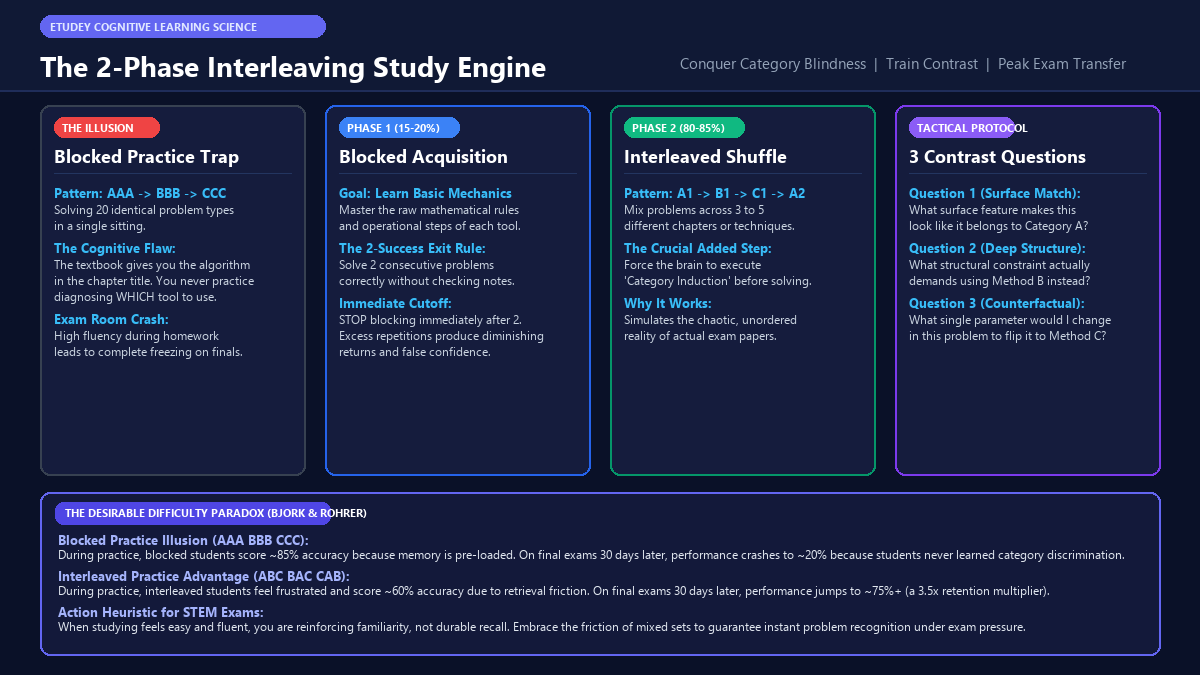
The Homework-to-Exam Disconnect: Why A-Grade Homework Leads to C-Grade Finals
Every semester across university engineering, mathematics, physics, and computer science departments, thousands of diligent students experience the exact same agonizing mystery. Throughout the term, they complete every single assigned homework problem set. They sit at their desks, open Chapter 4, Section 2 ("Integration by Trigonometric Substitution"), and work through 20 consecutive integrals. By problem fifteen, they are solving them rapidly, confidently, and accurately without checking the back of the textbook. They legitimately feel like masters of calculus.
Three weeks later, they sit down in a silent lecture hall for the 3-hour midterm exam. They flip open the test paper, look at Problem 3—an integral containing a square root and a polynomial—and their minds freeze into a state of total blankness. They do not know whether to apply integration by parts, a \(u\)-substitution, partial fractions, or a Weierstrass half-angle transformation. The mathematical fluency they felt in their dorm room has evaporated into thin air.
When students receive their graded exam papers with a shocking 54% in red ink, they almost universally draw the wrong conclusion: "I must have panicked," or "I need to work through twice as many practice problems next time."
In cognitive science, this widespread phenomenon is known as the Homework-to-Exam Disconnect. The student did not fail because of anxiety or a lack of effort. They failed because their entire study architecture was built on Blocked Practice (drilling problem type \(A\) twenty times, then problem type \(B\) twenty times, then problem type \(C\) twenty times). Blocked practice creates a powerful, dangerous cognitive illusion of competence that catastrophically shatters under real exam conditions.
"Blocked practice gives away the hardest part of the problem for free: the diagnosis. When every problem in Section 6.3 uses Method 6.3, your brain never practices selecting the tool—only operating it. On an exam, nobody tells you the chapter number."
The Cognitive Mechanics: Why Blocked Practice Creates an Illusion of Competence
To understand why blocked practice fails on university examinations, we must dissect what the human brain actually does when solving a complex technical problem. In any STEM discipline—whether calculating shear stress in a beam, solving a second-order non-homogeneous differential equation, or designing an operational amplifier circuit—problem solving consists of two distinct cognitive stages:
- Stage 0 (Category Induction & Diagnosis): Inspecting the raw physical scenario or mathematical expression, identifying deep structural markers, and deciding which governing physical law, theorem, or algebraic technique applies.
- Stage 1 (Algorithmic Execution): Carrying out the step-by-step mathematical calculations, algebraic rearrangements, and arithmetic computations.
When you solve 20 consecutive problems at the end of Chapter 5, Stage 0 is completely eliminated. You already know that every problem in the section requires the Chapter 5 formula. The textbook heading has pre-selected the tool for you. As a result, your working memory pre-loads the specific algorithm into its temporary cognitive cache. By problem four, your brain is operating on pure mechanical auto-pilot. You experience rapid speed and effortless fluency.
However, pioneering cognitive research led by Dr. Doug Rohrer at the University of South Florida and Dr. Robert Bjork at UCLA has proven that this practice-session fluency is fundamentally deceptive. In rigorous controlled trials comparing blocked versus interleaved mathematics practice:
- During the initial learning sessions, students using blocked practice scored an average of 89% accuracy, while students using interleaved practice struggled, feeling frustrated and scoring only 60% accuracy.
- When both groups were given an unannounced comprehensive exam thirty days later, the results inverted dramatically: the blocked students collapsed to an abysmal 20% accuracy, whereas the interleaved students maintained an extraordinary 74% accuracy—representing a greater than 3.5x retention multiplier.
Interleaving works because of the Contextual Interference Effect. By constantly switching between distinct problem types (e.g., \(A o B o C o B o A o C\)), the brain is denied the luxury of keeping a single formula pre-loaded in working memory. Every new problem forces your brain to dump its previous cognitive state, re-examine the problem statement from scratch, and execute Stage 0 diagnosis. That cognitive friction—what Robert Bjork famously termed a Desirable Difficulty—is the biological catalyst that burns durable neural pathways into long-term memory.
The 2-Phase Interleaving Engine Protocol
While educational psychologists enthusiastically recommend interleaving, most college students abandon it after two days because diving directly into a completely scrambled problem set creates overwhelming cognitive chaos. If you have not yet learned the basic algebraic steps of a method, scrambling problem types produces acute confusion and cognitive overload.
To make interleaving practical, sustainable, and stress-free for heavy engineering and STEM courses, implement the 2-Phase Interleaving Engine:
Phase 1: Blocked Acquisition (15% to 20% of Study Time)
The sole objective of Phase 1 is learning the basic mechanical steps of a newly introduced technique. When your professor introduces a new topic (for example, finding eigenvalues and eigenvectors in Linear Algebra):
- The 2-Success Exit Rule: Work through 2 to 3 representative textbook examples in a blocked manner until you can successfully complete two consecutive problems correctly without looking at your lecture notes or reference sheets.
- Enforce Immediate Cutoff: As soon as you hit two consecutive unassisted successes, stop blocking immediately. Do not solve problems four through twenty in that section. Every additional blocked repetition beyond this threshold yields rapidly diminishing cognitive returns and begins manufacturing the false illusion of mastery.
Phase 2: The Interleaved Shuffle Matrix (80% to 85% of Study Time)
Once you have achieved basic mechanical competence across three to five related techniques (e.g., in Calculus II: \(u\)-substitution, integration by parts, trigonometric substitution, and partial fractions), migrate 100% of your remaining study time into the Interleaved Shuffle Matrix:
- The Shuffle Pool: Create a pool of 15 to 20 unworked problems drawn randomly from across all five chapters or units.
- Randomized Sequencing: Never solve two problems of the same category back-to-back. If Problem 1 is an integration by parts problem, Problem 2 must be partial fractions, Problem 3 must be a trigonometric identity, and Problem 4 must be a \(u\)-substitution.
- Mandatory 30-Second Diagnostic Pause: Before touching your pencil to paper to execute calculations, you must spend 30 seconds explicitly answering the question: "What specific structural feature in this expression proves that Method X is required instead of Method Y?"
When practicing complex derivations on the Handwriting Studio digital canvas, use split-screen mode to compare the visual anatomy of two contrasting problems side-by-side to train your visual recognition of subtle structural differences.
Structured Comparison Table: Blocked vs. Interleaved Practice Mechanics
The following comparative table summarizes the structural, neurological, and performance differences between traditional blocked study and the 2-Phase Interleaving Engine:
| Operational Parameter | Traditional Blocked Practice (AAA BBB CCC) | 2-Phase Interleaving Engine (ABC BAC CAB) | Impact on Exam Performance |
|---|---|---|---|
| Problem Sequencing | Monolithic batches of 15-25 identical problem types grouped by chapter section. | Brief blocked acquisition (2 problems), followed by scrambled multi-chapter problem sets. | Interleaving mirrors the chaotic, unordered reality of actual university examination papers. |
| Stage 0: Category Diagnosis | Bypassed completely. The section title gives away the applicable theorem for free. | Actively trained on every problem. Student must diagnose the governing law before solving. | Eliminates exam room blankouts where students cannot determine which formula applies. |
| Working Memory Load | Artificially low. The required algorithm remains pre-loaded in working memory cache. | High. Working memory must clear and reload new schemas on every consecutive question. | Trains rapid schema retrieval under time constraints and high-stakes examination pressure. |
| Subjective Feeling During Study | Feels fast, smooth, effortless, and highly satisfying ("I completely understand this!"). | Feels slow, challenging, and frustrating ("Why am I making so many careless mistakes?"). | Blocked practice creates a false sense of security; interleaving exposes real knowledge gaps. |
| Practice Session Accuracy | High (~85% to 90% correct answers during initial homework sessions). | Moderate (~55% to 65% correct answers during initial practice sessions). | Low practice friction reflects shallow encoding; high friction reflects deep neural consolidation. |
| 30-Day Exam Retention | Abysmal (~20% retention on unannounced cumulative final examinations). | Superior (~75%+ retention on cumulative midterms and comprehensive finals). | Delivers a proven 3.5x multiplier in durable long-term retention and cross-topic transfer. |
The 3 Discriminative Contrast Questions: Training Mathematical Intuition
The true cognitive magic of interleaving is not merely scrambling problems; it is cultivating Discriminative Contrast. Discriminative contrast is the human cognitive capacity to perceive the subtle, defining boundary line that separates two superficially identical problem categories.
Novice students categorize problems by their surface features (e.g., "This problem has a triangle," or "This problem has an exponential function"). Expert engineers and mathematicians categorize problems by their deep structural features (e.g., "This problem has non-conservative friction work," or "This differential equation has a non-zero right-hand driving function").
Whenever you transition between two problems in your interleaved queue, force your brain to answer the 3 Contrast Questions:
- Question 1 (The Surface Trap): "What surface feature makes this problem appear similar to the one I just solved?" (e.g., Both integrals contain \(\sqrt{a^2 - x^2}\)).
- Question 2 (The Deep Structural Divergence): "What structural property makes the previous method fail on this new problem, requiring a different approach?" (e.g., In the first integral, an extra factor of \(x\) outside the root allows simple \(u\)-substitution \(u = a^2 - x^2\), whereas in the second integral, the absence of \(x\) forces trigonometric substitution \(x = a \sin\theta\)).
- Question 3 (The Counterfactual Perturbation): "What single number, operator, or boundary condition would I need to alter in this problem to legally flip it back into the previous category?"
By repeatedly interrogating problems with these three questions, you rewire your neural networks. You stop viewing mathematics as a phonebook of arbitrary formulas and start seeing it as a dynamic landscape of decision boundaries. If you get stuck identifying why two derivations diverge, paste both problem statements into the AIgom Derivation Tutor and prompt: "In two bullet points, what is the deep structural difference that prevents Method A from working on Problem B?" AIgom pinpoints the mathematical pivot point instantly.
How to Build an Interleaved Study Timetable for STEM Courses
Transitioning from blocked homework assignments to a 2-Phase Interleaving Engine requires a deliberate weekly operational system. You cannot simply wait for the night before the exam to start interleaving.
1. The 3-Folder Problem Shuffling System
Whenever you complete a university homework assignment, do not file it away and forget about it. Photocopy, screenshot, or extract the problem statements (without their solutions) and deposit them into three physical or digital folders:
- Folder A (Current Week - Active Acquisition): Contains problems from the lectures delivered over the past 7 days. These are used for Phase 1 blocked acquisition until you hit the 2-Success Exit Rule.
- Folder B (Bi-Weekly Mixed Deck): Contains a randomized mix of problems from 2 to 4 weeks ago. Every study session, draw 4 to 6 random problems from this folder.
- Folder C (Cumulative Master Deck): Contains challenging problems from all previous units across the entire semester. This deck is refreshed continuously and serves as your final exam simulation engine.
2. Structuring Your Focus Sessions in the Etudey Workspace
Deep work sessions are most effective when paired with structured temporal boundaries. Launch the Etudey Workspace focus timer and configure a 3-Cycle Interleaving Block (75 minutes total):
- Cycle 1 (25 Minutes): Draw 2 problems from Topic Alpha (e.g., Second-Order RLC Circuits) and 1 problem from Topic Beta (e.g., Thevenin Equivalents). Solve under strict silence.
- Short Rest (5 Minutes): Step away from the desk; hydrate and allow diffuse-mode consolidation.
- Cycle 2 (25 Minutes): Draw 2 problems from Topic Gamma (e.g., Maximum Power Transfer) and 1 problem from Topic Alpha. Execute the 30-Second Diagnostic Pause before writing calculations.
- Short Rest (5 Minutes): Physical stretch.
- Cycle 3 (15 Minutes - Diagnostic Review): Audit all errors. Identify whether each mistake was an Algorithmic Execution slip (algebraic sign error) or a Stage 0 Diagnostic error (wrong formula selected). Log all Stage 0 errors directly into your error log.
Track your weekly problem shuffle volume using the Study Kanban Board to ensure you maintain a healthy distribution of active problem cards across all course modules, and pull comprehensive multi-chapter problem sets from the verified Notes Archive.
Frequently Asked Questions
Won't interleaving slow me down when I already have a crushing assignment workload?
In the first 48 hours, interleaving will feel slower because your brain is forced to execute Stage 0 diagnosis on every question instead of riding the momentum of a single pre-loaded formula. However, interleaving actually saves dozens of hours over the semester. Students who use blocked study spend 20 hours cramming and re-learning forgotten chapters before finals. Interleaving consolidates knowledge permanently during your weekly study, eliminating the need for panicked, desperate pre-exam re-reading.
Can I use interleaving if I am studying a concept for the very first time?
No. Interleaving is not designed for the absolute zero-knowledge acquisition stage. Attempting to scramble problem types before you understand the fundamental vocabulary and basic operational steps of a technique causes severe cognitive overload. This is why the protocol begins with Phase 1: Blocked Acquisition. Drill 2 to 3 problems in a block to master the mechanical movements; then, as soon as you achieve two consecutive unassisted successes, transition into Phase 2 interleaving.
How many different topics or problem types should I mix in a single session?
For undergraduate STEM courses, the optimal cognitive mixing window is 3 to 5 distinct categories. Mixing only two categories (e.g., \(A \leftrightarrow B\)) does not provide sufficient contextual interference. Conversely, mixing eight or ten completely unrelated subjects (e.g., jumping between German grammar, organic reaction mechanisms, and thermodynamics) causes cognitive whiplash. Keep your interleaving pool confined to 3 to 5 related methods within the same discipline or across closely related courses.
What should I do when I misdiagnose a problem during an interleaved session?
Treat diagnostic errors as gold dust. When you mistakenly apply Method A to a problem that actually required Method B, do not simply erase your work and write the correct solution. Stop and write a 1-sentence Discriminative Warning Note at the top of the page: "I tried to use Integration by Parts because of the product \(x \cdot f(x)\), but because the derivative of the inside function was present, simple \(u\)-substitution was 5x faster." That single warning note builds the exact neural contrast needed for the final exam.
How does Etudey support interleaved study workflows?
Etudey provides an integrated ecosystem built for high-performance STEM learning. Use the Etudey Workspace focus timer to automate your 25-minute interleaved study cycles. Use the Study Kanban Board to manage your 3-folder problem decks. Solve your mixed derivations with zero paper friction in the Handwriting Studio, consult verified multi-chapter past exams on the Notes Archive, and get instantaneous feedback on why two similar problems require different mathematical solutions using the AIgom Derivation Tutor.
Conquer Exam Problem-Type Blindness with Etudey
Stop freezing on final exams when problem categories appear out of order. Build your 2-phase interleaving study engine with Etudey's free digital Handwriting Studio, smart Focus Timer, Study Kanban Board, and step-by-step AI derivation tutor.