
Staring silently at a stuck mathematical derivation or broken code loop traps your brain in predictive auto-completion, hiding obvious sign flips and false assumptions. Rubber Duck Problem Solving adapts software debugging to STEM coursework: explaining each equation line-by-line aloud forces sequential System-2 verification, triggering the cognitive Self-Explanation Effect to expose errors in seconds.
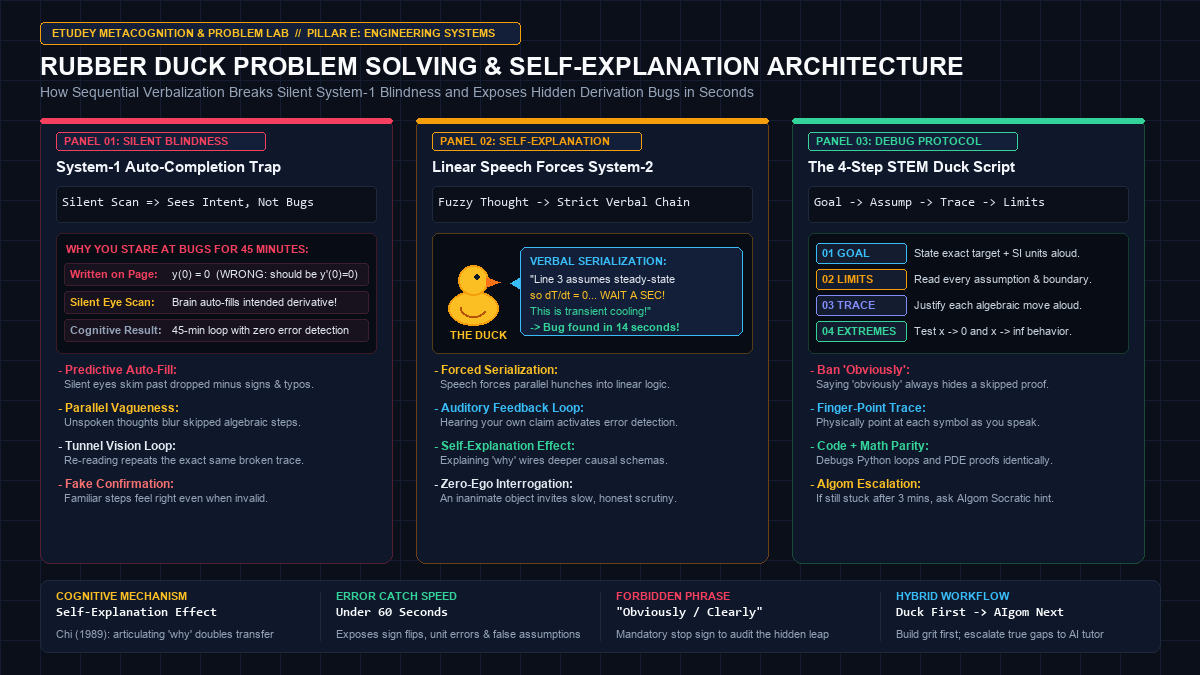
Figure 1.0: How sequential verbalization shifts silent System-1 auto-completion into line-by-line System-2 auditing—exposing dropped signs, violated assumptions, and code bugs in under 60 seconds.
1. The 45-Minute Stare: Why Your Roommate Fixes Bugs Without Saying a Word
Every engineering, physics, and computer science student knows this bizarrely universal hostel phenomenon. You have been hunched over your desk for forty-five minutes staring at a stuck 10-line differential equation derivation—or a Python dynamic programming function returning the wrong integer. You have scanned every single line ten times in dead silence. Everything looks spotless. You are convinced the textbook answer key has a printing error.
Defeated, you wheel your chair over to your roommate or raise your hand for a Teaching Assistant. You open your mouth and begin explaining: "Okay, look—first I applied the initial condition at \( t = 0 \), which sets \( C_1 = 0 \), and then I integrated across—WAIT A SECOND! The boundary condition says initial velocity \( y'(0) = 0 \), not position \( y(0) = 0 \)! Never mind, I got it!"
Your roommate did not even finish putting down their headphones. Yet somehow, twelve seconds of speaking out loud instantly broke a forty-five-minute mental paralysis. In 1999, software engineers Andrew Hunt and David Thomas immortalized this exact trick in The Pragmatic Programmer as Rubber Duck Debugging: carry a small yellow rubber duck, place it next to your monitor, and explain your code to it line by line until you catch yourself contradicting reality.
What most STEM undergraduates never realize is that Rubber Duck Debugging is not just a quirky coding meme. It is an applied hack of one of the strongest empirical findings in cognitive psychology—and it works just as powerfully on Laplace transforms, Mohr's Circle, organic synthesis pathways, and thermodynamics proofs as it does on C++ pointers.
2. The Cognitive Science: Why Silent Eyes Lie & Speech Tells the Truth
Why could you stare at \( y(0) = 0 \) ten times silently without seeing the error, yet spot it immediately the moment you spoke it aloud? Three intersecting neurological mechanisms explain the shift:
- Predictive System-1 Auto-Completion: When you silently re-read your own handwritten equations, your brain does not parse every ink stroke from scratch. Instead, fast System-1 pattern matching reads what you intended to write—mentally glossing over dropped minus signs, swapped sine/cosine terms, and illegal algebraic cancellations.
- Forced Linear Serialization: Unspoken thoughts move in fast, parallel, fuzzy leaps ("and then by standard integration we get this..."). Spoken language is strictly linear and sequential: you can only speak one word and one premise at a time. That artificial slowdown forces slow, analytical System-2 scrutiny over every single link in your logical chain.
- The Self-Explanation Effect: In a landmark 1989 study published in Cognitive Science, cognitive scientist Dr. Michelene T.H. Chi analyzed college students solving Newtonian mechanics problems. The "Good" problem solvers did not simply have higher IQs—they spontaneously generated self-explanations aloud, constantly articulating why each equation applied and checking boundary conditions. Students who merely read steps silently failed dramatically on novel exam transfer problems.
"Good students actively generate self-explanations that monitor their own comprehension, infer missing physical conditions, and link abstract algebraic actions directly to underlying principles—whereas poor students skim over worked steps with an illusion of understanding." — Dr. Michelene T.H. Chi et al., Cognitive Science (1989)
3. Four Classic STEM Stalls & How the Duck Unsticks Them
Whether you are debugging a Verilog testbench at 1:00 AM or grinding through a Mechanics problem set, almost every frustrating stall falls into one of four forensic categories:
| STEM Stall Category | Silent Staring Failure Mode | Rubber Duck Prompt | Instant Verbal Catch |
|---|---|---|---|
| Violated Assumption | Auto-applying favorite textbook formula | "Why is this equation legally valid right here?" | Spots compressible flow, transient heat, or saturated op-amp. |
| Dropped Sign / Algebra | Eyes skip past missing negative sign | "How exactly did Line 4 turn into Line 5?" | Finger-tracing aloud catches \( -(a - b) = -a + b \) flip. |
| Code / Logic Loop Bug | Tracing intended behavior instead of code | "What is variable i literally equal to on iteration 0?" |
Catches off-by-one array index or unreset accumulator. |
| Unit / Scale Blunder | Plugging raw numbers into calculator blindly | "Do the SI units on the left match the right?" | Spots mm vs. m, Celsius vs. Kelvin, or RPM vs. rad/s. |
4. The 4-Step STEM Rubber Duck Protocol (Execute in 3 Minutes)
Simply muttering frustrated curses at your desk does not work. To force System-2 analytical precision, place a physical marker—a water bottle, pen cap, or actual rubber duck—next to your notebook or screen, and run this strict four-step script out loud (or in an audible whisper if you are in a quiet library):
Step 1: State the Exact Goal & Expected Physical Behavior
Before touching a single line of your math, tell the duck: "We are trying to find the steady-state voltage across resistor \( R_2 \), measured in Volts. Physically, if \( R_2 \) increases, this voltage should rise toward \( V_{cc} \)." Stating the target and physical intuition anchors your audit before algebraic noise begins.
Step 2: Read Every Given Assumption & Boundary Condition Literally
Do not paraphrase from memory. Put your finger on the problem statement and read every constraint word-for-word to the duck: "It says frictionless pulley, massless rope, starting from rest, and \( \theta = 30^\circ \) measured from the vertical—WAIT, from the vertical, not the horizontal!" Nearly 30% of all engineering homework bugs die right here in Step 2.
Step 3: Trace Line-by-Line with the Forbidden-Word Rule
Point your pen directly at Line 1, then Line 2, then Line 3, justifying every single transition out loud as if the duck knows basic calculus but knows zero physics. Enforce one non-negotiable guardrail:
The Forbidden-Word Rule: Never Say "Obviously" or "Clearly"
The moment you hear yourself say "obviously this term cancels," "clearly this is positive," or "so that just simplifies to..."—FREEZE! In mathematics and coding, the word "obviously" is almost always a psychological smokescreen hiding an unverified assumption, a division by zero, or a dropped minus sign. Force yourself to unpack that exact step in slow motion.
Step 4: Run the Extreme-Limits Sanity Check
If your derivation finished cleanly but disagrees with the solution manual, tell the duck what happens at mathematical extremes: "What does my formula predict if mass \( m \to 0 \)? What if frequency \( \omega \to \infty \)?" If your circuit impedance formula predicts infinite current when resistance goes to infinity, you have an inverted fraction—a trick that pairs seamlessly with our Guide to Eliminating Silly Math Mistakes.
5. How to Use Rubber Duck Debugging Inside a Silent Exam Hall
Obviously, you cannot talk out loud to a yellow plastic duck during a silent 3-hour university final exam without getting escorted out by the invigilator. Fortunately, you can trigger the exact same System-2 serialization silently using two exam-legal adaptations:
- Sub-Vocalization + Pen-Pointing: Silently mouth the words inside your head at real speaking speed (roughly 130 words per minute—never skimming!) while physically tapping the tip of your pen on each symbol and sign on the answer sheet. The physical motor rhythm prevents your eyes from jumping ahead.
- Margin Justification Tags: When stuck on a high-stakes 15-mark proof, write 3-word justifications in pencil along the right margin beside every line (`KCL @ Node A`, `Sub V- = 0`, `Chain Rule`). Writing a micro-explanation forces the exact same sequential accountability as speech—and builds on the Feynman Technique under timed exam pressure.
6. The Hybrid Upgrade: Pairing Your Rubber Duck with Etudey
What if you complete the full 3-minute Rubber Duck trace and you are still genuinely stuck? That means your error is not a careless slip—it is a real conceptual blindspot that requires an interactive Socratic partner rather than silent suffering. Here is the optimal workflow inside Etudey:
- Step 1 — Duck First on Handwriting Studio: Trace your equations line-by-line aloud on the digital canvas, circling the exact transition line where your verbal justification falters.
- Step 2 — Escalate to AIgom Socratic Tutor: Instead of asking for a raw final answer, share your stuck step with AIgom using our Socratic Problem-Solving Method. Asking "I assumed steady-state on Line 3—does that violate this boundary condition?" builds permanent mastery.
- Step 3 — Log the Bug in Interactive Notes & Flashcards: Record every recurring trap inside your Engineering Error Log and track assignment completion smoothly on Etudey Kanban.
Frequently Asked Questions
Why does explaining a math or coding problem out loud help you find mistakes faster?
Silent reading relies on fast predictive pattern recognition, causing your brain to see what you intended to write rather than what is actually on the page. Explaining each step out loud forces linear verbal serialization, slowing down processing into analytical System-2 mode and triggering the Self-Explanation Effect so hidden assumptions and sign flips stand out immediately.
How is Rubber Duck Problem Solving different from the Feynman Technique?
The Feynman Technique is a broad conceptual learning method used to teach an entire topic from scratch in plain language so you verify deep understanding. Rubber Duck Problem Solving is a targeted, real-time tactical debugging protocol used mid-problem when you are stuck on a specific equation line, boundary condition, or broken code loop.
Do I actually need a physical rubber duck on my desk?
No—any inanimate focal point (a pen, coffee mug, plush toy, or sticky note with a drawn face) works identically. The physical object simply acts as a concrete conversational anchor that keeps you from slipping back into vague silent thoughts.
Can I use Rubber Duck Debugging in a quiet university library or dorm room?
Yes. If speaking aloud is impractical, you can type a step-by-step explanation into a blank scratchpad note or into Etudey AIgom—before even hitting Send, the act of typing complete sequential sentences explaining your exact premise triggers the same verbal serialization breakthrough.
When should I stop talking to the duck and ask a tutor or AI for help?
Use a strict 3-to-5-minute timer rule. If walking aloud through your assumptions, line transitions, and units does not reveal the error within five minutes, you have hit a genuine conceptual gap rather than a careless slip. At that point, escalate the exact blocked line to a TA, professor, or AIgom Socratic Tutor so you do not waste an hour spinning in circles.
Upgrade Your Rubber Duck with an Interactive Socratic Partner
Trace stuck proofs line-by-line in Handwriting Studio first—and whenever a genuine conceptual wall appears, let Etudey's AIgom Derivation Tutor guide you past the exact broken assumption.