
Karpicke and Blunt's landmark Science (2011) experiment proved that active retrieval practice dramatically outperforms open-book elaborative concept mapping on both factual verbatim questions and complex conceptual inference tests one week later. By switching from copying open-book mind maps to drawing closed-book retrieval maps first, students lock in lasting exam comprehension.
The Open-Book Mind Map Paradox: Why Effortless Color-Coding Fails Finals
Walk into any university library two weeks before midterms and you will see dozens of diligent students spreading colorful A3 sheets across desks, meticulously copying textbook headings, arrows, and sub-bullets into sprawling concept maps. It feels productive. Visually connecting ideas looks sophisticated—far smarter than boring plain outlines.
Yet when those exact same students walk into a closed-book Thermodynamics, Neurobiology, or Algorithms paper and hit unfamiliar inference questions that require combining Chapter 3 with Chapter 7, something unsettling happens: their minds go blank. Despite spending four hours crafting beautiful diagrams, they cannot reconstruct half the dependencies without the textbook propped open in front of them.
That frustration is not a personal flaw—it is a well-documented cognitive trap uncovered cleanly in one of the most cited learning-science studies of the past two decades.
Inside Karpicke & Blunt's Landmark Science (2011) Experiment
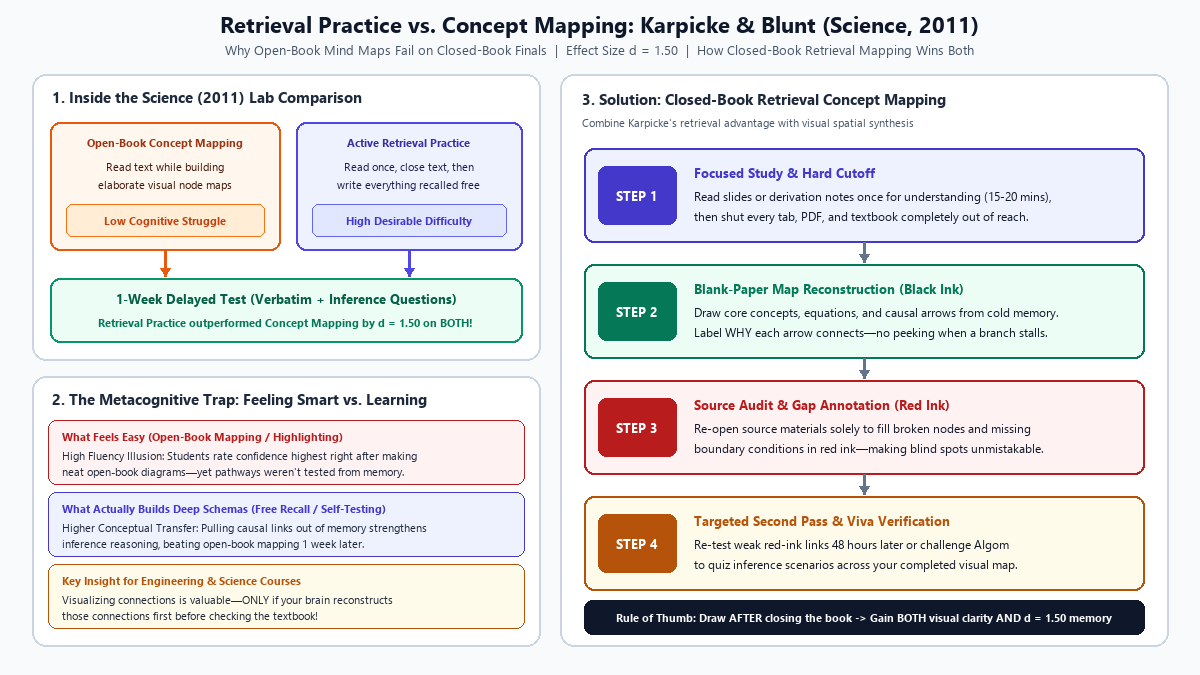
In 2011, cognitive psychologists Jeffrey D. Karpicke and Janell R. Blunt published a pivotal paper in the journal Science titled "Retrieval Practice Produces More Learning than Elaborative Studying with Concept Mapping." At the time, educational orthodoxy assumed that elaborative concept mapping—drawing visual node-and-link diagrams while reading—produced deeper conceptual organization than practicing recall, which critics dismissed as mere rote memorization.
Karpicke and Blunt put both methods head-to-head using authentic university-level science passages:
- Elaborative Concept Mapping Group: Students read the passage and spent carefully timed blocks constructing detailed node-and-link concept maps with the text open beside them, capturing key terms and relationships visually.
- Retrieval Practice Group: Students read the passage once, closed the text completely, wrote down everything they could recall on blank paper, re-read briefly to catch missed ideas, and performed a second free-recall test.
- One-Week Delayed Assessment: Seven days later, all students returned for an unannounced final short-answer exam measuring two distinct cognitive tiers:
- Verbatim Questions: Direct factual relationships explicitly stated in the reading.
- Inference Questions: Higher-order conceptual synthesis requiring students to deduce implications and link ideas never paired explicitly in the source text.
The delayed exam delivered a shock to traditional study advice. Retrieval practice beat concept mapping by roughly 1.5 standard deviations (\(d = 1.50\)) across the board—and remarkably, retrieval practice produced vastly higher scores on conceptual inference questions just as strongly as on verbatim recall. Pulling relationships out of memory without looking did not just drill isolated facts; it forged tighter mental schemas capable of transferring knowledge to new problems.
The Metacognitive Blind Spot (Judgments of Learning): Before taking the delayed test, participants rated how well they thought they would remember the material one week later. Students who practiced open-book concept mapping and repeated studying predicted the highest future exam scores, while retrieval-practice students felt least confident—an upside-down metacognitive illusion caused by ease of copying versus effort of recall.
| Study Strategy | Source Access During Activity | Subjective Confidence (Fluency Feel) | Actual 1-Week Delayed Inference Retention | Hidden Cognitive Bottleneck |
|---|---|---|---|---|
| Repeated Reading / Highlighting | Open book throughout | Very High ("Looks familiar!") | Lowest overall retention | Passive recognition replaces active cue generation |
| Open-Book Concept Mapping | Open book beside diagram | High ("Great visual layout!") | Significantly weaker than retrieval | Copying relations skips prefrontal search effort |
| Free-Recall Retrieval Practice | Closed book during recall | Feels hard / uncertain initially | Highest retention (\(d = 1.50\) edge) | Pure text free recall can miss global layout if unreviewed |
| Closed-Book Retrieval Mapping | Closed while drawing; open ONLY for audit | Effortful first, razor-clear after audit | Combines retrieval strength + visual structure | Takes discipline not to peek mid-branch |
Why Open-Book Concept Maps Trigger the Fluency Illusion
Understanding why open-book diagramming fails helps you diagnose wasted study hours immediately. When the textbook sits open right next to your blank notebook page, your working memory executes a shallow spatial translation task: eye sees term in Paragraph 2 → hand writes oval → eye sees connecting verb → hand draws arrow.
That visual layout feels organized and soothing because the textbook keeps every retrieval cue alive on the page in front of you. Your brain never actually generates the pathway from long-term memory under uncertainty. Seven days later in a closed-book exam hall—or across an external examiner's table during a tense engineering lab viva—those external cues vanish, and pathways that were merely traced rather than retrieved collapse completely.
By contrast, every time you force your brain to retrieve "Wait—what causes venous return to drop before stroke volume falls, or why does integral action eliminate steady-state error?" without peeking, your neural network strengthens the exact retrieval routes needed to answer inference questions cold.
The Hybrid Fix: Closed-Book "Retrieval Concept Mapping"
Wait—does Karpicke and Blunt's research mean visual diagrams and knowledge graphs are useless? Not at all! Later follow-up studies confirmed that visual synthesis fails only when done open-book as a substitute for retrieval. When you invert the order and turn concept mapping into a closed-book reconstruction test, you harness both retrieval strength and spatial relational organization simultaneously:
- Focused Single-Pass Ingestion (15–20 Minutes): Read your chapter, lecture deck, or solved derivation thoughtfully once with zero highlighter clutter, clarifying unfamiliar vocabulary up front.
- Hard Cutoff & Black-Ink Reconstruction (10–12 Minutes): Close every laptop tab, PDF, and textbook. Grab a blank sheet and a black pen. Draw the core system, formulas, boundary conditions, and causal arrows purely from memory. Leave intentional question-mark gaps wherever recall stalls—never cheat by peeking mid-diagram.
- Open-Source Audit in Red Ink (5 Minutes): Now open your textbook or lecture notes solely to inspect misses. Fill missing prerequisites, dropped minus signs, and broken causal arrows strictly in red ink. Those red zones instantly reveal high-priority exam vulnerabilities.
- 48-Hour Inference Challenge & Second Pass: Two days later, look ONLY at the core topic title, rebuild the map clean without peeking, and ask inference questions ("What happens if variable X doubles while boundary Y locks?").
If you draw your closed-book maps physically on paper during evening hostel study sessions, scanning those black-and-red sheets into structured digital notes with Handwriting Studio preserves both formulas and gap highlights cleanly across semesters. Once digitized, you can prompt AIgom AI Tutor to generate targeted inference questions specifically targeting your weakest branches (our learning guides adhere strictly to our Editorial & Verification Policy).
Applying Retrieval Mapping Across Heavy Engineering & Science Semesters
Between 75% attendance rules, weekly lab reports, and overlapping midterm weeks, students rarely suffer from laziness—they suffer from low-yield study habits masquerading as hard work. Replacing two hours of open-book note decoration with two focused 20-minute closed-book Retrieval Concept Maps per unit yields dramatically sharper recall with half the desk fatigue.
To turn this into a repeatable semester routine without burnout, schedule each unit's initial closed-book map plus its 48-hour rebuild right on your Study Kanban Board so unfinished red-ink gaps never vanish beneath new assignments. You can also explore peer-structured unit summaries on Peer College Notes to benchmark whether your closed-book map captured all syllabus dependencies, and dive deeper into our related cognitive science guides on Active Recall vs. Passive Rereading and Cross-Subject Concept Mapping.
Frequently Asked Questions
Did Karpicke and Blunt prove that concept maps don't work for studying?
Not quite. Their Science (2011) experiment showed that open-book elaborative concept mapping is significantly less effective for 1-week retention and conceptual inference than practicing closed-book free recall. Turning concept mapping into a closed-book retrieval task preserves visual organization while capturing the retrieval benefit.
Why does retrieval practice help on inference questions, not just rote memorization?
Trying to reconstruct knowledge cleanly from memory forces your brain to build coherent mental models linking causes, mechanisms, and prerequisites together. That relational reconstruction trains exactly the same mental pathways required to deduce novel answers on unfamiliar exam inference problems.
Why do students consistently think passive rereading or open-book mapping works better?
Psychologists call this the fluency illusion. Because an open textbook or neatly drawn diagram makes information effortless to read right now, learners confuse ease of processing in the moment with durable long-term accessibility a week later.
Can I use AI flashcards instead of blank-paper concept maps?
Atomic flashcards excel for crisp formulas, terminology, and boundary rules, whereas closed-book Retrieval Concept Maps excel at big-picture system dependencies across an entire chapter. Combining rapid retrieval cards with one closed-book summary map per unit covers both micro details and macro understanding.
How long should a closed-book Retrieval Concept Map session take?
Keep it tightly bounded: 15–20 minutes to absorb a lecture unit cleanly, 10 minutes to draw everything from memory without peeking, and 5 minutes to audit misses in a second ink color. Short, demanding closed-book passes consistently outperform marathon open-book copying sessions.
Turn Effortful Recall Into Exam-Day Confidence
Next time you open a dense textbook chapter, resist reaching straight for highlighters or tracing open-book mind maps. Close the source early, challenge your memory on blank paper first, audit your red-ink blind spots honestly, and reinforce weak branches using Etudey—so every hour at your desk translates directly into unshakeable closed-book exam performance.