
Preparing for five or six engineering final exams in 30 days fails when students passively reread textbooks from chapter one. The 30-Day Engineering Finals Sprint replaces panic cramming with a four-phase chronological system: PYQ Pareto triage, interleaved active derivations, timed mock simulations, and a strategic cognitive taper—turning survival-mode study into Dean's List execution.
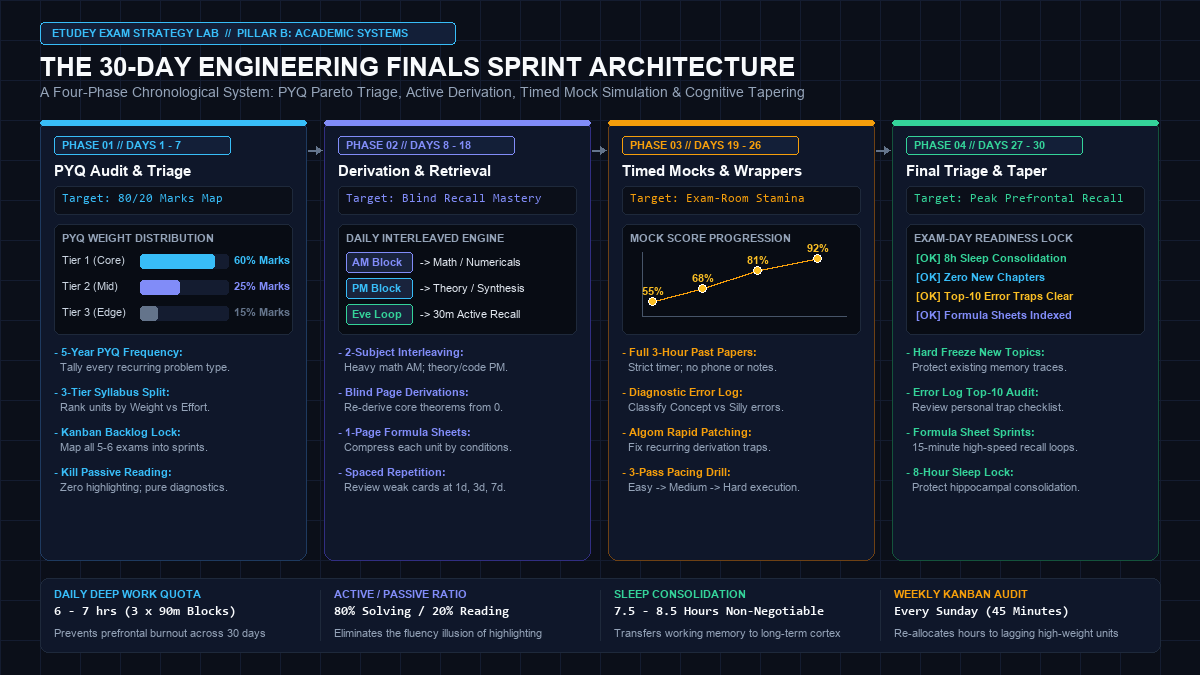
Figure 1.0: The complete 30-Day Engineering Finals Sprint—chronological transition from PYQ Pareto triage and active derivations to full-length mock simulation and pre-exam sleep consolidation.
Why Most 30-Day Exam Plans Collapse by Day 9
Every semester, the exact same tragedy plays out across engineering campuses and late-night hostel rooms. Thirty days before university finals, you open a fresh notebook, write an ambitious color-coded timetable ("Monday: Finish all of Thermodynamics Unit 1 & 2; Tuesday: Finish Control Systems..."), and sit down with a 900-page PDF textbook. For three days, you feel productive. You highlight definitions, copy lecture slides verbatim, and binge-watch 2x-speed YouTube playlists while still scrambling to protect your 75% attendance requirement and clear pending lab viva sign-offs.
Then Day 9 hits. A single heavy numerical chapter takes twelve hours instead of three. Your neat timetable falls behind by four days. Guilt triggers avoidance; avoidance triggers panic; and by Day 24, you are pulling toxic 3:00 AM caffeine-fueled cram sessions praying that the invigilator hands out a forgiving paper.
This failure is not a character flaw or a lack of intelligence. It is an architectural failure. Standard college study schedules fail because they suffer from three fatal cognitive design bugs:
- Linear Coverage Fallacy: Treating Chapter 1, Page 1 with the same urgency as high-weightage capstone modules—even when five years of Previous Year Questions (PYQs) prove that 65% of exam marks consistently originate from just 30% of the syllabus.
- The Fluency Illusion: Watching a professor or YouTuber derive a differential equation feels smooth and clear. Cognitive psychologists call this recognition fluency—it fools your brain into thinking you own the skill, right until you face a blank answer sheet and freeze on step two.
- Blocked-Practice Burnout: Studying one dense mathematical subject for ten straight hours saturates working memory and causes rapid proactive interference, tanking retention by the following morning.
Dean's List engineering students do not possess superhuman memory. They treat the final 30 days like an engineering project sprint with strict phases, measurable deliverables, and protected cognitive recovery. Here is the exact Day-1-to-Day-30 protocol.
The 30-Day Engineering Sprint Master Blueprint
Instead of juggling random chapters each night, divide your 30-day runway into four distinct operational phases. Each phase shifts your cognitive objective from mapping, to building, to stress-testing, and finally to tapering.
| Sprint Phase | Timeline | Primary Cognitive Mode | Study / Practice Ratio | Concrete Deliverable |
|---|---|---|---|---|
| Phase 1: PYQ Audit & Triage | Days 1 – 7 | Diagnostic & Structural Mapping | 40% Audit / 60% Tier-1 Core | 5-year PYQ heatmap + Kanban sprint board for all subjects. |
| Phase 2: Derivation & Retrieval | Days 8 – 18 | Interleaved Active Generation | 20% Review / 80% Blind Solving | 1-page Master Formula Sheets + zero-hint derivation mastery. |
| Phase 3: Timed Mocks & Wrappers | Days 19 – 26 | Exam-Condition Stress Testing | 10% Review / 90% Timed Papers | 2+ full timed papers per subject + Diagnostic Error Log. |
| Phase 4: Final Triage & Taper | Days 27 – 30 | Consolidation & Sleep Protection | Rapid Recall / Zero New Topics | Top-10 Trap Checklist mastered + 8-hour sleep debt clearance. |
Phase 1 (Days 1–7): The PYQ Pareto Audit & Syllabus Triage
Before you solve a single textbook problem, spend Days 1 and 2 conducting a ruthless reconnaissance mission. If you skip this step, you will inevitably spend six hours perfecting a low-yield esoteric proof worth 2 marks while ignoring a foundational numerical technique worth 20 marks every single year.
Step 1: The 5-Year PYQ Frequency Matrix
Download the last five years of end-semester examination papers (and midterm papers if your professor writes the final) for every subject. Do not attempt to solve them yet. Instead, open a spreadsheet or an Etudey Interactive Note for each course and tally every question back to its exact syllabus unit and problem archetype.
You will immediately uncover the Academic Pareto Distribution: in virtually every university engineering curriculum, roughly 20% to 30% of the core problem archetypes generate 65% to 75% of recurring exam points. Using the principles from our Syllabus Triage Matrix Protocol, sort every topic into three strict tiers:
- Tier 1 (Non-Negotiable Core — 60% of Marks): Appeared in 4 or 5 of the last 5 exams. Examples: Rankine cycle efficiency calculations, Bode plot stability margins, K-map minimization, or Kirchhoff nodal circuits. You must achieve 100% blind mastery here.
- Tier 2 (High-ROI Differentiators — 25% of Marks): Appeared in 2 or 3 of the last 5 exams. These are the concepts that push a student from a B grade (70%) to an A or Dean's List standing (88%+).
- Tier 3 (Low-Yield Edge Cases — 15% of Marks): Appeared once in five years or requires massive time investment for tiny point returns. Quarantine these until Phase 2 is complete.
Step 2: Move All 5–6 Subjects Onto a Visual Kanban Board
Mental clutter destroys focus. When you try to hold pending lab viva prep, three assignment deadlines, and 25 exam units inside your head, your prefrontal cortex burns glucose purely on anxiety. Offload the entire 30-day sprint onto your Etudey Study Kanban Board using four columns: Tier 1/2 Backlog, In Active Retrieval, Timed Tested, and Exam-Ready. Keep your "In Active Retrieval" column capped at strictly 2–3 cards per day so you finish what you start.
Step 3: Days 3–7 Execution (Clear Administrative Friction + Attack Tier 1)
During Days 3 through 7, knock out any lingering lab journals, attendance make-ups, or project reports in low-energy late afternoons so they stop haunting your deep-work mornings. Use your peak morning energy (90-minute focused blocks) to conquer the top two Tier-1 foundational chapters of your hardest mathematical courses.
Phase 2 (Days 8–18): Interleaved Active Derivations & Formula Compression
Days 8 through 18 are the heavy-lifting engine of your entire 30-day sprint. By Day 18, your goal is to own every Tier-1 and Tier-2 concept across all subjects—not by recognition, but by unassisted generation.
"Conditions of instruction that make performance improve rapidly often fail to support long-term retention and transfer, whereas conditions that create desirable difficulties—such as spacing, interleaving, and active retrieval—optimize durable exam performance." — Dr. Robert A. Bjork, Distinguished Research Professor of Psychology, UCLA
The Daily 3-Block Ultradian Architecture (6.5 Hours of True Deep Work)
Forget the hostel myth of "studying 14 hours a day." Neuroimaging research demonstrates that human focused analytical capacity degrades steeply past 6 to 7 hours of genuine cognitive strain. Most "14-hour" study marathons are actually 4 hours of study padded with 10 hours of phone checking, doomscrolling, and staring blankly at pages. Instead, run three razor-sharp 90-to-120-minute blocks using 2-Phase Interleaving:
- Block 1 — Peak Morning (2.0 Hours | Heavy Quantitative Subject A): Tackle your hardest numerical or derivation-heavy course (e.g., Signals & Systems, Fluid Mechanics, Differential Equations) when prefrontal dopamine and alertness peak. Strictly no passive reading: spend 20 minutes grasping the first-principles physical law, then 100 minutes solving representative problems from scratch.
- Block 2 — Mid-Afternoon (2.0 Hours | Conceptual / Applied Subject B): Switch gears to a distinctly different cognitive domain (e.g., Operating Systems, Digital Logic, Engineering Economics, or Organic Mechanisms). Switching modalities prevents neural fatigue while forcing your hippocampus to discriminate between distinct problem frameworks.
- Block 3 — Early Evening (1.5–2.0 Hours | Synthesis & Spaced Retrieval): Zero new textbook pages. Spend this block re-deriving the morning's formulas on a blank sheet, updating your 1-page Master Formula Sheets, and drilling rapid-fire conceptual flashcards on Etudey Flashcards from topics studied 1 day, 3 days, and 7 days earlier.
The Blank-Page Derivation Rule
Whenever you encounter a core theorem, differential equation, or circuit analysis proof, close the textbook immediately after reading it once. Open a blank canvas in Etudey Handwriting Studio and force yourself to reconstruct the entire derivation—including boundary conditions, sign conventions, and dimensional units—purely from memory. Wherever you get stuck, you have uncovered an exact structural gap. Use the Feynman Technique to explain that exact broken step aloud in plain language until the mechanism clicks.
Build 1-Page Master Formula Sheets (Not Equation Dumps)
At the end of every completed syllabus unit, compress the entire 100-page chapter onto a single clean sheet. Do not merely list isolated equations. For every formula, write three mandatory metadata tags beside it:
- Physical Assumptions: (e.g., "Valid ONLY for steady, incompressible, inviscid flow along a streamline").
- SI Unit Verification: (e.g., "Watts = Joules/sec = kg·m²/s³").
- Classic Exam Trap: (e.g., "Convert Celsius to Kelvin before plugging into Stefan-Boltzmann T&sup4;").
Phase 3 (Days 19–26): Full-Length Timed Mocks & Exam Wrappers
Knowledge inside a calm dorm room with Spotify playing and solutions one click away does not equal performance inside a silent, high-stress 3-hour examination hall. Phase 3 bridges the gap between knowing the subject and executing under strict clock pressure.
The Strict Exam Simulation Protocol
Between Days 19 and 26, complete at least two full-length, 3-hour closed-book PYQ papers per subject. Replicate examination physics down to the smallest detail:
- Put your smartphone in another room—not face down on the desk.
- Use only the exact non-programmable scientific calculator permitted by your university exam board.
- Practice the 3-Pass Exam Pacing Strategy:
- Pass 1 (First 60 mins): Sweep every high-confidence, rapid-marks question to bank 40–50% of the score immediately and trigger dopamine momentum.
- Pass 2 (Next 80 mins): Attack multi-step derivations and medium-difficulty numerical problems.
- Pass 3 (Final 40 mins): Wrestle with unfamiliar, curveball questions for partial credit and audit dimensional units across earlier answers.
The Diagnostic Exam Wrapper (Where 15–20% Grade Jumps Happen)
Taking a mock test without auditing your mistakes wastes 70% of its learning value. Immediately after finishing each timed paper, run our Exam Wrapper Reflection Protocol. Categorize every single lost mark into one of four forensic buckets inside a dedicated Error Log:
- Type A — Conceptual Blindspot: You did not recognize which physical law or theorem governed the problem. Fix: Feed the exact problem into Etudey AIgom Problem Solver to inspect the first-principles setup, then re-solve a twin problem 24 hours later.
- Type B — Formula / Sign Recall Slip: You knew the method but inverted a minus sign, forgot a factor of \( 2\pi \), or swapped sine and cosine. Fix: Add directly to your daily spaced-repetition flashcard deck.
- Type C — Execution / Calculator Blunder: Dropped exponent, degree-vs-radian calculator mode error, or unit mismatch (mm vs m). Fix: Write a red-ink warning on your Top-10 Personal Trap Checklist.
- Type D — Time Pacing Failure: You knew how to solve the final question but ran out of time after getting stubbornly trapped on Question 2b for 35 minutes. Fix: Enforce a strict 5-minute "abort and skip" timer rule during Pass 2.
Most engineering students discover a shocking truth during Phase 3: nearly 40% of their lost marks are not conceptual ignorance—they are preventable Type B and Type C execution errors! Eliminating those recurring mechanical blunders routinely lifts exam scores from 68% to 88%+ inside a single week.
Phase 4 (Days 27–30): Final Triage, Error-Log Loops & The Sleep Taper
Olympic marathon runners do not run 40 kilometers the night before the race; they taper so glycogen stores peak on race morning. Yet university students routinely commit cognitive suicide during the final 72 hours by cramming untouched Tier-3 chapters until 4:00 AM.
Neuroscience is unambiguous on this point: during Deep Non-REM Slow-Wave Sleep and REM sleep, the hippocampus replays newly encoded neural firing patterns and transfers them into stable neocortical long-term storage. Pulling an all-nighter slashes working-memory capacity by up to 40%, elevates cortisol, and triggers acute prefrontal retrieval blockages—causing the dreaded "exam hall blankout."
The 4 Non-Negotiable Rules of Days 27–30
- Rule 1: Hard Freeze on Brand-New Topics (Day 28 Onward). If you have not studied a low-yield sub-topic by Day 28, let it go. Trying to cram complex unfamiliar theory at the eleventh hour induces retroactive interference that actively blurs the high-yield formulas you already mastered.
- Rule 2: Error-Log & Formula-Sheet Sprints Only. Spend 3 to 4 relaxed hours per day flipping through your 1-page Master Formula Sheets and re-solving ONLY the problems that appeared in your Phase 3 Diagnostic Error Log.
- Rule 3: The 8-Hour Sleep Lock. Go to bed and wake up at the exact hours aligned with your actual exam schedule. If your Thermodynamics final begins at 9:00 AM, your brain must be conditioned to hit peak alertness at 9:00 AM—not waking up groggy after going to sleep at 4:30 AM.
- Rule 4: Night-Before Hardware Check. Pack your admit card, spare batteries for your scientific calculator, blue/black pens, geometry tools, and water bottle by 8:00 PM. Shut all textbooks by 9:30 PM. A calm, rested prefrontal cortex solves unfamiliar derivations twice as fast as a panic-flooded exhausted brain.
How to Execute Your 30-Day Sprint Inside Etudey
Running a 30-day multi-subject sprint across scattered PDFs, sticky notes, and WhatsApp group chats creates massive friction. Consolidate your entire finals command center inside one unified workspace:
- Orchestrate All 5–6 Courses on Etudey Kanban: Visualize every Tier-1 and Tier-2 unit moving chronologically from PYQ Backlog to Timed Tested with weekly Sunday 45-minute resets.
- Run Blind Derivations in Handwriting Studio: Sketch circuit diagrams, free-body diagrams, and 1-page compressed formula sheets cleanly without paper clutter.
- Patch Conceptual Gaps Instantly with AIgom Problem Solver: When a Phase 3 mock paper exposes a Type A conceptual gap at 10:00 PM, walk through step-by-step derivations immediately instead of losing two hours searching dead forums.
- Automate Daily Retrieval in Interactive Notes & Spaced Flashcards: Convert your Phase 3 Error Log traps into rapid-fire recall loops for effortless Phase 4 consolidation.
Frequently Asked Questions
Is 30 days genuinely enough to prepare for 5 or 6 engineering final exams from scratch?
Yes—provided you abandon linear textbook reading and execute Pareto PYQ triage. Because 60% to 70% of university engineering exam marks consistently come from recurring Tier-1 core derivations and problem archetypes, 6.5 focused hours per day across 30 days delivers nearly 200 hours of targeted active retrieval—more than enough to achieve top-decile grades across five to six courses.
Should I study one subject per day or multiple subjects per day during finals prep?
Always interleave two contrasting subjects per day (for example, a heavy quantitative course in the morning and a conceptual or programming course in the afternoon). Studying a single subject for 8 to 10 consecutive hours triggers cognitive saturation, diminishing returns, and weaker long-term retrieval compared to structured daily interleaving.
How many hours a day should an engineering student study in the last month before exams?
Aim for 6 to 7 hours of genuine, distraction-free deep work split into three 90-to-120-minute blocks, paired with 7.5 to 8.5 hours of sleep. Pushing beyond 8 hours of intense mathematical problem-solving daily typically induces diminishing accuracy and sleep debt that sabotages memory consolidation.
What should I do if I fall behind my 30-day timetable by 2 or 3 days?
Never panic or sacrifice sleep to "catch up" linearly. Instead, use your Sunday 45-minute Kanban audit to prune Tier-3 low-yield edge topics and protect your Tier-1 and Tier-2 milestones. A resilient sprint adapts its scope rather than collapsing its execution rhythm.
When should I start solving full-length Previous Year Question (PYQ) papers under timed conditions?
Audit PYQs on Days 1 and 2 purely to map topic weightage, practice individual PYQ problems throughout Phase 2 (Days 8–18), and transition to strict, closed-book, 3-hour full-paper simulations starting on Day 19 (Phase 3). Waiting until the final two days leaves zero time to fix the execution traps uncovered by your Diagnostic Error Log.
Launch Your 30-Day Finals Command Center Today
Stop letting five overlapping syllabi overwhelm your semester. Map your Tier-1 units on Kanban, practice blind derivations in Handwriting Studio, and verify tricky PYQs with AIgom—completely free for students.