
Winning an engineering capstone defense or thesis viva requires replacing dense bullet-point slides with Assertion-Evidence visual proof, pacing a tight 10-slide engineering narrative, and hiding deep derivations inside backup appendix slides so you answer tough jury stress-tests cleanly without bluffing.
Why 70% of Strong Engineering Projects Under-Score at Defense
Think back to the last senior capstone jury or semester seminar presentation you watched. A team builds a genuinely solid IoT sensor node, composite drone frame, or neural defect classifier over four exhausting months—and then steps up to the projector with 28 cramped PowerPoint slides packed with 12-point paragraphs and clipped textbook screenshots.
Within ninety seconds, two fatal things happen simultaneously in the jury room: the external examiners drop their eyes from the presenter to decode tiny bullet lists (Cognitive Split-Attention), and half of the allotted 12 minutes burns away reading introductory background slides—forcing the chair to cut the team off right before their actual experimental validation curves appear!
Technical defense panels rarely penalize engineering students because their project failed to cure a grand challenge. Examiners deduct marks sharply when presenters fail to isolate what quantitative problem was solved, why one design trade-off beat alternatives, and where physical system boundaries break down.
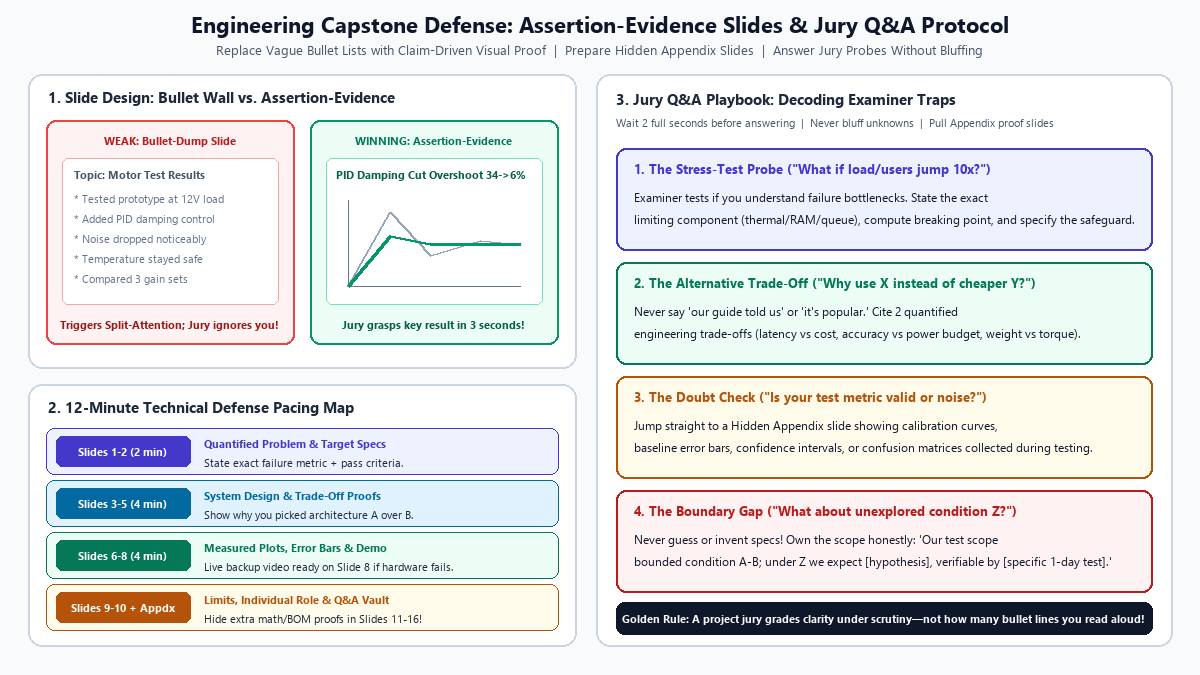
The Assertion-Evidence Slide Rule: Claim First, Visual Proof Second
Pioneered for engineering and science communication by **Michael Alley (Penn State University)**, the **Assertion-Evidence structure** fixes bullet-induced audience fatigue in one stroke. Every technical body slide obeys just two rules:
- Headline = Full-Sentence Engineering Assertion (Not a Label): Never write a vague noun heading like
"Motor Results"or"Methodology". Instead, write a concise 1–2 line testable takeaway summarizing what the slide proves: "Adding Differential Damping Reduced Step Overshoot From 34% to 6% Under 2-kg Load." - Slide Body = Visual Evidence + Short Callouts (Zero Bullet Paragraphs): Replace five indented bullet sentences with one crisp labeled block diagram, comparative plot with units and error bars, oscilloscope capture, or benchmark table—letting your spoken voice explain causal nuances cleanly while the jury absorbs visual proof effortlessly.
The 3-Second Comprehension Benchmark: An external viva examiner flipping through your deck silently should understand your entire technical story strictly by reading your top slide assertions from Slide 1 to Slide 10—even before hearing your voice.
| Defense Phase (12-Min Slot) | Slide Allocation | Core Engineering Proof Required | Fatal Mistake Jury Penalizes |
|---|---|---|---|
| Problem & Target Spec | Slides 1–2 (2 min) | Quantified gap + numeric pass criteria (latency, SNR, FOS) | Spending 4 slides giving Wikipedia history of IoT/AI |
| System Trade-Off Design | Slides 3–5 (4 min) | Block diagram + weighted trade-off table (Option A vs B) | Claiming "we chose Sensor X because it is popular" |
| Experimental Validation | Slides 6–8 (4 min) | Measured curves with units, error bars, baseline comparison + fallback demo video | Relying blindly on live Wi-Fi/breadboard wires with zero backup clip |
| Limits & Individual Role | Slides 9–10 (2 min) | Honest operating bounds + clear per-teammate engineering ownership | Vague "we all worked equally" answers during panel grilling |
| Hidden Appendix Vault | Slides 11–16 (Q&A Only) | BOM costs, PCB schematics, raw derivations, confusion matrices | Cramming raw math onto main slides "just in case" |
The Hidden Appendix Secret: Winning Q&A Before Anyone Asks
Why do nervous teams stuff 25 equations, full circuit schematics, and bill-of-materials spreadsheets onto main presentation slides? Out of fear that an examiner might demand proof! Yet packing contingency detail onto main slides destroys main-talk pacing.
Instead, keep your main deck razor-lean at **10 slides**, place an understated "Thank You — Questions?" slide at Slide 10, and quietly build **Slides 11 through 16 as a Hidden Q&A Appendix**. Prepare one dedicated backup slide for every predictable jury doubt:
- Slide 11: Complete Sensor Calibration Curve & Uncertainty Calculation
- Slide 12: Cost Breakdown / Bill of Materials vs. Commercial Alternative
- Slide 13: Ablation Table Comparing Model Features or Alternate Materials
- Slide 14: Unedited 30-Second Backup Video of Hardware Running Under Load
When a professor raises their hand and asks, "How do you know your thermocouple reading isn't drifting due to ambient self-heating?" and you calmly reply, "Great question—Slide 11 shows our ice-bath calibration offset across 4 hours," you project instant mastery.
What External Examiners Grade Behind Closed Doors
Once you leave the defense seminar room, internal guides and external industry or academic judges rarely argue over whether your slide animations looked flashy. Instead, university project rubrics consistently weight four crisp engineering pillars across final viva evaluations:
- Engineering Fundamentals Over Hype: Did the team size components, choose algorithms, or verify stress limits using first-principles calculations rather than assembling pre-built tutorials? Can the presenter defend why every tolerance factor, resistor value, or database index was chosen quantitatively?
- Honest Error Analysis & Repeatability: Did you run at least 5–10 trials, measure mean variance or failure rates, and explain discrepancies between theoretical simulation and benchtop reality? Reporting honest error bars immediately separates serious engineers from cosmetic demo builders.
- Hardware & Demo Resilience: Did the prototype function cleanly or recover gracefully using embedded oscilloscope/benchmark video rather than stalling the panel for seven awkward minutes while someone hunts for a USB-serial cable or restarts a crashed local server?
- Authentic Team Ownership: Can every member explain the core system equation and trace how their specific hardware, firmware, or software block interfaces cleanly with adjacent modules under real operating loads?
How to Handle Hostile or Unknown Jury Questions Without Freezing
Examiners probe weakest spots intentionally—not to embarrass students, but to test whether you built the engineering work genuinely yourself and understand physical boundaries. Follow this disciplined 4-step vocal protocol whenever hit by a tough curveball:
- Pause Two Full Seconds & Clarify Scope: Never interrupt a jury member mid-sentence. Wait two calm breaths, paraphrase the core engineering constraint ("So you're asking how latency scales if concurrent requests hit 10x?"), and stay anchored physically—zero rambling filler.
- Use Quantitative Anchors, Never Vague Adjectives: Replace "very fast" or "high accuracy" with exact numbers verified from testing ("median inference latency stayed under 42 ms on Jetson Nano, dropping accuracy by 1.8% after quantization").
- Deflect Team Blame Never — State Your Sub-System Ownership: On group projects, know your teammates' modules at high-level block architecture while demonstrating surgical command over your own subsystem calculations, code, or CAD assemblies.
- When You Truly Don't Know, Draw the Boundary Cleanly: Never fabricate equations or invent test numbers—juries spot bluffing within seconds! Say cleanly: "We tested input pressures strictly across 1 to 5 bar in our scope; we have not measured cavitation past 8 bar yet, though I expect seal chatter first and would verify that with a stepped hydrostatic test." Honest engineering rigor often earns higher marks than reckless guessing.
If you are organizing a multi-person capstone team while juggling 75% attendance rules and regular semester coursework, breaking milestones cleanly into design, testing, slide prep, and appendix tasks on our Study Kanban Board keeps everyone aligned weeks ahead of final review. Before stepping into the viva room, you can digitize hand-drawn block sketches cleanly via Handwriting Studio and rehearse tough adversarial examiner Q&A sessions directly against your own project report inside AIgom AI Tutor (all platform guides follow our Editorial & Verification Policy).
You can also benchmark report layouts inside Peer College Notes and review our companion guides on Engineering Lab Viva Mastery and Complete Engineering Capstone Execution before defense week arrives.
Frequently Asked Questions
How many slides should a 10-to-15-minute engineering capstone defense contain?
Aim for roughly **10 to 12 main slides** (averaging ~1 minute per Assertion-Evidence slide), supported by 4–6 hidden **Appendix slides** kept strictly after your conclusion slide for answering detailed math, BOM, or calibration questions during Q&A.
Should we do a live hardware or software demo during the final jury defense?
Yes—whenever permitted—**provided you always keep an unedited 30-to-45-second backup MP4 video embedded in your deck**. Campus Wi-Fi drops, loose breadboard jumpers, and projector adapter bugs happen constantly; switching calmly to pre-recorded lab footage saves your presentation marks cleanly.
What should you do when two external jury members disagree with each other?
Stay diplomatic and grounded in empirical metrics rather than taking sides emotionally. Acknowledge both viewpoints clearly ("Professor A highlights minimal BOM cost, while Professor B emphasizes thermal headroom; our current revision prioritized thermal safety factor 2.0 because...").
How can nervous speakers avoid rushing or blanking out on Stage Slide 1?
Script and rehearse **only your opening 45 seconds verbatim** (problem hook, target metric, and overview) plus transition phrases between major slides—leaving technical explanations natural rather than robotic. Recording one full timed dry run under realistic 12-minute limits cures 80% of pacing errors.
How much math derivation belongs directly on capstone defense slides?
Place only the governing physical trade-off equation (`F = ...` or system control law) alongside key boundary assumptions on main slides. Put multi-line algebraic derivations, circuit KVL matrices, and hyperparameter sweeps safely into hidden Appendix slides.
Walking Into Your Defense Panel With Calm Authority
Your capstone jury wants to leave convinced of one thing: that you are a thoughtful engineer who built real work, tested real failure modes, and communicates trade-offs crisply under scrutiny. Upload your project report and prototype test plots into Etudey, drill 10 tough examiner stress-test questions out loud beforehand, and walk into your defense panel ready to lead the conversation.