
High-scoring STEM students never treat timed multiple-choice exams like open-ended derivations. By applying dimensional analysis, extreme limiting cases (\(x \to 0, x \to \infty\)), symmetry checks, and expected-value guessing math, you can eliminate wrong symbolic options in 15 seconds, dodge deliberate examiner traps, and turn negative-marking exams into predictable point engines.
You know the exact panic of a timed engineering or physics MCQ exam—whether it is a university Circuits midterm, GATE, JEE, GRE Physics, or the FE Exam. With 90 seconds per question and a harsh \(-\frac{1}{3}\) negative marking penalty staring at you, Question 14 asks for the steady-state tension or transfer function of an ugly multi-body system. You put your head down, grind through two pages of simultaneous equations for five tense minutes, get an expression that does not match any of the four choices, panic, skip it anyway, and finish the exam leaving six easy questions untouched at the end.
Here is the mindset shift that separates top-1% test-takers from everyone else: an MCQ does not ask you to derive the truth from scratch—it asks you to identify which three options violate physics or mathematics. Every symbolic STEM option carries physical fingerprints (units, scaling limits, sign parity, and symmetry). Testing those fingerprints takes ten seconds and routinely kills two or three distractors before you even pick up your calculator.
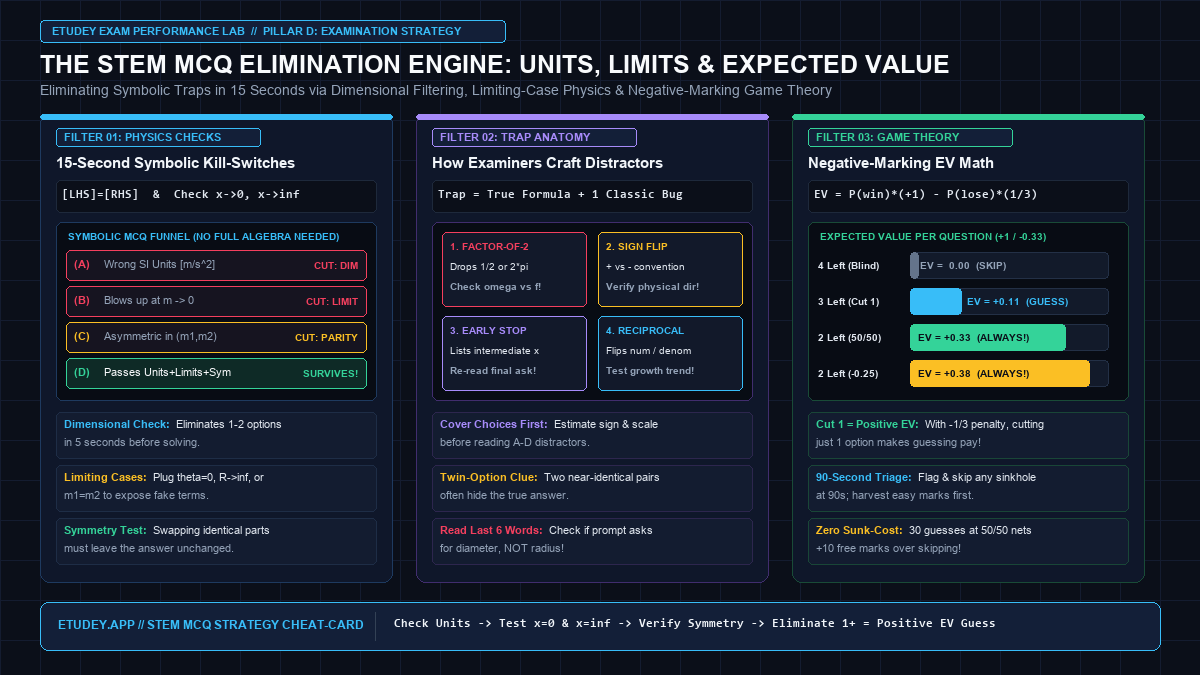
1. The 15-Second Physics Filter: Units, Limits & Symmetry
Before you ever expand a determinant or set up a coupled differential equation on a symbolic MCQ, run the four choices through three rapid kill-switches in strict order:
- Dimensional Homogeneity (\([\text{LHS}] = [\text{RHS}]\)): Every additive term inside parentheses or under a square root must share identical SI units, and the final expression must match the target quantity's dimensions. For deeper dimensional drills, review our guide on Dimensional Analysis Sanity Checks for Engineering Exams.
- Extreme Limiting Cases (\(x \to 0\), \(x \to \infty\), \(\theta \to 0^\circ/90^\circ\)): Push one physical parameter to an extreme where you instantly know the real-world behavior—like zero friction, infinite resistance, or zero mass—and check which options survive.
- Symmetry & Sign Parity: If two identical components (such as two masses \(m_1, m_2\) or two parallel resistors \(R_1, R_2\)) play symmetric roles in the physical setup, swapping their labels must leave the final formula unchanged.
Live 12-Second Walkthrough: Zero Algebra Required
Suppose a timed Mechanics MCQ shows two unequal masses \(m_1\) and \(m_2\) suspended over an ideal massless pulley (an Atwood machine) and asks for the string tension \(T\):
- (A) \(T = \frac{m_1 + m_2}{m_1 m_2} g\)
- (B) \(T = \frac{m_1^2 + m_2^2}{m_1 + m_2} g\)
- (C) \(T = \frac{2 m_1^2}{m_1 + m_2} g\)
- (D) \(T = \frac{2 m_1 m_2}{m_1 + m_2} g\)
Watch all three distractors collapse in twelve seconds without solving a single equation of motion:
- Check Units: Tension is a force \([\text{kg}\cdot\text{m/s}^2]\). Option (A) has \(\frac{\text{kg}}{\text{kg}^2} \cdot \text{m/s}^2 = \text{kg}^{-1}\text{m/s}^2\) → Kill (A) instantly.
- Test the Extreme Limit (\(m_1 \to 0\)): If one side of the string has zero mass hanging on it, the other mass falls freely and the rope goes completely slack (\(T \to 0\)). Plug \(m_1 = 0\) into Option (B): \(T = m_2 g \neq 0\) → Kill (B) instantly.
- Test Physical Symmetry (Swap \(m_1 \leftrightarrow m_2\)): Left and right sides of an ideal pulley are physically identical, so tension cannot change if you swap labels \(m_1\) and \(m_2\). Option (C) turns into \(\frac{2 m_2^2}{m_1 + m_2} g \neq \frac{2 m_1^2}{m_1 + m_2} g\) → Kill (C) instantly.
- Bonus Sanity Check on Survivor (D): Set \(m_1 = m_2 = m\) (balanced stationary pulley). Physically, tension must hold one hanging weight (\(T = m g\)). Option (D) yields \(\frac{2m^2}{2m} g = m g\). 100% locked in.
This exact workflow applies across every STEM discipline: test \(\omega \to 0\) (DC) and \(\omega \to \infty\) (high-frequency short) on AC circuit transfer functions; test \(n = 1\) and \(n = 2\) on discrete math recurrences; test \(T \to 0\) or ideal-gas limits on Thermodynamics expressions.
2. Examiner Distractor Anatomy: The 4 Traps Built to Catch You
Standardized STEM exams rarely fill wrong choices with random garbage. Examiners intentionally engineer distractors by taking the correct derivation and injecting the four exact algebra slips students commit under time pressure:
- The Factor-of-2 / \(2\pi\) Trap: Forgetting the \(\frac{1}{2}\) in kinetic energy or capacitor energy (\(\frac{1}{2}CV^2\)), confusing angular frequency \(\omega\) with linear frequency \(f = \frac{\omega}{2\pi}\), or forgetting to double a single-sided integral.
- The Sign-Flip Trap: Dropping a minus sign in Lenz's Law, bending-moment conventions, or work done by vs. on a thermodynamic gas. Always verify direction from physical intuition rather than trusting raw algebra blindly.
- The Intermediate-Value Trap: On a two-step calculation—say, finding acceleration \(a = 4\text{ m/s}^2\) first and then computing tension \(T = 28\text{ N}\)—you can bet \(4\) sits waiting as Option (A) to harvest students who celebrate one step early.
- The "Last Six Words" Misread Trap: Solving cleanly for radius \(r\) when the prompt asks for diameter, finding efficiency \(\eta\) when it asks for heat rejected, or picking the true statement when the question specifies "Which of the following is NOT valid?"
The Cover-Before-Peek Habit: Before reading Options A–D on numerical questions, cover the choices with your scratch sheet for five seconds and estimate the rough sign and order of magnitude (e.g., "positive, around 10–30 N"). Reading distractors too early anchors your brain toward plausible-looking traps—a major driver of careless errors detailed in How to Eliminate Silly Mistakes in Math Exams.
3. Negative-Marking Game Theory: When Should You Guess?
Countless well-prepared students throw away 8 to 15 marks on GATE, JEE, and timed college tests because of loss aversion: the psychological sting of losing \(-0.33\) marks feels twice as painful as the joy of gaining \(+1\) mark, so students leave every 50/50 question blank to "play it safe."
Let's replace gut fear with cold probability math. Suppose a correct answer awards \(+1\) mark, a wrong answer deducts penalty \(p\), and after applying our physics/unit filters you have narrowed the question down to \(k\) equally plausible surviving options. Your Expected Value (EV) per guess is:
\[ \text{EV} = \left(\frac{1}{k}\right)(+1) - \left(\frac{k - 1}{k}\right) p \]Plug in the classic GATE / 4-option \(-\frac{1}{3}\) penalty (\(p = \frac{1}{3}\)):
- Blind Guess (\(k = 4\)): \(\text{EV} = \frac{1}{4}(1) - \frac{3}{4}\left(\frac{1}{3}\right) = 0.25 - 0.25 = \mathbf{0.00}\) (Pure zero-sum coin flip—skip to protect variance).
- Eliminated 1 Option (\(k = 3\)): \(\text{EV} = \frac{1}{3}(1) - \frac{2}{3}\left(\frac{1}{3}\right) = 0.333 - 0.222 = \mathbf{+0.111}\) (Strictly positive!).
- Eliminated 2 Options (\(k = 2\), 50/50): \(\text{EV} = \frac{1}{2}(1) - \frac{1}{2}\left(\frac{1}{3}\right) = 0.500 - 0.167 = \mathbf{+0.333}\) (Massive edge!).
Over 18 narrowed 50/50 questions across an exam, guessing mathematically adds \(+6.0\) net marks compared to leaving them blank. Even under brutal \(-0.50\) marking, a 50/50 still yields \(\text{EV} = +0.25\)! Bookmark this complete decision matrix:
| Exam Penalty Scheme (Per +1 Mark) | 4 Options Left (Blind) | 3 Options Left (Cut 1) | 2 Options Left (50/50) | Optimal Mathematical Rule |
|---|---|---|---|---|
| No Penalty (\(p = 0\)) (FE, GRE, most US exams) | \(+0.25\) | \(+0.33\) | \(+0.50\) | Never leave any blank—answer 100% before time expires. |
| \(-1/4\) Penalty (\(p = 0.25\)) (JEE Main, CAT-style) | \(+0.06\) | \(+0.17\) | \(+0.38\) | Always guess if 1+ cut (even blind is slightly positive!). |
| \(-1/3\) Penalty (\(p = 0.33\)) (GATE, standard 4-choice) | \(0.00\) | \(+0.11\) | \(+0.33\) | Skip blind 4-way; ALWAYS guess once 1 or 2 options are cut. |
| \(-1/2\) Penalty (\(p = 0.50\)) (Harsh departmental quiz) | \(-0.13\) | \(0.00\) | \(+0.25\) | Skip 4-way and 3-way; ALWAYS guess on clean 50/50 splits. |
4. The 3-Pass Time-Budget Protocol: Never Die on a Sinkhole
Even with elite elimination habits, one brutal 6-minute trap question early in the paper can destroy your entire score if your ego refuses to let it go. Top exam performers run a strict Three-Pass Triage Loop:
- Pass 1 — The 90-Second Harvest (First 55% of Exam Time): Sweep from Question 1 to the end. Solve every immediate recognition problem and every 15-second unit/limit kill-switch immediately. If a question shows zero clear path by the 90-second mark, circle your partial eliminations (e.g., cross out A and C cleanly on scratch paper), flag it, and move on ruthlessly.
- Pass 2 — The Flagged Deep-Solve (Next 35% of Time): Return exclusively to flagged questions where you already narrowed the choices or recognize the exact setup. Your subconscious background processing often cracks blocks you froze on during Pass 1.
- Pass 3 — The EV Harvest & Bubble Audit (Final 10% of Time): Never waste the last five minutes wrestling an unsolved 4-way monster. Instead, execute every positive-EV 50/50 and 3-way elimination guess from your scratch notes, and verify that your marked bubbles match your final answers cleanly.
5. Training MCQ Instincts in Your Weekly Etudey Routine
Limiting-case physics and distractor radar are reflexes—you cannot invent them for the first time inside the exam hall. Build them automatically during your 30-Day Engineering Exam Sprint:
- Log Your Personal Distractor Archetypes: After every mock test, tag why you picked a wrong option inside an Engineering Error Log stored in Etudey Notes (e.g., "Factor-of-2 trap" or "Skipped unit check"). Patterns vanish the moment you name them.
- Drill Symbolic Verification with AIgom: Paste a tough textbook formula into Etudey AIgom Tutor and ask it to generate three realistic exam distractors (one wrong-unit, one bad-limit, one sign-flip) so you practice spotting physical flaws at speed.
- Sketch Boundary Cases Visually: Map extreme limits (\(\theta = 0^\circ, 90^\circ\), DC vs. high-frequency circuit equivalents) on Etudey Handwriting Studio so limiting behavior becomes visual muscle memory.
- Simulate Timed Pass-1 Sprints: Track timed 20-question PYQ sprint blocks on your Study Kanban Board and run cold practice sets inside Etudey Workspace under an actual 90-second-per-question timer.
Frequently Asked Questions
Can dimensional analysis really eliminate options when formulas contain \(\sin(\theta)\) or \(e^{-t/\tau}\)?
Yes—even better! Inside every transcendental function (\(\sin\), \(\cos\), \(\ln\), \(\exp\)), the entire argument must be strictly dimensionless. If an RC-circuit option writes \(e^{-t R C}\) instead of \(e^{-t/(RC)}\), the exponent carries units of \([\text{s}^2]\) instead of \([1]\), allowing you to eliminate that distractor in three seconds flat.
What if two options look nearly identical except for one sign or factor of 2?
In human-written STEM exams, a "twin pair" (for example, \(\frac{1}{2}mv^2\) vs. \(mv^2\), or \(+4.2\text{ V}\) vs. \(-4.2\text{ V}\)) strongly signals that the test author built the distractor by mutating the true answer. Never guess blindly between twins—use a fast boundary limit, energy-conservation bound, or sign-direction check to split the pair cleanly.
Is the "always pick C" or "longest answer wins" advice actually useful in STEM?
No—those folk heuristics collapse on modern randomized computer-based tests (GATE, GRE, FE, LMS quizzes) that automatically shuffle choice order for every student. Stick strictly to invariant mathematical and physical checks—dimensions, limiting cases, symmetry, and expected-value math—which work regardless of answer ordering.
Should I change my first answer if I spot a flaw during Pass 3 review?
Yes! Contrary to the popular myth that "your first instinct is always right," meta-analyses of over 60 educational psychology studies show that when students revise an answer based on a concrete detected error (such as catching a sign flip or misread unit), wrong-to-right switches outnumber right-to-wrong switches by nearly 3 to 1. Only avoid changing answers on pure anxious second-guessing with no new evidence.
How do I handle numerical integer-type (NAT) questions where there are no options to eliminate?
Numerical-entry questions (like GATE NAT) usually carry zero negative marking! Even without A–D options, run the exact same physical sanity checks—order-of-magnitude bounds, sign check, and unit conversion check (kW vs. W, radians vs. degrees)—and always enter your sharpest physics-bounded estimate rather than leaving a zero-penalty box blank.
Turn Timed STEM MCQs Into Predictable High-Score Sprints
Practice distractor diagnostics with AIgom Tutor, sketch limiting-case physics on Handwriting Studio, and track every recurring exam trap in your personal Etudey Workspace—100% free to start.
Launch Etudey Workspace Free →