
Syllabus triage is the systematic classification of exam topics by historical frequency, mark yield, and time-to-mastery when covering 100% of the curriculum is impossible. By ruthlessly eliminating low-yield academic sinkholes and prioritizing high-frequency core foundations, college students secure 80% of exam marks in under 40 study hours.
The 5-Day Exam Emergency: Why Trying to Cover Everything Guarantees Failure
Every semester, across engineering, medical, commerce, and science colleges worldwide, thousands of undergraduates find themselves trapped in the exact same high-stakes mathematical crisis. It is Sunday evening. Your first semester final examination begins on Friday morning. Your syllabus consists of five dense units—covering approximately 180 distinct concepts, derivations, and problem archetypes.
You perform a sobering calculation. Mastering each topic thoroughly would require roughly 45 minutes of textbook reading, derivation practice, and numerical solving. Total time required: 135 study hours. Total hours remaining before your exam, factoring in minimal sleep and meals: 42 hours.
Confronted with this massive temporal deficit, 90% of students make a fatal strategic blunder driven by perfectionist anxiety: they open Unit 1, Chapter 1, Page 1, determined to study the syllabus linearly from beginning to end. They tell themselves: "If I just study without stopping for five days straight, I can cover everything."
By Wednesday night, the catastrophic consequences of this linear completion strategy become irreversible:
- The Early Unit Time Sinkhole: The student spends 22 of their precious 42 available hours trapped in the introductory theory and non-essential historical proofs of Units 1 and 2—topics that typically account for only 20% of the total exam marks.
- The Heavyweight Blindspot: Units 4 and 5—which contain the massive 15-mark compulsory derivations, complex multi-stage design problems, and advanced numerical questions—remain completely untouched as the exam eve arrives.
- Cognitive Saturation & Panic: Exhausted from 16-hour cramming sprints without strategic breaks, the student's working memory collapses. They walk into the 3-hour exam hall with shallow, disorganized knowledge across 40% of the syllabus, completely unprepared for the high-weightage questions that decide pass-fail cutoffs.
Top-performing students facing severe time constraints do not attempt to cover 100% of the syllabus. They recognize that academic examinations are not tests of total reading volume; they are games of asymmetric mark distribution. By applying the clinical principles of emergency room triage, you can systematically discard low-yield academic dead weight and capture 80% of the available marks in less than a third of the time.
The Medical Triage Metaphor: How Emergency Room Logic Saves College Semesters
In hospital emergency medicine, when a mass-casualty event occurs, emergency physicians do not treat patients in the chronological order of their arrival. Nor do they attempt to treat every minor scratch and abrasion while critically injured patients bleed out. Instead, they deploy Medical Triage: an objective protocol that categorizes patients based on physiological urgency and survivability.
"Triage is the art of making peace with finite resources. When demand vastly exceeds capacity, attempting to treat every condition equally guarantees systemic collapse. Maximum survival is achieved only by ruthlessly prioritizing high-probability recoveries and intentionally deferring non-survivable or low-impact cases."
— Principles of Emergency Medicine & Clinical Resource Allocation
Your semester exam crunch is an academic mass-casualty event. Your time is strictly rationed. Every hour you spend trying to memorize an obscure, 3-mark derivation that has appeared once in seven years is an hour stolen from a 15-mark core design question that appears on every single semester exam paper. Syllabus Triage is the deliberate, guilt-free alignment of your finite study hours with maximum mark capture.
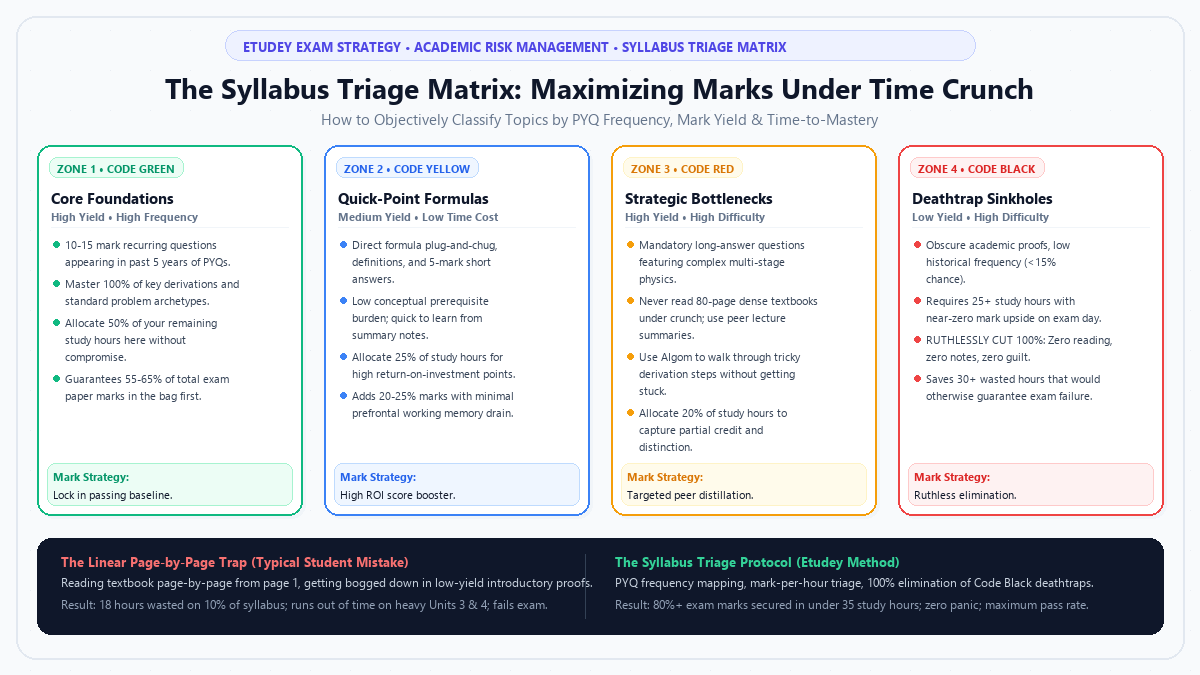
The 4-Zone Syllabus Triage Matrix
To execute a flawless academic triage, take your course syllabus and past 5 years of Previous Year Questions (PYQs). Classify every topic into one of four distinct operational zones:
Zone 1: Core Foundations (Code Green — High Yield, High Frequency)
Zone 1 contains the foundational pillars of the course. These are topics that satisfy two non-negotiable criteria: they carry high individual mark weightage (10 to 15 marks per question) and have appeared in at least 4 out of the past 5 years of university exams. Examples include the Navier-Stokes derivation in Fluid Mechanics, Maxwell's equations in Electromagnetism, Thevenin/Norton equivalents in Circuit Analysis, or the Carnot cycle in Thermodynamics.
- Time Allocation: Commit 50% of your remaining study hours (e.g., 20 out of 40 hours) exclusively to Zone 1.
- Execution Standard: Achieve 100% mastery. Practice drawing the derivations by hand without looking at solutions using the Handwriting Studio. Solve at least three past-year numerical variations.
- Strategic Outcome: Mastering Zone 1 secures 55% to 65% of the total exam marks, completely removing the threat of an academic backlog before you touch any other chapter.
Zone 2: Quick-Point Formulas (Code Yellow — Medium Yield, Low Time-to-Mastery)
Zone 2 consists of "low-hanging fruit"—topics that have moderate mark weightage (4 to 8 marks) but require very little conceptual heavy lifting. These are typically direct formula plug-and-chug questions, standard definitions, or straightforward 2-step calculations (e.g., calculating Reynolds number, determining op-amp closed-loop gain, or defining thermodynamic state postulates).
- Time Allocation: Allocate 25% of your study hours (e.g., 10 out of 40 hours).
- Execution Standard: Do not read textbook prose. Build a condensed 1-page formula reference sheet. Memorize the formula, identify the units and boundary conditions, and solve two quick benchmark problems.
- Strategic Outcome: Adds an effortless 20% to 25% incremental score boost with minimal working memory fatigue.
Zone 3: Strategic Bottlenecks (Code Red — High Yield, High Conceptual Friction)
Zone 3 topics carry heavy exam weightage (12 to 15 marks), but they are conceptually complex, mathematically intimidating, and feature steep learning curves. Examples include complex contour integration in Engineering Mathematics, state-space stability analysis in Control Systems, or multi-step retrosynthesis in Organic Chemistry.
- Time Allocation: Allocate 20% of your study hours (e.g., 8 out of 40 hours).
- Execution Standard: Never read an 80-page textbook chapter under crunch conditions. Instead, download verified peer summaries from the Etudey Notes Archive to understand the standard question archetype. If a derivation step is unclear, paste it into AIgom to get a simplified, step-by-step breakdown. Focus on learning the general solution template to capture 70% to 80% partial credit.
- Strategic Outcome: Converts potential zero-mark exam disasters into high-scoring partial credit victories.
Zone 4: Deathtrap Sinkholes (Code Black — The Topics You Must Ruthlessly Cut)
Zone 4 represents the greatest danger to your GPA. These are topics characterized by extreme mathematical abstraction, immense conceptual difficulty, and low historical exam frequency (appearing in less than 15% of past exams, usually as optional 3-mark trivia questions). Examples include obscure thermodynamic phase proofs, fringe historical case studies, or advanced tensor derivations.
- Time Allocation: EXACTLY ZERO HOURS (0%).
- Execution Standard: Take a thick red marker and cross these topics off your syllabus sheet. Do not read them. Do not print lecture slides on them. Do not feel guilty about ignoring them.
- Strategic Outcome: Saves 20 to 30 hours of agonizing confusion that would otherwise derail your entire exam preparation. If a Zone 4 question appears on the exam, you utilize the exam paper's built-in question choice (e.g., "Answer any 5 out of 7 questions") to skip it cleanly.
| Strategic Dimension | The Linear Completion Trap (Perfectionist Error) | The Syllabus Triage Protocol (Etudey Method) | Academic Impact Under High Time Crunch |
|---|---|---|---|
| Sequencing Logic | Chronological from Page 1 of Unit 1 through Unit 5. | Strictly prioritized by Historical Yield (Zone 1 \(\rightarrow\) Zone 2 \(\rightarrow\) Zone 3). | Eliminates the risk of running out of time before reaching high-mark chapters. |
| Handling Obscure Topics | Spends 8 hours trying to understand a 3-mark obscure proof. | Identifies as Code Black (Zone 4) and eliminates with zero hesitation. | Protects 25+ wasted study hours for high-yield mark mastery. |
| Source Material Usage | Wrestles with 900-page dense university textbooks. | Verified peer notes, 1-page formula sheets, and targeted AIgom tutoring. | Cuts reading volume by 75% while preserving 100% of exam-relevant patterns. |
| Cognitive Load & Stamina | Overwhelmed by infinite syllabus scope; severe anxiety and burnout. | Calm execution of a finite, high-probability task list on a Kanban board. | Preserves prefrontal executive energy for problem-solving in the exam hall. |
| Mark Capture Efficiency | Captures ~35% of marks despite studying 40 hours (due to missing Units 4 & 5). | Captures 75% to 85% of total exam paper marks in identical 40 hours. | Turns inevitable exam failure into a comfortable first-class grade. |
| Question Choice Exploit | Ignores exam paper structure; attempts to prepare for 100% of questions. | Directly reverse-engineers the paper format (e.g. "Attempt 4 out of 6"). | Maximizes optionality and eliminates vulnerability to surprise trick questions. |
The 3-Step Mathematical Triage Audit: Quantifying Return on Time Invested (ROTI)
To implement this system without guesswork, execute this 45-minute audit before opening any study materials:
Step 1: The 5-Year PYQ Frequency Mapping
Download the past five years of semester examination question papers for your course. Open a spreadsheet or a fresh sheet of paper. Create a table with three columns: Unit Number, Topic Name, and Frequency Count. Walk through all five exam papers and mark a tally every time a topic appears.
Within thirty minutes, an unmistakable pattern will emerge: roughly 20% of the syllabus accounts for over 75% of the total exam marks (the classical Pareto Principle in higher education). The professor's favorite question archetypes will be glaringly obvious.
Step 2: Calculating Mark-per-Hour Ratios
For each major topic, calculate its Return on Time Invested (ROTI):
\[\text{ROTI} = \frac{\text{Expected Exam Marks}}{\text{Estimated Hours to Master}}\]
Compare two real engineering examples:
- Topic A (Bode Plot Construction): Carries a guaranteed 14 marks on every exam paper. Requires 2.5 hours to master the 4 standard asymptotic rules. \(\text{ROTI} = 14 / 2.5 = \mathbf{5.6 \text{ marks/hour}}\). (Zone 1 - Code Green).
- Topic B (Nyquist Stability Contour Proof): Carries 4 marks, appears once every 3 years. Requires 6 hours to wade through complex variable mapping theory. \(\text{ROTI} = (4 \times 0.33) / 6 = \mathbf{0.22 \text{ marks/hour}}\). (Zone 4 - Code Black).
The math is undeniable: one hour spent on Topic A is 25 times more valuable to your semester survival than one hour spent on Topic B.
Step 3: Enforcing the 40-Hour Time Budget
Divide your remaining hours across your triaged topics. Load these tasks into the Etudey Study Kanban:
- Create cards only for Zone 1, Zone 2, and Zone 3 topics.
- Label each card with its allocated time budget (e.g., "[2 Hours] Fluid Kinematics - Continuity & Stream Function Derivations").
- When the timer expires, move the card to Done and move forward. Do not allow perfectionism to steal time allocated to subsequent chapters.
The Psychological Shift: Overcoming the Fear of "Missing Something"
The single greatest obstacle to successful syllabus triage is not logic—it is emotional FOMO (Fear Of Missing Out). Students feel an irrational sense of guilt when intentionally skipping a textbook section. They think: "What if the professor asks a question on this exact page I skipped?"
You must reframe your mindset through the lens of probabilistic risk management:
- The Cost of Perfectionism is Guaranteed Failure: If you try to study everything, you will run out of time and enter the exam hall knowing 40% of the material poorly. You are guaranteed to fail.
- The Power of Selective Mastery: If you triage ruthlessly, you might sacrifice a 4-mark optional question from Zone 4. But in exchange, you guarantee 100% mastery on the 65 marks of Zone 1 and Zone 2. A paper scored out of 80 with 90% accuracy yields a final score of 72/100 (Grade A)!
Accepting that you cannot know everything is not surrender—it is the hallmark of elite strategic thinking under pressure.
Frequently Asked Questions
What if my exam does not offer optional questions (100% compulsory paper)?
Even on exams with zero optional questions, the Syllabus Triage Matrix remains your best strategy. If a 100-mark paper is completely compulsory, studying linearly ensures you will get 0 marks on the entire second half of the paper because you never reached it. Triaging ensures you secure full marks on all high-frequency Zone 1 questions and capture rapid formula marks on Zone 2, guaranteeing a solid passing grade (60% to 70%) rather than a catastrophic zero.
How do I identify Zone 1 topics if I cannot find Previous Year Questions (PYQs)?
If past exam papers are unavailable, use two reliable proxies: Professor Lecture Emphasis and Curated Notes. Review your professor’s lecture slides: any topic where the professor spent more than two full lectures, assigned dedicated homework problems, or explicitly derived equations on the board is a Zone 1 candidate. Additionally, search the Etudey Notes Archive for notes uploaded by previous batches from your exact department—students routinely highlight recurring exam questions in their study summaries.
Is it safe to cut an entire syllabus unit if it seems too difficult?
Never cut an entire unit blindly. Most university exam papers enforce a structural rule: at least one question must be drawn from each of the five syllabus units. If you completely skip Unit 4, you automatically forfeit an entire 15-mark section. Instead, triage within the difficult unit: identify the easiest Zone 2 formula question or standard definition from Unit 4 and master it in 90 minutes. That single formula secures vital partial credit without forcing you to master the unit's complex derivations.
How should I use AI when I only have 48 hours left before an exam?
Do not use AI to generate long, verbose essays. Use AIgom as a rapid diagnostic unsticking tool. When you are working through a Zone 1 derivation and cannot understand why a variable cancels, paste that specific step into AIgom and prompt: "In two sentences, what mathematical identity or physical assumption allows this cancellation?" AIgom resolves your confusion in ten seconds, allowing you to resume practice without losing momentum.
What tools on Etudey help me execute a pre-exam triage?
Etudey is designed for rapid academic execution. Use the Study Kanban Board to map your triaged topics into visual priority columns (Code Green, Yellow, Red). Use the Etudey Workspace focus timer to enforce strict time-boxing on each topic. Practice derivations on the Handwriting Studio canvas, and download high-yield formula roadmaps directly from the Notes Archive.
Survive and Ace Your Exam Crunch with Etudey
Eliminate pre-exam panic, prioritize high-yield marks, and pass with confidence. Triage your syllabus with Etudey's free Study Kanban Board, verified semester lecture notes, digital handwriting studio, and step-by-step AI tutor.