
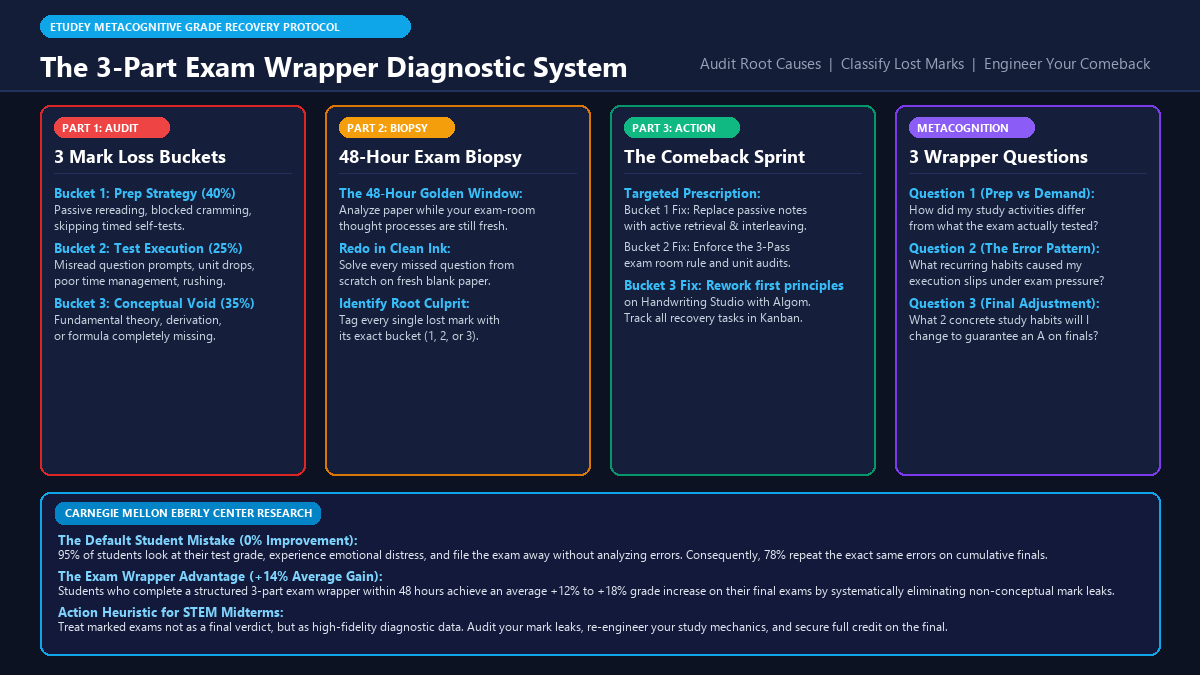
An exam wrapper is a structured metacognitive diagnostic protocol completed immediately after receiving a graded test to audit the root causes of lost marks. By categorizing errors into preparation flaws, execution slips, and conceptual gaps, students transform emotional exam disappointment into an empirical blueprint that guarantees grade recovery on finals.
The Post-Exam Emotional Trap: Why 95% of Students Learn Nothing from Returned Tests
Every semester across college campuses, an identical ritual unfolds in lecture halls. The professor walks into the room carrying a heavy stack of graded midterm exam papers. As the exams are distributed, a heavy silence descends over the room. Students flip open the front cover, their eyes darting immediately to the top right corner to locate the red-ink number.
For students who score significantly lower than their expectations—perhaps a 48 out of 100 on an engineering mechanics or organic chemistry midterm—their immediate psychological response is almost always governed by emotional self-defense. Students typically split into two counterproductive camps:
- The Defensive Deflector: They blame external variables: "The professor made the test unfairly difficult," "The grading rubric was harsh," or "Problem 4 was trick question nobody could have anticipated."
- The Defeated Resigner: They internalize the failure as an unchangeable identity: "I'm just not cut out for engineering," or "My brain simply cannot handle high-level mathematics." They crumple the test paper in disgust and shove it into the deepest crevice of their backpack, never to look at it again.
Both responses share a fatal commonality: they treat a marked examination as a final verdict rather than an empirical biological biopsy. When students vow vaguely to "study twice as hard next time," they almost always repeat the exact same study behaviors that produced the failure in the first place. You cannot fix an invisible operational defect by blindly increasing the hours you spend executing it.
"A marked examination paper is the most expensive piece of diagnostic data you will ever own in college. Ignoring your red-ink errors is the academic equivalent of having an MRI scan done and refusing to let the physician read the results."
The Science of Metacognitive Calibration: The Carnegie Mellon Framework
In educational psychology, the concept of the Exam Wrapper was pioneered by Dr. Marsha Lovett and researchers at Carnegie Mellon University's Eberly Center for Teaching Excellence. An exam wrapper is a self-reflective diagnostic instrument that "wraps" around an exam: students complete a pre-exam forecast, followed by a post-exam structural error audit within 48 hours of receiving their grades.
The science underpinning exam wrappers rests on Metacognitive Calibration—the degree of alignment between a student's perceived mastery and their actual measured performance. Novice undergraduates suffer from severe calibration errors due to the Dunning-Kruger effect: they mistake familiarity (recognizing textbook equations during passive re-reading) for durable retrieval competence.
In multi-year studies conducted at Carnegie Mellon and replicated across major STEM universities, researchers discovered that implementing structured exam wrappers yielded transformative results:
- Students who completed a systematic 3-part exam wrapper after their first midterm achieved an average +12% to +18% grade increase on their cumulative final exams compared to control groups who merely received marked papers.
- More remarkably, over 75% of the points students lost on midterms were not due to an inability to understand the subject. They were lost due to flawed preparation strategies (e.g., blocked cramming) and test-taking execution slips (e.g., misreading constraints, sign errors, unit drops).
When you realize that nearly three-quarters of your lost marks are simple operational leaks rather than a lack of cognitive horsepower, the entire emotional burden of a bad exam evaporates. Your low grade ceases to be an intellectual crisis and becomes a straightforward engineering optimization problem.
Part 1: The 3-Bucket Mark Loss Audit
To execute an exam wrapper, you must conduct a forensic accounting of every single point subtracted from your paper. Take a blank sheet of paper or open a clean document in the Handwriting Studio. Create three columns corresponding to the 3 Root-Cause Buckets:
Bucket 1: Preparation Strategy Flaws (Typically 35% - 45% of Lost Marks)
These marks were lost before you ever set foot in the examination hall because your study architecture was misaligned with the cognitive demands of the test. Common Bucket 1 indicators include:
- You re-read your lecture notes or highlighted textbook paragraphs instead of conducting closed-book active retrieval.
- You completed homework problems in blocked sequences (solving 15 problems of the exact same type), so when the exam scrambled problem types, you could not diagnose which method to apply.
- You practiced without strict time limits, so your problem-solving speed was too slow under exam pressure.
- You studied with solutions open on your laptop, falsely believing you understood a derivation because the worked steps made sense while reading them.
Bucket 2: Test-Taking Execution Slips (Typically 20% - 30% of Lost Marks)
These marks represent self-inflicted wounds. You possessed the necessary mathematical knowledge to earn full credit, but you surrendered points through procedural breakdowns under time pressure. Common Bucket 2 indicators include:
- Misreading the problem statement (e.g., calculating radius instead of diameter, missing the word "adiabatic" in thermodynamics).
- Algebraic sign errors, unit conversion omissions (e.g., forgetting to convert cm to m, or kHz to rad/s), or arithmetic calculator typos.
- Time misallocation: spending 35 minutes wrestling with a stubborn 5-mark question and running out of time to attempt two easy 10-mark questions at the end.
- Messy handwriting and scratch work that caused you to misread your own intermediate variables.
Bucket 3: True Conceptual Voids (Typically 30% - 40% of Lost Marks)
These marks represent genuine gaps in your fundamental mental model. You encountered a problem where you did not know the governing physical law, could not derive the required formula, or had zero idea how to set up the boundary conditions. This is the only bucket that represents true conceptual difficulty.
Part 2: The 48-Hour Exam Biopsy
The single most critical rule of the exam wrapper is the 48-Hour Golden Window. You must complete your audit within two days of receiving your marked paper. If you wait two weeks, the contextual episodic memory of what you were thinking, guessing, or feeling when you solved each question will fade completely.
Follow this exact 3-step biopsy protocol:
- Calculate Your Mark Loss Distribution: Add up the total points deducted on your exam. Calculate what percentage of those lost marks belongs to each bucket: \[ \% \text{ Bucket } i = \left(\frac{\text{Marks Lost in Bucket } i}{\text{Total Marks Subtracted}}\right) \times 100 \] Seeing in black and white that 65% of your lost marks belong to Buckets 1 and 2 is an incredible psychological relief. It proves that you do not need a brain transplant to pass; you only need to plug your operational leaks.
- Re-Solve Missed Problems in Clean Ink: For every problem where you lost points, pull out fresh blank paper. Without looking at the answer key or lecture slides, re-solve the problem from scratch until you reach the final boxed answer. If you get stuck, prompt AIgom to identify the exact step where your mathematical setup diverged: "Here is my derivation for this circuit analysis problem. Point out the exact line where my Kirchhoff voltage loop equation fails."
- Write a 1-Sentence Post-Mortem Tag: Next to each re-solved problem, write a single declarative sentence describing the root error. For example: "Lost 6 marks on Problem 2 because I assumed normal force \(N = mg\) on an inclined plane without taking vertical equilibrium."
Structured Comparison Table: The 3 Error Buckets vs. Targeted Tactical Prescriptions
The following table maps each error category to its biological cause and the exact tactical prescription required for final exam grade recovery:
| Mark Loss Bucket | Root Cognitive Cause | Typical Exam Symptoms | Targeted Study Prescription | Recovery Tool on Etudey |
|---|---|---|---|---|
| Bucket 1: Preparation Strategy Flaw | Passive encoding; lack of retrieval practice; pre-loaded working memory illusions. | "I knew this formula yesterday in my room, but my mind went completely blank during the exam." | Replace note-reading with timed blurting, self-quizzing, and multi-chapter problem interleaving. | Configure timed active recall intervals on the Etudey Workspace focus timer. |
| Bucket 2: Test-Taking Execution Slip | Cognitive overload; rushed pacing; lack of systematic checking heuristics. | "I dropped a negative sign," "I forgot to convert degrees to radians," "I ran out of time on Section B." | Implement the 3-Pass Exam Room Strategy; write unit checks; maintain a 2-minute buffer per question. | Track exam pacing checklists and error logs on the Study Kanban Board. |
| Bucket 3: True Conceptual Void | Missing mental model; rote memorization without physical first-principles intuition. | "I had no idea what governing equation applied to this setup," "I've never seen this question before." | Rebuild the concept from scratch using the Feynman Technique; derive formulas step-by-step. | Audit derivations on AIgom; cross-reference verified guides on the Notes Archive. |
Part 3: The 4-Week Grade Recovery Sprint
Once your exam wrapper audit is complete, translate your findings into a rigorous 4-week recovery sprint leading into final examinations:
Week 1: Conceptual Hole-Plugging
Dedicate your first week exclusively to Bucket 3 errors. Schedule two 90-minute deep work blocks to revisit the specific chapters where conceptual voids appeared. Do not read the textbook passively. Open the Handwriting Studio and write out the first-principles derivation of each missed formula from memory. If you cannot explain the physical meaning of every variable in the equation, you do not yet understand it.
Week 2: Interleaved Retesting
Take the problems you missed on Midterm 1, mix them with related problems from previous year university exams (PYQs), and shuffle them into a mixed deck. Solve these problems under strict closed-book conditions. This trains your brain to recognize problem types without relying on topical hints.
Week 3: Timed Simulated Pressure Tests
Address Bucket 2 execution slips by simulating realistic exam pressure. Set a timer for 50 minutes and attempt an unworked past exam paper. Enforce strict exam room rules: no checking notes, no pausing the clock, and full dimensional analysis on every final numerical result.
Week 4: Final Triage and Polishing
In the final week before your cumulative exam, review your Post-Mortem Tags. Build a 1-page condensed error summary sheet listing the specific traps your brain tends to fall into (e.g., "Remember: always check if the system is open or closed before applying Bernoulli's Equation!"). Review this sheet right before walking into the final exam.
The 3 Metacognitive Questions to Answer Before Professor Office Hours
One of the highest-leverage outcomes of an exam wrapper is transforming a professor's office hours from an uncomfortable confrontation into a powerful mentorship session. Most students visit office hours to complain about grades or plead for extra credit. Professors despise this.
When you walk into your professor's office holding a completed Exam Wrapper with your missed problems re-solved on clean paper, you immediately distinguish yourself from 99% of your peers. Before walking into their office, prepare concise answers to these three questions:
- Question 1 (Preparation vs Demand): "Looking at my preparation, I spent 80% of my time reviewing slide derivations, but the exam required complex numerical boundary condition setup. What specific problem resources would you recommend to bridge that gap?"
- Question 2 (The Execution Pattern): "I noticed that 14 of my lost points came from algebraic slips on Question 3 because I rushed my matrix inversion. What systematic checks do practicing engineers use to catch sign errors quickly?"
- Question 3 (The Conceptual Deep-Dive): "I re-solved Question 5 at home and understand Step B, but I am still unclear on why the boundary shear stress is zero at the free surface. Could you help me visualize that physical assumption?"
When a professor sees this level of metacognitive maturity and intellectual responsibility, they will spend unlimited time helping you master the material—and they will remember your dedication when grading subjective edge-cases on the final exam.
Frequently Asked Questions
What if my professor does not return the physical exam papers?
In many university STEM departments, professors do not allow students to keep their midterm papers to prevent questions from leaking. If this is the case, attend the post-exam review session or visit your professor or teaching assistant during office hours immediately. Bring a notebook, request to view your graded paper, and spend 15 minutes transcribing the questions you missed and noting where points were deducted. You can then complete your Exam Wrapper audit at home.
Is it possible to recover my GPA if I scored below 40% on my first midterm?
Yes, absolutely. In most collegiate grading rubrics, a single midterm typically accounts for 20% to 25% of your final semester grade, while the final exam carries 40% to 50%. Furthermore, many STEM professors implement grade replacement policies (where a higher final exam grade replaces a lower midterm score) or curve final grades based on trajectory. A structured 4-week recovery sprint that eliminates Bucket 1 and Bucket 2 errors can easily elevate your final grade from a borderline D/C to a solid B+ or A.
How much time does completing an exam wrapper take?
A thorough exam wrapper takes between 45 and 90 minutes. While taking 90 minutes to dissect an exam you would rather forget feels uncomfortable, it is the most time-efficient academic investment you can make. The 90 minutes spent auditing your errors will save you 25 to 30 hours of unfocused, panicked cramming before final exams.
What if all my lost marks are in Bucket 3 (Conceptual Voids)?
If over 70% of your lost points fall into Bucket 3, it indicates that your lecture attendance, note-taking, or foundational prerequisite knowledge is severely compromised. Do not attempt to solve advanced exam problems immediately. Step back and rebuild the conceptual spine of the course. Use the Notes Archive to study clear, structured peer lecture notes, and use AIgom to break down fundamental theorems into plain, intuitive English using the Feynman Technique.
How does Etudey support the exam wrapper recovery process?
Etudey provides a unified academic OS to execute every stage of your grade recovery. Use the Study Kanban Board to track your 4-week comeback sprint tasks. Re-work failed derivations and visual problem setups on the Handwriting Studio. Audit your algebraic steps with AIgom, enforce timed active recall sessions in the Etudey Workspace, and download verified semester problem sets from the Notes Archive.
Turn Your Test Results into an Academic Comeback with Etudey
Stop stressing over bad midterm grades. Turn your marked exam into an empirical roadmap for success with Etudey's free Study Kanban Board, digital Handwriting Studio, smart Focus Timer, and step-by-step AI derivation tutor.