
Highlighting 900-page university textbooks creates an illusion of mastery while leaving retention below 20%. The Reverse Question Bank flips note-taking upside down: instead of copying passive summaries, you convert chapter headings, theorems, and worked examples into a diagnostic question ledger with page pointers—transforming dense readings into a spaced active recall engine.
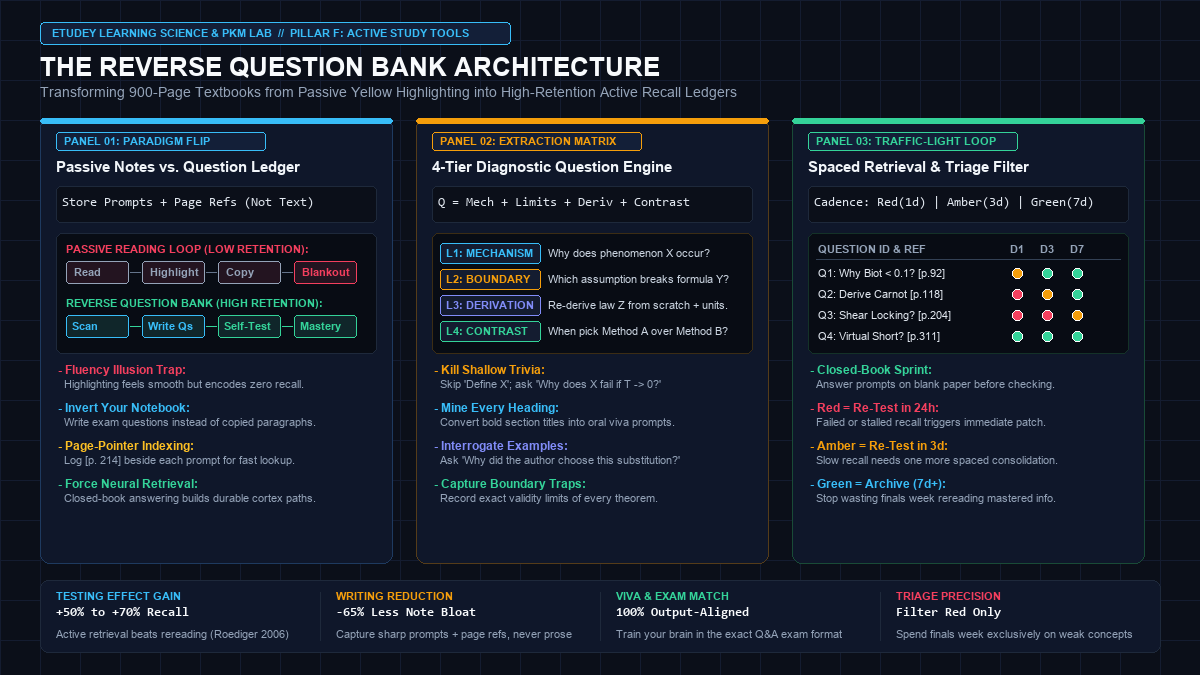
Figure 1.0: The Reverse Question Bank architecture—inverting passive textbook notes into a 4-tier diagnostic question ledger driven by a traffic-light spaced retrieval loop.
1. The 900-Page Textbook Trap: Why Yellow Highlighting Fails
Open any engineering or pre-med student's copy of Sedra & Smith, Griffiths' Electrodynamics, CLRS Algorithms, or Çengel's Thermodynamics two weeks before semester exams. Almost every second sentence is painted neon yellow. Beside the textbook sits a thick spiral notebook filled with neatly transcribed paragraphs, copied definitions, and color-coded subheadings. The student spent four exhausting hours in the hostel reading room completing a single chapter—yet when asked to close the book and derive the core theorem on a blank sheet, their mind goes completely blank.
Cognitive psychology has exposed this exact phenomenon for decades. In a landmark meta-analysis published in Psychological Science in the Public Interest, Professor John Dunlosky and colleagues ranked ten common study techniques across hundreds of controlled experiments. Highlighting, underlining, and rereading passive summaries ranked dead last in utility.
Why do traditional notes sabotage exam performance? Because traditional note-taking trains your brain in the wrong direction:
- Input vs. Output Mismatch: Textbooks and summary notes feed information into your eyes (encoding). Final exams, lab vivas, and technical interviews demand pulling information out of your cortex under time pressure (retrieval).
- The Fluency Illusion: When you reread your own neatly rewritten paragraphs, the phrasing feels familiar. Your brain misinterprets visual familiarity as genuine comprehension—an illusion explored deeply in our Active Recall vs. Passive Rereading Evidence Guide.
- Massive Note Bloat: Copying 40 pages of dense technical text into 15 pages of handwritten summaries creates a second miniature textbook that you never actually have time to reread before finals—especially when juggling 75% attendance rules and weekly lab submissions.
The solution is not taking prettier notes. The solution is inverting your notebook completely using the Reverse Question Bank.
2. What Is a Reverse Question Bank?
In traditional note-taking, your notebook stores answers without questions. When you review before an exam, your eyes passively glide over the answers, giving your brain zero reason to struggle or strengthen synaptic pathways.
In a Reverse Question Bank (RQB), your notebook stores ONLY high-precision diagnostic questions plus compact page pointers—never copied textbook paragraphs. Every heading, theorem, assumption, and worked example you read is immediately converted into a ruthless exam prompt logged in a clean ledger:
Sample Reverse Question Bank Entry (Thermodynamics Ch. 6)
[Q6.1 | p. 294] Why is it physically impossible to build a 100% efficient heat engine even with zero friction?
[Q6.2 | p. 301] Derive Carnot thermal efficiency η = 1 - T_L/T_H and state the exact temperature unit trap.
[Q6.3 | p. 308] When does the Clausius inequality integral ∮(dQ/T) equal zero vs. strictly negative?
Notice what just happened: instead of writing 600 words summarizing the Second Law of Thermodynamics, you wrote 55 words of surgical exam interrogation. The answers already exist inside the textbook (indexed cleanly via `[p. 294]`) or inside your own closed-book derivations. Every single time you open your notebook from this moment onward, you are physically forced to engage in Retrieval Practice.
"Testing is not merely a neutral assessment tool to measure what has been learned; the act of retrieving information from memory directly alters memory itself, producing far greater long-term retention than repeated studying." — Dr. Henry L. Roediger III & Dr. Jeffrey D. Karpicke, Psychological Science (2006)
3. Comparing Study Systems: Why the Question Ledger Wins
Before adopting the protocol across your courses, examine how the Reverse Question Bank compares structurally against traditional college study habits:
| Study Method | Cognitive Mechanism | Writing Time / Chapter | 7-Day Recall Rate | Finals Triage Speed |
|---|---|---|---|---|
| Yellow Highlighting | Passive visual selection | 15 mins | ~15% – 20% | Terrible (must reread whole book) |
| Verbatim Summary Notes | Low-effort transcription | 2.5 – 4 hours | ~25% – 35% | Slow (massive bloated binder) |
| Standard Flashcards | Atomic fact retrieval | 1.5 hours | ~65% – 75% | Fast for facts; weak for big proofs |
| Reverse Question Bank | Deep conceptual & derivation recall | 35 – 50 mins | ~80% – 90%+ | Instant (filter Red rows only) |
4. The 4-Tier Question Extraction Matrix (How to Write Killer Prompts)
The biggest mistake beginners make when trying question-based notes is writing lazy, low-level trivia prompts like "What is Bernoulli's equation?" or "Define a Karnaugh map." University engineering exams and oral vivas rarely reward dictionary definitions—they test physical causality, hidden assumptions, derivations, and transfer to novel geometries.
As you read each textbook subsection (combining seamlessly with the scanning phase of our SQ3R Method for STEM Textbooks), deliberately extract questions across all four cognitive tiers:
- Level 1 — Core Physical Mechanism ("Why"): Interrogate the underlying cause rather than the label.
- Weak prompt: "What is virtual ground in an op-amp?"
- RQB prompt: "Why does negative feedback force the inverting pin to sit at 0V without drawing current into the chip? [p. 74]"
- Level 2 — Boundary Conditions & Failure Modes ("When Does It Break?"): Every engineering equation hides fine-print assumptions. Professors love building trick problems that violate one assumption.
- Weak prompt: "Write the lumped capacitance formula."
- RQB prompt: "Why does the lumped capacitance cooling model fail when the Biot number exceeds 0.1? [p. 212]"
- Level 3 — Blind Derivation & Worked-Example Logic ("How"): Never copy a 12-line textbook derivation. Instead, ask yourself to reconstruct the critical pivot step from scratch.
- RQB prompt: "In Example 4.3, why did the author apply KCL at the supernode instead of mesh analysis, and how do the signs cancel? [p. 148]"
- Level 4 — Contrast & Synthesis ("A vs. B"): Force your hippocampus to discriminate between easily confused concepts.
- RQB prompt: "Compare linear TET4 vs. quadratic TET10 elements under thin-wall bending: which suffers shear locking and why? [p. 389]"
5. Step-by-Step Workflow: Turning a 40-Page Chapter into a Recall Engine in 60 Minutes
Follow this exact four-step cycle the next time you open an intimidating STEM textbook chapter:
Step 1: Structural Pre-Scan (5 Minutes)
Flip through the entire chapter before reading paragraph one. Look strictly at bold section titles, boxed theorems, diagram captions, and the end-of-chapter summary. Open a blank ledger inside Etudey Interactive Notes and convert every major section heading directly into a skeleton Level-1 question. Your brain now enters the reading session in active hunter mode rather than passive grazing mode.
Step 2: Deep Read & Prompt Extraction (35 Minutes)
Read one subsection at a time with your pen down. Resist the reflex to highlight sentences mid-paragraph! Only after finishing the entire subsection (typically 1 to 2 pages), pause for 60 seconds and ask: "If I were the professor writing a brutal 10-mark exam question or lab viva trap from these two pages, what would I ask?" Write 2 to 3 crisp Level-1 through Level-4 questions into your Reverse Question Bank alongside the exact textbook page number `[p. XX]`.
Step 3: Immediate Closed-Book Retrieval Pass (15 Minutes)
Close the textbook completely. Open a clean canvas in Etudey Handwriting Studio and answer your freshly written questions purely from memory—sketching diagrams, deriving equations, and speaking explanations aloud using the Feynman Technique. You will feel uncomfortable friction—that friction is the exact biological signal of synaptic myelination.
Step 4: The Traffic-Light Confidence Audit (5 Minutes)
Reopen the textbook strictly to grade your closed-book output. Next to every question in your ledger, stamp a colored status dot under Review Column 1 (`D1`):
RED (Failed / Blanked Out): You could not answer, dropped a critical assumption, or stalled mid-derivation. Mandatory re-test within 24 hours.
AMBER (Hesitated / Partial Recall): You eventually reached the answer, but slowly or with minor sign/unit uncertainty. Schedule re-test in 3 days.
GREEN (Fluent & Unassisted): You explained the physical intuition, stated boundary limits, and nailed the derivation cleanly. Archive for 7–14 days.
6. The Magic of Finals Week: Filtering Strictly by Red Rows
Fast-forward three weeks to final exams. Your classmates are staring in horror at five 800-page textbooks and 300 pages of disorganized notes, frantically rereading chapters they already half-know just to calm their nerves.
You open your Reverse Question Bank across all five courses. Because every chapter has been distilled into 15 to 25 razor-sharp questions tracked across `D1`, `D3`, and `D7` columns, you simply filter out every Green row. Suddenly, an overwhelming 4,000-page semester shrinks down to the exact 45 Red and Amber questions where your understanding is genuinely fragile. You spend 100% of your final 72 hours surgically converting those remaining Red rows into Green—achieving maximum grade return per minute with zero wasted rereading.
7. Integrating Your Reverse Question Bank Inside Etudey
While a paper notebook works, managing hundreds of questions, page pointers, and traffic-light spaced dates across five engineering courses is dramatically faster inside a unified digital workspace:
- Build Master Ledgers in Etudey Interactive Notes: Create one structured Question Bank per subject with collapsible page references and instant search across chapters.
- Run Closed-Book Derivations in Handwriting Studio: Answer your Level-3 derivation prompts freehand on an infinite digital canvas without wasting stacks of scratch paper.
- Unstick Persistent Red Questions with AIgom Problem Solver: If a prompt stays Red across two consecutive reviews, paste the exact question into AIgom for a first-principles breakdown of the missing conceptual bridge.
- Automate Atomic Prompts on Etudey Flashcards & Study Kanban: Push quick Level-2 boundary traps into spaced flashcards and track chapter Question Bank completion across your semester sprint board.
Frequently Asked Questions
Should I write the answers inside my Reverse Question Bank, or leave them out?
For textbook chapters, leave out long written answers and record only the textbook page number (`[p. 214]`) or a 1-line numerical checkpoint. Hiding the answer prevents your eyes from accidentally glancing down and spoiling active retrieval, while slashing note-taking time by over 65%. Only store full custom answers if the explanation came from a professor's verbal lecture not found in the book.
How many questions should I extract from a typical 30-to-40-page engineering textbook chapter?
Aim for 15 to 25 high-leverage diagnostic questions per chapter (roughly 2 to 3 questions per major subsection). If you write 90 questions per chapter, you are capturing trivial micro-facts instead of core physical mechanisms, boundary limits, and derivations—which creates review burnout.
How is a Reverse Question Bank different from Cornell Notes or Anki flashcards?
Cornell Notes still devote 70% of the page to passive written summaries, whereas a Reverse Question Bank eliminates passive prose entirely. Compared to Anki flashcards—which excel at 5-second atomic vocabulary or formula recall—a Reverse Question Bank shines at multi-step engineering derivations, free-body sketches, and deep oral viva questions that require 3 to 5 minutes of blank-page reasoning.
Does this method work for heavy mathematics and numerical problem-solving courses?
Yes—it is especially powerful for math and physics. Instead of copying worked examples line by line, log the problem archetype, the exact strategic trigger ("Why use Laplace transform instead of undetermined coefficients here?"), and the tricky boundary step. During closed-book review, re-solve the benchmark problem blind without peeking at the solution manual.
What if a question feels too hard to answer during my very first review pass?
Struggling and failing on your first retrieval attempt is actually beneficial—cognitive researchers call this the pretesting effect. Attempting to recall an answer before checking `[p. XX]` primes your brain to encode the correction far more deeply than passive reading ever could. Simply mark the row Red, study the exact gap, and re-test 24 hours later.
Ditch Passive Highlighting & Build Your First Question Bank Today
Turn your hardest 900-page semester textbook into a precision active recall engine. Organize question ledgers in Interactive Notes, test derivations in Handwriting Studio, and resolve Red traps instantly with AIgom.