
An effective 1-page exam formula sheet is a spatially chunked external working memory grid, not a microscopic archive of lectures. By organizing formulas into a 4-quadrant layout, tagging every shortcut with explicit physical boundary conditions, and embedding 3-step decision flowcharts for trick problem archetypes, students eliminate visual search latency and prevent catastrophic exam calculation traps.
The Illusion of the "Microscopic Cheat Sheet": Why Cramming More Equations Guarantees Worse Exam Performance
In undergraduate STEM, medical, and quantitative commerce courses across the globe, few announcements bring as much instant relief—and subsequent academic disaster—as the professor’s syllabus policy: "For the midterm and final examinations, students are permitted one single A4 sheet of paper, front and back, containing handwritten notes and formulas."
Immediately, an instinctive ritual unfolds across college hostel rooms and study halls. Students purchase ultra-fine 0.3mm mechanical pencils or micro-point gel pens. Over the course of twelve grueling hours before exam night, they copy down every single equation from twelve weeks of lecture slides, textbook appendices, and homework solutions. They pack the page edge-to-edge, leaving zero margins, eliminating line breaks, and writing characters barely half a millimeter tall. Some even write equations in alternating layers of red and blue ink, planning to use colored transparent plastic filters to read two different layers of notes on the same physical sheet.
This exhaustive effort is driven by a seductive cognitive bias: the belief that if an equation is physically present on your sheet of paper, you will be able to solve the exam problem that requires it. But when the three-hour timed exam begins, this microscopic transcription trap creates an acute cognitive crisis:
- Visual Search Latency: In a high-stakes exam with twenty minutes remaining, finding one specific shortcut equation in a dense sea of microscopic black scribbles takes 3 to 6 minutes of panicked scanning. Under adrenaline, your saccadic eye movements become erratic, and visual hunting consumes precious calculation time.
- The Boundary Condition Blindspot: You find the equation, but in the frantic effort to cram five hundred formulas onto the page, you omitted the three lines of text specifying the assumptions: valid only for laminar flow, ideal gases, or frictionless surfaces. You plug numbers into an equation that violates the fundamental physics of the problem, guaranteeing zero marks.
- Variable Semantic Confusion: When variable names collide—where the symbol \(k\) appears simultaneously as the spring constant, thermal conductivity, Boltzmann's constant, and reaction rate—a crowded sheet offers zero context. You substitute the wrong constant and compound arithmetic errors across subsequent derivation sub-parts.
- Cognitive Paralysis (Split-Attention Effect): Trying to decipher tiny handwriting while simultaneously holding intermediate algebraic terms in short-term working memory overloads the prefrontal cortex, precipitating a sudden exam blankout.
Cognitive ergonomics and educational psychology demonstrate that a formula sheet is an external working memory indexing system, not an external hard drive. Top-performing students in engineering, physics, and mathematics treat the preparation of a 1-page crib sheet as a high-level distillation exercise. The sheet is not designed to replace understanding—it is engineered to provide lightning-fast, error-free retrieval of critical anchors under extreme temporal stress.
Cognitive Ergonomics & Working Memory Under Exam Stress: How Cortisol Destroys Visual Search
To design a formula sheet that actually functions under exam conditions, you must understand how stress impacts human cognitive architecture. When you enter an examination hall, your autonomic nervous system responds to high stakes by activating the sympathetic branch. Cortisol and norepinephrine flood the bloodstream. While moderate arousal sharpens focus, severe time pressure triggers tunnel vision and severely constricts working memory capacity.
"Human working memory can hold only 4 to 7 discrete chunks of novel information simultaneously. Under acute evaluation pressure, cognitive bandwidth contracts further. If your external memory aid requires significant cognitive processing simply to locate or interpret an entry, it ceases to be an aid and becomes an active source of extraneous cognitive load."
— Cognitive Load Theory in Technical Problem Solving
When an unorganized, microscopic cheat sheet is placed on the desk, the student experiences severe visual search latency. Because the sheet lacks clear visual anchors, borders, and spatial chunking, the student's gaze flits randomly across hundreds of indistinguishable lines of text. This visual hunting induces panic, raising cortisol levels further and degrading executive function. By contrast, a sheet designed according to principles of spatial contiguity and cognitive chunking allows the brain's visual cortex to instantly identify the relevant quadrant based on color, geometry, and position.
The 4-Quadrant Architecture: Designing an External Working Memory Grid
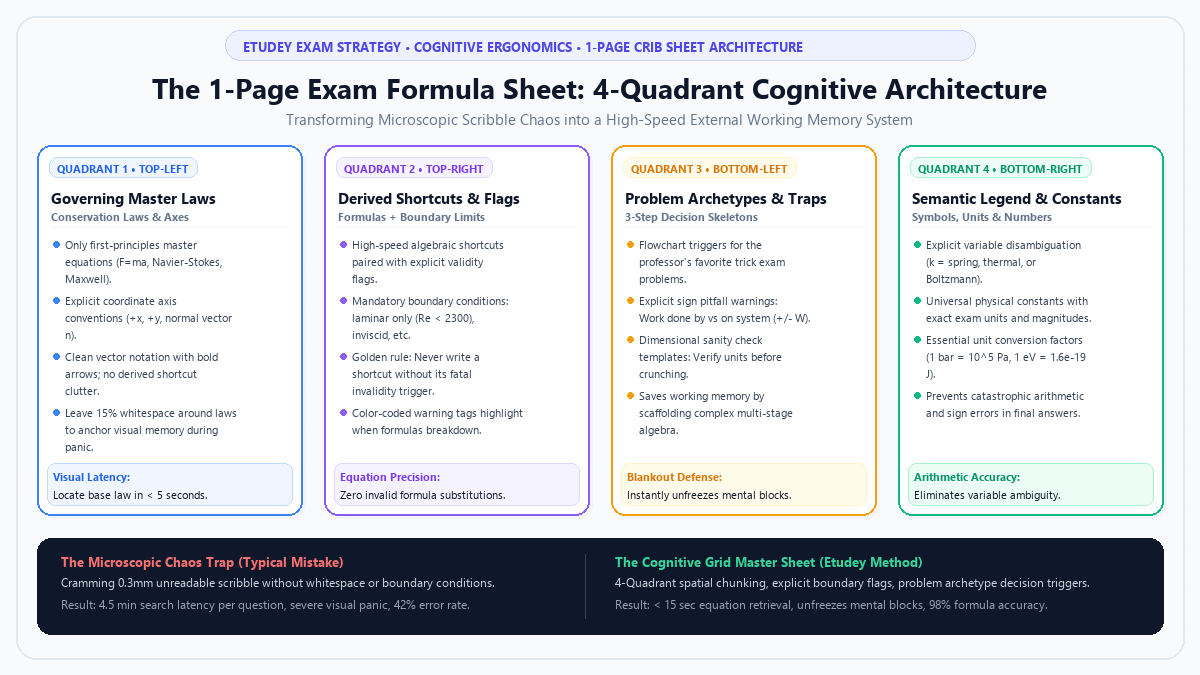
The core innovation of the Etudey Crib Sheet System is the 4-Quadrant Spatial Grid. Rather than writing linearly from top-to-bottom or chronologically by lecture date, divide both sides of your standard A4 paper into four distinct, dedicated functional zones. Each quadrant serves a specific, non-overlapping cognitive purpose during problem solving.
Quadrant 1 (Top-Left): The Governing Master Laws & Coordinate Conventions
The top-left quadrant is the bedrock of the entire subject. It contains exclusively first-principles governing equations, vector definitions, and coordinate system conventions. If you are preparing a sheet for Fluid Mechanics, this quadrant houses the differential and integral forms of Continuity, Navier-Stokes, and Energy. For Electromagnetism, it contains Maxwell's four equations in differential and integral forms. For Dynamics, it contains Newton's Second Law (\(\sum \mathbf{F} = m\mathbf{a}\)) and Euler's rotational equations.
Crucially, Quadrant 1 must preserve 15% whitespace. Do not pack this area with derived shortcuts. Its purpose is to provide an unmistakable visual anchor. Whenever a problem on the exam paper appears completely unfamiliar or does not match any standard textbook template, your eyes immediately travel to Quadrant 1. From these foundational laws, you can set boundary conditions and derive the specific solution from first principles, ensuring you never sit paralyzed when an unexpected problem appears.
Always draw a small, explicit coordinate diagram in this quadrant: define positive sign conventions for Cartesian (\(+x, +y, +z\)), Cylindrical (\(r, \theta, z\)), or Spherical (\(r, \theta, \phi\)) systems, alongside normal vector conventions (\(\mathbf{\hat{n}}\) pointing outwards from closed control volumes). Over 40% of sign errors in university physics and engineering exams stem from mixing sign conventions midway through a multi-page derivation.
Quadrant 2 (Top-Right): Derived Shortcuts & Mandatory Boundary Condition Flags
While Quadrant 1 provides safety and foundational rigor, time limits require computational speed. Quadrant 2 is dedicated to high-speed algebraic shortcuts—equations derived from master laws under specific, frequent engineering assumptions. Examples include the Hagen-Poiseuille equation for pipe flow, the Bernoulli streamline relationship, simplified beam deflection formulas, or standard RC/RL circuit transient time constants.
However, Quadrant 2 enforces the Mandatory Boundary Condition Rule: Never write an algebraic shortcut without writing its fatal breakdown criteria directly next to it in an outlined warning box. For instance:
- Bernoulli Equation: \(\left(P + \frac{1}{2}\rho v^2 + \rho g z = \text{const}\right)\) \(\rightarrow\) [FLAG: Incompressible, Inviscid, Steady, Along a Streamline Only!]
- Hagen-Poiseuille Flow: \(\left(Q = \frac{\pi \Delta P R^4}{8 \mu L}\right)\) \(\rightarrow\) [FLAG: Laminar Flow Only, \(Re < 2300\), Fully Developed, Circular Pipe!]
- Hooke's Law: \((\sigma = E \epsilon)\) \(\rightarrow\) [FLAG: Linear Elastic Regime Only, Below Yield Strength \(\sigma_y\)!]
By visually coupling the equation with its physical boundaries, you eliminate the single most common cause of exam failure: applying a specialized formula to a general case where the underlying physical assumptions are violated.
Quadrant 3 (Bottom-Left): Problem Archetype Skeletons & Pitfall Traps
Professors rarely invent brand-new concepts for final exams; instead, they design problems around classic problem archetypes with deliberate traps built in. Quadrant 3 is reserved for 3-step decision flowcharts and structural solution skeletons for the course's most notorious trick questions.
Instead of copying entire worked numerical examples (which wastes vast amounts of space and provides zero generalizable utility), write condensed decision logic. For example, in an Engineering Thermodynamics exam:
- Turbine / Compressor Archetype: 1) Steady flow energy equation \(\rightarrow\) 2) Adiabatic assumption (\(q = 0\)) \(\rightarrow\) 3) Check isentropic efficiency (\(\eta_t = w_a / w_s\)).
- Common Trap: Work output is positive for turbines, but work input is negative for compressors (\(w < 0\)). Watch out for gauge pressure vs. absolute pressure (\(P_{\text{abs}} = P_{\text{gauge}} + P_{\text{atm}}\)).
These compact skeletons act as cognitive scaffolding. When you read a complex, multi-paragraph exam prompt, looking at Quadrant 3 immediately deconstructs the problem into a sequential execution pipeline, eliminating mid-exam blankouts.
Quadrant 4 (Bottom-Right): Semantic Symbol Legend, Universal Constants & Conversion Sanity Checks
The bottom-right quadrant is your precision safety net. It contains three critical components that prevent self-inflicted grade loss:
- The Disambiguation Legend: Clearly list symbols that share letters across different textbook chapters. For instance:
- \(k_s\) = Spring constant (\(\text{N/m}\))
- \(k_t\) = Thermal conductivity (\(\text{W/(m}\cdot\text{K)}\))
- \(k_B\) = Boltzmann's constant (\(1.3806 \times 10^{-23} \text{ J/K}\))
- Universal Physical Constants with Full Units: List the exact numeric values and units required by your course (e.g., \(g = 9.81 \text{ m/s}^2\), universal gas constant \(R_u = 8.314 \text{ kJ/(kmol}\cdot\text{K)}\), permittivity of free space \(\epsilon_0 = 8.854 \times 10^{-12} \text{ F/m}\)).
- Conversion Factors & Dimension Sanity Checks: Key conversions that frequently appear in problems (e.g., \(1 \text{ bar} = 10^5 \text{ Pa}\), \(1 \text{ poise} = 0.1 \text{ Pa}\cdot\text{s}\), \(1 \text{ eV} = 1.602 \times 10^{-19} \text{ J}\)). Include fundamental dimensional combinations so you can quickly perform dimensional analysis when uncertain about an algebraic exponent.
| Design Dimension | The Microscopic Scribble Trap | The 4-Quadrant Cognitive Grid | Cognitive Impact Under Exam Stress |
|---|---|---|---|
| Spatial Organization | Linear, chronological stream of text; zero whitespace; microscopic unbordered formulas. | Strict 4-quadrant functional chunking; bold geometric borders; 15% dedicated whitespace. | Reduces visual search latency from ~4.5 minutes down to less than 15 seconds. |
| Assumptions & Limits | Omitted entirely to save paper space; only raw algebraic relations copied. | Mandatory boundary condition flags coupled directly to every derived equation. | Prevents catastrophic physical invalidity errors (e.g. applying Bernoulli to viscous flow). |
| Problem Solving Support | Random full numerical solutions copied from past homework; zero generalizable logic. | 3-step decision flowcharts, archetype execution skeletons, and common trap callouts. | Scaffolds working memory; unfreezes panic when confronting complex multi-stage problems. |
| Variable Disambiguation | No variable definitions; identical letters (\(k, \mu, \rho\)) create massive confusion. | Dedicated semantic legend specifying exact meaning, subscripts, and SI units. | Eliminates wrong-constant substitution errors and arithmetic failure across sub-questions. |
| Preparation Method | Passive, late-night transcription copied directly from lecture slides on exam eve. | Active 3-stage iterative synthesis: draft \(\rightarrow\) battle-test in mock exam \(\rightarrow\) final sheet. | Forces active recall and metacognitive pruning; 80% of knowledge is mastered during synthesis. |
| Retrieval Ergonomics | Requires reading text line-by-line with a ruler or magnifying eye tracking. | Instant pre-attentive visual recognition guided by color coding and spatial quadrant cues. | Preserves prefrontal working memory for problem calculation rather than visual hunting. |
The 3-Draft Iterative Protocol: How Top Students Actually Build Their Crib Sheet
The greatest misconception regarding formula cheat sheets is that they should be written in a single sitting the night before the exam. Elite scholars understand that the value of a crib sheet lies in the act of synthesis, not the final physical paper. If someone hands you a beautifully typeset crib sheet created by the top student in your class, it will be virtually useless to you under exam conditions because your brain lacks the neural memory trace of deciding what to include, what to discard, and where each equation lives.
To achieve exam mastery, follow the 3-Draft Iterative Protocol over the four days leading up to your exam:
Phase 1: The Raw Synthesis Condensation Draft (Post-Syllabus Audit)
Four days before the exam, gather your lecture notes, textbook chapters, and tutorial sheets. Take two blank sheets of lined notebook paper. Walk through each syllabus unit and write down every single equation, definition, and concept that you feel you might need. Do not worry about neatness, micro-writing, or space constraints. This initial unfiltered list typically runs 4 to 6 pages long. As you write, consult the Etudey Notes Archive to cross-reference verified peer lecture summaries and identify recurring semester exam question patterns.
Now, perform the first deliberate pruning pass. Group every equation into one of three categories: Fundamental Master Law (belongs in Quadrant 1), Derived Shortcut (belongs in Quadrant 2), or Redundant/Trivial (must be permanently deleted). If an equation is simply basic algebra that you can derive in three seconds (such as \(v = u + at\)), strike it off immediately. It has no place on a high-speed reference sheet.
Phase 2: The Battle-Testing Mock Exam Simulation (Stress-Testing the Sheet)
Two days before the exam, transfer your pruned formulas into a rough, penciled 4-Quadrant layout on a single sheet of paper. Now comes the critical step that 95% of students skip: you must battle-test your draft under strict, timed mock exam conditions.
Take an unattempted Previous Year Question (PYQ) paper or mock midterm. Clear your desk of all textbooks, laptops, and solution manuals. Place only your rough draft crib sheet, your calculator, and blank paper in front of you. Set a timer for 60 minutes and solve the questions at maximum speed.
During this simulation, you will immediately discover the operational weaknesses of your sheet:
- Did you spend two minutes searching for an equation? Its spatial location is unintuitive—move it to a prominent anchor position.
- Did you reach a problem where you had the formula but didn't know how to initiate the first algebraic substitution? You need a 3-step decision skeleton in Quadrant 3.
- Did you calculate a numerical answer with the wrong units? Add the missing conversion factor to Quadrant 4.
- Did you not look at certain equations even once? Delete them to create more whitespace.
If you encounter a derivation step or boundary condition you don't fully understand during this mock test, paste the problem into AIgom. Ask the AI tutor to break down the underlying physical assumptions and pinpoint the exact boundary criteria required for that formula.
Phase 3: The High-Resolution Master Sheet (Handwriting Studio & DPI Optimization)
Twenty-four hours before the exam, construct your final, permanent sheet. While paper and pen work, using a digital vector canvas such as the Etudey Handwriting Studio provides immense technical advantages:
- Lossless Vector Scaling: You can zoom in to write exceptionally clear, high-legibility mathematical equations with perfectly formed superscripts, subscripts, and integral limits, then zoom out to verify overall quadrant balance.
- Color-Coded Semantic Layering: Use blue ink for governing laws, purple for shortcuts, amber for problem skeletons, red for boundary warning flags, and green for constants and units. Under exam pressure, your visual cortex processes color cues in less than 50 milliseconds.
- High-DPI Laser Printing: Export your completed digital canvas as a vector PDF and print it on high-grade 100 GSM paper using a 1200 DPI laser printer. The resulting sheet is razor-sharp, perfectly legible from normal reading distance, and completely free from smudged gel ink or graphite eraser residue.
The Five Fatal Crib Sheet Mistakes That Cost STEM Students Top Grades
Even when students attempt to organize their formula sheets, common traps undermine their performance. Ensure your final sheet avoids these five fatal mistakes:
- Writing Full Derivations Instead of Key Transition Steps: Copying a 15-line algebraic derivation from a textbook is a colossal waste of real estate. Only record the starting governing law, the critical substitution or mathematical trick (e.g., "integrate by parts with \(u = \ln x\)" or "apply separation of variables \(T(x,t) = X(x)\Theta(t)\)"), and the final result.
- Omitting Boundary Conditions and Assumptions: As highlighted in Quadrant 2, a formula without its valid domain is a liability. Stating that the Reynolds number is \(Re = \rho v D / \mu\) without specifying the transition thresholds (\(Re < 2300\) for laminar pipe flow vs. \(Re < 5 \times 10^5\) for flat plate flow) leads to catastrophic errors.
- Using Multiple Conflicting Notations: If your professor uses \(u\) for velocity while your textbook uses \(v\), or your professor uses \(j\) for imaginary numbers while your engineering calculator uses \(i\), harmonize your entire formula sheet to match your professor's exact grading notation. Never force your brain to translate variable names during a timed test.
- Zero Whitespace (The Wall of Text): When every square millimeter of paper is covered in ink, your brain's visual edge-detection neurons cannot segment the page. Maintain distinct 3mm blank borders between quadrants and 2mm margins around critical formula boxes. Whitespace is not wasted space—it is visual processing bandwidth.
- Bringing an Untested Sheet: Writing a sheet for the first time at 2:00 AM on exam morning guarantees that you will not know where your own notes are located. A formula sheet must be an extension of your existing memory, which requires at least one full timed practice session.
Frequently Asked Questions
Is it better to write an exam formula sheet by hand or type it in LaTeX?
While a typeset LaTeX sheet looks exceptionally neat and allows dense mathematical formatting, cognitive science strongly favors handwriting your sheet—either on paper or digitally using a stylus in Etudey Handwriting Studio. The physical act of writing triggers deep motor memory encoding and forces active spatial deliberation. Furthermore, many university exam boards and engineering departments explicitly mandate that formula sheets must be handwritten in the student's own handwriting to prevent students from simply printing someone else's document. Always check your course syllabus rules beforehand.
How do I decide which formulas to leave off the sheet when space runs out?
Apply the Three-Tier Priority Filter: Tier 1 (Must Include) consists of complex formulas with high arbitrary constant counts, multi-term signs, and tricky exponents that cannot be deduced intuitively under stress. Tier 2 (Include If Space Permits) consists of derived shortcut equations that save calculation time on common exam archetypes. Tier 3 (Leave Off) consists of foundational relations that you have solved so many times in problem sets that they are automated in long-term memory (e.g., basic trigonometric identities, Ohm's Law, or basic integration rules). If you can derive an equation from a Tier 1 law in under fifteen seconds, omit it.
What should I do if my professor allows open-book instead of a 1-page sheet?
Counter-intuitively, open-book exams are far more dangerous than closed-book exams because students assume they do not need to study. In an open-book exam, flipping through an 800-page textbook will cause you to run out of time on question three. Treat an open-book exam exactly like a closed-book exam: create the identical 1-Page Cognitive Grid crib sheet and tape it to the front cover of your textbook or notebook. Use the textbook only for complex empirical lookup tables (such as steam tables or Moody friction factor charts). For detailed strategies, read our guide on Open-Book Engineering Exam Indexing Protocols.
How can I test if my crib sheet is actually effective before exam day?
Use the "Blind Retrieval Stress Test". Have a study partner or use AIgom to select three random past exam problems from different syllabus units. Read each problem statement, start a stopwatch, and find the corresponding governing law, boundary conditions, and solution skeleton on your crib sheet. If your finger cannot land on the correct equation within 12 seconds, your spatial indexing has failed. Reorganize the quadrant, increase visual contrast with bold color framing, or eliminate surrounding text clutter until retrieval is instantaneous.
Can I use this 4-Quadrant system for non-mathematical subjects like Biology or Law?
Yes. The 4-Quadrant architecture is a general cognitive framework for external working memory. In Law, Quadrant 1 holds foundational statutory articles and constitutional clauses; Quadrant 2 holds legal doctrines with mandatory jurisdictional exceptions; Quadrant 3 holds landmark case precedent skeletons and test criteria; and Quadrant 4 holds legal Latin terminology definitions and procedural filing timelines. In Biology or Pharmacology, adapt the quadrants to Primary Physiological Pathways, Drug Classes with Contraindications, Clinical Decision Algorithms, and Receptor Subtypes with Normal Reference Values.
Build Your Ultimate Exam Reference Sheet
Eliminate exam blankouts, visual panic, and formula confusion. Design clean, spatially chunked, high-DPI formula reference sheets with Etudey's free digital handwriting studio, verified semester note archives, and step-by-step AI derivation tutor.