
An Engineering Error Log is a systematic post-mortem tracking protocol that treats every numerical, sign, or algebraic calculation slip not as bad luck or a “silly mistake,” but as an operational system failure requiring root-cause classification, preventive checklists, and targeted behavioral firewalls.
Every engineering, physics, and applied mathematics student knows the bitter ritual of post-exam debriefs. You walk out of an Advanced Thermodynamics, Structural Analysis, or Vector Calculus mid-term feeling confident you set up every differential equation correctly. Then the graded blue books are returned. You didn’t lose twenty marks because you failed to grasp the Navier-Stokes equations, Mohr’s Circle, or Laplace transforms. You lost twenty marks because in step four of problem three, you dropped a negative sign when expanding parentheses; because you evaluated a sine function with your scientific calculator locked in radian mode instead of degrees; or because you transposed a diameter of $0.045\text{ m}$ into $0.054\text{ m}$ when copying values onto your scratch sheet.
The universal student reaction to this heartbreak is tragic in its predictability: a shrug, a sigh, and the dismissive verdict: “It was just a silly mistake. I understood the concept, so I’ll get it right next time.”
This single rationalization is the most expensive cognitive trap in technical education. In professional aerospace engineering, nuclear operations, and biomedical device manufacturing, there is no such category as a “silly mistake.” When an O-ring burns through, a rudder actuator jams, or Mars Climate Orbiter disintegrates because Lockheed Martin calculated thrust in pound-force seconds while NASA calculated in Newton-seconds, no engineer is permitted to say, “It was just a careless slip.” It is classified as an unmitigated operational catastrophe born of inadequate verification architecture.
If you want to permanently plug the 15% to 25% grade leak draining your GPA, you must abandon the emotional label of “carelessness” and implement the exact investigative discipline used by aviation safety boards: The Black-Box Engineering Error Log Protocol.
The Cognitive Psychology of “Silly Mistakes”
To stop committing calculation errors, you must understand their cognitive etiology. Working memory in human adults has a strictly constrained bandwidth. According to cognitive load theory, your brain can juggle approximately four discrete operational chunks simultaneously in focal working memory during complex analytical tasks.
When you solve a multi-step engineering problem—such as calculating the shear stress distribution in an asymmetric I-beam under combined bending and torsion—your working memory is stretched to maximum capacity. You are simultaneously holding:
- The governing physical law and free-body equilibrium equations ($\Sigma F = 0, \Sigma M = 0$).
- The geometric coordinates, centroidal axes, and second moments of area ($I_{xx}, I_{yy}, I_{xy}$).
- The algebraic substitution sequences required to isolate the unknown reaction forces.
- The active execution of arithmetic operations on your calculator or scratchpad.
When working memory undergoes cognitive saturation, the prefrontal cortex sheds autonomic vigilance. The brain subconsciously delegates lower-level arithmetic operations to procedural memory while directing active executive attention toward conceptual strategy. It is in this operational blind spot that signs flip, exponents vanish, and unit prefixes shift by orders of magnitude. Calculation slips are not moral failures of willpower; they are mechanical memory overruns.
“The volume and complexity of what we know have exceeded our individual ability to deliver its benefits correctly, safely, or reliably. Knowledge has both saved us and burdened us. That means we need a different strategy: a systematic discipline that guards against our own inevitable cognitive fragility.” — Dr. Atul Gawande, The Checklist Manifesto
The 4-Tier STEM Error Taxonomy
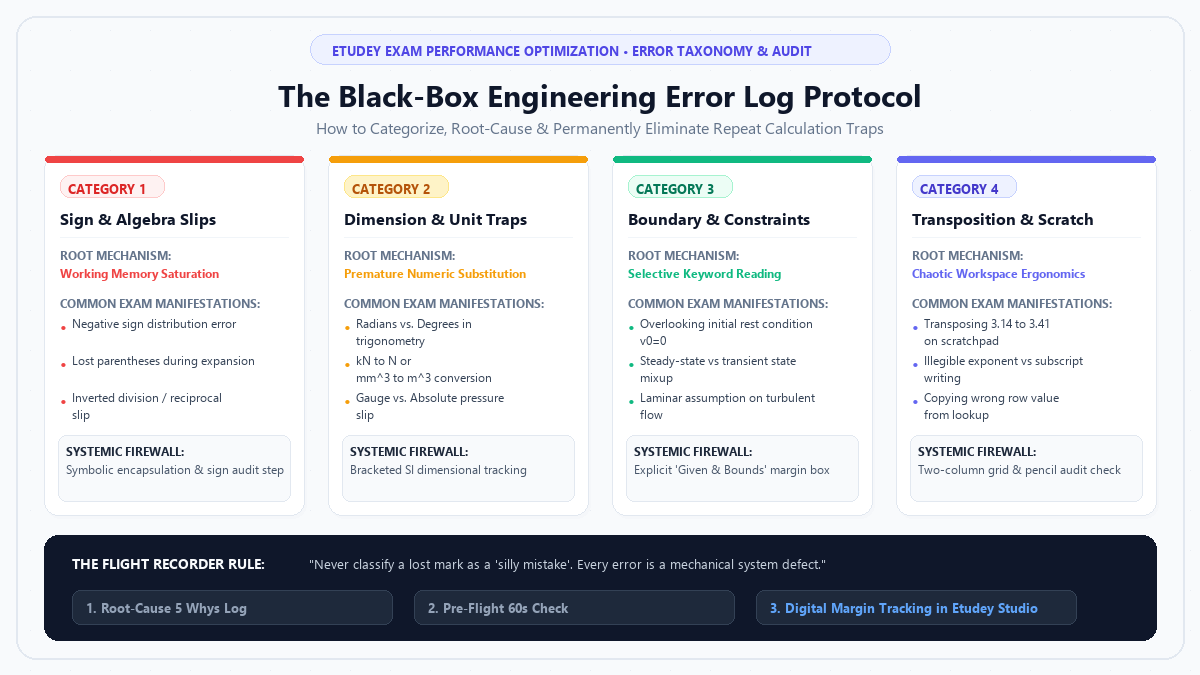
The core breakthrough of an Engineering Error Log is moving from vague emotional frustration to precise morphological taxonomy. Every error you make during practice problem sets, weekly assignments, or mock examinations must be dissected into one of four mutually exclusive structural categories:
Category 1: Sign & Algebraic Traps (Working Memory Saturation)
These errors occur entirely during the intermediate symbolic manipulation phase before numerical values are substituted. Classic manifestations include:
- Failing to distribute a negative sign across all terms inside a bracket: $- (3x - 4y + 2) \to -3x - 4y + 2$.
- Losing an exponent during term migration across an equals sign: $v^2 = 2gh \implies v = 2gh$.
- Dropping the constant multiplier in cross-multiplication or integration by parts.
- Confusing reciprocal division with multiplication during fraction inversion ($\frac{A}{B/C} \neq \frac{AB}{C}$).
The Systemic Firewall: The “Bracket Invariant Rule.” Never combine term migration with algebraic expansion in a single stroke. Always encapsulate grouped polynomials inside explicit brackets before operating on them.
Category 2: Dimension & Unit Traps (Premature Numeric Substitution)
Unit errors represent the single highest cause of total zero scores in STEM exams. A student performs 15 lines of flawless calculus, only to output a bridge displacement of 4.2 kilometers instead of 4.2 millimeters because modulus of elasticity was plugged in as $\text{GPa}$ ($10^9\text{ N/m}^2$) while length was left in centimeters ($10^{-2}\text{ m}$). Common traps include:
- Angle mode incongruity: Evaluating $\sin(\theta)$ or $\cos(\omega t)$ with calculator locked in radians when given degrees, or vice versa in kinematic trajectory equations.
- Volumetric and areal metric prefix scaling: Miscalculating $1\text{ m}^3$ as $10^3\text{ mm}^3$ instead of $10^9\text{ mm}^3$.
- Thermodynamic reference confusion: Forgetting to convert Celsius or Fahrenheit into Kelvin ($T_{\text{abs}} = T_C + 273.15$) in the Ideal Gas Law ($PV = mRT$).
- Gauge pressure vs. Absolute pressure omission in fluid hydrostatics ($P_{\text{abs}} = P_{\text{gauge}} + P_{\text{atm}}$).
The Systemic Firewall: Strict symbolic delay. Work purely in algebraic variables until the final step, then write out a dedicated Dimensional Bracket Equation where every single number carries its explicit physical SI units.
Category 3: Boundary & Constraint Lapses (Selective Keyword Reading)
These occur when a student rushes into calculation without codifying the physical system constraints dictated by the problem statement. Symptoms include:
- Overlooking implicit initial conditions: “A vehicle starts from rest” ($v_0 = 0$) or “an insulated rigid vessel” ($Q = 0, \Delta V = 0$).
- Applying formulas outside their valid domain: using laminar Darcy-Weisbach flow equations ($f = \frac{64}{\text{Re}}$) when the Reynolds number is $45,000$ (turbulent regime).
- Assuming standard atmospheric conditions when non-standard ambient elevation is explicitly specified.
The Systemic Firewall: The “Given & Bounds Box.” Before writing a single equation on your page, isolate a three-line boxed header cataloging Given Parameters, Boundary Conditions, and Applicable Physical Regimes.
Category 4: Transposition & Scratchpad Slips (Ergonomic Breakdown)
Transposition is a physical and spatial error caused by unorganized paper ergonomics. You calculate $R_1 = 4.87\ \Omega$ on scrap paper, glance back to your main exam sheet, and write down $R_1 = 4.78\ \Omega$. Symptoms include:
- Illegible handwriting where handwritten $z$ morphs into $2$, $t$ becomes $+$, or $u$ is mistaken for $v$.
- Subscript drifting where $C_1$ drifts upward and becomes interpreted as $C^1$ or $C$ in the next algebraic line.
- Copying a lookup value from the wrong row of a steam table, psychrometric chart, or material property appendix under exam panic.
The Systemic Firewall: The Structured Grid Protocol. Abandon unformatted scratch margins. Use structured, lined, or dotted engineering grid layouts in the Etudey Handwriting Studio to maintain distinct variable geometry and isolated calculation columns.
| Operational Dimension | Silly Mistake Dismissal | Passive Redoing Method | The Black-Box Engineering Error Log |
|---|---|---|---|
| Mental Model | Bad luck, random chance, exam fatigue | Need more generic practice problems | System defect in calculation architecture |
| Post-Exam Action | Gripes about grading, puts test in drawer | Re-reads solved solutions passively | Executes 5-Whys Root Cause Analysis into error register |
| Taxonomic Precision | Zero (all errors labeled “careless”) | Vague (“brush up on trigonometry”) | 4-Tier Category (Sign, Unit, Boundary, Transposition) |
| Pre-Exam Review | Re-reads textbook formulas and lecture slides | Skims highlighted solved examples | Studies personal Pre-Flight Error Checklist |
| Scratchpad Layout | Haphazard margins, scattered arithmetic | Unstructured blank paper scribbles | Two-column segregated ledger with visual anchors |
| Long-Term Yield | Identical errors repeated on final exams | Slow 5% gradual improvement | 15–25% permanent grade recovery in 3 weeks |
The Root-Cause 5-Whys Protocol for Calculation Mistakes
When Taiichi Ohno developed the Toyota Production System, he instituted the “5 Whys” method: whenever a machine halted or a defect appeared on the assembly line, operators were forbidden from blaming human error. They had to ask “Why?” five successive times until an underlying systemic flaw was unearthed.
Let us look at how an engineering student applies the 5 Whys to a classic mechanics exam error:
The Defect: I lost 8 marks on Question 2 because my calculated bending moment was off by a factor of 1,000.
- Why 1? Because I plugged in beam length $L = 300$ instead of $L = 0.3$.
- Why 2? Because the blueprint dimension was labeled in millimeters ($300\text{ mm}$), and I wrote down the number without its unit prefix.
- Why 3? Because I substituted numbers directly into $M_{\max} = \frac{wL^2}{8}$ without drafting an intermediate bracket equation.
- Why 4? Because I felt rushed for time and wanted to punch values into my Casio fx-991EX as fast as possible.
- Why 5 (Root System Cause)? Because I have no standardized visual rule requiring every numerical term to be written on paper with explicit SI units before calculator entry.
Notice the transformation: what initially appeared to be “I forgot it was in millimeters” is discovered to be an operational absence of an entry checkpoint. The fix is not “try harder to remember units.” The fix is a mandatory procedural checkpoint: “Never touch a calculator until all values are written in standard base SI units ($m, kg, s, N, Pa$).”
Building Your Physical and Digital Error Log
Your Error Log must be an active, living document, not a graveyard of old mistakes. You can maintain it physically in a dedicated spiral notebook or digitally inside Etudey Notes and the Etudey Kanban Board.
For every problem you miss during homework sets, past-year papers, or mock tests, document five mandatory fields:
- Problem DNA: Course code, assignment/exam number, specific topic (e.g., ME201 • Fluids • Bernoullis Equation with Head Loss).
- The Failure Mode: The exact erroneous step copied verbatim (e.g., “Wrote $+ \rho g z_2$ instead of $- \rho g z_2$”).
- Taxonomy Classification: Category 1, 2, 3, or 4.
- Root-Cause 5-Whys Summary: The core procedural failure identified during analysis.
- The Behavioral Rule (The Checklist Entry): A crisp, imperative rule designed to intercept that exact failure in future exams (e.g., “Rule #7: Set datum $z=0$ at the lowest physical elevation in the pipe network before writing Bernoulli terms”).
Track these remediation cycles using your Etudey Kanban Board: move an error from Logged to Drilled (3 Re-tests Passed) to Extinguished once you complete three consecutive problem sets without triggering the failure.
The 60-Second “Pre-Flight” Calculation Checklist
Commercial airline pilots do not rely on memory to ensure flaps are extended, fuel pumps are active, and pitot heat is on before takeoff. They run a physical checklist. Similarly, you must never hand in an engineering exam without subjecting your major calculations to a 60-second Pre-Flight Audit:
1. Order-of-Magnitude Sanity Check (Fermi Estimation)
Does the numerical output align with baseline physical reality? If you are calculating the natural frequency of a civil suspension bridge and get $1,200\text{ Hz}$, your bridge is vibrating faster than a violin string. If you calculate the velocity of water exiting a domestic garden hose and get $450\text{ m/s}$, your hose is supersonic. Run a quick rounded Fermi approximation in your head: $(3 \times 10^8) / (5 \times 10^{-7}) \approx 6 \times 10^{14}\text{ Hz}$.
2. Dimensional Homogeneity Verification
Pick the two most complex terms in your final symbolic equation before numeric substitution. Confirm their dimensional units are identical. If your equation states $v = at^2 + x$, verify the dimensions: $[a][t]^2 = (\text{m/s}^2)(\text{s}^2) = \text{m}$, which is a length, while $[v] = \text{m/s}$. The equation is dimensionally invalid on sight. You immediately know a calculus or transcription error occurred upstream without recalculating everything from scratch.
3. Extreme Boundary Value Testing
Test the extreme limits of your mathematical model. If your derived displacement equation is $x(t) = \frac{F_0}{k}(1 - \cos(\omega t))$, what happens as $t \to 0$? $\cos(0) = 1$, giving $x(0) = 0$, which matches your initial rest condition. If your formula outputs a non-zero displacement at $t=0$, you have an unintegrated constant error.
4. Sign-Polarity Physics Audit
Does the sign make physical sense within your coordinate system? If a friction force vector is pointing in the direction of motion, work is positive when energy is supposed to be dissipating, or compressive stress is labeled with a tensile positive sign, your sign convention slipped during moment balancing.
Ergonomics of the Exam Scratchpad
Over 35% of calculation mistakes are born directly of chaotic scratchpad layout. During high-stakes examinations, students treat rough work paper as an infinite landfill: equations written diagonally, calculations crammed into 2-centimeter margins, numbers floating without labels, and intermediate results scribbled across three different corners.
To eliminate transcription and transposition slips, institute the Two-Column Boxed Protocol:
- Left Column (70% Width) — The Formal Mathematical Sequence: Reserve this column strictly for step-by-step symbolic derivation and final boxed substitution equations. Keep equations strictly vertical with equals signs aligned.
- Right Column (30% Width) — The Scratchpad & Constant Ledger: Draw a vertical divider line down your page. Dedicate the right-hand column exclusively for side-arithmetic, bracket expansions, calculator intermediate logs, and explicit constant definitions ($g = 9.81\text{ m/s}^2, \mu = 1.002 \times 10^{-3}\text{ Pa}\cdot\text{s}$).
When practicing problem sets, leverage the Etudey Handwriting Studio to train yourself on structured digital engineering paper with active line grids. When studying derivations or debugging persistent problem sets, paste your calculations into AIgom for an automated forensic breakdown of where your symbolic steps deviated from standard textbook solutions.
Frequently Asked Questions
How often should I review my Engineering Error Log before an exam?
Review your compiled Error Log and its resulting “Personal Pre-Flight Checklist” exactly 24 hours and again 60 minutes before entering the examination hall. Do not solve new problems during the final hour before a test; instead, re-read your list of personal top-5 failure traps (e.g., “Watch radian mode on Q3 trigonometry,” “Check signs when expanding brackets in KVL loops”). This primes working memory to recognize and intercept your specific psychological pitfalls in real time.
Is it better to keep an error log digitally or by hand?
A hybrid approach works best. During problem sets and exam debriefs, capture handwritten screenshots of your actual calculation mistakes using the Handwriting Studio so you preserve the exact visual artifact of your handwriting breakdown. Consolidate these snapshots digitally in Etudey Notes tagged by subject and error category for instant cross-referencing and searchability.
What should I do if my mistake doesn't fit into the 4 error categories?
If an error does not fit into Sign/Algebra, Dimension/Unit, Boundary/Condition, or Transposition, it is almost certainly a Conceptual Knowledge Gap (e.g., you did not understand the underlying physical principle or picked the wrong governing theorem). A Conceptual Gap is not a calculation error; it requires returning to primary textbook derivations and syllabus lecture notes rather than error checklist logging.
How many problems do I need to log before seeing results?
Most STEM students experience an immediate 10% to 15% reduction in calculation slips within logging just 15 to 20 past exam mistakes. The reason is psychological: once you realize you have a chronic tendency to invert negative signs on line three of integration by parts, your executive attention automatically triggers an internal alarm every time you write a minus sign in an integral.
Can I use this error log method for multiple-choice and competitive exams?
Yes. In fact, multiple-choice competitive exams (such as GATE, FE/PE, GRE, or AP Physics) deliberately design wrong answer choices based on the exact 4-tier error taxonomy described here (e.g., one wrong choice reflects a radian mode slip, another reflects a dropped negative sign). By maintaining an Error Log, you learn to reverse-engineer test questions and immediately spot distractor traps designed to catch unwary students.
Stop Leaving Your Hard-Earned GPA to Luck
Engineering is the science of designing redundant, fail-safe systems to prevent predictable human errors. It is time to treat your academic performance with that same engineering rigor. You do not have to accept that 20% of your examination score will vanish into the void of “careless mistakes.”
Open your Handwriting Studio, pull out your last two graded midterms, and conduct your first aviation-style black-box autopsy today. Classify every slip, log the root causes, compile your Pre-Flight Checklist, and step into your next technical examination with complete operational confidence. Explore the full suite of student productivity tools on the Etudey Workspace to systematize your academic trajectory today.