
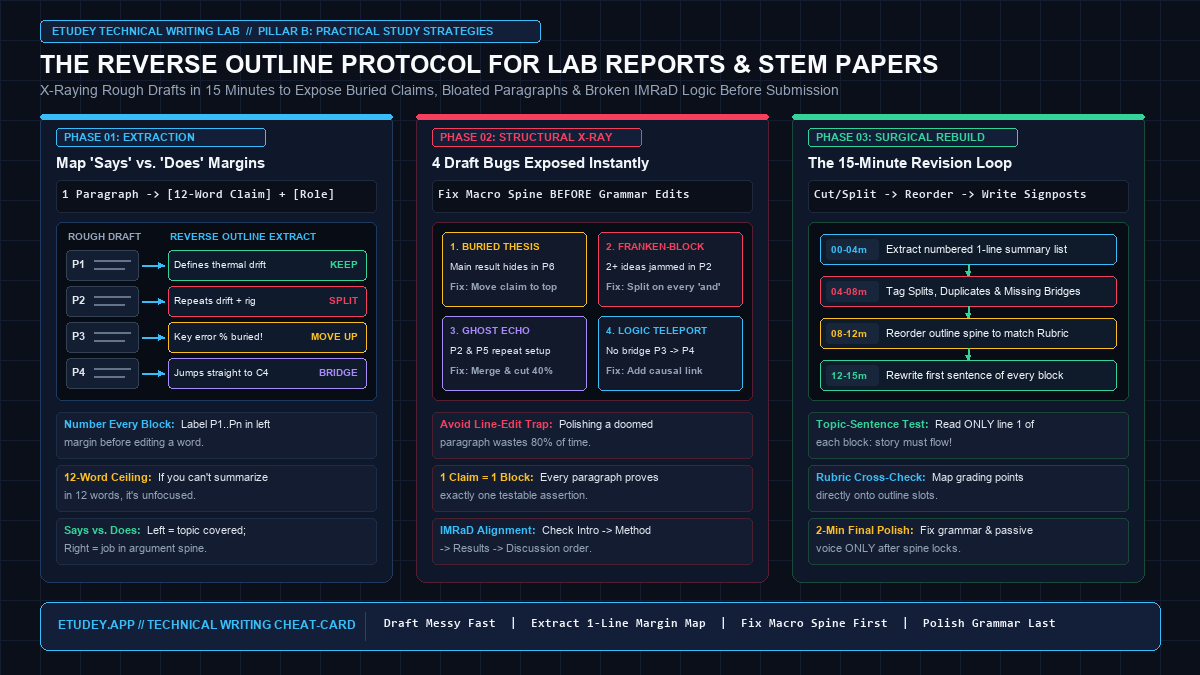
A reverse outline is a post-draft structural audit where you distill every finished paragraph into a single 12-word functional summary in the margin. By stripping away polished sentences to inspect your paper's bare skeleton, you expose buried conclusions, bloated multi-topic paragraphs, and broken logical bridges in under 15 minutes.
Every engineering and science student knows this exact sting. You spent four hours drafting a Fluid Mechanics lab report or an IEEE capstone paper, ran Grammarly until every green squiggle vanished, checked your citations, and submitted ten minutes before the portal locked. One week later, your teaching assistant hands it back at 68% with a blunt red comment scrawled across page three: "Clean English, but your argument jumps everywhere—what is your actual conclusion?"
Why do grammatically spotless STEM papers still score poorly? Because you edited like a copyeditor instead of an architect. In her landmark composition study comparing undergraduate students with seasoned technical writers, researcher Nancy Sommers discovered a striking gap: students treat revision as lexical polishing—swapping words, fixing commas, and trimming adverbs from top to bottom—while experts treat revision as structural re-engineering. Spending forty minutes polishing a paragraph that belongs two pages earlier (or deserves to be deleted outright) is the single biggest time trap in academic writing.
The cure is a deceptively simple cognitive tool used by top journal editors and graduate writing labs: the Reverse Outline Protocol. Instead of agonizing over a rigid outline before you discover what your data actually means, you draft fast, extract a bare-bones map after the rough draft exists, and repair the macro-architecture before touching a single comma.
1. Why Forward Outlines Fail STEM Students (And Why Reverse Outlines Work)
High school English teachers told you never to write a single sentence without a Roman-numeral outline first. For a five-paragraph book report, that advice works fine. For a university engineering lab report, experimental literature review, or final-year thesis, forward outlines routinely break down mid-draft.
Cognitive psychologists Linda Flower and John Hayes demonstrated that complex technical writing is not a linear transcription of pre-formed thoughts—it is a discovery process. While writing your Results and Discussion sections, you notice an unexpected calibration drift in Trial 3, realize your error-propagation formula explains a 6.4% thermal overshoot, and discover your strongest insight halfway through paragraph seven. Because you wrote your paper in the chronological order you discovered the truth rather than the logical order a reader needs to understand it, your rough draft inevitably ends up structurally tangled.
Worse still, once your eyes read your own prose, working-memory overload kicks in (a phenomenon detailed in our guide to Cognitive Load Theory for Hard STEM Topics). Your brain already knows what you meant to say, so it silently bridges missing logical leaps while you proofread. A reverse outline breaks that illusion instantly by compressing a 2,500-word manuscript down onto a single half-page index—small enough for your entire argument to fit inside visual working memory at once.
The 12-Word Ceiling Rule: If you cannot summarize a paragraph's core claim in twelve words or fewer without using the word "and" twice, that paragraph is not deep—it is overcrowded. Split it until every block defends exactly one testable idea.
2. The "Says vs. Does" Extraction Method (Minutes 0–4)
Never run a reverse outline inside your main editing window while tweaking sentences—you will get sucked straight back into micro-editing. Open a blank scratch document (or split-screen inside Etudey Notes) and execute four mechanical steps on your finished rough draft:
- Number Every Paragraph: Label your draft blocks sequentially from
P1toPndown the left margin. Ignore section headers for a moment so every block stands on its own feet. - Write the "Says" Column (Content): Next to each number, write one plain phrase (maximum 12 words) stating the literal information inside that paragraph. Be brutally honest—write what is actually on the page, not what you hoped it conveyed.
- Write the "Does" Column (Function): Right beside it, write a strong action verb naming the rhetorical job that paragraph performs for your reader: Defines problem, Reports control data, Explains 6.4% outlier, Contrasts with Smith (2023), Quantifies systematic error.
- Close the Full Draft: Hide your manuscript completely for the next five minutes. Stare only at your numbered outline list.
The moment you stare at that stripped-down skeleton, flaws that stayed invisible across three full proofreads leap off the screen with shocking clarity.
3. Live Lab Report X-Ray: Before & After Transformation
Watch how fast the protocol rescues a real undergraduate Discussion section from a Heat Transfer lab on steady-state aluminum rod conduction. Here is the extracted 5-paragraph reverse outline straight off a midnight rough draft:
- P1: Says: Restates Fourier's Law and mentions thermocouple placement on the brass vs. aluminum rig. Does: Repeats Introduction & Apparatus (Zero new Discussion value).
- P2: Says: Reports measured conductivity \(k = 191\text{ W/m}\cdot\text{K}\) (9.2% low) AND lists room air-conditioning drafts AND mentions contact grease thickness. Does: Jams three distinct mechanisms into one bloated Franken-paragraph.
- P3: Says: Quotes textbook standard \(210\text{ W/m}\cdot\text{K}\) for 6061-T6 alloy and shows percentage error calculation. Does: Gives benchmark after P2 already quoted the 9.2% error (Inverted logic!).
- P4: Says: Mentions radial convective heat loss through uninsulated rod sides accounts for ~7.5% of the discrepancy via energy balance. Does: Buried primary engineering insight!
- P5: Says: Concludes experiment succeeded despite "human error" and suggests buying better sensors next year. Does: Vague filler; fails to tie back to radial loss mechanism.
Look what a 4-minute X-ray just revealed without editing a single sentence:
- Delete P1 (already covered in Theory/Methods—saves 160 words of bloat immediately).
- Promote & Merge P3 + P2's headline into New P1: Establish the \(210\text{ W/m}\cdot\text{K}\) reference value first, then report the measured \(191\text{ W/m}\cdot\text{K}\) (9.2% negative bias).
- Elevate P4 to New P2: Lead the error diagnosis with the dominant physical mechanism—radial convective heat loss (~7.5%)—backed by your quantitative energy balance.
- Split P2's secondary cause into New P3: Dedicate a clean, focused paragraph to thermal contact resistance from uneven paste thickness (~1.7% residual gap).
- Rewrite P5 into New P4: Replace the cliché "human error" excuse with concrete engineering mitigation (fiberglass radial insulation sleeve + calibrated torque clamp).
In less than ten minutes, a rambling 68% draft transforms into a razor-sharp, publication-grade engineering Discussion that directly satisfies every rubric point in our Engineering Lab Report Blueprint.
4. The 5 Structural Bugs Matrix: Diagnose & Fix in Minutes
Use this diagnostic reference table whenever you scan your extracted reverse outline before submitting a lab report, seminar paper, or thesis chapter:
| Structural Draft Bug | Reverse Outline Symptom | Surgical Architectural Fix | Grading / Rubric Impact |
|---|---|---|---|
| 1. Buried Thesis / Finding | Your strongest numerical result or core claim hides in P5 or the Conclusion. | Cut and promote that claim into P1 (or your Abstract/Discussion opener) so readers see the payoff first. | Eliminates TA confusion; signals instant executive clarity. |
| 2. Franken-Paragraph | Your margin summary requires 20+ words or multiple "and" clauses to describe one block. | Split cleanly along conceptual seams until every paragraph defends exactly one verifiable claim. | Stops key calculations from getting lost inside dense walls of text. |
| 3. Ghost Echo (Redundancy) | Two non-adjacent blocks (e.g., P2 and P7) show near-identical "Says" phrases. | Merge the best evidence into the stronger slot and delete the duplicate block mercilessly. | Meets strict IEEE page limits while raising technical signal density. |
| 4. Logic Teleportation | Reading P3 → P4 in your outline feels like a sudden topic jump with no causal bridge. | Insert a 1-sentence backward-forward transition linking P3's evidence directly into P4's claim. | Transforms choppy bullet-dump prose into coherent scientific reasoning. |
| 5. Rubric Blind Spot | A major grading requirement (e.g., uncertainty propagation or limitations) never appears in the "Does" column. | Add a dedicated slot directly into the outline spine and draft the missing analysis before polishing. | Recovers easy 10–15% rubric points otherwise forfeited completely. |
5. The 15-Minute Surgical Revision Loop for Tight Deadlines
You do not need an empty weekend to apply reverse outlining. Even on a tight hostel deadline—juggling 75% attendance lectures and back-to-back lab submissions—follow this strict four-block clock:
- Minutes 0–4 (Extract): Number paragraphs and type 1-line "Says" and "Does" notes into a clean side pane. Resist the urge to fix typos along the way.
- Minutes 4–8 (Audit Against IMRaD & Rubric): Check whether your extracted outline marches cleanly through Introduction (Problem → Gap → Objective), Methods, Results, and Discussion. Tag every block with one of four commands:
KEEP,SPLIT,MERGE/CUT, orMOVE. - Minutes 8–12 (Rearrange & Rewrite Topic Sentences): Execute the cuts, splits, and drag-and-drop reorders first. Then rewrite the opening sentence of every paragraph so that it explicitly announces that paragraph's single job. Run the Topic-Sentence Skim Test: read only the first sentence of every paragraph from start to finish. If a busy professor skimming only those lines can follow your entire engineering argument without squinting, your macro-spine is rock solid.
- Minutes 12–15 (Micro-Polish Last): Only now—when you know every surviving sentence actually belongs in the paper—run a final pass for active voice, equation numbering, figure references, and unit consistency.
This same structural lens also accelerates literature reviews: when dissecting dense IEEE or Nature papers, pairing a 3-pass reading method (see How to Read a Scientific Research Paper) with a 5-line reverse outline of the authors' Discussion reveals exactly how top researchers structure technical persuasion.
6. Building a Zero-Panic Writing Workflow in Etudey
Most messy rough drafts happen because students try to draft, calculate, format figures, and edit simultaneously inside one chaotic Word document at midnight. Separate those phases cleanly across your workspace:
- Draft & Reverse-Outline Side-by-Side: Store your numbered rough draft and your "Says vs. Does" X-ray map cleanly inside Etudey Notes so you can drag blocks into rubric order without losing deleted snippets.
- Sketch Data & Error Flow Visually: Before writing a tangled Discussion paragraph, map your causal error tree (e.g., Radial Loss → Contact Resistance → Thermocouple Drift) on Etudey Handwriting Studio so your paragraph order mirrors real physics.
- Stress-Test Weak Bridges with AIgom: Paste your 10-line reverse outline (not your whole essay!) into Etudey AIgom Tutor and ask: "Act as a strict engineering TA—where is the biggest logical leap or missing justification in this argument spine?"
- Separate Drafting from Auditing on Your Schedule: Split big papers into two distinct cards on your Study Kanban Board—"Messy Rough Draft" and "15-Min Reverse Outline Audit"—spaced at least a few hours apart so you return with fresh, objective eyes.
Frequently Asked Questions
Should I still create a forward outline before writing a technical paper?
Yes—use a lightweight 3-to-5 bullet skeleton (matching IMRaD sections and your rubric) simply to prevent blank-page paralysis. Just avoid obsessing over paragraph-level perfection upfront. Treat your forward outline as scaffolding, draft rapidly to uncover what your data actually proves, and let the reverse outline lock in the final architecture.
How long should a reverse outline be for a 10-page capstone report?
Aim for roughly one concise line per paragraph—meaning a 10-page technical report (~30–35 paragraphs) condenses onto a single clean page. If your reverse outline spills across three pages, your summaries are still too wordy and are hiding multi-topic Franken-paragraphs.
What if a single paragraph genuinely covers two closely linked equations?
Two equations belong in one paragraph only if they serve a single unified claim (for example, stating a governing conservation law and substituting boundary conditions to derive one closed-form result). The moment you shift from deriving an equation to interpreting experimental anomalies or comparing prior literature, start a new paragraph.
Does reverse outlining work for group capstone reports written by four teammates?
It is arguably the single highest-leverage tool for group reports. When four students paste separate Google Docs chunks together, tone shifts, duplicated definitions, and contradictory notation ruin grades. Extracting a combined "Says vs. Does" list across all four sections exposes every duplicate explanation and missing handoff in ten minutes flat.
Why shouldn't I just ask an AI chatbot to rewrite my whole rough draft?
Asking an AI to blindly rewrite your prose often invents fake physical explanations, alters experimental numbers, strips your authentic engineering voice, and triggers academic integrity flags. Using a reverse outline keeps 100% of your technical data and authorship intact while fixing the true root cause of weak grades: macro-level structural logic.
Turn Messy Rough Drafts into A-Grade Engineering Reports
Organize your rough drafts and reverse-outline maps inside Etudey Notes, stress-test logical gaps with AIgom Tutor, and keep every lab submission ahead of deadline in Etudey Workspace—built for ambitious STEM students.
Launch Etudey Workspace Free →