
The SQ3R method for STEM is an active cognitive reading framework that replaces passive linear reading with a structured five-step interrogation cycle: Survey, Question, Read, Recite, and Review. Adapted specifically for dense engineering, calculus, and physics textbooks, it prevents cognitive overload by prioritizing equation derivations, schematic diagrams, and theorem boundaries over continuous prose.
The 11:00 PM Textbook Coma: Why Linear Reading Fails in STEM
Every STEM student knows the sensation: you sit at your hostel desk or library cubicle at 11:00 PM, determined to finish Chapter 7 of Sedra & Smith’s Microelectronic Circuits, Halliday & Resnick’s Fundamentals of Physics, or CLRS Introduction to Algorithms. You open page 314. You read sentence one, sentence two, and sentence three. You run a yellow highlighter across three lines of dense theoretical text.
By page 317, your eyes are glazed over. Your hand has mechanically underlined an entire paragraph about band-gap voltages, yet your brain has registered precisely zero percent of the conceptual logic. Ten minutes later, your head tilts forward, and you snap awake in a panic. You have succumbed to what cognitive scientists term passive reading coma.
The core problem is not your work ethic, your caffeine level, or your intelligence. The problem is that human working memory was never designed to ingest symbolic mathematics, multi-variable constraints, and physical theorems in a linear, left-to-right scanning pattern. When you read a history essay or a novel, narrative momentum carries your comprehension forward. But when you read an engineering chapter, every single sentence contains implicit dependencies, physical units, boundary constraints, and unstated assumptions.
Cognitive Load Theory (John Sweller, 1988): "Working memory has a strictly finite processing capacity of approximately four novel information chunks at any given moment. Attempting to absorb dense technical proofs linearly forces instantaneous cognitive overload, causing total attentional collapse."
To conquer dense STEM literature without burning out or wasting precious hours before semester exams, you need an active interrogation protocol. That protocol is the STEM-Adapted SQ3R Method.
The Origins of SQ3R: Why the Humanities Version Fails Engineers
The SQ3R method was originally invented in 1946 by American educational psychologist Francis P. Robinson in his landmark book Effective Study. Robinson designed the system to help military recruits rapidly digest voluminous training manuals and liberal arts curricula during World War II. The traditional 5-step framework consists of:
- Survey: Glance over headings, introduction, and summary.
- Question: Turn chapter titles into questions.
- Read: Read text to answer those questions.
- Recite: Recall the answers out loud or on paper.
- Review: Periodically reread notes to reinforce retention.
While this classic formula works wonders for psychology, history, and sociology, it catastrophically breaks down when applied to technical fields like thermodynamics, discrete mathematics, or digital signal processing. In STEM, you cannot simply "turn a heading into a question" like "What caused the French Revolution?" and expect to grasp Navier-Stokes fluid mechanics or eigenvalues.
Engineering textbooks are non-linear graph structures disguised as books. To extract value, we must re-engineer every single phase of Robinson's framework around mathematical models, circuit diagrams, and live proofs.
Comparison: Passive Reading vs. Humanities SQ3R vs. STEM SQ3R
Before detailing each tactical step, examine how the STEM SQ3R protocol fundamentally diverges from traditional study habits:
| Dimension | Passive Linear Highlighting | Classic SQ3R (Robinson, 1946) | STEM-Adapted SQ3R Protocol |
|---|---|---|---|
| Core Philosophy | Linear consumption: left-to-right page skimming | Verbal questioning of paragraph headings | Systemic reverse-engineering of formulas and schemas |
| Math & Derivations | Glanced over; treated as visual decorations | Ignored; assumes prose answers questions | Extracted, deconstructed, and derived on scratchpad |
| Diagram Handling | Looked at for 2 seconds without axis verification | Viewed as supplementary illustrations | Interrogated first: variables, axes, limits, and slopes |
| Recitation Phase | Non-existent; re-reads highlighted text | Verbal recall of definitions and dates | Closed-book derivation dump & boundary stress testing |
| Exam Readiness | Fragile illusion of competence; fails numericals | Adequate for essay and descriptive queries | Robust procedural fluency for semester exams & lab vivas |
| Cognitive Resistance | Severe drowsiness within 15–20 minutes | Moderate engagement; falters on equations | High alertness; continuous active puzzle-solving |
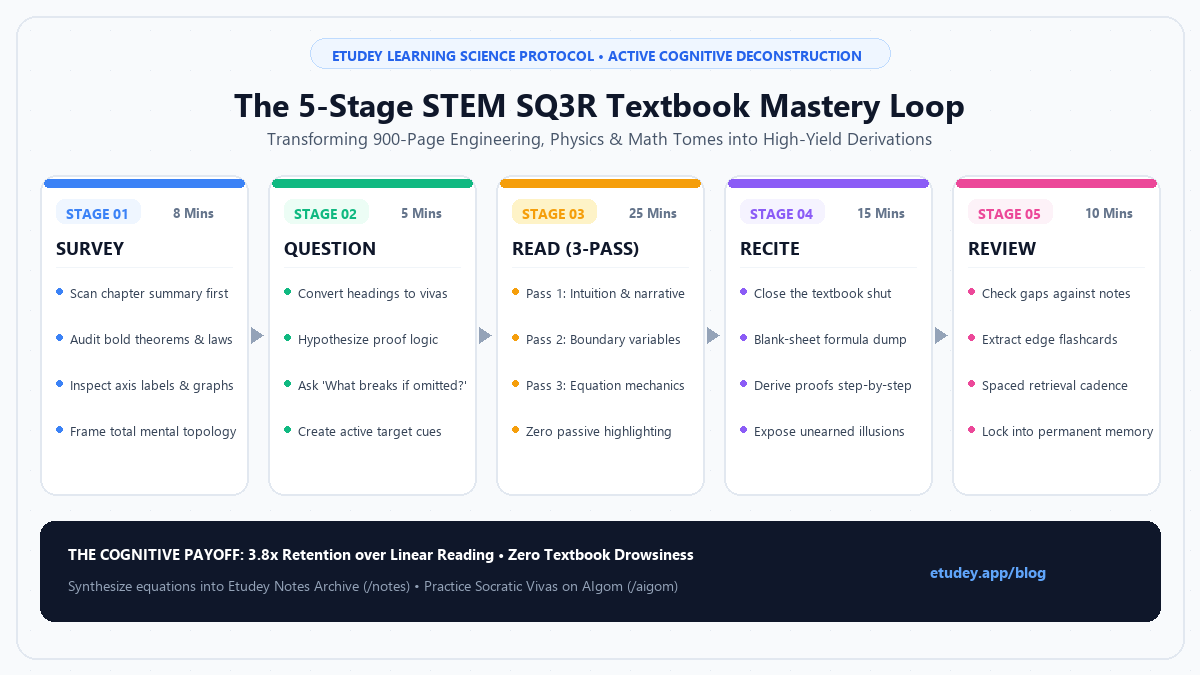
Stage 1: The 8-Minute Chapter Reconnaissance (Survey)
The biggest mistake STEM students make is starting on page one, paragraph one. You would never explore a dark, labyrinthine building by staring through a keyhole with a magnifying glass; you would turn on the floodlights to observe the floor plan. In STEM, Stage 1 is an 8-minute tactical reconnaissance mission designed to build an overarching mental cognitive scaffolding before you read a single sentence of body text.
Set a timer for 8 minutes and execute this exact 4-step sequence:
- Read the Chapter Summary and Objectives First: Flip directly to the final 2–3 pages of the chapter. Read the end-of-chapter summary, key equations box, and bullet points. This reveals the destination before you embark on the journey. When you know that the entire 45-page chapter culminates in deriving Maxwell’s wave equation in non-conducting media, every intermediate vector manipulation suddenly has a defined purpose.
- Inspect All Diagrams, Graphs, and Circuit Schemas: Flip through the chapter and examine every visual figure. For every graph, look strictly at three things: the x-axis variable and units, the y-axis variable and units, and whether the curve is linear, exponential, or asymptotic. In STEM, professors test graphs far more rigorously than introductory paragraphs.
- Catalog the Master Formula Boxes: Note every boxed equation, bold theorem, or numbered proposition (e.g., Equation 4.12: The Continuity Equation). You do not need to understand their full derivation yet; you simply need to register their existence in your sensory register.
- Review the End-of-Chapter Numerical Problems: Skim the first three and last three practice problems. What variables are they asking you to solve for? Are they asking for root-mean-square currents or transient settling times? This immediately calibrates your radar for what the author considers essential exam competencies.
Once your 8-minute timer dings, you stop. You now possess a topographical map of the entire terrain. If you are coordinating your study plan across multiple technical subjects, organize these chapter milestones directly inside your Etudey Study Kanban Board to track your reading sprint visually.
Stage 2: Converting Passive Subheadings into Viva Interrogations (Question)
Passive reading occurs because your brain is merely accepting statements without friction. To make technical reading stick, you must convert passive headings into active, uncomfortable interrogation prompts.
Instead of looking at the heading "4.3 The Bipolar Junction Transistor Early Effect" and thinking "Okay, now I will read about the Early Effect," you forcefully formulate three distinct types of technical queries on your notebook or tablet:
1. The Mechanism Query: "Why Does This Happen Physically?"
"What physical phenomenon causes the effective base width of a BJT to narrow when reverse-bias collector voltage increases, and why does this prevent collector current from saturating completely?"
2. The Edge-Case Boundary Query: "What Happens When Variables Go to Extreme Limits?"
"What happens if the base doping concentration approaches zero or infinity? Where does the mathematical model collapse?"
3. The Practical Viva Query: "How Will the Professor Trap Me on This?"
"If my external examiner during the lab viva asks me why the output resistance ro is not infinite, which equation do I write on the board to prove it?"
Writing down these targeted queries takes less than 5 minutes, but it completely rewires your reticular activating system. Your brain shifts from a passive spectator watching words scroll by into an active detective hunting down specific physical answers. For an even more realistic challenge, feed your textbook subheadings into AIgom, Etudey's Socratic STEM AI study partner, and prompt it: "Cross-examine me on the mathematical assumptions behind this heading as if you were a strict university professor."
Stage 3: The 3-Layer Reading Architecture for STEM (Read)
Now comes the reading phase. In humanities, reading is done once at a steady pace. In technical disciplines, reading a single passage once is guaranteed to generate confusion. Instead, adopt the 3-Layer STEM Reading Architecture:
Pass 1: The Intuitive Narrative Pass (Ignore the Algebra)
Read the paragraph text quickly without pausing to crunch algebra or verify intermediate calculus steps. Focus entirely on the conceptual intuition: What physical problem is the author trying to solve? Why did the previous engineering design fail? What analogy or intuitive model is being introduced? If an equation appears, read its verbal description ("Equation 5 tells us that heat flux is proportional to the negative temperature gradient") and move on. Do not stop to evaluate line-by-line substitutions yet.
Pass 2: The Variable & Dimension Audit
Now return to the equations. Before touching the proof, audit every single symbol in the expression:
- Identify each variable, constant, and subscript. What are their SI units?
- Check dimensional homogeneity: Does the left side of the equality have the exact same dimensional units ($[M][L]^2[T]^{-3}$) as the right side?
- Identify the independent variable (the cause) and the dependent variable (the effect).
- What are the operating assumptions? (e.g., Is this valid only for laminar flow? Ideal gases? Small-signal linear approximations? Isothermal boundaries?).
Pass 3: The Active Derivation Reconstruction
Never let your eyes casually glide over a phrase like "Integrating Equation 3.4 and simplifying yields Equation 3.5." Whenever an author writes that, they have skipped three tedious lines of algebraic or calculus gymnastics.
Place a blank sheet of paper over Equation 3.5. Take your pen, write down Equation 3.4, and execute the integration yourself. If you can perform the mathematical transformation smoothly, your comprehension is real. If you get stuck, look at the textbook line, pinpoint the exact identity or trigonometric substitution you missed, and re-derive it.
The Derivation Law of STEM: If you did not derive an equation with your own physical hand on paper, you do not understand it. Highlighting a formula gives you the illusion of knowledge; deriving it gives you genuine mathematical muscle memory.
Stage 4: The Closed-Book Derivation Dump (Recite)
Recitation in a STEM context does not mean mumbling definitions to yourself like a high schooler memorizing a poem. It means conducting a rigorous closed-book retrieval sprint.
Close the 900-page textbook shut. Push it away from your workspace. Take an unlined sheet of scratch paper or launch your digital canvas in Etudey's Handwriting Studio. Now execute the Triple-Recite Protocol:
- Draw the System Diagram from Memory: Recreate the circuit diagram, free-body diagram, state machine, or molecular lattice without looking. Label every node, current arrow, force vector, and coordinate axis.
- Write Down the Governing First-Principles Equation: Start from Newton's Second Law, Kirchhoff’s Current Law, the First Law of Thermodynamics, or the definition of limits.
- Derive the Target Result to the Final Boxed Formula: Step through the algebraic manipulations and state the physical significance of the final result.
If your pencil freezes midway through step 2, rejoice! You have successfully identified an unearned cognitive leap. When you were looking at the open textbook, your brain whispered, "Oh yeah, that makes total sense." But the closed-book blank page exposed that you could not reconstruct the logic independently. Open the textbook, study the exact missing hinge for 60 seconds, close the book again, and complete the derivation from scratch.
Once your derivation is pristine, you can preserve it alongside clean peer explanations by cross-referencing university-vetted notes in the Etudey Verified Notes Archive.
Stage 5: Spaced Retesting and High-Yield Flashcard Synthesis (Review)
The final stage prevents the brutal human forgetting curve from erasing your hard-won insights over the subsequent 72 hours. A common trap is waiting until two days before the mid-term or semester final to revisit the chapter. By then, the neural pathways have decayed, forcing you to relearn the material from square one.
The STEM Review cadence relies on Spaced High-Yield Distillation:
- 24-Hour Micro-Review (5 Mins): The morning after your SQ3R session, spend exactly 5 minutes reviewing your Stage 4 derivation sheet. Do not reread the textbook chapter. Simply confirm that your eyes can trace the logic of the derivation from top to bottom.
- Synthesize Formula Condition Flashcards: Do not make flashcards for basic definitions. Make flashcards for boundary conditions and assumptions. Front: "Under what 3 physical conditions does Bernoulli's Equation apply?" Back: "1. Incompressible fluid; 2. Inviscid (zero viscosity); 3. Steady flow along a streamline."
- Weekly Synthesis on AIgom: Once a week, open AIgom and initiate an interactive viva session. Paste your chapter headings and ask it: "Give me 3 multi-step numerical edge cases based on these topics." This stress-tests your procedural problem-solving skills under real-time exam conditions.
Overcoming Real-World Indian College Constraints: 75% Attendance & Viva Backlogs
In many engineering and science universities across India (such as VTU, Anna University, Mumbai University, AKTU, and IITs/NITs), students face grueling schedules: mandatory 75% attendance rules, 8:30 AM to 5:00 PM lab marathons, endless handwritten practical records, and frequent internal sessionals.
When you arrive at your hostel or PG room exhausted at 7:00 PM, nobody has the mental stamina to spend 4 hours reading a 60-page textbook chapter linearly. This is why traditional study advice fails Indian undergraduates.
The STEM SQ3R protocol is built precisely for time-constrained college realities. By capping Stage 1 (Survey) at 8 minutes and Stage 2 (Question) at 5 minutes, you can conquer the core concepts of an entire syllabus unit in a crisp, highly focused 45-minute sprint. Even if you only have one hour between practical lab sessions, you can derive the essential theorem on a scratch sheet and walk into your next viva examination completely bulletproof against unpredictable external examiners.
Frequently Asked Questions
Does the SQ3R method take too much time when I have an exam tomorrow morning?
If your exam is in 10 hours and you have never touched the syllabus, a full 5-stage SQ3R pass on multiple chapters is not realistic. For 24-hour emergencies, use the Survey-and-Recite Sprint: execute Stage 1 (Survey chapter summaries, formula boxes, and solved numericals) for 15 minutes, and then jump straight to Stage 4 (closed-book derivation dumps on high-weightage questions from previous year papers). For sustainable semester preparation, however, SQ3R actually saves 60% of total study time because you retain concepts on the first pass rather than rereading the same chapter four times.
How do I handle dense mathematical proofs with dozens of lines of intermediate calculus?
Break the proof down into conceptual milestones rather than trying to memorize every line. Most 20-line proofs consist of 3 distinct conceptual shifts: 1) Setting up the boundary conditions and governing differential equation, 2) Applying an algebraic or trigonometric transformation to isolate variables, and 3) Integrating and applying initial conditions. Write down the verbal description of each milestone on the margin of your derivation sheet, and practice jumping between those three anchors.
Can I use the SQ3R method on PDF textbooks on a tablet or laptop?
Yes, but you must strictly avoid passive scrolling. When reading PDFs, disable continuous scroll mode and use two-page or thumbnail view during Stage 1 (Survey). During Stage 3 and Stage 4, keep your physical notebook or a split-screen digital canvas like Handwriting Studio open on the side so your hands are actively drawing schematics and deriving equations rather than passively scrolling a trackpad.
What should I do if the textbook explanation is completely unreadable or convoluted?
Not all textbook authors are great communicators. If you get stuck on a convoluted explanation during Stage 3 (Read), do not stare at the same confusing paragraph for 40 minutes. Immediately cross-reference the topic against peer-annotated lecture notes in the Etudey Verified Notes Archive, or paste the confusing paragraph into AIgom with the prompt: "Explain the physical intuition behind this paragraph as if I were a first-year undergraduate, and highlight the main variable relationships."
How does SQ3R help prevent semester backlogs and academic burnout?
Semester backlogs in STEM rarely happen because students lack effort; they happen because students confuse passive familiarity with active procedural competence. Rereading a highlighted chapter makes you feel like you know it, but when the exam paper presents a twisted numerical problem with unexpected boundary conditions, the illusion collapses. SQ3R eliminates this vulnerability by forcing you to derive proofs and solve edge cases under closed-book conditions before the examiner ever tests you.
Stop Skimming. Start Interrogating.
The 900-page textbooks on your desk are not novels to be read passively; they are technical blueprints waiting to be reverse-engineered. By deploying the STEM SQ3R protocol, you transform boring, sleep-inducing textbook sessions into sharp, high-efficiency cognitive workouts.
Grab your notebook, open your next syllabus chapter, set your timer for 8 minutes, and start your reconnaissance pass today. Track your syllabus units in the Etudey Student Workspace, master your formulas, and build permanent academic fluency.