
Overcoming afternoon study brain fog requires addressing four biological drivers: circadian core temperature dips, adenosine sleep pressure, reactive hypoglycemia, and optical convergence fatigue. By deploying a 15-minute Non-Sleep Deep Rest protocol, viewing panoramic horizons, rehydrating with mineral electrolytes, and pivoting to tactile problem-solving, students restore sharp academic focus without caffeine crashes.
The 3:00 PM Library Crisis: Why Willpower Cannot Overpower Biology
It is 2:45 PM on a Tuesday in the central university library. You arrived at 9:00 AM with ambitious academic intentions: you plan to revise three chapters of Fluid Mechanics, finish an engineering problem set, and build formula sheets for Friday's midterm. The morning session went reasonably well. But right around 2:30 PM, after returning from a quick lunch at the college cafeteria, a suffocating mental paralysis descends upon your desk.
Your eyelids feel as heavy as lead weights. You stare at the same textbook paragraph for six consecutive minutes, reading the words without absorbing a single syllable. Your thoughts are sluggish, disjointed, and drifting toward your phone. You experience a deep, involuntary yawn every ninety seconds. In college campuses worldwide, this phenomenon is universally recognized as the 3:00 PM Afternoon Slump or Study Brain Fog.
Most students interpret this afternoon crash as a personal moral failure—a lack of self-discipline, dedication, or mental toughness. In response, they deploy the standard college emergency protocol: they walk down to the campus vending machine, buy a 500ml high-sugar energy drink or a double shot of espresso, and return to their desk, determined to force their eyelids open through pure willpower.
This brute-force approach backfires catastrophically:
- The Tachycardia Panic: By 4:00 PM, the massive dose of caffeine and synthetic sugar kicks your heart rate to 110 beats per minute. You are not more focused; you are simply anxious, jittery, and trembling, while the underlying brain fog remains unchanged.
- The 5:30 PM Secondary Abyss: Once the circulating glucose is violently cleared by insulin, you experience an even deeper reactive hypoglycemic crash. You pack your backpack in defeat, leaving your hostel desk before dinner with zero work accomplished.
- Ruined Nighttime Sleep Architecture: Because caffeine has a biological half-life of 6 to 8 hours and a quarter-life of 12 hours, the 3:30 PM energy drink ensures that adenosine receptors in your brain cannot initiate restorative slow-wave deep sleep at midnight. You wake up exhausted the next morning, perpetuating the vicious cycle.
Cognitive neuroscience and chronobiology reveal that afternoon study brain fog is not a lack of willpower; it is a predictable neurochemical oscillation. Top-performing scholars do not fight this biological dip with toxic stimulants; they deploy a 15-minute physiological reset that works in harmony with human circadian biology.
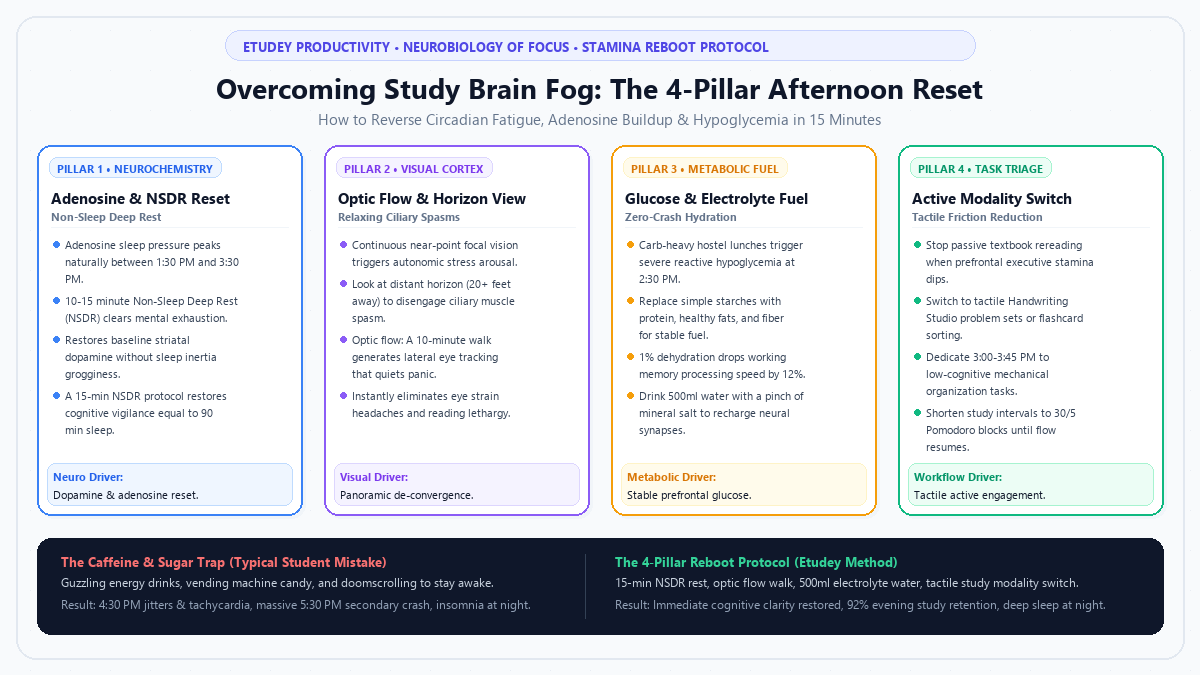
The Four Neurobiological Mechanisms Behind the Afternoon Slump
To defeat afternoon lethargy, you must understand the four distinct biological engines that converge simultaneously between 1:30 PM and 4:00 PM:
1. The Postprandial Circadian Temperature Dip
Human alert states are tightly tied to internal core body temperature, governed by the suprachiasmatic nucleus (SCN) in the hypothalamus. Your core temperature rises gradually after waking, peaks in the late morning, and naturally experiences a pronounced drop approximately seven to eight hours after waking—typically between 1:30 PM and 3:30 PM. This circadian dip evolved as an evolutionary mechanism for midday rest in warm climates. When body temperature falls, central nervous system firing rates slow down, inducing natural somnolence.
2. Adenosine Accumulation (The Sleep Pressure Curve)
From the moment you wake up, your brain's neurons metabolize adenosine triphosphate (ATP) for energy. The chemical byproduct of this cellular metabolism is adenosine. Throughout the morning, adenosine molecules bind to \(A_1\) and \(A_{2A}\) receptors in the basal forebrain, gradually increasing homeostatic sleep pressure. By 2:30 PM, after six to eight hours of intense academic concentration, adenosine levels reach a critical daytime threshold, dampening dopamine signaling in the prefrontal cortex.
3. Reactive Hypoglycemia: The Hostel Lunch Glucose Spike and Crash
Campus dining halls and hostel messes are dominated by cheap, refined carbohydrates: white rice, white bread, instant noodles, fried snacks, and sweetened beverages. When you consume a high-glycemic meal, glucose floods the bloodstream. In response, the pancreas secretes a massive bolus of insulin to shuttle glucose into muscle and adipose cells.
Because refined carbohydrates cause an exaggerated insulin surge, blood glucose levels do not simply return to baseline; they plummet below baseline into reactive hypoglycemia within 60 to 90 minutes. Deprived of its primary metabolic fuel, the prefrontal cortex shuts down non-essential executive functions, resulting in confusion, irritability, and profound lethargy.
4. Optical Convergence Spasm & Mental Fatigue
During a four-hour morning study sprint, your eyes remain locked in a fixed near-point convergence—staring at a laptop screen or printed textbook 18 inches away. The ciliary muscles inside the eyes contract continuously to maintain focal lens curvature, while the medial rectus muscles pull both eyes inward. This prolonged muscular contraction triggers an involuntary physical spasm that signals the autonomic nervous system to heighten mental exhaustion.
"When you maintain visual focus on a narrow point for hours, your brain enters a state of localized autonomic arousal that quickly leads to neural exhaustion. Looking into the far distance and engaging panoramic vision immediately down-regulates the sympathetic nervous system, shifting brain wave patterns from frantic beta waves to relaxed, alert alpha states."
— Dr. Andrew Huberman, Department of Neurobiology, Stanford University School of Medicine
The 4-Pillar Afternoon Focus Reboot Protocol
Instead of reaching for a chemical crutch, top university scholars execute the 4-Pillar Afternoon Reset Protocol. This systematic 15-to-20-minute routine resets all four biological levers, unlocking a fresh 4-hour evening focus window:
Pillar 1: The 15-Minute Non-Sleep Deep Rest (NSDR) Reset
The single most powerful intervention for afternoon cognitive fatigue is Non-Sleep Deep Rest (NSDR), also known scientifically as Yoga Nidra or physiological down-regulation. Unlike a daytime nap—which frequently results in 45 minutes of groggy sleep inertia where you wake up feeling worse than before—NSDR keeps your conscious awareness active while guiding the brain into slow alpha and theta oscillations.
The Protocol:
- Find a quiet corner in the library, an empty seminar room, or your hostel bed.
- Put on noise-canceling headphones and set a gentle timer for exactly 15 minutes.
- Lie on your back or recline in a chair with your eyes closed.
- Engage in slow, diaphragmatic breathing: inhale through the nose for 4 seconds, exhale slowly through pursed lips for 8 seconds. Prolonged exhalations engage the vagus nerve, slowing heart rate within 90 seconds.
- Perform a mental body scan from your toes to your scalp, releasing muscle tension in the jaw, shoulders, and brow.
Neuroimaging studies demonstrate that 15 to 20 minutes of NSDR restores striatal dopamine levels in the brain to near-morning baselines, clearing cognitive exhaustion without causing daytime sleep inertia.
Pillar 2: Optic Flow & The Panoramic Horizon Gaze
Immediately following your NSDR session, step outside the library into natural outdoor light for a 10-minute walk.
- Disengage Convergence: Look at the farthest horizon, tree line, or cloud formation you can see. Consciously expand your visual field into panoramic vision: try to perceive the periphery of your visual field—to the left, right, top, and bottom—without moving your eyeballs. This disengages ciliary muscle spasms and calms autonomic arousal.
- Generate Optic Flow: As you walk briskly, images of buildings and trees pass across your retina. This continuous visual movement is termed optic flow. Neuroscience shows that optic flow suppresses neural firing in the amygdala, reducing academic anxiety and mental stress.
- Sunlight Exposure: Natural photons entering the eyes stimulate melanopsin-containing retinal ganglion cells, signaling the suprachiasmatic nucleus to suppress daytime melatonin secretion and raise alertness.
Pillar 3: The Zero-Crash Hydration & Electrolyte Strategy
Your brain is 73% water. Clinical studies prove that a dehydration deficit of just 1% to 2% of body mass decreases working memory capacity, mathematical processing speed, and sustained attention by over 12%. Furthermore, air-conditioned college libraries have exceptionally low relative humidity, accelerating respiratory moisture loss.
Before resuming your study session, drink 500ml of cold water combined with a pinch of sea salt (sodium) or an electrolyte packet. Sodium and potassium are the fundamental mineral ions required for action potentials to fire across neuronal axon membranes. Cold water also triggers mild thermogenic activation, helping to counteract the circadian core body temperature dip.
Pillar 4: The Tactile Modality Pivot (Bypassing Executive Burnout)
Returning to your desk at 3:15 PM and attempting to read another 40 pages of dense legal theory or proof-heavy engineering textbooks is a recipe for instant relapse into brain fog. Passive reading requires immense prefrontal executive stamina.
Instead, deploy the Tactile Modality Pivot for your first 45-minute afternoon block:
- Switch from Passive to Active Physical Input: Close the textbook. Open the Etudey Handwriting Studio on your tablet or grab a fresh sheet of paper. Spend 30 minutes solving concrete practice problems, drawing Free Body Diagrams, sketching metabolic pathways, or creating mind maps. Physical hand movement engages the motor cortex, forcing neurological engagement.
- Deploy the Low-Cognitive Buffer: If your analytical brain is still warming up, use 3:00 PM to 3:45 PM for administrative and organizational tasks: updating your Study Kanban Board, organizing note tags, or reviewing missed questions in your Engineering Error Log.
- Shorten the Pomodoro Interval: If 90-minute ultradian study blocks feel overwhelming, open the Etudey Workspace and switch the focus timer to a 25/5 or 30/5 interval. A low barrier to entry lowers the perceived friction of getting started.
| Physiological Metric | The Caffeine & Sugar Panic Cycle | The 4-Pillar Biological Reboot Protocol | Impact on Exam Revision Stamina |
|---|---|---|---|
| Adenosine Management | Temporarily masks adenosine by blocking receptors; leaves underlying sleep pressure intact. | 15-minute NSDR down-regulates neural firing and re-sensitizes dopamine pathways. | Reboots genuine mental clarity instead of nervous adrenaline jitter. |
| Blood Sugar Dynamics | Massive glycemic spike followed by severe reactive hypoglycemia within 60 minutes. | Stable protein-fat fueling and mineral electrolyte hydration (500ml water + salt). | Provides constant, stable glucose supply to the prefrontal cortex without food coma. |
| Visual Cortex Strain | Continuous near-point convergence staring at screens/books; ciliary muscle spasm worsens. | Optic flow walk and panoramic horizon gazing relax intraocular tension. | Completely eliminates afternoon tension headaches and visual eye strain. |
| Heart Rate & Autonomic Tone | Spikes heart rate to 105+ bpm; elevates cortisol and triggers physical anxiety. | Vagus nerve stimulation via 2:1 exhalation ratios; calms sympathetic over-arousal. | Enables calm, analytical deep work on complex math and multi-step derivations. |
| Evening Study Capacity | Severe crash by 5:30 PM; student gives up and abandons evening study plans. | Sustained, steady focus extending effortlessly from 4:00 PM through 9:30 PM. | Unlocks an extra 3.5 hours of high-retention revision every single day. |
| Nighttime Sleep Architecture | Caffeine quarter-life blocks slow-wave deep sleep; REM memory consolidation impaired. | Zero stimulants; natural melatonin rise occurs on schedule at midnight. | Maximizes overnight synaptic consolidation of everything studied during the day. |
The Optimal Afternoon Study Schedule: Hour-by-Hour Blueprint
To implement this system seamlessly into college life, structure your afternoon using this proven timetable:
- 1:00 PM - 1:45 PM (The Low-Glycemic Fueling Window): Eat lunch. Prioritize eggs, chicken, paneer, lentils, raw salads, and healthy fats. Minimize white rice, naan, potatoes, and sugary desserts. Hydrate with water, not soda.
- 1:45 PM - 2:00 PM (Light Campus Walk): Walk casually around campus. The light muscular activity blunts the post-meal glucose spike by up to 35% as skeletal muscles take up glucose independently of insulin.
- 2:00 PM - 2:15 PM (The 15-Minute NSDR Protocol): Put on headphones in a quiet spot. Execute your 15-minute diaphragmatic breathing and body scan session.
- 2:15 PM - 2:30 PM (Optic Flow & Mineral Hydration): Walk outdoors for 10 minutes in natural sunlight with panoramic vision. Drink 500ml of water with an electrolyte pinch.
- 2:30 PM - 3:15 PM (Tactile Study Pivot Block): Sit down at your desk. Open Handwriting Studio. Tackle 3 to 5 challenging numerical problems or synthesis mechanisms. Keep writing by hand.
- 3:15 PM - 5:30 PM (Peak Deep Work Sprint): Your second wind is now fully unlocked. Transition into your heaviest analytical study tasks—deriving formulas, coding assignments, or memorizing pathways with AIgom.
Frequently Asked Questions
Is taking a power nap better than doing NSDR?
For most students, NSDR is significantly superior to a traditional power nap for two reasons. First, falling asleep during the day often slips past the 20-minute threshold into stage-3 slow-wave sleep. If your alarm wakes you from deep sleep, you experience severe sleep inertia—a groggy, disoriented state that can impair cognitive function for up to an hour. Second, many students cannot fall asleep on command in a noisy college library. NSDR does not require you to fall asleep; it simply requires conscious relaxation, delivering all the neurochemical recovery of a nap with zero sleep inertia.
Can I still drink coffee in the afternoon if I keep the dose small?
Neuroscience strongly recommends setting a strict Caffeine Curfew at 1:00 PM or 2:00 PM (at least 9 to 10 hours before your target bedtime). Even if you are one of those students who claims, "I can drink an espresso at 9:00 PM and fall asleep immediately," polysomnography brain scans show that circulating caffeine drastically disrupts the quality and depth of your sleep architecture. It reduces slow-wave deep sleep (essential for physical recovery) and REM sleep (essential for memory consolidation), ensuring that you wake up with lingering brain fog the following morning.
What should I do if the library does not have an outdoor area for optic flow?
If you are trapped in a basement or windowless library during bad weather, walk briskly up and down the building's stairwells for five to eight minutes. Find a large window on an upper floor and gaze out at distant street traffic or clouds for two minutes, relaxing your eye muscles. Splash cold water on your face in the restroom to trigger the mammalian dive reflex, instantly stimulating alertness.
Why does eating a big plate of rice or pasta make me fall asleep so fast?
High-carbohydrate meals stimulate the rapid release of the amino acid tryptophan into the brain. Tryptophan is the direct biochemical precursor to serotonin (which promotes calm and relaxation) and melatonin (which triggers sleep). Combined with the surge in insulin that temporarily drives down blood glucose, a heavy carb lunch creates the perfect neurochemical storm for instant drowsiness.
How does Etudey help students maintain afternoon study momentum?
Etudey is engineered specifically to eliminate friction during low-energy study blocks. Use the Etudey Workspace to customize low-friction Pomodoro intervals (e.g., 25/5 focus waves). When passive reading stalls, pivot to the Handwriting Studio to practice active derivation diagrams, or ask AIgom to quiz you interactively on your lecture materials. You can also explore the Notes Archive to review condensed 1-page peer summaries instead of wrestling with 800-page textbooks.
Conquer Study Fatigue with Etudey
Say goodbye to afternoon brain fog, energy drink crashes, and wasted library hours. Unlock clean, sustained academic focus with Etudey's free study workspace, digital handwriting studio, verified semester notes, and intelligent AI tutor.