
Checking your phone briefly during an engineering study session triggers Sophie Leroy's attention residue and incurs roughly a 23-minute recovery cost documented by Gloria Mark. Even keeping a smartphone face-down on your desk drains working memory silently according to Adrian Ward's Brain Drain research, making physical separation essential.
The 6-Hour Hostel Illusion: "Why Did Nothing Stick After Midnight?"
It is 11:30 PM on a Tuesday night in your college hostel. You sat down at your desk at 5:30 PM determined to finish Electromagnetics Maxwell derivations or Dynamic Programming problem sets. On paper, you just logged six solid hours in front of open textbooks and glowing slides.
Yet when you shut your laptop at midnight and ask yourself honestly what you can derive cold on blank scratch paper, your retention feels embarrassingly shallow. Why? Look at your study log transparently: every 10 to 15 minutes, a group chat pinged about tomorrow's 8 AM lab manual, a classmate sent an Instagram reel, or you switched browser tabs for 30 seconds to check internship Discord updates.
You spent maybe 12 total minutes glancing at your phone across the entire evening—seemingly harmless. Cognitive psychology proves those tiny micro-checks quietly demolished nearly all six hours of neural memory consolidation.
The Three Studies That Explain Broken College Concentration
Three landmark peer-reviewed findings in cognitive psychology and human-computer interaction explain exactly why "quick 30-second breaks" wreck demanding university coursework:
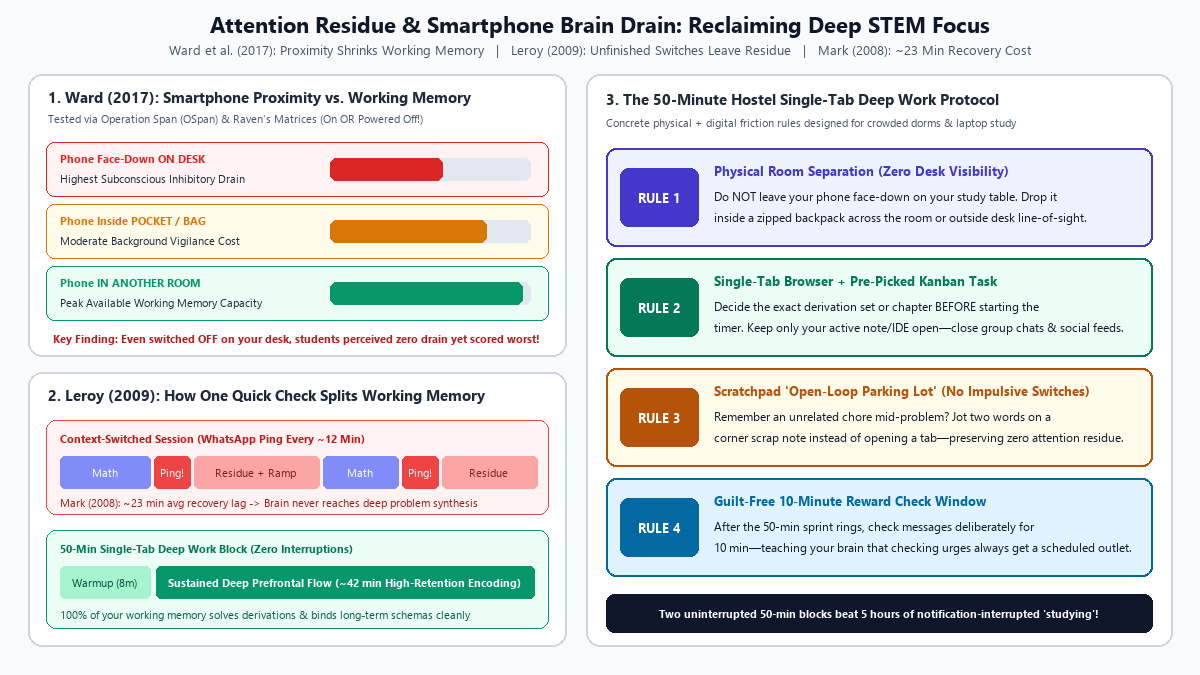
- Adrian Ward et al. (2017) — "Brain Drain" (*Journal of the Association for Consumer Research*): Researchers Adrian Ward, Kristen Duke, Ayelet Gneezy, and Maarten Bos asked students to solve demanding working-memory (**OSpan**) and fluid-reasoning (**Raven's Matrices**) tests under three randomized phone locations: face-down on the desk, stowed in a pocket/bag, or left in another room entirely. Participants whose phones stayed in another room scored highest, while the on-the-desk group suffered the sharpest drop—even when phones were completely silent and powered **OFF**! Worse still, participants falsely believed their phone placement had affected their focus "not at all."
- Sophie Leroy (2009) — "Attention Residue" (*Organizational Behavior and Human Decision Processes*): Professor Sophie Leroy proved that when you switch abruptly from an unfinished task (say, replying halfway to a hostel group debate or seeing an unresolved deadline message) back to a complex derivation, human attention does not snap instantaneously. A substantial chunk of working memory remains stuck chewing on the prior incomplete social thread—leaving your math problem starved of executive bandwidth.
- Gloria Mark, Daniela Gudith & Ulrich Klocke (2008) — *ACM CHI* Interruption Cost: Tracking knowledge workers under real interruptions, researchers observed that after shifting focus away from a task, it takes an average of **23 minutes and 15 seconds** to return fully to deep flow on the original thread. Check WhatsApp twice an hour, and your brain stays trapped in perpetual transition ramp-up all night.
The Silent Desk Tax: Flipping your phone face-down on Do-Not-Disturb right beside your keyboard does NOT restore full prefrontal capacity. Your brain expends continuous subconscious monitoring effort inhibiting the urge to check an object sitting within arm's reach—stealing working-memory slots needed to hold intermediate integral limits and circuit loops.
| Study Environment Condition | Available Working Memory (OSpan / Focus) | Residual Context Tax Per Hour | Real Retention Outcome for Technical Math / Code |
|---|---|---|---|
| Phone Face-Up / Face-Down on Desk | Lowest (chronic subconscious inhibitory drain) | High even before touching screen | Frequent sign errors, shallow slide skimming, midnight fatigue |
| Phone Silent Inside Pocket or Backpack | Moderate (visual trigger hidden; habit urge reduced) | Minimal if untouched; spikes after 1 peek | Works decently for routine homework sets and formatting |
| Phone Left Outside Desk Line-of-Sight / Room | Highest available working memory & reasoning | Near zero cognitive overhead | Sustained schema synthesis; crisp cold-recall derivations |
| 50-Min Single-Tab Sprint + Parking Lot | Maximum sustained deep prefrontal encoding | Zero mid-block tab-switch residue | Two blocks (~100 min) beat 5 hours of fragmented cramming |
Why Complex Derivations & Debugging Die First Under Residue
You can answer routine formatting tasks, fill attendance trackers, or watch passive lectures while glancing casually at chat notifications. Why do Calculus proofs, Compiler Design, Organic Synthesis, and Recursive Tree debugging fall apart instantly under attention residue?
Cognitive Load Theory explains the bottleneck: working memory holds only a tiny handful of novel interactive elements simultaneously—roughly **3 to 5 chunks** when processing unfamiliar math or code. Solving a multi-step engineering derivation consumes nearly 100% of those active chunks just tracking signs, coordinate axes, boundary assumptions, and intermediate expressions. When attention residue occupies even 1 or 2 slots with half-read peer drama or unfinished emails, mental overflow hits instantaneously—creating that miserable sensation of staring blankly at step 3 for twenty minutes.
The 50-Minute Hostel Single-Tab Deep Work Protocol
You do not need monastic willpower or expensive app blockers to fix fragmented focus. Engineer physical friction so deep work becomes the path of least resistance inside a noisy hostel or library:
- Enforce the "Arm's-Length Ban" (Physical Separation): Put your phone inside a zipped backpack on the opposite side of your room (or hand it to a roommate across the hall) for the next 50 minutes. Remove both visual sight and effortless reach.
- Declare One Concrete Output Before Hitting Start: Never sit down to vaguely "study Operating Systems." Write one concrete target card on our Study Kanban Board before starting—such as "Derive Producer-Consumer Semaphores + solve 3 PYQs cold." Ambiguity triggers procrastination tab-switching within four minutes.
- Use a Corner Scratchpad "Open-Loop Parking Lot": Whenever a sudden thought pops up mid-derivation ("Wait—did I submit the scholarship form?" or "Check lab timings!"), jot three quick words on a scrap paper beside your keyboard and stay inside your derivation. Capture stops the Zeigarnik itch cleanly without sacrificing attention residue!
- Close Every Browser Tab Except Your Active Study Artifact: Keep your PDF slides or notebook notes single-window cleanly inside Etudey, or digitize handwritten notebook sheets first via Handwriting Studio so you aren't hunting blindly through phone photos mid-session (triggering inevitable message notifications!).
- Schedule Guilt-Free 10-Minute Check Windows: When your 50-minute block ends, get up, grab water, and scroll messages freely for 10 minutes before resetting your next sprint.
If doubts block your flow mid-sprint, querying your own uploaded slides directly inside AIgom AI Tutor eliminates the worst source of modern attention residue—opening an open-web search tab that traps you down twenty unrelated links (all study methodology articles follow our Editorial & Verification Policy). Pair this distraction-free routine with clean peer course guides from Peer College Notes plus our guides on Ultradian Rhythms for Deep STEM Work and The Zeigarnik Effect & Open Loops.
Frequently Asked Questions
Why did putting my phone on Do-Not-Disturb face-down still hurt my focus?
In Adrian Ward's (2017) *Brain Drain* experiments, participants with phones powered **completely OFF** on their desks still performed significantly worse on working-memory tasks than peers whose phones were kept in another room. Simply knowing your primary communication hub sits within arm's reach triggers subconscious inhibitory effort.
Does checking for just 15 seconds really cost ~23 minutes of focus?
Gloria Mark's (2008) field research measured an average of **23 minutes and 15 seconds** to fully resume interrupted primary work when workers switched across contexts and intermediate secondary tasks before resetting. Even shorter micro-switches stack Sophie Leroy's attention residue, slashing derivation accuracy across the rest of the hour.
What if my college uses WhatsApp or Telegram for urgent class notices during study?
Unless an exam announcement is expected within that exact hour, checking messages every 50–60 minutes inside scheduled 10-minute breaks handles campus updates cleanly without fragmenting deep study sessions. True emergencies happen by phone call, not group chat pings.
How many 50-minute deep focus blocks can a student sustain daily?
Most engineering and science students sustain **3 to 4 genuinely uninterrupted 50-minute deep blocks per day** (~2.5 to 3.5 hours of pure prefrontal intensity)—especially alongside 75% attendance classes and labs. Trying to force 8 unfocused hours creates exhaustion with weak recall.
What should I do during the 10-minute break so residue doesn't carry into Block 2?
Avoid doom-scrolling high-arousal short-form video reels during short study breaks, which floods attention with dozens of unresolved emotional micro-threads. Walk down the hostel corridor, stretch, drink water, or handle quick logistics briefly before putting the phone back away.
Reclaim Three Clean Focus Hours Tonight
Real academic mastery rarely comes from punishing 10-hour all-nighters glued to five open tabs and a buzzing desk phone. Put your phone across the room tonight, park your active lecture notes inside Etudey, commit to two clean 50-minute single-tab blocks, and watch how much faster complex technical subjects lock into long-term memory.