
While unstructured college study groups routinely devolve into social distractions and passive listening, adopting Harvard physicist Eric Mazur’s Peer Instruction framework converts collaborative study into a high-yield cognitive accelerator. By combining timed silent problem sprints, blind polling, and Socratic peer debates, students achieve 100% active engagement and master complex engineering concepts.
The Study Group Tragedy: Social Comfort vs. Academic Output
Walk into any university campus library, student union, or hostel common room on a weekday evening, and you will witness an identical scene. Four or five classmates gather around a table with laptops open, textbooks piled high, and highlighters ready. The stated intention is noble: “We’re going to conquer thermodynamics Unit 3 together.”
Within twenty minutes, the structural decay begins. One student discovers a humorous video on social media and passes their phone around. Another launches into an extended complaint about a professor’s grading policy. A third student volunteers to go on a snack run.
When the group finally addresses a practice exam question, the most academically confident student grabs the whiteboard marker and begins solving the derivation. The other three students nod along in passive agreement, copying equations into their notebooks while experiencing a dangerous psychological phenomenon: the illusion of shared competence.
Three hours later, the session disbands. Everyone feels good because they spent the evening with friends. Yet, when seated alone in the examination hall forty-eight hours later, three of the four students discover they cannot reproduce the derivation unassisted.
Unstructured study groups suffer from three fatal cognitive flaws:
- Social Loafing: When responsibility for problem-solving is diffuse, individual working memory disengages. Passive observation of another person solving a math problem produces negligible synaptic consolidation.
- The Dominant Voice Bias: In open group discussions, the most vocal or socially dominant student dictates the solution path, even if their foundational physics assumptions are flawed. Quieter students suppress valid counter-arguments to avoid social friction.
- Friction Avoidance: True learning requires cognitive struggle. When an engineering problem produces mental discomfort, unstructured groups instinctively escape into social chit-chat to relieve psychological tension.
To harvest the extraordinary benefits of collaborative learning without succumbing to social distraction, students must abandon informal gatherings and adopt the structured protocol of Peer Instruction.
“Explaining a concept to an unconvinced classmate is the highest form of active retrieval. If you cannot defend your mathematical derivation under the rigorous scrutiny of an intelligent peer, you do not truly understand it.”
The Cognitive Science of Peer Instruction: The Eric Mazur Discovery
The pedagogical foundation of high-yield collaborative study was established in 1991 by Dr. Eric Mazur, the Balkanski Professor of Physics and Applied Physics at Harvard University.
Mazur made a startling discovery: despite receiving glowing student evaluations for his lecture delivery, his Harvard undergraduates could memorize formulas and plug numbers into standard textbook problems, but completely failed qualitative, conceptual questions testing physical first principles.
To solve this, Mazur pioneered Peer Instruction. Instead of lecturing for an hour, he posed conceptual questions (“ConcepTests”), instructed students to think silently, polled their individual answers, and then instructed them to turn to their neighbors and convince each other of their chosen answer.
The results were astonishing: student conceptual mastery doubled, problem-solving accuracy surged, and long-term retention outpaced traditional lecture methods across every demographic.
The Curse of Knowledge and the Peer Advantage
Why can an undergraduate peer often explain a difficult derivation better than a world-class university professor?
In cognitive psychology, this phenomenon is explained by the Curse of Knowledge (or the Expert Blind Spot). A tenured professor mastered calculus thirty years ago. Through decades of practice, the intermediate conceptual hurdles have become automated and neurologically compressed. When explaining a theorem, the expert routinely skips steps they consider “obvious,” unaware of where a novice’s working memory gets stuck.
In contrast, a classmate who understood the concept twenty minutes ago still vividly remembers the exact conceptual barrier they had to overcome. They speak the same linguistic and cognitive dialect, allowing them to translate the mathematical pivot with surgical clarity.
The 4-Stage Peer Instruction Protocol for Study Groups
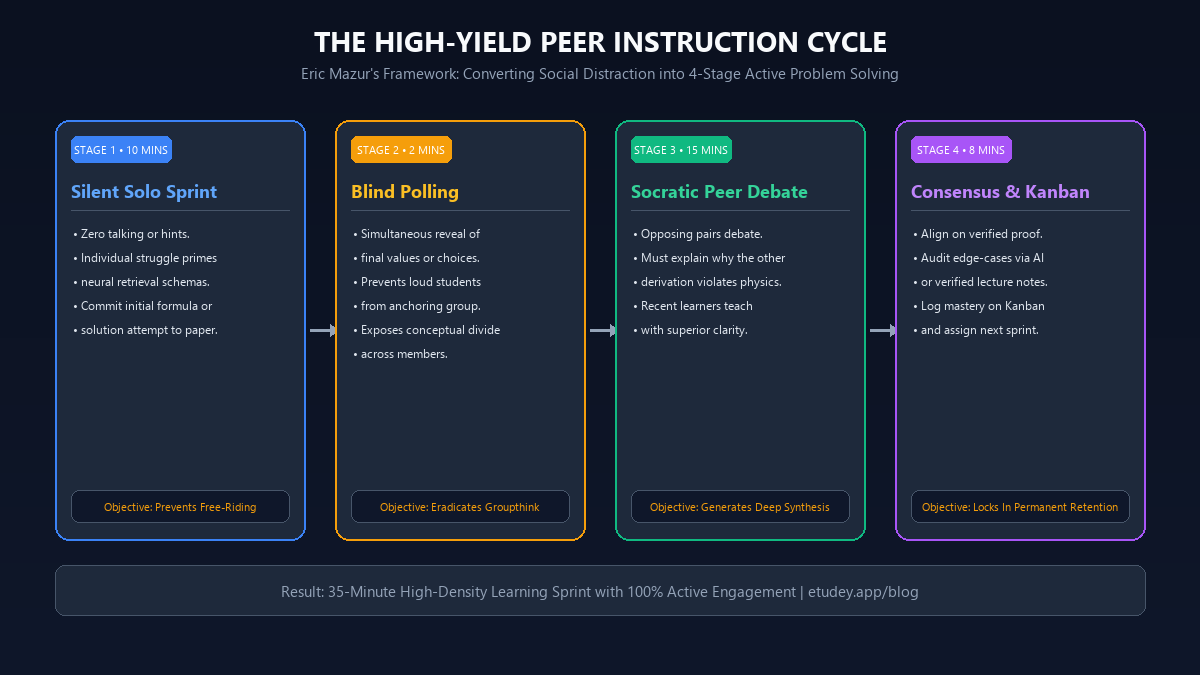
To implement Eric Mazur’s methodology in your university study group, structure your problem-solving sessions into repeating 35-minute sprints governed by four non-negotiable stages:
Stage 1: The Silent Solo Sprint (10 Minutes)
When a new problem, past-year exam question, or derivation is selected, all conversation immediately ceases. Pencils touch paper in complete silence for ten minutes.
Every member must independently construct their own free-body diagram, write down the governing physical laws, and attempt the solution on their personal scrap pad.
Why this is non-negotiable: Individual cognitive struggle primes your neural retrieval networks. Without the Silent Solo Sprint, weaker members immediately surrender their agency to the strongest student, destroying individual learning.
Stage 2: Blind Polling and Stance Declaration (2 Minutes)
At the ten-minute mark, all members simultaneously reveal their final numerical answer, chosen governing equation, or conceptual thesis.
This can be done using index cards, mini-whiteboards, or writing the final value at the top of their notebook.
Why this is non-negotiable: Simultaneous revelation prevents groupthink. It prevents dominant personalities from saying, “Obviously the answer is 42 MPa,” and having everyone else nod along dishonestly. It exposes the exact fault lines across the group.
Stage 3: Socratic Peer Debate (15 Minutes)
If all group members arrived at the identical correct answer with matching derivations, the problem is mastered; log the win and move forward.
However, in 80% of challenging STEM problems, answers will diverge. This is where the magic of Peer Instruction occurs. Pair members who hold opposing answers:
- The Golden Ground Rule: You are not permitted to simply assert that your answer is correct. You must explain why your peer’s mathematical assumption or boundary condition violates physical reality.
- Student A explains: “I assumed isothermal expansion because the container is described as thin-walled copper.”
- Student B counters: “Yes, but the piston moves at high velocity, which means the process occurs too rapidly for thermal equilibrium; it must be modeled as adiabatic.”
This dialectic exchange forces both students to articulate their mental schemas, uncover hidden misconceptions, and synthesize first principles.
Stage 4: Consensus, AI Audit, and Kanban Logging (8 Minutes)
During the final eight minutes of the sprint, the group aligns on the verified solution. If the group reaches a deadlock where members cannot reconcile their mathematical approaches, consult external verified resources or an AI tutor.
Once the verified solution is understood, each member records the key takeaway in their personal notes, logs the topic as “Mastered” on their shared study board, and takes a brief two-minute water break before launching the next sprint.
Comparative Analysis: Unstructured vs. Solo vs. Peer Instruction
To understand the cognitive efficiency of the Peer Instruction model, examine how it compares to conventional study methods across key academic metrics:
| Evaluation Metric | Unstructured Group (The Hostel Trap) | Solo Studying (The Isolated Grind) | High-Yield Peer Instruction Group |
|---|---|---|---|
| Active Engagement Rate | Low (20% – 30%); one speaks, three listen passively | High (80% – 90%); but prone to distraction & fatigue | Maximum (95% – 100%); enforced individual accountability |
| Social Distraction Risk | Extremely High (+70% time lost to non-study banter) | Moderate (Smartphone & digital distractions) | Minimal; structured timers eliminate aimless chatting |
| Blind-Spot Detection | Poor; group reinforces shared misconceptions | Zero; cannot detect your own unrecognized errors | Superior; peers instantly flag invalid mathematical leaps |
| Conceptual Retention (30-Day) | Poor (< 25% retention of complex proofs) | Moderate (50% – 65% depending on active recall) | Exceptional (> 80% via Socratic verbalization) |
| Optimal Academic Use Case | None (Social recreation, not effective study) | Initial reading, flashcard memorization, writing essays | Complex STEM numericals, PYQ past-paper audits, exam prep |
The 3 Non-Negotiable Rules of High-Yield Study Groups
To ensure your study group remains a high-performing academic asset rather than degenerating into a social club over the semester, enforce three operational rules:
Rule 1: The Law of Three to Four Members
Never form an academic study group with more than four members. Research into small-group dynamics demonstrates that as group size expands to five or six, coordination friction rises exponentially, social loafing becomes inevitable, and side-conversations split the table. Three or four is the mathematical sweet spot for diverse perspectives without conversational fragmentation.
Rule 2: The Pre-Meeting Syllabus Division
Do not show up to a study session asking: “What should we study today?”
Twenty-four hours before meeting, divide past-year university examination papers among group members:
- Member 1 audits 2023 questions on Fluid Kinematics.
- Member 2 audits 2023 questions on Navier-Stokes Simplifications.
- Member 3 audits 2023 questions on Boundary Layer Theory.
Each member arrives with three high-yield problems selected, having attempted them in advance. This eliminates thirty minutes of organizational paralysis at the start of every session.
Rule 3: The “No Spectators” Protocol
High-yield study groups operate on mutual reciprocity. If a member repeatedly arrives without completing the assigned preparatory reading, or sits passively during the Silent Solo Sprint waiting for others to feed them answers, they must be politely removed from the active problem-solving group. A study group is an intellectual training partnership, not an auditorium lecture.
Integrating Peer Instruction with the Etudey Academic Platform
Modern digital tools allow student study groups to coordinate their problem-solving sprints, divide past-year papers, and resolve conceptual deadlocks with frictionless velocity:
- Shared Task & Topic Tracking: Use the visual Etudey Study Kanban board to organize your group’s exam syllabus. Create cards for past university exam question sets, assign them to specific group members, and track topics from “In Progress” to “Peer-Verified Mastered.”
- Verified Curricular Reference Keys: When your group reaches a heated deadlock in Stage 3 and needs an authoritative benchmark solution, consult the Etudey Verified Notes Archive. Cross-reference top-ranker exam solutions from your university syllabus to confirm official marking schemes and step distributions.
- The Socratic Group Mediator: If two members propose conflicting derivations and neither can convince the other, submit the prompt to AIgom Tutor. AIgom will not merely blurt the final answer; it will interrogate both assumptions and guide the group through Socratic steps to identify the physical flaw.
- Timed Sprint Pacing: Keep your group strictly disciplined to the 10-minute solo and 15-minute debate windows by using Etudey Emergency Exam Mode to manage countdown timers and focus intervals.
Frequently Asked Questions
What should we do if one member of our study group is significantly behind academically?
An academic knowledge gap can actually benefit both students under the Peer Instruction framework. Explaining foundational concepts to a struggling peer reinforces the stronger student’s conceptual mastery (the Protégé Effect). However, the gap must not be a preparation gap. As long as the struggling student works diligently during the Silent Solo Sprint and actively engages in debate, the dynamic remains productive. If the student refuses to prepare in advance, they become a cognitive anchor and should be transitioned to solo remediation.
How do we remove a close friend who constantly derails the study group with social chatter?
Never make the conversation personal. Frame the shift around structural study rules: “We love hanging out with you, but our semester grades are slipping, so we’re enforcing a strict silent-sprint timer format during study hours. Let’s grab dinner or coffee at 8:00 PM after the session, but during study time we have to stick to zero chatting.” When you enforce strict timers, chronic procrastinators usually self-select out because they find disciplined focus unappealing.
What is the optimal weekly ratio between solo studying and group study?
For rigorous university STEM and business curricula, the golden ratio is approximately 70% Solo Studying to 30% Peer Instruction. You must spend the majority of your weekly study hours reading textbooks, authoring initial notes, and building baseline working memory independently. Reserve group sessions (2 to 3 hours, twice per week) for high-stakes problem sets, past-year question paper audits, and peer testing.
Can Peer Instruction work effectively over Discord, Zoom, or Google Meet?
Yes, provided you enforce the exact same discipline. In Discord or Zoom: during Stage 1 (Silent Solo Sprint), all members mute their microphones and turn cameras on. In Stage 2, members paste their final numerical answers into the text chat simultaneously on the count of three. In Stage 3, unmute for Socratic debate. Virtual groups often outperform in-person groups because physical screen-sharing and digital whiteboards streamline diagram comparisons.
How can we adapt this protocol specifically for engineering lab viva preparation?
Dedicate a 60-minute session to “Hot-Seat Viva Simulation.” One member sits in the “hot seat” as the examinee. The remaining three act as tough external examiners, firing rapid conceptual questions from past lab manuals (using the Etudey Notes Archive for sample viva questions). After 10 minutes of interrogation, the group pauses to give constructive feedback on the examinee’s first-principles explanations and body language before rotating the hot seat.
Conclusion: The Multiplier Effect of Intellectual Collaboration
In high-stakes academic environments, isolated studying is an uphill battle against cognitive fatigue, unrecognized blind spots, and procrastination. Unstructured group studying is a comfortable illusion that wastes precious time.
The Peer Instruction protocol gives you the best of both worlds: the rigorous focus of solo problem-solving paired with the explosive intellectual clarity of peer debate.
Form your team of three. Set your timer for ten minutes of absolute silence. Commit your formulas to paper, defend your reasoning with passion, and watch collaborative learning become your greatest academic advantage.