
An Open-Book Exam Strategy is a structured information-retrieval and time-triage architecture that treats reference textbooks not as an emergency learning crutch, but as an external data cache indexed for sub-ten-second access via color-coded edge tabs, single-page formula maps, and algorithmic search cutoffs.
Every engineering undergraduate remembers the profound relief of hearing a professor announce on the first day of class: “The midterm and final examinations for this course will be completely open-book and open-notes.” Smiles ripple across the lecture hall. Students mentally cross the course off their high-stress list, assuming that because textbook formulas, derivation tables, and lecture slides are legally permitted at their desks, the exam requires minimal memorization and virtually zero cramming.
Then exam day arrives. Students walk into the auditorium dragging rolling luggage stuffed with three different 1,200-page textbooks, two binders of printed lecture slides, five years of unsolved homework assignments, and a stack of loose-leaf tutorial solutions. Two hours later, the room is enveloped in a palpable aura of collective devastation. The class average comes back at 41%. Half the class failed to even reach the final question, having spent 45 minutes frantically thumbing through indices trying to locate an equation that was never there.
This is The Open-Book Paradox: across university engineering, physics, and applied science faculties worldwide, open-book examinations consistently yield lower median scores than standard closed-book tests. The reason is not that professors are inherently sadistic; it is that students completely misunderstand the fundamental nature of open-book cognitive testing.
The Cognitive Psychology of The Open-Book Paradox
To master an open-book technical exam, you must first recognize the structural shift in how professors construct the question paper. When an exam is closed-book, instructors are constrained by human memory limitations. They must award a significant portion of marks (typically 40% to 50%) to direct recall and straightforward procedural application: stating governing physical laws, defining boundary assumptions, and executing standard derivations.
The moment an exam is declared open-book, that baseline constraint vanishes. In the framework of Bloom’s Revised Cognitive Taxonomy, open-book exams completely eliminate Level 1 (Remembering) and Level 2 (Understanding). The question paper begins directly at Level 4 (Analyzing), Level 5 (Evaluating), and Level 6 (Creating).
“An open-book examination is not an invitation to look up how to solve a problem; it is an examination designed under the assumption that you already know the material completely, and only need to verify empirical constants and edge-case boundary conditions.” — Engineering Faculty Assessment Standards Committee
When an instructor writes an open-book paper in Fluid Mechanics, Structural Dynamics, or Digital Signal Processing, they operate under three implicit premises:
- Unprecedented Problem Geometries: You will not see standard textbook problems with numbers swapped. You will be given non-standard boundary conditions (e.g., an asymmetric composite cantilever beam with temperature gradients across the web, or a transient thermodynamic cycle operating on an exotic non-ideal gas).
- Calculated Time Starvation: The examination is calibrated so that an expert who never opens the textbook can finish with barely fifteen minutes to spare. Every minute you spend looking at an index is a minute stolen directly from mathematical execution.
- The Search-Latency Trap: If finding an equation takes more than 60 seconds, your working memory suffers context fragmentation. You lose the cognitive thread of the derivation, leading to algebraic and sign errors downstream.
The “Luggage Fallacy” & Desk Ergonomics
The single most dependable predictor of exam failure is the physical volume of material a student brings into the exam hall. Bringing four textbooks, three spiral notebooks, and five past-year papers is an act of psychological panic that destroys performance through three mechanical bottlenecks:
- Visual Clutter and Physical Obstruction: When your exam desk is buried under a mountain of paper, you lose the clean physical layout required for engineering scratchpad calculation. You drop pencils, knock over water bottles, and spend valuable seconds shifting heavy hardcovers just to write down an integral.
- Analysis Paralysis: When faced with a complex vibration problem, having three different textbooks (e.g., Rao, Inman, and Thomson) forces your brain into a meta-decision: “Which author has the best notation for damping ratios?” You spend seven minutes cross-checking different variable conventions instead of calculating.
- False Security Procrastination: Relying on external materials suppresses active retrieval practice during the revision weeks leading up to the test. You skim notes thinking, “I have the book anyway,” failing to build the deep procedural fluency required to synthesize novel engineering models.
The Desk Hygiene Rule: You are permitted exactly three physical artifacts on your examination desk:
- Your designated primary reference textbook (or approved course handbook).
- Your single-sheet laminated 1-Page Master Formula Map.
- Your writing tools, calculator, and official exam booklet. Everything else stays inside your backpack under the desk.
| Tactical Dimension | The Unprepared “Luggage” Method | Passive Highlighting & Sticky Notes | The 3-Tier Indexing & Triage Protocol |
|---|---|---|---|
| Desk Payload | 3–5 full textbooks, loose papers, printed slide decks | 1 textbook with 50 unorganized identical sticky flags | 1 primary book (edge-indexed) + 1-Page Master Map |
| Formula Access Speed | 3 to 7 minutes of chaotic index thumbing | 45 to 90 seconds searching through colored tabs | Instant (< 3 seconds from Master Sheet) |
| Empirical Data Lookup | Haphazard flipping to back appendices | Searching for property tables by memory | Sub-5-second targeted access via Amber outer tabs |
| Time Allocation | Spends 40% of exam duration searching references | Spends 25% of exam duration flipping pages | Spends < 5% referencing, 95% synthesizing solutions |
| Search Abort Discipline | Never gives up; spends 25 min hunting one formula | Abandons question after 10 min of panic | Strict algorithmic 5-minute search cutoff rule |
| Typical Score Range | 30% – 48% (severe time-starvation failure) | 55% – 68% (incomplete final questions) | 85% – 98% (top decile finish with time to review) |
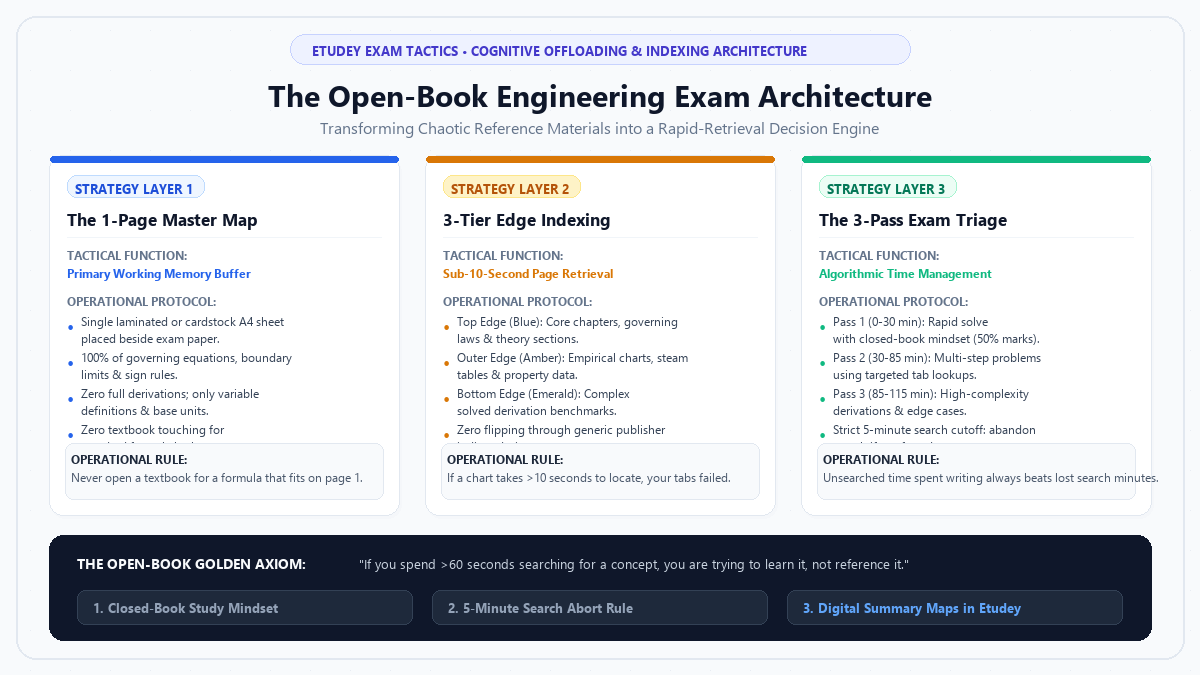
Layer 1: The 1-Page Master Formula Map
The foundation of the indexing protocol is the 1-Page Master Formula Map. Even if the examination allows an unlimited library, you must prepare as if you are only permitted a single sheet of paper. This sheet acts as your primary working memory buffer.
Using Etudey Notes or structured digital grid canvases in the Etudey Handwriting Studio, construct a single two-sided A4 document organized into distinct thematic modules. Every module must contain:
- The Fundamental Governing Equation: Written symbolically with zero fluff (e.g., Navier-Stokes in cylindrical coordinates, or Maxwell’s curl equations).
- The Invariant Coordinate Axes & Sign Conventions: Sketches of coordinate directions ($x, y, z$ or $r, \theta, z$), normal vectors, and clockwise vs. counter-clockwise torque signs.
- Validity Boundaries: Explicit operational constraints where the formula fails (e.g., “Valid only for incompressible, laminar flow with $\text{Re} < 2300$” or “Elastic region only: $\sigma < \sigma_y$”).
- Direct Page Anchors: A small bracketed reference pointing to the exact page number of your primary textbook where the full derivation and empirical charts live (e.g., [Shigley p. 412]).
When solving problems during the exam, 90% of your numerical and algebraic operations should flow directly from this single master sheet. You only touch the heavy textbook when you need specific empirical lookups (friction factors, steam tables, stress concentration charts) or to verify a rare edge-case differential identity.
Layer 2: The 3-Tier Edge-Tab Indexing System
When you do need to consult your physical textbook, searching through the publisher’s alphabetical subject index is suicide. Technical indices are notoriously fragmented: is Mohr’s circle listed under Circle, Mohr, Stress, or Transformation? By the time you figure it out, three minutes have elapsed.
Instead, convert your textbook into a rapid-retrieval hardware cache using the 3-Tier Edge-Tab Indexing System with heavy-duty, writeable plastic tabs positioned strategically along the three open edges of the book:
1. Top Edge — Conceptual Domains & Governing Chapters (Blue Tabs)
Place blue tabs exclusively along the top edge of the book, sticking upward. Use one tab per major syllabus unit (e.g., Beam Bending, Torsion, Columns, Energy Methods). Label each tab with a crisp 3-letter acronym. When a question specifies a domain, your left hand instantly opens the book to the top-level chapter without scanning.
2. Outer Edge — Empirical Charts, Tables & Material Appendices (Amber Tabs)
The right outer edge is the most ergonomically accessible zone. Reserve this territory exclusively for data you cannot possibly memorize:
- Psychrometric charts, Moody diagrams, and Mollier diagrams.
- Steam property tables (saturated water, superheated steam, subcooled liquid).
- Structural steel cross-section geometry appendices (W-shapes, C-channels, angle irons).
- Standard resistor/capacitor E-series tables and transistor transfer characteristics.
Every tab on the outer edge must feature the exact variable or chart name in bold black permanent marker. Stagger the tabs so no tab obscures the one behind it.
3. Bottom Edge — Benchmark Solved Examples & Edge Cases (Emerald Tabs)
Place green tabs along the bottom edge pointing downward. These tabs flag the 5 to 8 most comprehensive, multi-step solved problems in the textbook that illustrate tricky edge cases: indeterminate beam configurations, combined convective-radiative heat transfer networks, or state-space control conversions. If you encounter an exam problem with obscure boundary conditions, a single flip to the bottom edge provides an immediate benchmark derivation template.
Layer 3: The 3-Pass Exam Triage Protocol
In a standard closed-book exam, you generally solve problems sequentially. In an open-book engineering exam, linear execution is lethal. Because question papers are designed with asymmetric difficulty spikes, students frequently get stuck on Problem 1, spend 40 minutes hunting through literature, and run out of time before even reading the straightforward 25-mark problem at the back of the test.
You must execute the 3-Pass Algorithmic Triage Protocol:
Pass 1: The Closed-Book Velocity Sprint (Minutes 0 – 30)
Open the exam booklet and read every problem. With your textbook firmly closed, immediately solve all questions (or sub-parts) that require direct analytical setup, standard calculus, or familiar algebraic execution. Rely solely on your memory and your 1-Page Master Map. In a well-designed exam, 35% to 50% of the total marks can be captured in this first sprint without ever opening a book. This secures your passing floor and builds immense psychological momentum.
Pass 2: Targeted Synthesis & Tab Lookups (Minutes 30 – 85)
Now turn to the multi-step design problems that require empirical parameter lookup. Open your textbook directly via your Amber outer-edge tabs to extract kinematic viscosities, yield strengths, or convective coefficients. Plug these values into your governing equations and execute the arithmetic. Because your core equations were already outlined on your Master Map, your textbook interactions are surgical: open tab, record constant, close book, solve.
Pass 3: The Novel Frontier & The 5-Minute Search Cutoff (Minutes 85 – 115)
You are now left with the novel, complex questions specifically engineered to test first-principles reasoning. Here, you enforce the 5-Minute Search Cutoff Rule:
The 5-Minute Search Abort Rule: If you cannot identify the relevant governing equation, case study, or empirical relationship within five minutes of searching your reference materials, stop searching immediately. Close the book. Write down the fundamental conservation laws ($\Sigma F = ma$, First Law of Thermodynamics, or Kirchhoff’s Laws) and construct your own first-principles derivation from scratch.
In university grading rubrics, professors award 70% to 80% of problem marks for correct physical framing, assumptions, and logical differential setups, even if your final numerical answer is incomplete. A student who spends 20 minutes searching for a magic formula and leaves the page blank receives zero. A student who aborts the search and writes a rigorous first-principles derivation receives 18 out of 25 marks.
Synthesizing Digital Reference Hubs for Open-Book Mastery
Preparing an open-book reference library is not a task for the night before the exam. It requires systematic curation throughout the entire semester. Using Etudey Notes, you can digitize textbook derivations, professor hints, and assignment edge cases into atomic, searchable modules.
During revision sessions, paste complex assignment problems into AIgom with the prompt: “Synthesize this problem into an open-book exam challenge. Alter the boundary conditions so standard textbook formulas fail, and identify which fundamental physical laws must be applied to solve it.” This trains your brain to anticipate the exact structural twists university professors use to defeat lazy textbook referencing.
Track your indexing progress across subjects with your Etudey Kanban Board: create columns for Chapter Read, Master Map Extracted, Edge Tabs Affixed, and Timed Open-Book Mock Completed. By testing your indexing architecture under simulated exam conditions, you eliminate search friction before walking into the examination hall.
Frequently Asked Questions
Are digital open-book exams on laptops easier than paper-based open-book exams?
No, they are often significantly harder. While a laptop allows you to press Ctrl+F inside PDF textbooks and lecture slides, search queries often return 80 different occurrences of a keyword, creating severe cognitive overwhelm. Furthermore, computer-based open-book exams often feature algorithmic parameter randomization, meaning your question numbers and boundary configurations are uniquely generated for your terminal, preventing any memorized answer matching.
Can I use sticky notes instead of permanent plastic edge tabs?
Standard paper sticky notes are not recommended for engineering textbooks. During high-intensity exam flipping, paper notes easily tear, bend, crumple, and fall out. Use rigid, writeable plastic index tabs (such as Post-it Solid Index Flags or Avery Ultra Tabs) that extend exactly 1 centimeter past the page edge and cannot be dislodged when sliding books in and out of your bag.
What should I do if a formula I need is completely missing from my book?
Do not panic. If a formula is truly missing from the primary course textbook, the exam question was intentionally designed to be derived from first principles. State your baseline assumptions clearly, write down the foundational conservation equation (mass, energy, or momentum balance), and perform the algebraic integration step by step. Professors award overwhelming partial credit for sound methodology.
How many mock open-book exams should I take before finals?
Complete at least two full-length past-year papers under strict timed conditions using only your designated book and 1-Page Master Map. If you find yourself searching for a formula for more than two minutes during a mock test, immediately add that formula to your Master Sheet. The mock exam is the ultimate stress test for your indexing architecture.
Is it cheating to write annotations in my textbook margins?
Check your university’s specific examination policy. Most engineering faculties permit hand-written marginal notes, highlighting, and tab flags in standard textbooks, but strictly prohibit loose inserted pages, printed solution manuals, or worked past-year exam sheets. Always verify regulations with your course coordinator at least two weeks before the examination.
Transform Your Reference Materials into an Unfair Advantage
An open-book exam is not a vacation from studying; it is the ultimate test of your academic engineering systems. When you replace chaotic luggage piles with the 3-Tier Edge-Tab Indexing System and anchor your problem-solving in a single-page Master Formula Map, you transform reference textbooks from an intimidating burden into a high-speed precision instrument.
Open Etudey Notes today, launch the Handwriting Studio, and begin drafting your Master Formula Maps. Test your understanding against synthetic open-book scenarios with AIgom, and discover the calm, decisive clarity of entering your next technical exam with an unshakeable operational protocol. Explore the complete academic OS on the Etudey Platform now.