
A binary semaphore is not just a mutex—and confusing lock ownership with thread signaling costs marks on every Operating Systems exam. Mastering concurrency requires three mental models: non-atomic race conditions, strict Mutex ownership versus Semaphore permit counters, and breaking Coffman deadlock cycles through lock ordering and Banker's Algorithm.
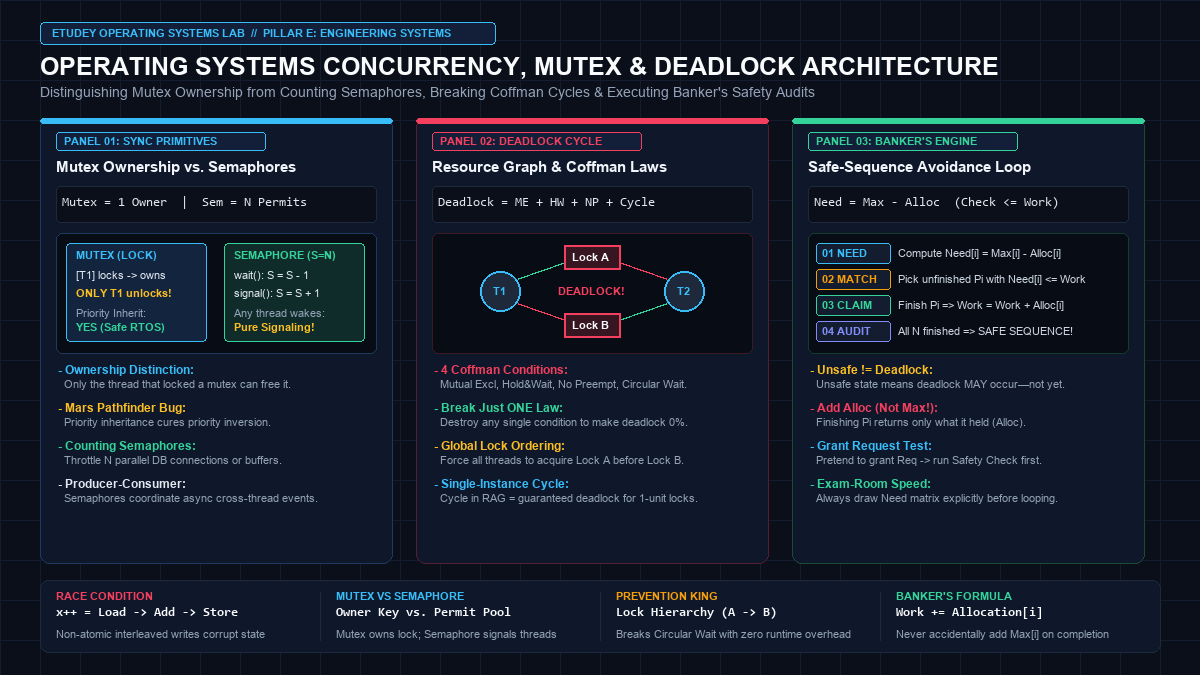
Figure 1.0: The complete Operating Systems concurrency architecture—distinguishing Mutex ownership from counting Semaphores, mapping Coffman Resource Allocation cycles, and executing Banker's safety checks.
1. Why Even Simple Code Like balance++ Corrupts Memory
Every Computer Science and Computer Engineering student writes their first multi-threaded C or Java program expecting clean arithmetic: spin up two threads, have each thread execute counter++ one million times, and print the total. Instead of 2,000,000, the terminal prints 1,348,912—and a completely different wrong number every single time you run it!
Why? Because a single line of C code is not atomic inside the CPU. The hardware splits counter++ into three separate machine instructions: (1) LOAD counter from RAM into a CPU register, (2) ADD 1 inside the ALU, and (3) STORE the register back into RAM. If the OS scheduler preempts Thread 1 right after Step 1—while both threads hold 100 in their private registers—both threads add 1 and write back 101, silently erasing an entire increment! This timing-dependent data corruption is a Race Condition, and the block of code touching shared memory is a Critical Section.
2. Mutex vs. Semaphore: The Ownership Distinction Everyone Gets Wrong
In university OS exams and backend systems interviews, the most famous trick question is: "Isn't a binary semaphore (initialized to 1) identical to a mutex?" Answer "yes," and you lose the question instantly. Here is the physical intuition that makes the difference unforgettable:
- A Mutex Is a Bathroom Key (Strict Ownership): Only one thread can hold the key to enter the critical section, and ONLY the exact thread that locked the mutex is legally permitted to unlock it. Because the OS kernel knows exactly who owns the key, a mutex supports Priority Inheritance—temporarily boosting a low-priority key-holder so it doesn't stall a high-priority mission-critical thread (the exact bug that repeatedly rebooted NASA's 1997 Mars Pathfinder rover!).
- A Semaphore Is a Parking-Lot Permit Counter (Signaling Mechanism): Invented by Edsger Dijkstra using Dutch operators
P()(proberen / wait: decrement \( S \)) andV()(verhogen / signal: increment \( S \)), a semaphore has zero concept of ownership! Thread A (a Consumer) can sleep onwait(items), and a completely different Thread B (a Producer—or even a hardware interrupt handler!) callssignal(items)to wake Thread A up.
| Sync Primitive | Mental Analogy | Strict Ownership? | Priority Inheritance | Primary Engineering Use-Case |
|---|---|---|---|---|
| Mutex | Single room key | Yes (Owner unlocks) | Supported | Protecting shared memory / critical sections cleanly. |
| Binary Semaphore | 1-slot event bell | No (Any thread signals) | Not possible | Cross-thread event signaling & execution ordering. |
| Counting Semaphore | N-spot parking gate | No | Not possible | Bounding N database connections or producer-consumer buffers. |
| Spinlock | Repeatedly knocking | Yes | N/A (Busy-waits) | Ultra-short (< 1 μs) kernel locks avoiding context-switch cost. |
3. The 4 Coffman Conditions of Deadlock (and How to Break Them)
Locks cure race conditions—but introduce a terrifying new failure mode: Deadlock. Suppose Thread 1 locks Account_A and requests Account_B, while Thread 2 simultaneously locks Account_B and requests Account_A. Neither thread can ever proceed; both freeze permanently until you reboot the server.
In 1971, Edward Coffman proved that deadlock can occur if and only if all four conditions hold simultaneously:
- Mutual Exclusion: At least one resource is non-shareable (only one thread holds it at a time).
- Hold and Wait: A thread holds at least one lock while sitting blocked waiting for additional locks.
- No Preemption: The OS cannot forcibly rip a lock away from a holding thread; it must be released voluntarily.
- Circular Wait: A closed cycle exists where \( T_1 \to T_2 \to \dots \to T_n \to T_1 \) each waits for a resource held by the next thread.
The Industry Prevention Gold Standard: Break Circular Wait via Lock Ordering
In real systems, breaking Mutual Exclusion or forcing Preemption breaks data integrity. The cleanest zero-overhead fix is breaking Circular Wait: assign every lock a global numeric ID and enforce an unbreakable rule—every thread must acquire locks strictly in ascending order (lock(min(A, B)) then lock(max(A, B))). Because no thread can ever request a lower-numbered lock while holding a higher-numbered one, a closed cycle becomes mathematically impossible! This exact asymmetric trick also solves the classic Dining Philosophers problem (just make the last philosopher pick up their right fork before their left fork!).
"The Banker's Algorithm grants a resource request if and only if there exists at least one safe future sequence in which every competing customer can finish and return all borrowed capital." — Edsger W. Dijkstra, Cooperating Sequential Processes (1965)
4. Mastering Banker's Algorithm in 4 Minutes (15-Mark OS Exam Machine)
While Lock Ordering prevents deadlock statically, Dijkstra's Banker's Algorithm avoids deadlock dynamically at runtime by refusing any allocation that pushes the OS into an Unsafe State. Let us run a complete exam-style Safety Audit so you never lose a mark:
Given Snapshot: 4 processes (\( P_0, P_1, P_2, P_3 \)) share 3 resource types (\( A, B, C \)). Current Available vector = [3, 3, 2].
- P0: Alloc = [0, 1, 0] | Max = [7, 5, 3] → Need = [7, 4, 3]
- P1: Alloc = [2, 0, 0] | Max = [3, 2, 2] → Need = [1, 2, 2]
- P2: Alloc = [3, 0, 2] | Max = [9, 0, 2] → Need = [6, 0, 0]
- P3: Alloc = [2, 1, 1] | Max = [2, 2, 2] → Need = [0, 1, 1]
- Initialize
Work = Available = [3, 3, 2]. Scan for any unfinished process withNeed ≤ Workelement-by-element. - Check P0:
[7,4,3] ≤ [3,3,2]? False (skip). Check P1:[1,2,2] ≤ [3,3,2]? TRUE! Run P1 to completion and reclaim itsAllocation [2,0,0]: \[ \text{Work} = [3,3,2] + [2,0,0] = \mathbf{[5, 3, 2]} \] - Check P2:
[6,0,0] ≤ [5,3,2]? False. Check P3:[0,1,1] ≤ [5,3,2]? TRUE! Run P3 and reclaimAllocation [2,1,1]: \[ \text{Work} = [5,3,2] + [2,1,1] = \mathbf{[7, 4, 3]} \] - Loop back to P0:
[7,4,3] ≤ [7,4,3]? TRUE! Run P0 and reclaim[0,1,0]→Work = [7,5,3]. - Finally P2:
[6,0,0] ≤ [7,5,3]? TRUE! Run P2 → All 4 processes finish! Valid Safe Sequence:<P1, P3, P0, P2>.
Exam Trap Warning: Never accidentally add Max[i] back into Work—the process only ever held Allocation[i]! And remember: an Unsafe State does NOT mean the system is already deadlocked—it simply means the OS can no longer guarantee avoiding deadlock if every process suddenly demands its full remaining Max.
5. Mastering Systems & OS Coursework Inside Etudey
Build rock-solid concurrency habits across your OS labs and exams inside Etudey:
- Draw Resource Allocation Graphs in Handwriting Studio: Sketch process circles, resource squares, and Banker's `Need` tables neatly so you catch cycles at a glance.
- Debug Concurrency Traces with AIgom Problem Solver: Pair our Rubber Duck Debugging Protocol with AIgom to verify producer-consumer semaphore ordering and Banker's grant-request checks.
- Organize OS Cheat Sheets in Interactive Notes & Flashcards: Drill the 4 Coffman laws, Mutex vs. Semaphore nuances, and track heavy OS C-programming lab milestones cleanly on Etudey Kanban (alongside our Big-O & Amortized Analysis Guide).
Frequently Asked Questions
What is the main difference between a Mutex and a Binary Semaphore?
Ownership. A mutex is a locking mechanism owned strictly by the thread that acquires it—only that same thread can unlock it, allowing the OS to apply priority inheritance. A binary semaphore is a signaling mechanism with zero ownership—one thread can block on wait() while an entirely different thread or interrupt wakes it up with signal().
Does a cycle in a Resource Allocation Graph always guarantee a deadlock?
Only when every resource type in the cycle has a single instance (like standard mutex locks). If resources have multiple instances (e.g., 3 identical printers), a cycle is a necessary condition for deadlock, but NOT sufficient—because an external thread outside the cycle might finish and free an instance to break the logjam.
What is the difference between Deadlock, Livelock, and Starvation?
In a Deadlock, threads are permanently blocked waiting for each other and consume 0% CPU. In a Livelock, threads remain active and keep changing state in response to each other (like two polite people stepping left-and-right in a hallway) without ever making forward progress. In Starvation, a low-priority thread is perpetually bypassed by higher-priority threads grabbing resources first.
Why don't Linux or Windows run Banker's Algorithm on every system call?
Banker's Algorithm requires every program to declare its exact maximum future resource demand upfront—impossible for dynamic user apps like web browsers—and incurs \( O(m \cdot n^2) \) runtime check overhead on every allocation. General-purpose OS kernels instead follow the pragmatic "Ostrich Algorithm" alongside strict internal lock ordering.
When should you use a Spinlock instead of a standard Mutex?
Use a spinlock only on multi-core CPUs when the critical section executes in a few nanoseconds—shorter than the time cost of putting a thread to sleep and performing two OS context switches. On a single-core CPU, a spinlock wastes an entire scheduler timeslice burning 100% CPU while the lock holder cannot even run!
Ace Operating Systems & Systems Interviews with Clarity
Trace Banker's safety tables step-by-step in AIgom, sketch Resource Allocation Graphs in Handwriting Studio, and organize your OS exam sprints on Etudey Kanban.