
Why does Python's list.append() claim O(1) time when full-array resizes require copying every single element? Big-O measures scaling slope rather than milliseconds, the Master Theorem is simply a recursion-tree tug-of-war between root and leaves, and amortized analysis proves geometric doubling pays for rare O(n) spikes in advance.
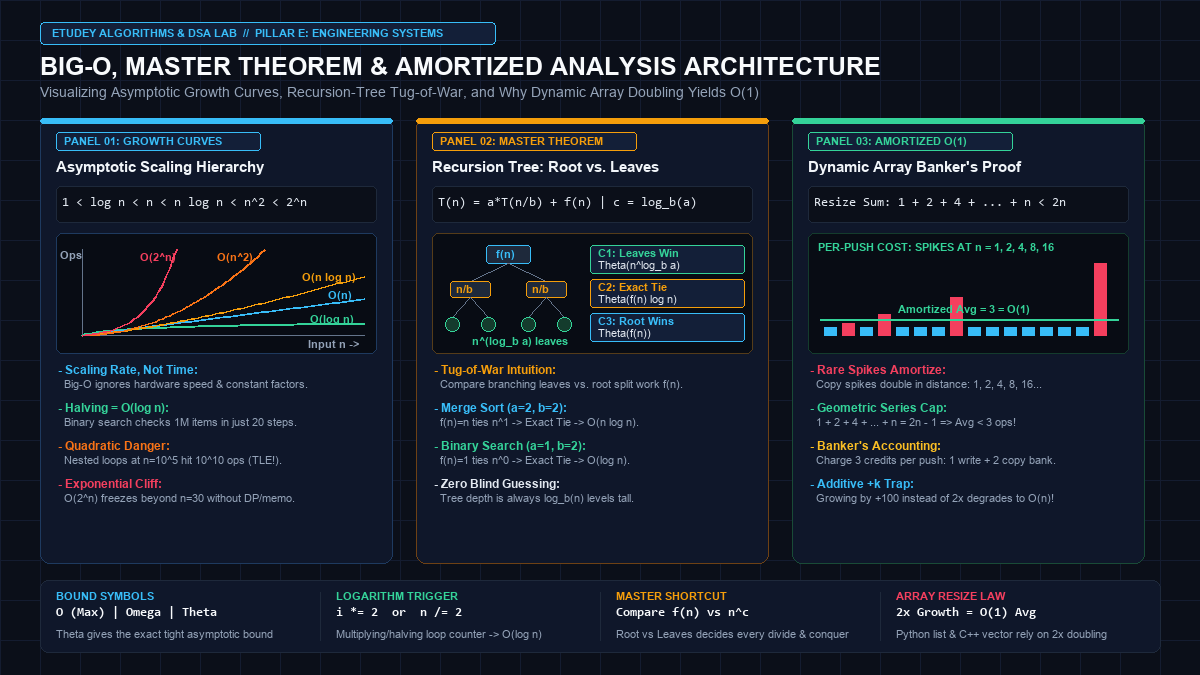
Figure 1.0: The complete algorithm complexity architecture—from asymptotic scaling curves and Master Theorem recursion trees to dynamic array Banker's Method amortized O(1) doubling proofs.
1. Why Students Hate Big-O (and What It Actually Measures)
Open any Data Structures & Algorithms (DSA) textbook during semester exams and you are immediately drowned in formal epsilon-delta quantifiers: "A function \( T(n) \in O(g(n)) \) if there exist positive constants \( c \) and \( n_0 \) such that \( 0 \le T(n) \le c \cdot g(n) \) for all \( n \ge n_0 \)." Students memorize flashcard tables—Merge Sort is \( O(n \log n) \), Hash Map lookup is \( O(1) \)—only to freeze the moment a midterm throws a non-standard nested loop, a weird recurrence relation, or asks why std::vector::push_back() is \( O(1) \) amortized despite triggering expensive memory reallocations.
Strip away the formal Greek notation and Big-O answers one dead-simple engineering question: "If I multiply my input size \( n \) by 10, how brutally does my operation count explode?"
Big-O does not measure wall-clock seconds—because a sloppy \( O(n^2) \) C++ loop on an RTX workstation beats a clean \( O(n \log n) \) Python script when \( n = 50 \). Instead, asymptotic notation measures the structural scaling curve as \( n \) grows toward millions of users or gigabytes of sensor data. At scale, constants vanish and the dominant growth curve dictates whether your server responds in 4 milliseconds or crashes with a Time Limit Exceeded (TLE) timeout.
Big-O vs. Big-Omega vs. Big-Theta in Three Sentences
- Big-O (\( O \)) — The Ceiling (Upper Bound): Your algorithm grows at most this fast (\( \le \)). Technically, Linear Search is \( O(n) \), and also legally \( O(n^2) \) or \( O(2^n) \)—though engineers always report the tightest useful upper bound.
- Big-Omega (\( \Omega \)) — The Floor (Lower Bound): Your algorithm requires at least this many operations (\( \ge \)). Comparison-based sorting has a famous information-theoretic floor of \( \Omega(n \log n) \).
- Big-Theta (\( \Theta \)) — The Tight Sandwich: Your algorithm is sandwiched both above and below by the exact same growth curve (\( = \)). Merge Sort is strictly \( \Theta(n \log n) \) in best, average, and worst cases.
2. The Scaling Reality Table (How to Predict TLE Instantly)
Modern competitive coding judges and university exam servers execute roughly \( 10^8 \) simple CPU operations per second. Keep this mental benchmark table locked in so you can choose the winning algorithm within 15 seconds of reading the input constraints:
| Complexity Class | Ops at \( n = 1{,}000 \) | Ops at \( n = 10^6 \) | Max Safe \( n \) (1s TLE) | Canonical Algorithms |
|---|---|---|---|---|
| O(1) | 1 | 1 | Unlimited | Array indexing, Hash Map lookup, Stack push/pop. |
| O(log n) | ~10 | ~20 | \( 10^{18} \) | Binary Search, Balanced BST (AVL/Red-Black) query. |
| O(n) | 1,000 | \( 10^6 \) | \( 10^7 \text{ to } 10^8 \) | Two Pointers, Sliding Window, BFS / DFS graph traversal. |
| O(n log n) | ~10,000 | \( \sim 2 \times 10^7 \) | \( \sim 10^6 \) | Merge Sort, Heap Sort, Divide & Conquer, FFT. |
| O(n²) | \( 10^6 \) | \( 10^{12} \) (Crash!) | \( \sim 5{,}000 \) | Nested pair loops, Bubble/Insertion Sort, 2D DP grid. |
| O(2n) | \( 10^{301} \) | Heat death | \( n \le 22 \) | Unmemoized recursive Fibonacci, brute-force subset sum. |
Three Tricky Exam Loop Patterns Decoded
- The Triangular Loop (
for i=0..n: for j=i..n): Runs \( n + (n-1) + \dots + 1 = \frac{n(n+1)}{2} \). Dropping the constant \( 1/2 \) still leaves \( \Theta(n^2) \)—halving a quadratic triangle never changes its asymptotic class! - The Multiplicative Counter (
for i=1; i < n; i *= 2): After \( k \) iterations, \( i = 2^k \). The loop terminates when \( 2^k = n \implies k = \log_2 n \), yielding \( \Theta(\log n) \). - The Harmonic Sieve Loop (
for i=1..n: for j=i; j <= n; j += i): Looks nested, so students blindly guess \( O(n^2) \). Look closer! The inner loop runs \( n/1 + n/2 + n/3 + \dots + n/n = n \sum_{i=1}^n \frac{1}{i} = n H_n \approx n \ln n \). Its true tight bound is \( \Theta(n \log n) \)!
3. The Master Theorem Without Memorization: Root vs. Leaves
Every divide-and-conquer algorithm follows a recurrence relation of the form:
\[ T(n) = a \, T\!\left(\frac{n}{b}\right) + f(n) \]Here, \( a \) is the number of recursive subproblems spawned at every split, \( n/b \) is the shrunken size of each subproblem, and \( f(n) \) is the extra work done to split and merge results at the current level. Textbooks ask you to memorize three terrifying epsilon inequalities. Throw them away and visualize a Recursion Tree Tug-of-War instead!
Because each level divides \( n \) by \( b \), the tree height is strictly \( \log_b n \). Since every node branches \( a \) ways, the total number of tiny base-case leaves sitting at the bottom of the tree is:
\[ \text{Leaf Count} = a^{\log_b n} = n^{\log_b a} \]Now simply compare the Root Work \( f(n) \) against the Leaf Explosion \( n^{\log_b a} \):
- Case 1 — Leaves Dominate (\( n^{\log_b a} \gg f(n) \)): Branching explodes so violently that almost all total work lives at the bottom leaves. Total time = \( \Theta(n^{\log_b a}) \). Example: Strassen's Matrix Multiply has \( T(n) = 7T(n/2) + n^2 \). Leaves = \( n^{\log_2 7} \approx n^{2.81} \), crushing root \( n^2 \implies \Theta(n^{2.81}) \).
- Case 2 — Exact Tie (\( f(n) = \Theta(n^{\log_b a}) \)): Every single level of the tree performs the exact same amount of work! Multiply per-level work by tree height \( \log n \): Total time = \( \Theta(f(n) \log n) \). Example: Merge Sort has \( T(n) = 2T(n/2) + n \). Leaves = \( n^{\log_2 2} = n^1 \), tying root \( n \implies \Theta(n \log n) \). Binary Search has \( T(n) = 1T(n/2) + 1 \implies n^0 = 1 \) ties root \( 1 \implies \Theta(\log n) \).
- Case 3 — Root Dominates (\( f(n) \gg n^{\log_b a} \)): Work shrinks geometrically down the tree, so the top call dominates everything. Total time = \( \Theta(f(n)) \). Example: \( T(n) = 2T(n/2) + n^2 \implies \) Root \( n^2 \) crushes leaves \( n^1 \implies \Theta(n^2) \).
"An algorithm must be seen to be believed, and the best way to understand recurrence costs is to visualize how work distributes across the levels of its recursion tree." — Thomas H. Cormen, Charles E. Leiserson, Ronald L. Rivest & Clifford Stein, Introduction to Algorithms (CLRS)
4. Amortized Analysis Decoded: Why Dynamic Array Doubling Is O(1)
This is one of the most frequent viva and FAANG interview stumpers: "A Python list or C++ std::vector stores items in contiguous RAM. When the buffer fills up, it allocates a new buffer of double the size (\( 2n \)) and copies all \( n \) existing items—an \( O(n) \) operation! So how can .append() possibly be \( O(1) \)?"
The secret is Amortized Analysis: averaging the worst-case cost across an entire sequence of \( n \) consecutive operations (NOT probabilistic average-case randomness—amortized guarantees hold 100% of the time even against an adversarial input!).
Proof 1: The Aggregate Geometric Sum
Suppose we start with capacity 1 and perform \( n \) consecutive appends (where \( n \) is a power of 2, say \( n = 16 \)). Every single append costs 1 operation to write the new item. Extra copy spikes ONLY occur when the array hits capacities \( 1, 2, 4, 8, \dots, n/2 \):
\[ \text{Total Cost of } n \text{ Appends} = \underbrace{n}_{\text{normal writes}} + \underbrace{(1 + 2 + 4 + 8 + \dots + n/2)}_{\text{doubling copy spikes}} \]Recall the magic of a geometric series: \( 1 + 2 + 4 + \dots + \frac{n}{2} = n - 1 \). Therefore:
\[ \text{Total Cost} = n + (n - 1) = 2n - 1 \implies \text{Amortized Cost per Append} = \frac{2n - 1}{n} < 2 = \mathbf{O(1)} \]Proof 2: The Banker's Accounting Method (Zero Algebra)
Imagine every new item arriving via .append() pays 3 gold coins at the door:
- 1 coin pays immediately for writing the item into its empty array slot.
- 2 coins are taped onto the item inside the savings bank: 1 coin to move itself during the next doubling, and 1 coin to help move an older partner item from the first half of the array!
By the time the array fills from \( n/2 \) to \( n \), the \( n/2 \) newly added items have banked \( 2 \times (n/2) = n \) gold coins—the exact amount needed to pay for copying all \( n \) items when doubling triggers! The bank balance never drops below zero, proving mathematically that amortized cost is strictly \( \le 3 = O(1) \).
Why Fixed Additive Growth (+100 Slots) Catastrophically Fails
What if a rookie engineer grows the array by a constant \( +k \) slots (say \( +100 \)) instead of multiplying by \( 2\times \)? Now resizes trigger every 100 elements: copy work becomes an arithmetic series \( 100 + 200 + 300 + \dots + n = \Theta(n^2 / k) \). Dividing by \( n \) appends yields \( \Theta(n) \) amortized per push—slowing a million appends from 20 milliseconds to 15 minutes!
5. Mastering Algorithms & DSA Inside Etudey
Move beyond passive LeetCode memorization by integrating visual complexity proofs into your Etudey study workflow:
- Draw Recursion Trees in Handwriting Studio: Sketch branch counts, level costs, and Banker's Method token balances cleanly on a grid canvas before exams.
- Verify Recurrences & Loops with AIgom Problem Solver: Stuck proving the tight bound of a gnarly nested loop or Master Theorem edge case? Pair our Rubber Duck Debugging Protocol with AIgom's step-by-step derivations.
- Build Your Interview Vault in Interactive Notes & Flashcards: Drill complexity bounds across sorting, graphs, and heaps, and track your semester DSA problem sprints on Etudey Kanban—helping you avoid the traps outlined in Escaping Tutorial Hell.
Frequently Asked Questions
Why do we drop constants and lower-order terms in Big-O notation?
Because as input size \( n \) approaches infinity, the highest-order term completely dwarfs smaller terms and constant multipliers. For example, in \( 5n^2 + 100n + 500 \), at \( n = 10^6 \) the \( 5n^2 \) term contributes \( 99.998\% \) of total runtime. Constants also depend on compiler optimization and CPU clock speed rather than the algorithm's fundamental scaling structure.
What is the difference between Average-Case complexity and Amortized complexity?
Average-case complexity relies on probability distributions over random inputs—meaning an unlucky adversarial input can still trigger terrible worst-case performance every single time (like Quicksort on an already-sorted array with poor pivot choice). Amortized complexity uses zero randomness: it guarantees that every possible sequence of \( n \) operations averages out cleanly, even under worst-case inputs.
Does the base of the logarithm matter in O(log n)?
No. By the change-of-base identity \( \log_b(n) = \frac{\log_2(n)}{\log_2(b)} \), switching from base 2 to base 10 simply multiplies the function by a fixed constant factor (\( 1/\log_2(10) \approx 0.301 \)). Since Big-O drops constant multipliers, \( O(\log_2 n) \), \( O(\log_{10} n) \), and \( O(\ln n) \) are asymptotically identical.
When does the Master Theorem fail to apply?
The standard Master Theorem requires subproblems of equal fractional size \( n/b \) where \( a \ge 1, b > 1 \), and requires \( f(n) \) to differ polynomially (by a factor of \( n^\epsilon \)) from \( n^{\log_b a} \) in Cases 1 and 3. It cannot directly solve subtractive recurrences like \( T(n) = T(n-1) + n \) (use recursion tree / summation) or uneven splits like \( T(n) = T(n/3) + T(2n/3) + n \) (use the Akra-Bazzi method).
Why do C++ vectors and Python lists grow by 1.5x or 2x instead of 10x?
Any multiplicative growth factor \( r > 1 \) guarantees \( O(1) \) amortized appends via geometric series convergence. Choosing \( r = 1.5 \) or \( 2.0 \) balances low copy overhead against memory waste: growing by \( 10\times \) would leave up to 90% of allocated RAM sitting empty, whereas \( 1.5\times \) (used by MSVC/Folly) even allows previously freed memory blocks to be reused cleanly by the heap allocator.
Decode Algorithms Visually—Zero Rote Memorization
Sketch recursion trees in Handwriting Studio, test tricky loop bounds step-by-step in AIgom, and organize your DSA interview prep on Etudey Kanban—completely free.