
Amdahl's Law proves that the indivisible sequential portion of a program strictly caps how fast parallel hardware can run: if 20% of execution stays serial, even infinite CPU cores can never surpass a 5x speedup. Balancing serial bottlenecks alongside Gustafson scaling prevents wasted optimization effort.
Why Adding 64 CPU Cores Doesn't Make Code 64x Faster
When undergraduate students first parallelize a matrix solver or web scraper using Python multiprocessing, OpenMP, or C++ std::thread, the intuitive expectation is simple: running on 16 CPU cores should finish the job in roughly 1/16 the time. Instead, profiling often reveals a stubborn 3.5x speedup—with CPU utilization flatlining well below 100%.
In 1967, computer architect Gene Amdahl captured this fundamental limit in one deceptively simple conservation equation. Every program's baseline 1-core runtime splits into two complementary fractions:
s(Serial fraction): Work that must happen strictly sequentially—file parsing, memory allocation setup, thread spawning, barrier synchronization, or inherently dependent loop iterations (0 <= s <= 1).1 - s(Parallelizable fraction): Independent compute tasks that divide evenly acrossNparallel cores or execution lanes.
On N identical processors, parallel execution shrinks the parallel chunk to (1 - s) / N, while the serial block s stays completely unchanged. Dividing old runtime (1) by new runtime gives Amdahl's Law:
Speedup(N) = 1 / ( s + (1 - s) / N )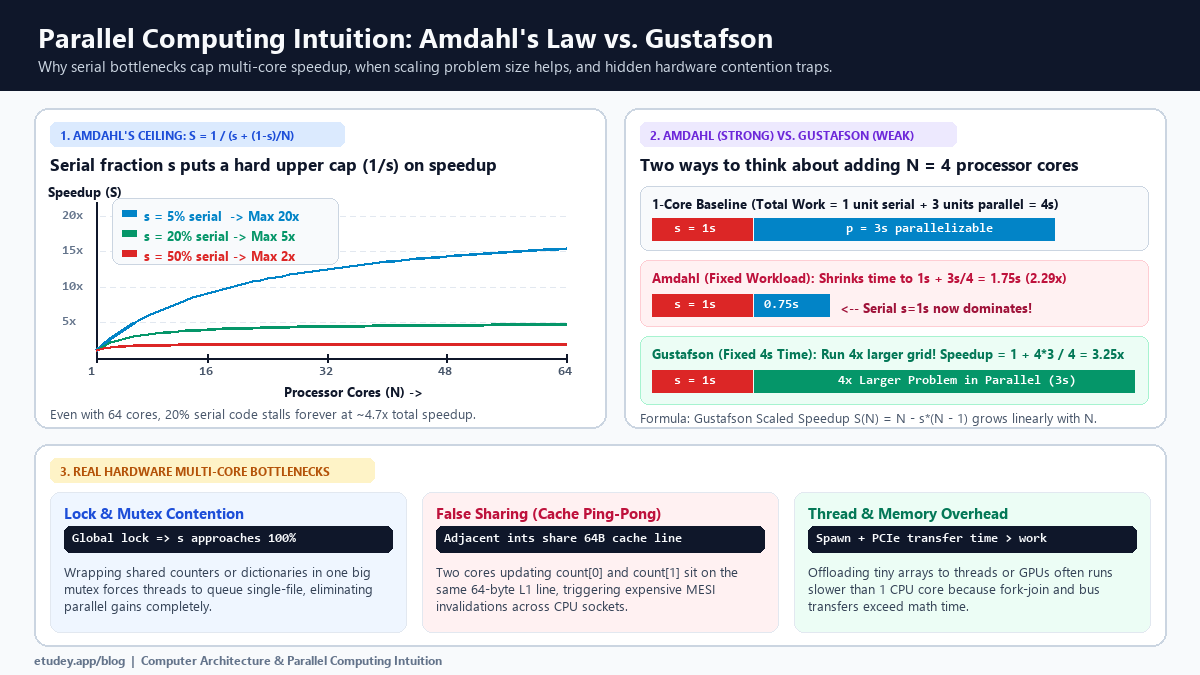
The 1 / s Ceiling: Reading the Asymptote Intuitively
Look at what happens mathematically inside Amdahl's equation as N -> infinity. Because (1 - s) / N shrinks toward zero, the theoretical maximum speedup collapses completely to the reciprocal of the serial bottleneck:
S_max = 1 / sPlugging real engineering fractions reveals why hardware upgrades alone cannot rescue unoptimized software:
- If 50% of your pipeline is serial (
s = 0.50): Even a 1,000-core server cannot beat1 / 0.50 = 2.0x. Half your time is permanently trapped waiting sequentially. - If 20% stays serial (
s = 0.20): Theoretical infinity caps at5.0x. Buying 64 cores instead of 16 pushes speedup from4.00xonly up to4.71x—quadrupling your hardware budget for less than an 18% gain! - If you trim serial code down to 5% (
s = 0.05): Suddenly the ceiling jumps to20.0x, unlocking genuine value from multi-core chips.
Before adding more threads, optimize the serial fraction s first: cutting a 20% single-threaded bottleneck down to 5% often multiplies multi-core ceiling more cleanly than doubling CPU core count.
Generalizing Amdahl's Insight: Optimizing One Component
Amdahl's logic applies far beyond CPU thread counts—it governs GPU acceleration, caching, and network latency too. If rendering images accounts for 40% of page load time and you optimize image compression to be 4x faster (leaving the other 60% untouched), total speedup is 1 / (0.60 + 0.40/4) = 1 / 0.70 = 1.43x, NOT 4x. Always benchmark with a profiler first instead of polishing minor helper loops.
Worked Exam Drill: Combining Partial Speedups Across Multiple Stages
University Computer Architecture exams routinely ask multi-stage optimization questions that test whether you track fractions cleanly rather than averaging speedups incorrectly. Suppose a telemetry pipeline spends its execution budget across three sequential stages:
- Stage 1 — CSV parsing & validation: Takes
20%of total runtime (strictly single-threaded). - Stage 2 — Matrix feature transforms: Takes
50%of total runtime and moves onto vector SIMD lanes running5xfaster. - Stage 3 — Disk compression & flush: Takes
30%of total runtime and moves onto parallel worker pools running3xfaster.
Compute the new normalized runtime sum directly: T_new = 0.20 + (0.50 / 5) + (0.30 / 3) = 0.20 + 0.10 + 0.10 = 0.40. Dividing original runtime (1.0) by 0.40 gives an exact 2.5x overall speedup. Notice what happened cleanly in Stage 1: after accelerating compute and compression, single-threaded CSV parsing grew from a minor 20% chore into half of the entire new runtime (0.20 / 0.40 = 50%)—demonstrating directly why bottleneck chasing is always a moving target!
Compute-Bound vs. Memory-Bandwidth-Bound Code (The Roofline Ceiling)
Even if 100% of a loop contains zero branches and zero dependencies, throwing 16 cores at simple vector addition (c[i] = a[i] + b[i]) hits another physical ceiling completely independent of Amdahl's serial fraction: DRAM memory bandwidth. Every CPU socket shares limited memory controllers moving bytes between main RAM and caches. Because reading two floats and writing one float barely performs one addition per 12 bytes transferred (low arithmetic intensity), two or four cores saturate the memory bus completely—so adding cores 5 through 16 yields flat performance unless you block tiles inside L1/L2 cache first.
Amdahl vs. Gustafson's Law: Why Supercomputers Still Scale
Amdahl's 1967 formula looked pessimistic enough that critics once doubted massively parallel supercomputers could ever justify thousands of processors. Then in 1988, John Gustafson at Sandia National Labs pointed out an implicit assumption hidden inside Amdahl's math: Amdahl holds problem size fixed.
In real weather forecasting, finite-element structural simulations, and modern neural network training, scientists rarely take yesterday's tiny 100x100 grid just to finish it in 2 milliseconds. Instead, when handed 64x more compute power, they expand resolution to an 800x800 simulation that still runs in roughly one fixed wall-clock window! Under fixed-time (weak) scaling, parallel work grows linearly with processor count N, yielding Gustafson-Barsis's Law:
Scaled Speedup(N) = N - s * (N - 1) = s + N * (1 - s)Compare strong scaling and weak scaling side by side across parallel systems problems:
| Scaling Model | What Stays Constant? | Core Formula | Behavior as N Grows |
Best Real-World Match |
|---|---|---|---|---|
| Amdahl's Law (Strong Scaling) | Total problem workload | 1 / (s + (1 - s)/N) |
Asymptotically flattens at 1 / s |
Speeding up a fixed database query or frame render under strict latency SLA |
| Gustafson's Law (Weak Scaling) | Wall-clock time budget | N - s * (N - 1) |
Grows linearly with slope (1 - s) |
3D fluid meshes, Monte Carlo batches, and high-res LLM training clusters |
| Universal Scalability Law (Gunther) | Contention + coherence costs included | N / (1 + alpha(N-1) + beta*N(N-1)) |
Actually peaks and drops (retrograde scaling) | Distributed locks, shared databases, and multi-socket cache coherence overhead |
Three Hidden Bottlenecks That Break Theoretical Speedup
Notice the third row in the table above: Neil Gunther's Universal Scalability Law shows that real systems don't merely plateau—after too many threads, adding more cores often makes your program slower! Three hardware mechanisms explain why:
- Mutex & Lock Contention: Every critical section guarded by a lock forces parallel threads into single-file queuing, effectively inflating your serial fraction
sdynamically. Fine-grained locks, lock-free queues, or thread-local accumulators shrink contention back down (explore deadlock and synchronization traps in our OS concurrency, mutexes & semaphores guide). - False Sharing Across L1 Cache Lines: Modern CPUs fetch memory in contiguous 64-byte cache lines, not individual 4-byte integers. If Thread 0 increments
counters[0]while Thread 1 incrementscounters[1], both variables sit inside the same 64-byte cache line—so hardware coherence (MESI protocol) ping-pongs ownership back and forth across cores on every write! Padding thread-local accumulators to 64-byte alignment eliminates false sharing immediately (learn more in our CPU pipelining and cache locality guide). - Thread Spawn & Bus Transfer Overhead: Launching OS threads, synchronizing barriers, or shipping arrays across PCIe to a GPU costs microseconds to milliseconds of fixed overhead. Parallelizing a 50-element loop wastes more time starting workers than computing sequentially.
How to Attack Parallel Optimization Like an Engineer
Whether prepping for a Computer Architecture exam, optimizing an OS lab benchmark, or defending a capstone project pipeline, follow a strict four-step measurement discipline:
- Profile first, parallelize second: Measure wall time across functions so you optimize the dominant hotspot, never a 3% setup step.
- Eliminate unnecessary serial shared state: Replace shared global sums with thread-local arrays merged once at the very end.
- Verify memory-bandwidth vs. compute limits: Adding cores helps compute-bound math far more than memory-bandwidth-bound array copies sharing one DRAM channel.
- Test scaling across 1, 2, 4, and 8 threads: Plot measured speedup directly against Amdahl's theoretical curve; if throughput drops past 4 threads, suspect lock contention or false sharing immediately.
When working through multi-step derivation problems for Computer Architecture or Parallel Computing finals, drawing exact execution timelines cleanly inside Handwriting Studio helps catch missed barrier steps before exams. You can organize scaling problem sets cleanly on a Study Kanban Board, quiz speedup vs. contention edge cases with an AI engineering tutor, and centralize profiling formulas inside organized course notes or the unified Etudey workspace. Read how our technical study content is reviewed on our editorial policy page.
Frequently Asked Questions
What does Amdahl's Law tell us about throwing hardware at slow code?
It tells us that hardware parallelism only compresses the parallelizable fraction (1 - s), leaving the sequential fraction s untouched. Even with unlimited CPU cores, maximum speedup cannot exceed 1 / s—meaning single-threaded bottlenecks eventually choke overall speed.
Why do Amdahl's Law and Gustafson's Law appear to contradict each other?
They measure two different goals cleanly without contradiction. Amdahl fixes total workload size and asks how much faster one fixed problem finishes on N cores; Gustafson fixes wall-clock execution time and asks how much larger a simulation or batch job you can finish within that same time budget.
What is false sharing and why does it hurt speedup?
False sharing occurs when separate CPU cores write to distinct variables that happen to reside inside the same 64-byte L1 cache line. Hardware cache coherence treats the entire line as shared state and invalidates it repeatedly between cores, stalling parallel loops as badly as lock contention.
Can parallel speedup ever exceed N cores ("superlinear speedup")?
Occasionally yes—not by violating math, but via hardware cache effects! Splitting a massive dataset across N cores also multiplies available aggregate L2/L3 cache capacity by N, so data that previously spilled to slow RAM may suddenly fit cleanly inside fast CPU cache.
How is Amdahl's Law tested on university Computer Architecture exams?
Exam questions usually give an execution profile where a floating-point or parallel kernel occupies some percentage (e.g., 60%) and accelerates by factor k (e.g., 5x on SIMD/GPU lanes), asking for overall speedup 1 / ((1 - f) + f / k) or the fraction needed to reach a target 4x system gain.