
Dynamic programming is simply recursion saved onto a lookup cache so overlapping subproblems on a Directed Acyclic Graph (DAG) never recompute twice. By defining state semantics clearly before coding loops, computer science students choose cleanly between top-down memoization and bottom-up tabulation and compress 2D DP tables effortlessly.
The Coffee Shop Tab Analogy: Why DP Is Just Smart Caching
Imagine someone hands you a chalkboard equation: 1 + 1 + 1 + 1 + 1 = ?. You count slowly and announce "5." Then they tack + 1 onto the right end and ask: "Now what does it equal?" You snap back "6!" instantaneously—without recounting the first five ones from scratch—because you remembered the prefix sum `5`.
That single mental shortcut captures **100% of Dynamic Programming (DP)**. Coined by mathematician Richard Bellman in the 1950s ("programming" meant tabular scheduling back then, not coding!), dynamic programming solves complex optimization and counting problems by breaking them into smaller subproblems and storing every answer the very first time it is computed.
Why do Computer Science students dread DP during Algorithms midterms and technical coding interviews? Because tutorials start backwards—dumping mysterious nested for (int i = 0...) table loops onto screens without ever showing the underlying **Directed Acyclic Graph (DAG)** of decisions that forced those indices!
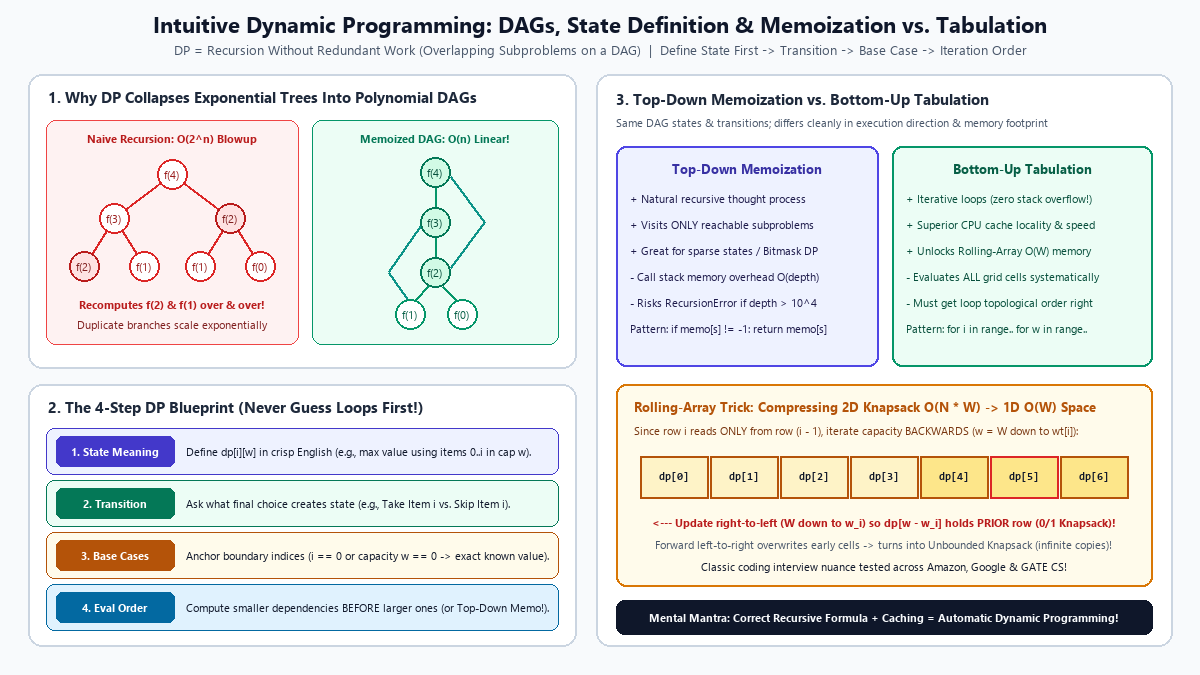
The Two Prerequisites (And The 4-Step State Design Blueprint)
Before writing a single loop, confirm your problem satisfies the two mathematical traits required for dynamic programming:
- Overlapping Subproblems: Naive recursion hits identical function inputs repeatedly (as shown in Figure 1, Panel 1: computing
fib(4)computesfib(2)twice and explodes to \(O(2^n)\) redundant calls for large \(n\)). - Optimal Substructure: The best answer for the full problem builds strictly from optimal answers to smaller subproblems—forming a loop-free **Directed Acyclic Graph (DAG)** (never cyclic mutual dependencies!).
How to Design Any DP Recurrence Cold in 4 Clean Steps
- Step 1 — State Meaning First (Exact English Sentence): Pick parameters identifying a subproblem uniquely—such as
dp[i][w]representing "maximum value achievable using items 0..i inside a knapsack of remaining capacity w." If you cannot state whatdp[i][w]means in plain English, pause—your loop will fail! - Step 2 — Decision Transition (Last Choice Branching): Look strictly at the *decision right in front of you* at state `(i, w)`. On `0/1 Knapsack`, you only hold two options for item `i`: skip it (`dp[i-1][w]`) or pack it (`val[i] + dp[i-1][w - wt[i]]` when `wt[i] <= w`). Take the `max()` of those two subproblem calls!
- Step 3 — Explicit Base Cases: Identify smallest terminal boundaries where recursion halts cleanly without out-of-bounds indices (e.g., zero items left or capacity `w == 0` yields value `0`).
- Step 4 — Execution Order (Memoize OR Tabulate): Run recursive transitions with a cache (**Top-Down Memoization**), or fill an array iteratively in valid DAG topological order (**Bottom-Up Tabulation**).
Golden Rule for Coding Interviews & Exams: Never start by guessing
dp[i][j]table loop boundaries! Always write the crystal-clear recursive relation first on scratch paper, verify every base case on a tiny 2-item trace, and only then translate it cleanly to memoized recursion or bottom-up loops.
| Dimension / Trade-Off | Top-Down Memoization (Recursive + Cache) | Bottom-Up Tabulation (Iterative Table) | When to Pick Which on Exams / Interviews |
|---|---|---|---|
| Thought Flow | Natural decomposition from goal down to base cases | Must explicitly order smaller subproblems first | Pick **Memoization** first under strict interview clocks |
| Subproblems Evaluated | Computes only reachable states lazily | Computes every cell inside table bounds | Pick Memoization for sparse state spaces (Bitmask / Tree DP) |
| Stack Overflow Risk | Consumes call-stack frames (\(O(\text{depth})\)) | Zero recursion stack; safe on \(10^6\) loops | Pick **Tabulation** on deep linear sequences (`N >= 10^4`) |
| Space Optimization | Harder to evict old cache entries cleanly | Unlocks Rolling-Row 1D compression! | Pick Tabulation whenever tight memory limits apply |
The Rolling-Array Trick: Compressing 2D Knapsack Down to 1D
Why does Bottom-Up Tabulation win performance benchmarks in systems labs and GATE CS theory? Look closely at the transition inside 0/1 Knapsack:
dp[i][w] = max(dp[i-1][w], val[i] + dp[i-1][w - wt[i]])
Notice that computing row `i` looks exclusively at row `i - 1`—it never peeks backward at row `i - 2`! That lets us throw away the entire 2D `(N x W)` grid and compress storage cleanly down into a **single 1D array `dp[0..W]`** (`O(W)` space).
Watch out for the famous **Loop Direction Trap** (Panel 3 of Figure 1):
- 0/1 Knapsack (Each item usable AT MOST ONCE): Iterate capacity `w` strictly **BACKWARDS from `W` down to `wt[i]`**. Updating right-to-left guarantees that when computing `dp[w]`, index `dp[w - wt[i]]` to the left still holds yesterday's value from row `i - 1` (preventing picking the same item twice!).
- Unbounded Knapsack / Coin Change Combinations (Infinite copies allowed): Iterate capacity `w` **FORWARDS from `wt[i]` up to `W`** so updated left cells chain cleanly! Flipping one loop sign flips 0/1 Knapsack into Unbounded Knapsack immediately.
Worked Trace: Filling a Tiny 0/1 Knapsack Row by Hand
To cement that backward 1D rule permanently, trace three items (`weights = [1, 3, 4]`, `values = [15, 20, 30]`) with knapsack capacity `W = 4` inside `dp[0..4] = [0, 0, 0, 0, 0]`:
- Process Item 1 (`w=1, v=15`), loop `w` from `4` down to `1`: Each cell checks `max(dp[w], 15 + dp[w - 1])`. Since all prior cells were `0`, array becomes `[0, 15, 15, 15, 15]`. Notice scanning backwards ensured we packed Item 1 at most once per capacity rather than four times!
- Process Item 2 (`w=3, v=20`), loop `w` from `4` down to `3`:
dp[4] = max(15, 20 + dp[4 - 3]) = max(15, 20 + 15) = 35dp[3] = max(15, 20 + dp[3 - 3]) = max(15, 20 + 0) = 20
- Process Item 3 (`w=4, v=30`), check `w=4`:
dp[4] = max(35, 30 + dp[0]) = max(35, 30) = 35. Maximum value under capacity `4` equals **35** (Items 1 + 2), matching the full 2D grid identically!
Recognizing the 5 Classic DP Patterns on Exam Day
Nearly every university Algorithms paper and technical interview problem maps cleanly onto one of five core structural templates:
- Linear Sequence DP (`O(N)` / `O(N^2)`): House Robber, Climbing Stairs, Longest Increasing Subsequence (state `dp[i]` ends at or considers prefix `0..i`).
- Two-Sequence Grid DP (`O(N * M)`): Edit Distance, Longest Common Subsequence (LCS) (state `dp[i][j]` matches prefixes `A[0..i]` vs `B[0..j]`).
- Knapsack / Subset Sum DP (`O(N * W)`): Partition Equal Subset Sum, Coin Change, Target Sum (track item index + accumulated weight/sum).
- Interval / Range DP (`O(N^3)`): Matrix Chain Multiplication, Burst Balloons (`dp[l][r]` splits range `[l..r]` at intermediate pivot `k`).
- DAG & Tree DP (`O(V + E)`): Longest Path in DAG, House Robber III (root state combines settled child return values).
Staring at code snippets rarely builds DP intuition; drawing tiny `3 x 4` grids and DAG transitions with pen and paper makes state dependencies crystal clear. You can scan handwritten recursion trees and DP transitions neatly into searchable digital pages with Handwriting Studio, or ask AIgom AI Tutor to critique your recurrence transition directly against your Algorithms course notes (see our Editorial & Verification Policy for technical review standards).
During intense placement prep and end-semester sprints, track all 5 core DP families cleanly on the Study Kanban Board and cross-check shared asymptotic proofs inside Peer College Notes. Pairing this visual DP guide with our articles on Intuitive Big-O & Amortized Analysis and Backward Chaining Hard Proofs builds rock-solid algorithmic thinking.
Frequently Asked Questions
What is the exact difference between Dynamic Programming and Divide & Conquer?
Divide & Conquer (such as Merge Sort) splits problems into independent, non-overlapping subproblems, solves each separately, and merges them cleanly. Dynamic Programming handles **overlapping subproblems** that repeat heavily across branches, storing results so every distinct subproblem is evaluated once.
Can Greedy algorithms replace Dynamic Programming cleanly?
Only when a problem exhibits the strict **Greedy Choice Property** (where a locally optimal decision never closes off the global optimum, such as Fractional Knapsack or Dijkstra with non-negative weights). Whenever local greedy choices trap later steps—as in `0/1 Knapsack` or general Coin Change—full DP tracking is mandatory.
How do I compute the time complexity of any DP solution quickly?
Multiply (Total Distinct States) x (Work Done Per State Transition)! For example, Longest Common Subsequence has `N * M` states `(i, j)` and checks `O(1)` character choices per state—yielding `O(N * M)` total time cleanly.
Why do I sometimes get Stack Overflow in Python/Java with Top-Down Memoization?
Recursive memoization places one stack frame per active nested call (`O(N)` recursion depth). Python defaults to ~1,000 stack frames (`sys.getrecursionlimit()`), so deep sequences of `10,000+` steps crash unless converted into iterative **Bottom-Up Tabulation**.
How can I reconstruct the actual optimal path or chosen items, not just max score?
Either store a small parent choice pointer alongside your DP table (`choice[i][w] = True/False` recording whether item `i` was picked) and walk backwards from `(N, W)` to `(0, 0)`, or backtrack cleanly from `dp[i][w]` checking whether `dp[i][w] == dp[i-1][w]`.
Turn DP Into Calm Step-by-Step Geometry
Dynamic programming loses all intimidation the moment you treat it as writing clear English state meanings, spotting DAG dependencies on scratch paper, and caching answers once. Open Etudey with your Algorithms notes today, trace one 2D grid down into a backward 1D rolling loop, and test your understanding ahead of exams and interviews.