
Backward chaining for STEM is a goal-directed mathematical heuristic that solves complex proofs by working in reverse from the target conclusion toward initial premises. Instead of making blind forward deductions, students break the final claim into necessary precursor lemmas, identify required algebraic invariants, and construct a bidirectional bridge that turns intractable derivations into deterministic steps.
The Blank Sheet Paralysis: Why Forward Proof Deduction Fails
There is no academic horror quite like opening a university engineering mathematics or theoretical physics exam paper and reading: "Prove that every orthogonal matrix has a determinant of positive or negative one," or "Derive the Navier-Stokes momentum equation from the Reynolds Transport Theorem."
You write down the given starting equations at the top of the answer sheet. You pick up your pen, stare at the blank white expanse, and freeze. You know where you are starting (Point A), and you know the target equation you are supposed to arrive at (Point B). Yet between Point A and Point B lies an impenetrable fog of potential mathematical transformations.
Should you apply integration by parts? Should you expand using a Taylor series? Should you substitute trigonometric identities or transform coordinates into spherical harmonics?
When students try to solve proofs strictly forward—starting from axioms and trying random algebraic manipulations in the hope that they magically stumble upon the answer—they enter an exponential combinatorial explosion. Starting from a basic premise, there are dozens of valid mathematical operations you could perform. Within three steps, you have created hundreds of dead-end branches. Your working memory collapses, twenty minutes vanish, and your scratch paper looks like a chaotic graveyard of crossed-out equations.
George Pólya (Legendary Mathematician, How to Solve It, 1945): "We must begin by examining the end. If we wish to find a way from our present position to our goal, we should look back from the goal toward our present position. It is much easier to see what leads directly to our destination than to guess which of a hundred paths leading away from our start will eventually reach it."
The antidote to blank-sheet paralysis is Backward Chaining—the very same heuristic used by master mathematicians, chess grandmasters, and automated AI theorem-proving algorithms.
The Cognitive Science of Goal-Directed Reasoning
In computer science and formal artificial intelligence, inference engines operate in two distinct modes:
- Forward Chaining (Data-Driven): Starts with known facts and applies inference rules forward to see what conclusions can be drawn. This is exploratory, open-ended, and susceptible to combinatorial explosion.
- Backward Chaining (Goal-Driven): Starts with a specific hypothesis or goal and searches backward through the rule base to find supporting premises. If a premise is unknown, it recursively becomes a sub-goal.
Human psychology mirrors this computational reality. When you look at the starting premise $P$, your brain asks: "What can I do from here?" That question has nearly infinite answers. But when you look at the target conclusion $Q$, your brain asks a much more constrained question: "What mathematical statement, if true, would immediately make $Q$ true?"
Because target conclusions in engineering and mathematics have rigid geometric, algebraic, or physical symmetries, the number of valid backward precursors is drastically smaller than the number of forward options. Backward chaining narrows your search space from a divergent cone into a converging funnel.
Comparison: Forward Guessing vs. Backward Chaining vs. Bidirectional Meet-in-the-Middle
Notice how different problem-solving paradigms approach the challenge of proving technical theorems:
| Dimension | Forward Guessing (The Novice Trap) | Pure Backward Chaining | Bidirectional "Meet-in-the-Middle" |
|---|---|---|---|
| Starting Anchor | Given premises only; wanders aimlessly | Target conclusion; decomposes backward | Both: Expands forward and chains backward simultaneously |
| Branching Factor | Massive (Dozens of valid algebraic moves) | Low (Very few lemmas directly imply target) | Constrained: Pins search between two known anchors |
| Handling Algebraic Traps | Gets stuck in 3-page dead-end derivations | May hit unprovable sub-goals without axioms | Instantly detects misalignment at the intermediate bridge |
| Scratchpad Utilization | Unstructured scribbling; erases frequently | Sequential reverse ledger of requirements | Two-column scratchpad (Forward from Top, Reverse from Bottom) |
| Exam Hall Success Rate | Low (Severe freeze states under time crunches) | Moderate to High (Requires reverse inversion) | Very High: Produces flawless forward proofs in minimum time |
Step 1: Formalize the Target Conclusion and Extract Implied Invariants
The first tactical step in backward chaining is to write down the target conclusion at the bottom of your scratch paper in rigorous mathematical symbols. Never leave it as a vague verbal thought.
Once written, perform an Invariant Audit:
- What Form Does the Target Take? Is it an equality ($A = B$)? An inequality ($A \le B$)? A limit ($\lim f(x) = L$)? A vanishing derivative ($df/dx = 0$)? Each mathematical form has a limited set of natural precursor tools.
- What Variables Vanished? Look closely at the given starting equations and compare them to the target. If the starting equations contain time $t$ and velocity $v$, but the target equation contains only position $x$ and acceleration $a$, you immediately know that time must be eliminated using a differential identity such as $a = v(dv/dx)$.
- What Dimension or Unit Does the Target Demand? If the target expression represents energy (Joules), every intermediate backward lemma must maintain energy homogeneity. Dimensional analysis serves as your permanent sanity anchor.
Step 2: The Precursor Query: "What Lemma Directly Precedes This Goal?"
With your target conclusion $Q$ locked down, ask the master backward chaining question:
"What is the single mathematical step that must happen immediately before $Q$ appears?"
Consider classic examples across STEM disciplines:
- In Real Analysis (Epsilon-Delta Proofs): Your goal is to show $|f(x) - L| < \epsilon$. Working backward, you factor the expression into $|x - c| \cdot |g(x)| < \epsilon$. What immediately precedes this? An upper bound on $|g(x)| \le M$, which forces the requirement that $|x - c| < \epsilon / M$. You have just deduced the required definition of $\delta$ in reverse without guessing!
- In Linear Algebra (Determinant of Orthogonal Matrices): Your goal is to prove $\det(A) = \pm 1$. What immediately precedes this? The algebraic equation $(\det(A))^2 = 1$. What precedes that? The property $\det(A^T A) = \det(I) = 1$. Since $A^T A = I$ by definition of an orthogonal matrix, the entire proof is solved backward in three lines.
- In Thermodynamics (Maxwell Relations): Your goal is to prove $(\partial S / \partial P)_T = -(\partial V / \partial T)_P$. What precedes this? Clairaut’s Theorem on the equality of mixed partial second derivatives of the Gibbs free energy function $dG = V dP - S dT$. The target tells you precisely which thermodynamic potential to differentiate.
Step 3: Expanding Forward from the Given Axioms
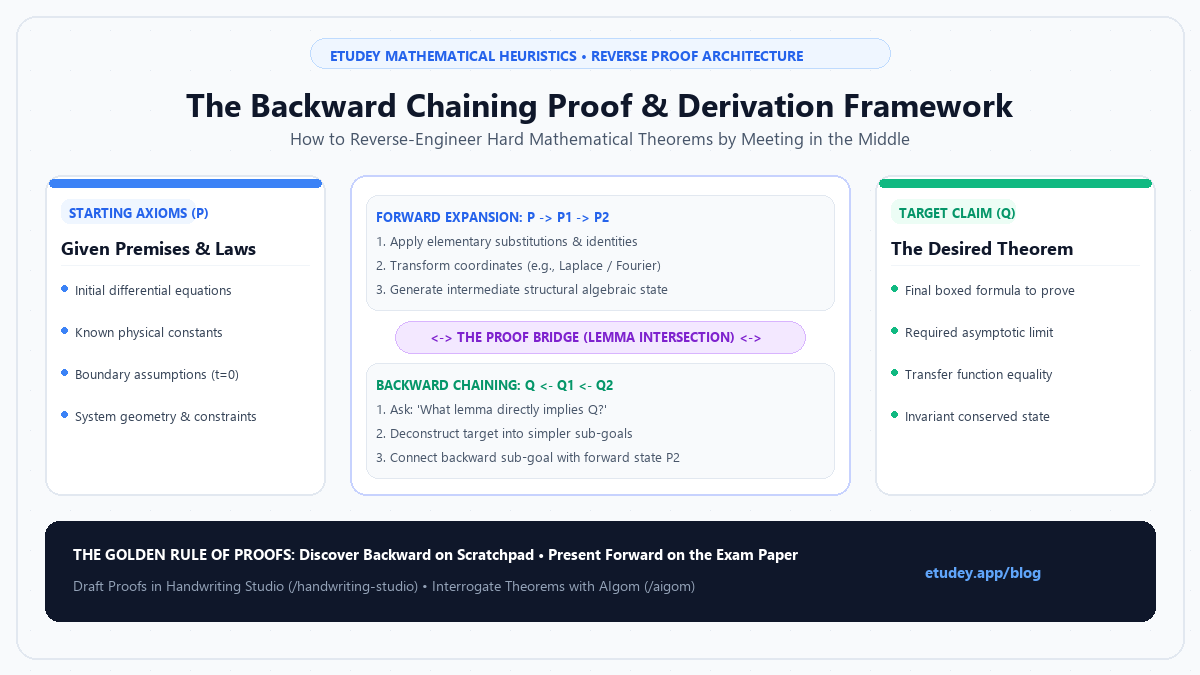
While backward chaining is extraordinarily powerful, pure backward reasoning can occasionally produce sub-goals that are difficult to connect directly to the initial axioms. This is why elite mathematicians utilize the Bidirectional Meet-in-the-Middle Architecture.
Take a blank sheet of paper or open a clean canvas in Etudey's Handwriting Studio. Divide your sheet into two distinct zones:
- Top Zone (Forward Lane): Write your given premises (Axioms $P$). Perform one or two standard, low-risk expansions. Expand definitions, state governing conservation laws, and convert differential forms into integral forms if boundaries are known. This creates state $P_1$ and $P_2$.
- Bottom Zone (Backward Lane): Write your target goal $Q$ at the very bottom. Work upward one or two steps, writing precursor lemmas $Q_1$ and $Q_2$.
Now, the cognitive distance your brain has to bridge is no longer the massive chasm between $P$ and $Q$; it is the tiny gap between intermediate state $P_2$ and precursor lemma $Q_2$.
Step 4: The "Meet-in-the-Middle" Intersection Lock
As your forward derivation descends and your backward derivation ascends, look for the structural isomorphism—the moment an algebraic expression in the forward lane shares the exact same terms, exponents, or matrix symmetries as an expression in the backward lane.
Once that intersection is spotted, you snap the two chains together like a jigsaw puzzle. You have successfully solved the proof. What felt like an impossible, opaque mathematical barrier thirty seconds ago has dissolved into a clean chain of deterministic transformations.
If you want to practice recognizing these structural bridge points across university-specific syllabus theorems, examine peer-annotated derivations and solved past papers in the Etudey Verified Notes Archive.
Step 5: The Inversion Protocol (Writing for the University Examiner)
Here is the most critical exam warning in this entire guide: Never write a backward proof on your official exam paper in the reverse direction!
External examiners and university professors expect proofs to be presented in standard deductive forward order (Premises $\implies$ Lemma 1 $\implies$ Lemma 2 $\implies$ Conclusion). If you write backward from the conclusion on your exam paper, examiners will assume you are confused, circular in your logic, or "assuming what you are trying to prove" (the logical fallacy of petitio principii).
Deploy the Inversion Protocol:
- Do the Discovery Backward on Scratch Paper: Use the margin, the back page of the answer booklet, or your digital stylus to discover the proof path backward and meet in the middle.
- Number the Steps from Start to Finish: Label your forward steps $1, 2, 3...$ and your reverse steps $4, 5, 6...$ so the narrative path is seamless.
- Transcribe the Clean Forward Proof onto the Answer Sheet: Write: "Given premise P... Applying identity... We observe that Lemma L holds... Therefore, concluding Q (Q.E.D.)."
To the examiner grading your paper, your proof will look like an act of effortless, divine mathematical genius. They will see a student who walked straight from axioms to the final theorem in five clean, elegant steps, unaware that you discovered the path by reverse-engineering the destination first.
The 4-Week Proof Fluency Protocol: Practice with AIgom
Becoming fluent in backward chaining requires deliberate practice on real semester theorems. Here is how to build proof-solving muscle before your next mid-term:
- Catalog the Top 15 Core Proofs: Map out the 15 mandatory derivations in your course syllabus (e.g., Carnot theorem, Thevenin equivalent, Central Limit Theorem, Cayley-Hamilton theorem) as milestone cards on your Etudey Study Kanban Board.
- Socratic Proof Critiques on AIgom: Open AIgom, Etudey's Socratic AI Study Partner. Enter your target theorem and prompt it: "I want to derive this theorem using backward chaining. Do not give me the full derivation. Tell me what my first backward precursor lemma should be, and critique my reasoning step-by-step."
- Closed-Book Re-Derivation Drills: Once you discover a proof path, close all notes and execute the complete forward transcription from memory within 10 minutes.
Frequently Asked Questions
Is backward chaining considered "cheating" or mathematically invalid?
Not at all. Backward chaining is a recognized heuristic in formal mathematics, logic, and automated theorem proving (used in systems like Coq, Lean, and Prolog). The distinction is between the context of discovery and the context of presentation. You discover the proof backward using heuristics; you present the proof forward using formal deductive logic. Every major research mathematician throughout history—from Archimedes to Carl Friedrich Gauss—worked backward on scratch paper before publishing clean forward papers.
How do I avoid the mistake of "assuming what I want to prove"?
When working backward, write implication arrows that point backward ($\impliedby$), not forward ($\implies$). Clearly label your scratchpad: "To show Q, it suffices to show Q1." As long as each step is a valid sufficiency condition (meaning $Q_1 \implies Q$), and you write the final proof starting from known axioms, your logic is airtight and 100% rigorous.
What should I do if my backward chain leads to a dead end?
If working backward from target $Q$ leads to a sub-goal that seems impossible or false, you chose a precursor condition that was sufficient but not necessary. Return to target $Q$ and ask: "What alternative algebraic identity or geometric theorem could also yield $Q$?" For example, if expanding via Taylor series fails, try an integral representation or switch coordinates. Having an alternative path is the essence of mathematical resilience.
Can backward chaining be applied to computer science algorithm proofs?
Yes, backward chaining is extraordinarily effective in computer science for loop invariant proofs and dynamic programming correctness. To prove that an algorithm correctly sorts an array, you start with the target post-condition ($A[0 \dots n-1]$ is sorted) and work backward to determine what loop invariant must be maintained on each iteration of the loop.
How does backward chaining help during high-pressure university exams?
Under intense exam stress, working memory capacity shrinks drastically due to adrenaline surges. Forward guessing requires you to hold multiple branching possibilities in your head simultaneously, leading to immediate overwhelm. Backward chaining reduces cognitive load by giving you a clear, static target to interrogate, eliminating panic and replacing blind guessing with structured, step-by-step reverse engineering.
Stop Guessing. Start Reverse-Engineering.
Mathematical derivations and engineering theorems are not arbitrary riddles designed to test your luck. They are structural bridges connecting basic physical laws to profound scientific conclusions.
The next time you face an intimidating blank sheet of paper, do not stare blindly into the fog. Turn around, look at your destination, work backward to meet in the middle, and master your technical curriculum with absolute clarity. Organize your proof sprints in the Etudey Student Workspace and unlock your true mathematical power today.