
While conventional study habits dictate reading textbook theory before attempting homework problems, cognitive psychology reveals that flipping this sequence doubles long-term retention. Driven by the Generation Effect and Productive Failure, attempting unsolved problems before reading theory primes neural schemas, exposes conceptual gaps, and turns passive reading into high-hunger memory consolidation.
The Theory-First Trap: Why Diligent Reading Leads to Exam Blankouts
Consider the standard study routine practiced by millions of university undergraduates every semester: you open a thick, intimidating textbook on Thermodynamics, Electromagnetism, or Operating Systems. You begin diligently on page one of Chapter 4.
For three hours, you read quietly. You highlight key sentences with fluorescent markers. You follow the author’s worked derivations step-by-step, nodding along as each algebraic transition makes logical sense. When you finish the forty pages, your brain feels satisfied. You experience a warm, comfortable sensation that cognitive scientists call the illusion of competence.
Then, you turn to the end-of-chapter problem set. You read Problem 4.1: a multi-step engineering scenario requiring you to calculate heat transfer across composite walls with convection boundaries.
Suddenly, your mind freezes. You stare at the blank sheet of paper, completely unable to determine where to begin. You know you just spent three hours reading this exact topic, yet you cannot construct the governing equation. Frustrated, you flip back to the textbook, look at the solution, and sigh: “Oh, of course, they applied Fourier’s Law first. I knew that.”
You did not know that. You recognized it.
Reading someone else’s clear explanation is a passive sensory reception task. Solving an exam problem is an unassisted generative task. By feeding your brain the answers before it has ever experienced the friction of the question, you short-circuit the neurological machinery required for durable memory consolidation.
“Your brain does not remember answers to questions it never asked. Attempting an unsolved problem before reading the theory creates the intellectual hunger that transforms abstract textbook prose into permanent memory.”
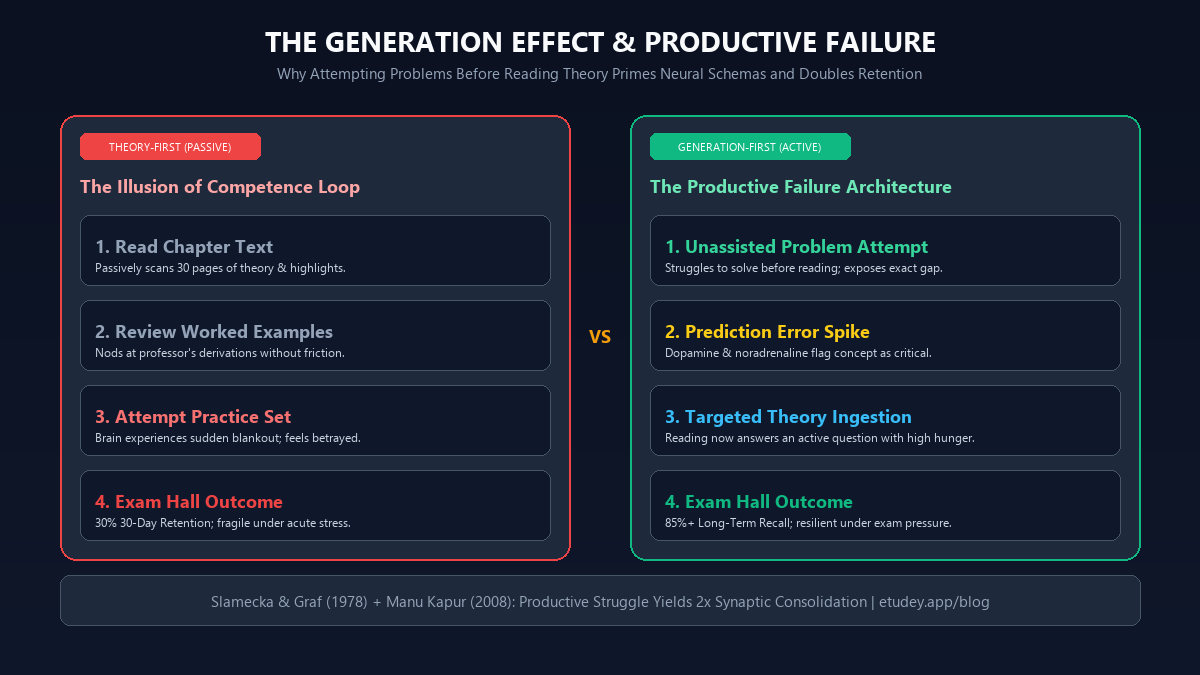
The Cognitive Science of Generation: Slamecka, Graf, and Kapur
The biological advantage of attempting problems before reading theory rests on two foundational discoveries in cognitive psychology:
1. The Slamecka & Graf Generation Effect (1978)
In 1978, researchers Norman Slamecka and Peter Graf published a landmark paper in the Journal of Verbal Learning and Verbal Behavior. They presented subjects with two learning conditions:
- The Read Condition: Participants passively read paired antonyms (e.g., hot – cold).
- The Generate Condition: Participants were given the first word and a partial prompt to generate the antonym themselves (e.g., hot – c___).
When tested on long-term recall, participants who actively generated the words remembered more than double the material compared to those who merely read the complete pairs. Decades of subsequent research have confirmed that whenever working memory actively generates information rather than passively receiving it, synaptic connections between the prefrontal cortex and hippocampus consolidate with vastly greater structural durability.
2. Manu Kapur’s “Productive Failure” (2008)
While Slamecka and Graf studied verbal pairs, Professor Manu Kapur (Chair of Learning Sciences and Higher Education at ETH Zürich) investigated complex STEM problem-solving.
Kapur divided engineering and mathematics students into two distinct instructional groups:
- Group A (Direct Instruction First): Students received a comprehensive lecture and detailed worked examples, followed by practice problem solving.
- Group B (Productive Failure): Students were handed complex, novel problems and instructed to solve them before receiving any lecture or textbook explanation. They struggled, explored flawed mathematical paths, and frequently failed to arrive at the final answer. Only after this struggle did they receive targeted theoretical instruction.
The result stunned educators worldwide: Group B vastly outperformed Group A on both conceptual understanding and transfer problem-solving. Even though their initial attempts were unsuccessful, the very act of struggling with the problem primed their mental schemas, making them dramatically more receptive to the subsequent theoretical instruction.
The Neurobiology of Productive Struggle: Prediction Errors
Why does failing to solve a problem make you smarter when you subsequently read the solution?
The answer lies in how the brain handles Prediction Errors:
- Prefrontal Hypothesis Generation: When you tackle an unfamiliar problem, your prefrontal cortex recruits existing knowledge to construct a hypothetical solution pathway. You guess which variables matter, sketch a coordinate frame, and test algebraic combinations.
- The Prediction Error Spike: When your derivation hits a dead end or yields an impossible physical result, your dopaminergic reward circuits register a sharp “prediction error.” The locus coeruleus releases a burst of noradrenaline, signaling to your cortical networks: “Our current mental model is incomplete. Pay intense attention to incoming data.”
- Targeted Theoretical Ingestion: When you now open the textbook to read the theory, your brain does not read passively. It actively hunts for the exact missing link that broke your derivation. The textbook formula is no longer a boring collection of symbols; it is the satisfying resolution of an unresolved puzzle.
- Long-Term Synaptic Consolidation: Neurologically, dopamine and noradrenaline act as molecular tags, marking activated synapses for protein synthesis and dendritic spine growth during sleep. Information learned in the wake of productive failure sticks.
Systematic Comparison: Theory-First vs. Generation-First
To evaluate the cognitive efficiency of both approaches, examine how they function across critical academic performance dimensions:
| Pedagogical Dimension | Theory-First (Conventional Reading) | Generation-First (Productive Failure) | Cognitive Advantage |
|---|---|---|---|
| Initial Task Experience | Smooth, comfortable, low cognitive friction | Challenging, uncertain, active struggle | Struggle triggers noradrenaline & dopamine salience |
| Metacognitive Monitoring | Severe “Illusion of Competence”; masks knowledge gaps | Brutally accurate; exposes exact ignorance boundaries | Eliminates surprise exam blank-outs |
| Textbook Reading Mode | Linear, passive skimming from start to finish | Surgical, high-speed hunting for missing puzzle pieces | Cuts reading time by 50%; triples comprehension |
| 30-Day Concept Retention | Poor (25% – 35% on unassisted problems) | Exceptional (75% – 85% long-term recall) | 2x to 3x memory durability via Generation Effect |
| Transfer Problem Solving | Struggles with unorthodox or re-phrased exam questions | Excels at novel, multi-disciplinary engineering problems | Deep schema encoding adapts to varied boundary conditions |
The 4-Step Problem-First Implementation Protocol for STEM
To implement the Generation Effect in your weekly university studies, flip your preparation workflow using this 4-step protocol:
Step 1: The Blind 10-Minute Assault (Pre-Testing)
When starting a new syllabus module, do not open the chapter text. Instead, flip immediately to the end-of-chapter problem set or pull up two past university examination questions on the topic.
Set a timer for ten minutes. Pick up a pencil and attempt to solve Problem 1 on a blank sheet of scratch paper with zero assistance.
Even if you have no idea what formula applies, force yourself to write:
- List the given variables with their physical units.
- Draw a physical schematic or free-body diagram representing the system.
- Write down what physical laws you intuitively believe govern the behavior (e.g., conservation of energy, momentum balance, or Kirchhoff’s laws).
Step 2: The Diagnostic Gap Inventory
When your ten-minute timer sounds and your attempt stalls, identify your exact point of failure. Write a one-sentence diagnostic question at the top of your page:
- “How do I relate shear stress to fluid velocity when the viscosity varies with shear rate?”
- “What boundary condition determines the integration constants in this beam deflection differential equation?”
Step 3: Surgical Theoretical Ingestion
Now, open the textbook chapter. But do not read it like a novel. Scan the headings and derivations with a singular mission: find the answer to your diagnostic question.
Notice what happens: your eyes skip past introductory historical fluff and zero in on the critical equation. Because your brain has an active, unanswered question waiting, the textbook explanation slots into place with instant clarity.
Step 4: Immediate Generation Closure
The moment you find the missing conceptual link, close the textbook immediately.
Do not copy the solution out of the book. Turn back to your blank scratch paper and complete the derivation from your own working memory. By closing the loop with unassisted generation, you cement the neural pathway permanently.
Integrating the Generation Effect with the Etudey Academic Platform
Modern learning technology can automate and accelerate the problem-first generation cycle, preventing students from getting hopelessly stuck while preserving the benefits of productive struggle:
- Socratic Pre-Testing via AI: Launch an unassisted problem attempt inside AIgom Tutor. When you hit a roadblock, AIgom will not spoil the answer by blurting textbook solutions; it acts as an intelligent Socratic coach, providing subtle scaffolding nudges that keep you in the zone of productive struggle.
- Mining Past Exam Problems Before Reading: Rather than relying on generic textbook problems, access the Etudey Verified Notes Archive to find real past-year university examination questions for your specific syllabus. Attempting real exam questions before opening lecture notes ensures your generative effort matches your professor’s exact evaluation standards.
- Digitizing Generative Scratch Work: Capture your handwritten problem attempts and diagnostic diagrams using the Etudey Handwriting Studio. The multi-modal math OCR extracts your handwritten derivations, allowing you to compare your initial intuitive attempts against verified reference solutions.
- Structured Pacing & Mastery Tracking: Schedule your 10-minute blind problem assaults using Etudey Emergency Exam Mode, and log completed generative modules from “Productive Failure” to “Verified Mastery” on the visual Etudey Study Kanban board.
Frequently Asked Questions
Won't attempting hard problems before reading theory cause unnecessary frustration and waste time?
Research in the learning sciences demonstrates that ten minutes of focused, unsuccessful struggle followed by ten minutes of targeted reading produces vastly superior retention compared to sixty minutes of passive reading. The initial friction feels uncomfortable because working memory is actively firing, but this friction is the precise biological signal that triggers long-term synaptic growth. Limit the struggle to a strict 10-minute timer to prevent unproductive demoralization.
Does the Generation Effect work for purely qualitative subjects like biology, law, or history?
Yes. In qualitative disciplines, the Generation Effect is applied through Pre-Testing and Free Recall. Before reading a chapter on constitutional law or cellular respiration, write down everything you intuitively know or predict about the topic, or attempt to answer the chapter review questions blind. Generating predictions activates pre-existing semantic networks, doubling reading comprehension speed and recall.
What if I encode a completely wrong method in my brain during the initial generation attempt?
Cognitive research shows that initial erroneous guesses do not cause negative transfer or fossilized errors, provided that corrective feedback is received shortly thereafter (the “Hypercorrection Effect”). In fact, students who make high-confidence errors and then discover the correct explanation retain the correct concept more powerfully than students who never guessed at all.
How does the Generation Effect differ from the Testing Effect?
The Testing Effect (Retrieval Practice) refers to retrieving previously studied material from memory (testing after learning). The Generation Effect (Productive Failure / Pre-testing) refers to generating an answer or solution pathway before or during the initial encoding phase. When combined—generating solutions first, reading theory second, and testing recall third—students achieve the highest possible cognitive retention.
How can I apply this method during a 48-hour pre-exam emergency?
In an exam emergency, reading textbook chapters is academic suicide. Open the last three years of past university question papers (available in the Etudey Notes Archive). Spend five minutes attempting each question blind. If you cannot solve it, look up only the specific formula required to complete that step, execute the algebra yourself, and move immediately to the next question. You will cover three times more syllabus in half the time.
Conclusion: Embrace the Friction of the Unsolved Page
True academic mastery is not about avoiding cognitive discomfort. It is about understanding that intellectual friction is the exact neurobiological sensation of learning taking place.
The students who coast through semesters reading highlighted textbooks with ease are the ones who suffer devastating blank-outs on exam day. The students who embrace the challenge of the unsolved problem—who sit with a blank sheet of paper and dare to generate an answer before looking at the key—are the ones who walk into examination halls with unbreakable confidence.
On your next study session, don’t open the chapter. Open the problem set. Set your timer for ten minutes, embrace the productive struggle, and let the Generation Effect unlock your highest academic potential.