
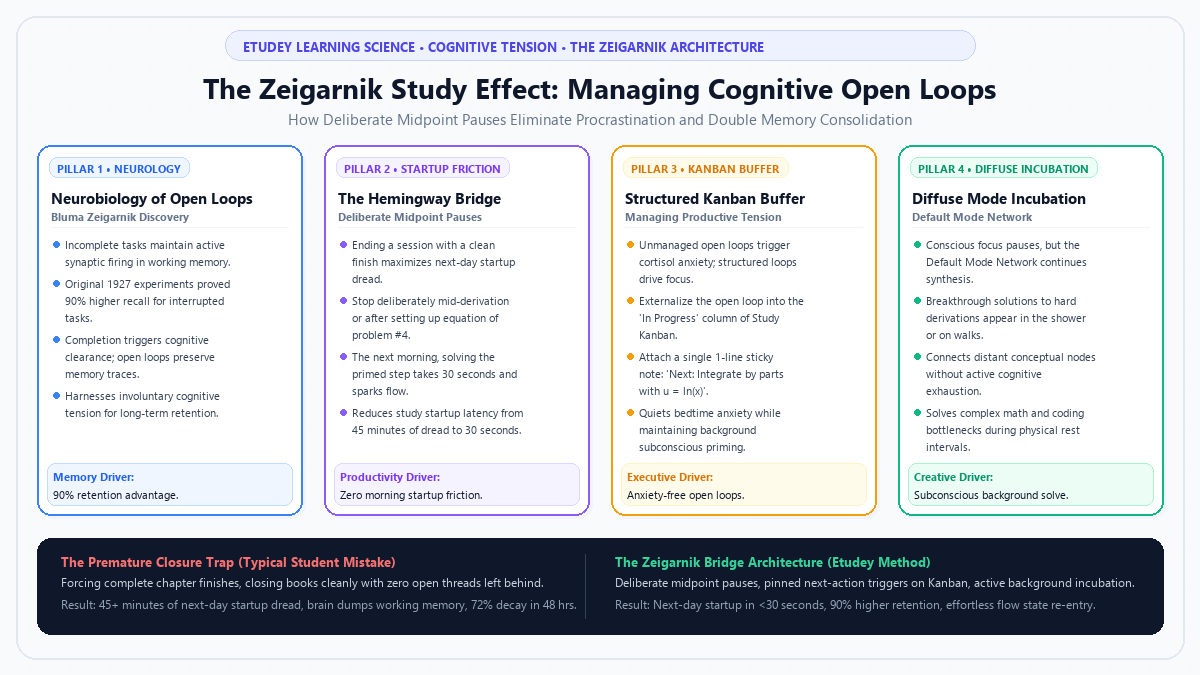
The Zeigarnik Effect states that the human brain retains uncompleted tasks with up to 90% higher recall than completed ones. By intentionally pausing study sessions at a clear midpoint rather than a chapter's end, students maintain productive cognitive tension, activate subconscious incubation, and eliminate next-day study startup friction.
The Berlin Cafe Epiphany: How a Waiter's Memory Unlocked Cognitive Science
In the early 1920s, renowned psychologist Kurt Lewin and his graduate student Bluma Zeigarnik were sitting in a bustling restaurant in Berlin. As they observed the floor staff, they noticed a peculiar phenomenon: the waiters could memorize extraordinarily complex food and drink orders across dozens of tables without writing down a single word. They remembered exactly who ordered the roasted duck, which patron asked for sparkling water with lemon, and whose coffee required oat milk.
Yet, the moment the bill was paid and the transaction was complete, a dramatic cognitive shift occurred. When Zeigarnik stopped a waiter outside the cafe minutes later and asked him to recall the orders from the table he had just served, the waiter stared at her blankly. He could not remember a single dish, the total cost of the meal, or even how many people were sitting at the table. Once the task was finished, his brain had completely purged the data from working memory.
Intrigued by this observation, Zeigarnik returned to the psychological laboratory at the University of Berlin to design a formal experiment. She gave 138 participants a series of 20 simple tasks—such as solving arithmetic riddles, assembling cardboard boxes, or stringing beads. During half of the tasks, Zeigarnik intentionally interrupted the participants mid-action under the guise of an administrative distraction. Later, when subjects were asked to recall which tasks they had performed, participants remembered the interrupted, incomplete tasks with 90% greater detail and frequency than the tasks they had successfully completed.
This landmark discovery became known in cognitive psychology as the Zeigarnik Effect. For undergraduate students navigating intense college workloads—from complex engineering derivations to dense medical physiology—understanding how the brain treats incomplete tasks is the single most powerful secret to eliminating study procrastination and cementing long-term memory.
The Neurobiology of the Unfinished: Why Your Brain Hates Open Loops
Why does an unfinished puzzle occupy our thoughts while a completed one is forgotten within minutes? The answer lies in the brain's executive control architecture within the dorsolateral prefrontal cortex (dlPFC) and the anterior cingulate cortex (ACC).
When you initiate a goal-directed activity—such as solving a difficult multi-step thermodynamics problem or drafting an essay introduction—your brain creates what Kurt Lewin described as a psychological quasi-need. Neurochemically, the brain allocates sustained synaptic firing and dopamine tone to keep the relevant neural representations primed in active working memory. This persistent activation is an Open Cognitive Loop.
"When an activity is interrupted prior to completion, a state of psychological tension is created and maintained. This dynamic cognitive tension acts as an internal quasi-need, compelling the cognitive system to retain the task representation until closure is achieved."
— Bluma Zeigarnik, On Finished and Unfinished Tasks (Psychologische Forschung, 1927)
The moment you achieve closure—finishing the problem, closing the textbook, or checking a box—the anterior cingulate cortex registers goal fulfillment. Dopamine signaling drops, the cognitive tension dissipates, and the hippocampus begins the process of working memory clearance. The brain actively purges the temporary operational variables to free up metabolic bandwidth for novel stimuli. If you have not yet consolidated that information into long-term memory structures, this clearance triggers rapid forgetting.
The Premature Closure Trap: Why "Finishing the Chapter" Destroys Memory Retention
Almost every college student is taught the same universal study rule: "Never stop until you finish the chapter. Complete your assignment to the very end before taking a break."
While this sounds disciplined, educational psychology reveals that forcing premature cognitive closure is the primary cause of next-day study dread and rapid memory decay. When you push yourself to complete Chapter 4 late at night, close your laptop, and collapse into bed, two devastating things happen:
- The Memory Dump Phenomenon: Because your brain perceives the task as 100% "finished," it immediately ceases background processing. The synaptic representations cool down. Within 48 hours, the Ebbinghaus forgetting curve wipes out up to 70% of the nuanced connections you just read.
- The Blank-Page Startup Crisis: The next morning, when you sit down at your hostel desk to begin Chapter 5, you face the most terrifying obstacle in academic life: Maximum Startup Friction. You have zero momentum. You must open a brand-new chapter with completely unfamiliar vocabulary, complex theorems, and zero pre-existing cognitive activation. Your brain perceives this enormous cognitive load, cortisol spikes, and you spend 45 minutes scrolling social media or cleaning your desk to avoid getting started.
Top-performing scholars avoid this trap by deliberately subverting closure. They use an incomplete loop as a cognitive bridge from one study session to the next.
The Hemingway Bridge for Students: Engineering Deliberate Study Cliffhangers
The most famous practitioner of the Zeigarnik Effect was the Nobel Prize-winning author Ernest Hemingway. Throughout his writing career, Hemingway adhered to a strict, counter-intuitive rule: "Always stop when you are going good and when you know what will happen next. If you do that every day ... you will never be stuck."
Instead of writing until he ran out of ideas and hitting an exhausting mental wall, Hemingway would deliberately stop writing in the middle of a sentence or right before an obvious plot dialogue. When he sat down at his typewriter the following morning, he didn't stare at an intimidating blank sheet of paper. He knew the exact next six words to write. He finished the sentence in ten seconds, his fingers began typing, momentum sparked, and within two minutes he was fully immersed in a deep flow state.
Students can engineer the identical Hemingway Bridge across academic subjects using three tactical rules:
Rule 1: Never Stop at a Conceptual Dead End (Only Stop at a Known Step)
The cardinal error students make when attempting this technique is stopping when they are completely confused or stuck on a difficult derivation. Stopping at an impasse creates anxiety, not productive momentum. Only pause your study session when you know the exact next step. If you are working through an engineering assignment with five problems, solve Problem #1, #2, and #3 completely. Then, open Problem #4, read the prompt, write down the given variables, sketch the coordinate axes, and set up the initial equation. Then stop.
Rule 2: The Two-Minute "Primed Entry Note" Protocol
Before closing your desk, take two minutes to write a brightly colored sticky note or digital header on your Handwriting Studio canvas. The note must specify the exact, low-friction action required to resume:
- "Next: Substitute \(u = \ln(x)\) into the numerator of Equation 4 and integrate by parts."
- "Next: Define the boundary condition \(T(0, t) = 100^{\circ}\text{C}\) and solve for constant \(C_1\)."
- "Next: Type the second paragraph of Section 3 arguing that the enzyme is allosterically inhibited by ATP."
When you return to your desk the next morning, your brain does not have to decide what to study. You read the note, perform the 30-second mechanical substitution, and instantly bypass the procrastination barrier.
Rule 3: Mid-Problem Pauses in STEM Derivations
In quantitative fields (Calculus, Physics, Control Theory, Circuit Analysis), deliberately leave the final algebraic arithmetic unfinished. If you have already set up the differential equation and decoupled the state variables, leave the final numerical integration for tomorrow morning. You get the psychological benefit of knowing the hard conceptual work is done, while preserving an active open loop that draws you back to your desk effortlessly.
| Behavioral & Cognitive Metric | The Premature Closure Habit (The Common Error) | The Zeigarnik Bridge Architecture (The Etudey Method) | Impact on Academic Exam Performance |
|---|---|---|---|
| Session Termination Point | End of chapter, final page of textbook, or complete problem set. | Deliberately mid-problem or after setting up the first step of the next task. | Eliminates end-of-session mental exhaustion and burnout. |
| Working Memory State | Brain registers task as "done"; immediately clears working memory variables. | Active cognitive tension maintained in dorsolateral prefrontal cortex. | Preserves synaptic memory traces, yielding up to 90% higher recall over 48 hours. |
| Next-Day Startup Friction | Severe; facing a blank page or brand-new difficult topic creates 45 min dread. | Near-zero; student solves the 30-second primed step and enters flow instantly. | Destroys chronic study procrastination at the root. |
| Subconscious Incubation | Zero; the Default Mode Network (DMN) switches completely off that topic. | High; background neural networks synthesize solutions while walking, showering, or resting. | Produces unexpected epiphanies and breakthroughs on complex math derivations. |
| Long-Term Retention Decay | Steep exponential decay according to the classical Ebbinghaus forgetting curve. | Interrupted open loop acts as a spaced rehearsal anchor, flattening decay. | Information remains permanent for comprehensive midterms and finals. |
| Psychological Health | False satisfaction followed by acute panic when realization of forgetting hits. | Structured, calm execution with clear visual cues and zero bedtime anxiety. | Builds self-efficacy and authentic academic momentum. |
The Open Loop Paradox: Distinguishing Productive Tension from Toxic Anxiety
A critical question naturally arises: "If open loops keep the brain active, won't having unfinished tasks keep me awake at night and cause overwhelming stress?"
This is the Open Loop Paradox. In psychology, there is a fundamental difference between an unmanaged open loop and a structured open loop:
- Unmanaged Open Loops (Toxic Anxiety): Vague, floating worries like "I need to study for Machine Design" or "I have an assignment due Friday" that live only in your head. Because the brain cannot see a concrete physical plan or execution step, the amygdala treats the uncertainty as a persistent threat, elevating cortisol, triggering insomnia, and destroying focus.
- Structured Open Loops (Productive Focus): An unfinished task that has been explicitly captured, externalized, and assigned a specific next action on an external visual board. When a task is physically pinned to the "In Progress" column of your Study Kanban Board, your executive control system relaxes. The brain knows the task is safely documented, which eliminates anxiety while allowing subconscious incubation to continue quietly in the background.
Harnessing Diffuse Mode Incubation: How the Brain Solves Equations While You Sleep
In her research on cognitive modes in engineering education, Dr. Barbara Oakley distinguishes between two fundamental modes of brain operation: the Focused Mode and the Diffuse Mode.
When you sit with your forehead furrowed, staring intently at an organic synthesis pathway or a partial differential equation, you are in Focused Mode. Your brain uses tight, localized neural circuits in the prefrontal cortex. But if you hit a wall, continued focused grinding only causes cognitive tunneling.
When you intentionally step away from an incomplete task—taking a walk, eating lunch, or taking a shower—your brain shifts into Diffuse Mode, mediated by the Default Mode Network (DMN). While your conscious mind thinks about what you are eating, your subconscious DMN continues to manipulate the open loop in parallel. It cross-references distant cortical memories, finds analogies from other subjects, and reorganizes concepts. This is why breakthrough mathematical insights almost always arrive when you are not actively at your desk.
By using the Zeigarnik Effect to plant a primed, structured open loop before taking a break, you are giving your subconscious mind a specific problem to solve in the background.
The 4-Step Zeigarnik Study Workflow on Etudey
To implement this cognitive science methodology effortlessly into your daily college routine, follow this 4-step workflow on the Etudey platform:
- Step 1: Set Up the Next Card on Your Kanban Board: Before concluding your evening study block, open the Etudey Study Kanban. Do not leave your active card in "To Do". Move the next module card into "In Progress", and type a 1-sentence next action directly into the card description (e.g., "Derive Euler-Bernoulli beam deflection equation using boundary conditions at x = 0").
- Step 2: Prime the Canvas in Handwriting Studio: Open the Handwriting Studio. Write down the problem statement and the first two lines of algebra. Draw an arrow pointing to the next line with the word "NEXT". Then close the tab. Your workspace is now pre-loaded for tomorrow.
- Step 3: Allow Overnight Diffuse Incubation: Go to sleep knowing your open loop is safely managed. As you sleep, your hippocampus replays the day’s neural patterns, consolidating the primed concepts into the neocortex without anxiety.
- Step 4: Execute the 30-Second Morning Ignition: Wake up, sit down, and launch your primed canvas. Complete the single primed step. If you need a hint on the intermediate math, ask AIgom to verify your algebraic step. By 8:05 AM, you have completed your first problem, generated dopamine momentum, and entered a state of effortless academic flow.
Frequently Asked Questions
Won't leaving tasks incomplete make me feel disorganized and stressed?
Only if the task is unorganized and unstructured. The stress of unfinished work comes from uncertainty—not knowing what to do next or fearing that you will forget an upcoming deadline. When you use the Hemingway Bridge method, you know exactly what the next step is, and that step is physically written down on your Study Kanban Board. This provides absolute psychological safety: your executive brain knows the plan is secure, while your background subconscious mind continues processing the problem.
How does the Zeigarnik Effect differ from simple procrastination?
Procrastination is the avoidance of beginning a task due to fear of failure, perfectionism, or high perceived effort. The Zeigarnik Effect is the continuation of cognitive tension on a task that has already been initiated. In fact, the Zeigarnik Effect is the ultimate cure for procrastination: because initiating an intimidating task feels difficult, starting with a tiny 2-minute setup creates an open loop that compels you to finish it.
Can I use the Zeigarnik Effect for writing college essays and research papers?
Yes, essays are one of the most effective applications. Never stop writing an essay at the end of a section. Stop in the middle of a paragraph where you already know the evidence or quote you plan to cite next. Write down the bullet point: "Next: cite the 2024 neural imaging study and explain the connection to working memory." When you return, typing that single paragraph will instantly dissolve writer's block.
What should I do if a difficult math derivation has an open loop that I genuinely don't know how to solve?
If you are completely stuck and have zero idea what the next step is, that is not a primed bridge—that is a cognitive block. Do not leave a block unassisted overnight, as it can cause anxiety. Instead, open AIgom, paste your derivation so far, and prompt: "Give me a Socratic hint: what mathematical substitution or identity unlocks the next step of this derivation?" Once AIgom provides the hint, write down that specific hint on your canvas and then take your break. Your open loop is now primed with an actionable path forward.
Where can I find syllabus-specific problem sets to prime my study sessions?
Visit the Etudey Notes Archive. Search for your university and course syllabus to access curated problem banks, lecture slides, and Previous Year Questions (PYQs). Pick tomorrow’s problem set the night before, prime the first problem on your desk, and let the Zeigarnik Effect handle your morning startup friction.
Eliminate Study Procrastination with Etudey
Harness the power of cognitive open loops and effortless academic flow. Manage your study momentum with Etudey's free Study Kanban Board, digital handwriting studio, verified semester note archives, and intelligent AI derivation tutor.