
The 2-Notebook Study System separates real-time working memory capture from post-lecture conceptual synthesis. By using a raw, low-friction scratchpad during fast university lectures and deliberately distilling key derivations, formulas, and mental models into a permanent synthesis ledger within 24 hours, students eliminate cognitive split-attention and cut pre-exam revision time in half.
The Classroom Paradox: Why Trying to Take Pretty Notes Destroys Learning
Walk into any university lecture hall across an engineering, medical, or commerce campus, and you will witness a universal struggle. A professor stands at the podium speaking at 180 words per minute, clicking through PowerPoint slides every 45 seconds, while writing complex mathematical derivations or anatomical pathways across two sliding chalkboards. In response, half the students in the auditorium are frantically typing on laptops or juggling four different colored gel pens, desperately attempting to copy every single equation, definition, and bullet point before the slide changes.
This frantic ritual creates an insidious illusion of competence known in cognitive psychology as the transcription trap. You leave the 90-minute lecture with four pages of colorful notes, convinced that because the ink is on your paper, the knowledge is in your brain. But two weeks later, when you sit down in your hostel room to prepare for mid-semester exams, reality hits hard:
- Your notes are a chaotic chronological stream of consciousness with zero hierarchical structure.
- Key derivation steps are missing because you were busy switching between pink and turquoise highlighters when the professor explained an essential algebraic substitution.
- You spent 80% of your cognitive bandwidth formatting, indenting, and drawing neat lines, leaving zero working memory available to actually comprehend what the professor was saying.
- You face the dreaded "archaeological revision crisis": spending hours trying to decipher your own frantic handwriting instead of practicing problems.
This breakdown happens because traditional schooling teaches students to treat a single notebook as both a recording device and a reference library. In fast-paced university education, asking one notebook to perform both functions simultaneously is cognitively impossible. The solution developed by top-performing STEM and medical scholars is the 2-Notebook Study System: a deliberate decoupling of raw, real-time capture from structured, long-term synthesis.
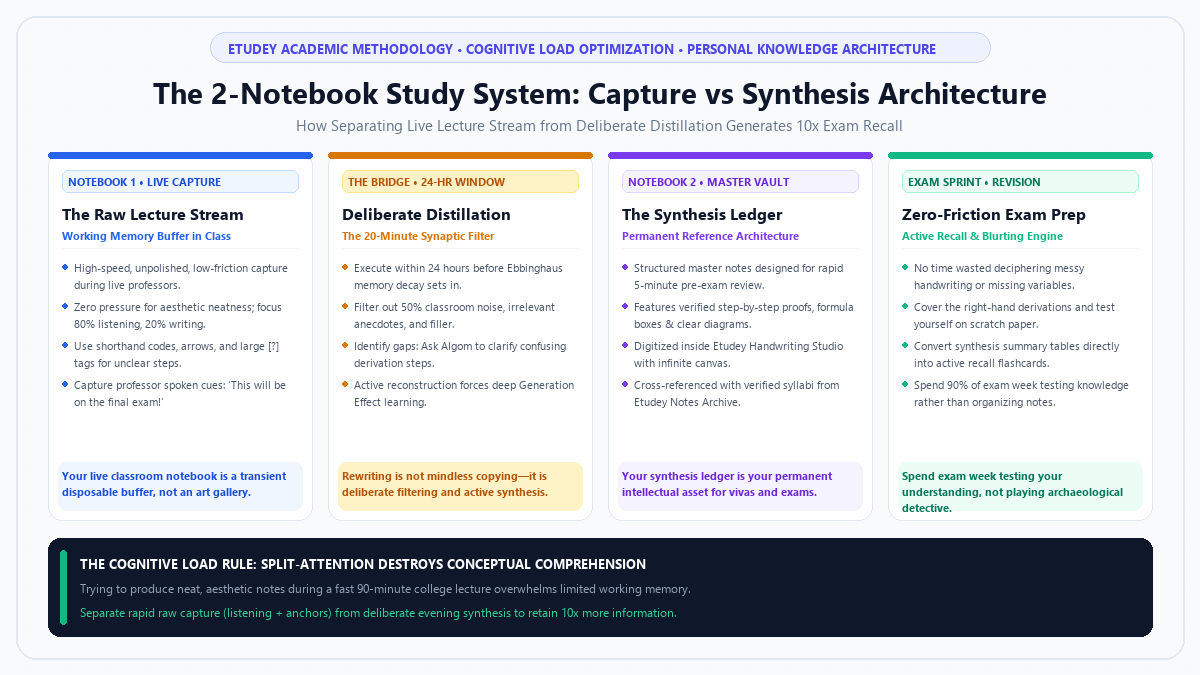
The Cognitive Science of Note-Taking: Working Memory vs. Generation Effect
To understand why the 2-Notebook architecture produces exceptional exam results, we must examine the biological constraints of the human cognitive architecture:
1. Cognitive Load Theory & The Split-Attention Effect
Educational psychologist John Sweller established that human working memory is severely limited: it can hold only 4 to 7 novel pieces of information simultaneously for roughly 20 to 30 seconds before synaptic decay occurs. When you try to simultaneously listen to a professor, understand a multi-variable calculus derivation, decide what is important, and format a pretty page, you induce severe extraneous cognitive load.
Your attention splits between listening and physical drafting. By attempting to make your in-class notes look like an Instagram aesthetic study post, you choke your working memory, guaranteeing that you absorb neither the conceptual logic nor the spoken nuances of the lecture.
2. The Generation Effect & Active Synthesis
In a landmark 1978 cognitive study, researchers Norman Slamecka and Peter Graf proved the Generation Effect: information is retained significantly better if it is actively generated and restructured by the learner's own mind rather than merely read or copied. When you mechanically copy what a professor writes on a chalkboard, your brain operates in passive recording mode. But when you close the lecture slides, sit down with a blank sheet, and deliberately summarize, reorganize, and re-derive the material in your own words, your hippocampus constructs dense, durable neural pathways.
3. Beating the Ebbinghaus Forgetting Curve
Hermann Ebbinghaus demonstrated that within 24 hours of a lecture, students lose up to 70% of newly acquired information unless an active retrieval event occurs. The 2-Notebook System embeds this retrieval event directly into your daily routine through the 24-Hour Distillation Bridge. Rewriting raw lecture notes is not busywork—it is the exact spaced retrieval intervention required to freeze the forgetting curve in its tracks.
The Core Study Axiom: Never attempt to create permanent knowledge during a live lecture. Live lectures are for rapid, low-friction sensory capture; your desk in the evening is where genuine learning, synthesis, and intellectual ownership happen.
Notebook 1: The Raw Capture Log (Live Working Memory Buffer)
The first component of the system is Notebook 1: The Raw Capture Log (often called the "Scratchpad" or "Rough Book"). This can be an inexpensive spiral notebook, a cheap legal pad, or a scratch canvas on a tablet.
The operational philosophy of Notebook 1 is absolute freedom from perfection. Its sole purpose is to serve as a transient working memory buffer. During class, your mental energy should be allocated 80% to active listening and conceptual tracking, and only 20% to writing.
Rules of Engagement for Notebook 1:
- Embrace the Mess: Write quickly in a single blue or black pen. Cross out mistakes with a single slash; never waste time with white-out, erasers, or changing pens. Do not worry about straight margins or beautiful handwriting.
- Capture Spoken Anchors, Not Slide Transcripts: Slide presentations will be uploaded to your university portal anyway. Do not waste energy copying text directly from slides. Instead, write down what the professor says out loud—the analogies, intuitive explanations, edge-case warnings, and vocal emphasis ("Pay attention here, 80% of students fail this step on the final exam!").
- The 4-Symbol Shorthand Protocol: Keep capture speed high by using a standardized shorthand symbol set in the left-hand margin:
[?]— Doubt/Confusion: Marks a derivation step or concept you did not understand, signaling that you must resolve it during evening synthesis.[★ EXAM]— High Probability: Professor explicitly emphasized this concept for semester tests or lab vivas.[DEF]— Key Terminology: A formal academic definition or boundary condition.-->— Causality: Denotes cause-and-effect ("higher temperature --> faster diffusion").
- Time-Stamp Markers: If you get completely lost during a complex derivation, write the timestamp (e.g., "10:42 AM - Fourier boundary conditions lost") and put your pen down to simply listen to the professor's spoken intuition. You can patch the algebra later.
The 24-Hour Distillation Bridge: The 20-Minute Evening Ritual
Notebook 1 is useless if left alone; within three days, your messy scribbles become unintelligible hieroglyphics. The magic of the 2-Notebook System lies in the 24-Hour Distillation Bridge.
Every evening, set a 20-minute timer for each lecture attended that day. Open your messy Notebook 1 alongside your syllabus textbook or official lecture slides, and open your pristine Notebook 2: The Synthesis Ledger. Your objective during these 20 minutes is not to copy text line-by-line; your objective is to act as an aggressive intellectual editor.
- Filter Out 50% Classroom Noise: Delete repetitive examples, administrative announcements, meandering tangents, and redundant explanations. Extract only the core conceptual nuggets, governing formulas, and logical frameworks.
- Resolve All
[?]Doubt Tags: Look at every question mark in Notebook 1. Before writing anything into Notebook 2, resolve the doubt. If a derivation step skipped three lines of intermediate algebra, do not blindly copy the leap. Open AIgom, Etudey's Academic AI Tutor, upload a snapshot of your rough scratchpad, and ask: "Explain the algebraic intermediate steps between Equation 3 and Equation 4 in this derivation." Once you understand the bridge, write the complete, verified proof into Notebook 2. - Cross-Reference with Verified Syllabus Notes: Unsure whether your professor's notation matches standard university examination grading schemes? Cross-reference your notes against verified peer summaries in the Etudey Notes Archive to ensure your formulas and terminology match university expectations.
Notebook 2: The Permanent Synthesis Ledger (Master Reference Architecture)
Notebook 2: The Synthesis Ledger is your permanent academic vault. This is the master document you will open three days before final exams, during end-semester viva revision, and when preparing for competitive technical tests like GATE, GRE, or technical job interviews.
While Notebook 1 was messy and chronological, Notebook 2 is modular, beautifully structured, and organized by syllabus concept. Many high-achieving students maintain Notebook 2 digitally using the Etudey Handwriting Studio, which combines the cognitive benefits of handwritten pen strokes on a touchscreen tablet with the infinite canvas, searchable indexing, and cloud persistence of a digital archive.
| Architectural Dimension | Traditional 1-Notebook Approach | Notebook 1: Raw Capture Log | Notebook 2: Synthesis Ledger (Etudey System) |
|---|---|---|---|
| Primary Mindset | Desperate transcription under time pressure | 80% listening, 20% anchoring; zero aesthetic stress | Deliberate distillation, intellectual ownership & clarity |
| Visual Standard | Inconsistent, messy, half-colored, rushed | Intentionally rough, scratchpad shorthand, disposable | Pristine, modular, color-coded, standardized layout |
| Cognitive Mode | High split-attention; working memory overload | High auditory attention; low extraneous cognitive load | Deep active recall & Generation Effect synthesis |
| Derivation Quality | Rushed, skipped steps, missing algebraic minus signs | Gaps marked with [?] doubt tags |
Fully verified, step-by-step complete mathematical proofs |
| Pre-Exam Review Time | 15-20 hours wasted deciphering messy handwriting | 0 hours (Archived or discarded post-synthesis) | 2-3 hours of rapid active recall and formula blurting |
| Ideal Medium | Bulky 400-page register carried to every class | Inexpensive pocket pad or rough legal pad | Etudey Handwriting Studio or bound leather master book |
The Anatomy of a Perfect Synthesis Page
To ensure your Notebook 2 acts as a high-speed revision engine during exam season, structure every topic using the standardized 4-part modular layout:
1. The Concept Capsule (Top Header)
A single, bold box at the top of the page containing a 2-sentence first-principles definition of the concept in plain English. For example: "Carnot Efficiency represents the maximum theoretical work extractable from a heat engine operating between two temperatures, governed entirely by the Second Law of Thermodynamics: $\eta = 1 - T_C/T_H$."
2. The Keystone Derivation Roadmap (Central Body)
Never write derivations as unbroken walls of algebra. Break the proof into 3 or 4 numbered milestones with verbal justifications between lines. Use a dedicated color (such as emerald green) to highlight critical boundary condition substitutions or integration limits.
3. The Trap & Exception Box (Right Margin)
A shaded callout box detailing the common mistakes students make on university exams: "TRAP: Temperature $T$ must always be in Kelvin, never Celsius! Using Celsius results in an immediate zero mark."
4. The Memory Retrieval Cues (Bottom Footer)
Three active-recall prompt questions that test whether you understand the page without looking at the body: "Q1: Why can real heat engines never achieve Carnot efficiency? Q2: What happens if $T_C \to 0\text{ K}$?"
The Pre-Exam Sprint Protocol: Turning Synthesis into High Marks
When final exam week arrives, the difference between a student using a traditional single notebook and a student using the 2-Notebook System is staggering:
Traditional students spend days in their dorm rooms reading through hundreds of messy, half-legible pages, highlighting lines they have already highlighted, and suffering from the illusion of competence. In contrast, the 2-Notebook student never "reads" their notes passively. They use their Synthesis Ledger as an active examination engine:
- The Sheet-Cover Blurting Drill: Take a blank sheet of scratch paper and place it directly over the central derivation body of a synthesis page, exposing only the top Concept Capsule and bottom Retrieval Cues. Using the Etudey Handwriting Studio or rough paper, attempt to write out the entire derivation from memory. Because your synthesis ledger contains the clean, verified proof, you can immediately check your work and identify any missed steps.
- Targeted Backlog Sprinting: If you discover gaps in specific numerical problem types, schedule targeted 45-minute revision blocks using the agile Kanban board in the Etudey Study Workspace.
- Zero Time Wasted on Organization: While your peers are desperately messaging classmates on WhatsApp asking for photos of missing class notes, your complete semester curriculum is already organized, indexed, verified, and ready for rapid review.
Supercharging Your Note System with Etudey
The 2-Notebook Study System is built into the core philosophy of Etudey's free student workspace. Here is how to implement the workflow digitally without carrying stacks of heavy paper notebooks across campus:
- Digital Synthesis on Any Device: Use the Etudey Handwriting Studio on your iPad, Android tablet, or 2-in-1 touchscreen laptop. Enjoy zero-latency digital ink, infinite vertical scrolling, color-coded highlighters, and instant PDF exports that keep your Notebook 2 organized by semester and subject.
- Interactive AI Step Verification: When distilling messy class notes into clean derivations, use AIgom, Etudey's Academic Tutor. Upload rough sketches of equations or circuit diagrams and receive immediate, step-by-step mathematical explanations to ensure your permanent ledger is 100% error-free.
- University Peer Note Comparison: Ensure your synthesis notes cover every high-yield topic tested by your specific university by cross-referencing with the Etudey Notes Archive, containing thousands of verified lecture summaries and previous-year question solutions.
- Agile Study Planning: Track your daily 20-minute distillation sessions and semester exam sprints with the customizable Kanban boards in the Etudey Study Workspace.
Frequently Asked Questions
Isn't maintaining two notebooks twice as much work for busy college students?
It feels that way on the surface, but cognitive tracking proves it actually saves massive amounts of time. Re-reading messy, unorganized notes three weeks later takes 4 to 5 times longer than reviewing clean, structured synthesis sheets. Furthermore, the 20 minutes you spend distilling notes every evening replaces hours of painful, panicked cramming before exams. You do the same total work, but you distribute it at the point of maximum memory consolidation, yielding vastly higher exam grades.
Should Notebook 1 and Notebook 2 be physical paper or digital tablets?
The system is completely medium-agnostic. Many students prefer a cheap physical paper notepad for Notebook 1 (because flipping pages quickly and scribbling rough shorthand in class has zero digital friction) combined with a digital tablet running Etudey Handwriting Studio for Notebook 2 (which gives you infinite canvas space, searchable handwriting, perfect color-coding, and cloud backups). However, two physical paper notebooks or two digital notebooks work just as effectively.
What is the difference between the 2-Notebook System and the traditional Cornell Note-Taking Method?
The Cornell Method attempts to combine capture, cues, and summary onto a single page during or immediately after class. While effective for humanities and structured lectures, Cornell notes often fail in dense STEM, engineering, and medical courses where derivations span multiple continuous chalkboards and equations do not fit into rigid column templates. The 2-Notebook System completely untethers live capture from formal synthesis, giving you unlimited scratch space in class and pristine structural freedom during evening review.
What should I do if I miss a lecture or have huge gaps in Notebook 1?
Do not attempt to blindly copy a friend's messy class notes. Instead, open the Etudey Notes Archive and search for the specific topic or lecture number for your university syllabus. Cross-reference the verified peer summary with your course textbook, and synthesize the concepts directly into Notebook 2. If any conceptual logic remains unclear, use AIgom to walk you through the missing derivation step-by-step.
How do I organize Notebook 2 so it doesn't become another disorganized notebook?
Structure Notebook 2 by syllabus unit or module rather than chronological dates. Allocate a dedicated section or digital folder for each unit (e.g., "Unit 3: Second-Order Linear Differential Equations"). At the front of each unit, include a 1-page Master Index listing every core concept, derivation roadmap, and formula box with direct page references. This transforms your synthesis notebook into a high-speed reference handbook during exam season.
Transform Your College Note-Taking Today
Say goodbye to messy lecture panic and late-night deciphering. Build your ultimate digital synthesis ledger with Etudey's free handwriting studio, intelligent AI tutor, and verified semester note repositories.