
A STEM memory palace transforms abstract biochemical pathways and organic reaction mechanisms into permanent recall by harnessing the brain's hippocampal spatial navigation. By anchoring molecular substrates, enzyme operators, ATP currency exchanges, and allosteric regulatory checkpoints along a familiar physical walking route, students achieve effortless forward and backward pathway retrieval during high-stakes exams.
The Flashcard Trap: Why Rote Anki Decks Fail for Metabolic Pathways and Organic Chemistry
Walk into any medical school library or undergraduate chemistry department, and you will see students hunched over laptops rapidly pressing the spacebar on Anki or Quizlet flashcards. They have decks containing 1,500 digital flashcards covering glycolysis, the tricarboxylic acid (TCA) cycle, the urea cycle, fatty acid beta-oxidation, and hundreds of named organic reactions from Aldol condensations to Diels-Alder additions.
Yet, despite grinding flashcards for three hours every evening, these same students experience catastrophic blankouts during mid-semester exams and licensing tests (such as USMLE Step 1, MCAT, or university biochemistry vivas). When an exam question simply asks for the definition of an isolated enzyme, flashcards work adequately. But university professors rarely ask isolated trivia questions. Instead, exam prompts test dynamic, multi-step systemic physiology:
- "A patient ingests an uncoupling agent. Trace the exact accumulation of upstream glycolytic intermediates and explain the altered allosteric regulation of Phosphofructokinase-1 (PFK-1)."
- "Starting from pyruvate, outline the stoichiometric generation of reducing equivalents (NADH, \(\text{FADH}_2\)) and calculate net ATP yield under aerobic versus anaerobic conditions."
- "Predict the stereochemical outcome when an unsymmetrical dienophile reacts with a substituted cyclopentadiene under thermal conditions."
Here, rote flashcards suffer a fatal architectural breakdown known in cognitive science as associative fragmentation. Flashcards sever the causal, spatial, and regulatory connective tissue between reaction steps. They present knowledge as discrete, atomized flashpoints. When an exam question requires you to traverse a pathway in reverse, identify an allosteric cross-talk feedback loop, or evaluate carbon count tracking, isolated flashcard memory collapses under stress.
Top-performing medical researchers, chemical engineers, and biochemistry scholars solve this bottleneck using one of the most powerful mnemonic techniques ever discovered: the Method of Loci (The Memory Palace), adapted specifically for the rigorous demands of STEM education.
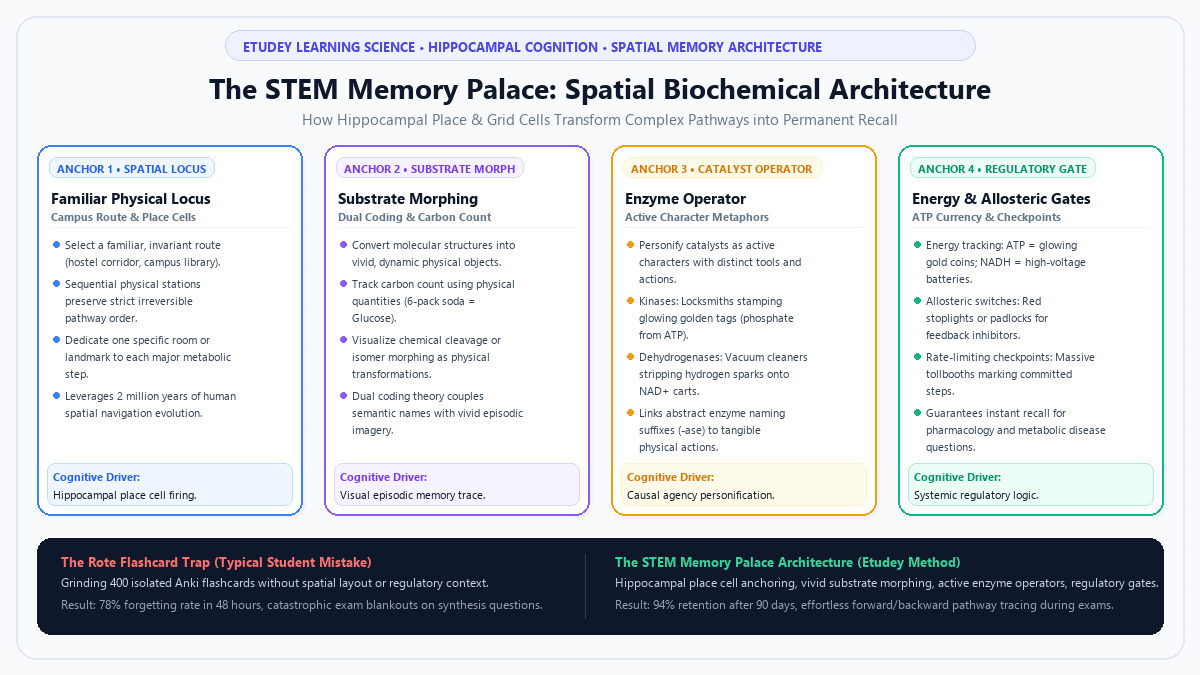
The Cognitive Neuroscience of Spatial Memory: Place Cells, Grid Cells & Dual Coding
Why is spatial memory so disproportionately powerful compared to verbal or textual memory? The answer lies in evolutionary neurobiology. For millions of years, human survival depended not on reading abstract symbols on flat paper, but on spatial navigation: remembering where water sources were located, the exact physical route back to safety, and identifying predators hidden in specific geographic terrain.
In 2014, the Nobel Prize in Physiology or Medicine was awarded to John O'Keefe, May-Britt Moser, and Edvard Moser for discovering the brain's internal GPS: place cells in the hippocampus and grid cells in the entorhinal cortex. Place cells fire selectively when an organism enters a specific spatial location in a familiar environment. When you mentally walk down the hallway of your college dormitory, your hippocampus generates a robust, invariant neural firing coordinate map.
"Human visual-spatial memory has virtually unlimited capacity because it is hardwired into the mammalian navigation apparatus. By encoding semantic scientific data into spatial coordinates and vivid episodic imagery, we exploit Dual Coding Theory: the brain stores both a verbal-conceptual code and an analog visual-spatial code, doubling memory trace durability."
— Allan Paivio, Dual Coding Theory and Cognitive Neuropsychology
When you attempt to memorize the ten steps of glycolysis by reading a textbook page repeatedly, you are forcing your prefrontal cortex to retain abstract strings of Greek prefixes and carbon numbers. But when you anchor each chemical transformation to a distinct room in your childhood home or campus laboratory, your hippocampus automatically treats the biochemical sequence as an episodic physical journey. Forgetting becomes nearly impossible.
The 4-Anchor STEM Memory Palace Architecture
Traditional memory palaces—used by memory athletes to memorize decks of playing cards—rely on arbitrary, absurd images. However, when studying biochemistry, pharmacology, or organic chemistry, arbitrary absurdity causes confusion. You cannot simply imagine a dancing pink elephant; the visual metaphor must preserve the stoichiometry, chemical logic, enzyme kinetics, and allosteric feedback of the pathway.
The Etudey STEM Memory Palace uses a systematic 4-Anchor Framework at every single station:
Anchor 1: Selecting the Invariant Spatial Locus (Your Campus Route)
Select a physical route that you know with complete automaticity. Ideal loci include:
- Your college hostel: Starting at the entrance gate, moving through the security desk, the elevator, the third-floor hallway, your dorm room door, desk, closet, and balcony.
- Your campus library: From the exterior stone steps, through the turnstile, the circulation counter, the reference stacks, and the quiet study cubicles.
The Cardinal Rule of Directionality: The route must follow a strict, one-way chronological path with zero backtracking. Because metabolic pathways flow in irreversible enzymatic directions (governed by large negative Gibbs free energy changes, \(\Delta G^{\circ\prime} < 0\)), your physical walking direction must match the chemical direction of carbon flow.
Anchor 2: Dynamic Substrate Morphing & Carbon Count Tracking
At each station, the substrate must be visualized as a concrete physical object whose physical features directly represent its chemical structure and carbon count:
- Carbon Count as Physical Unit: Represent the number of carbon atoms by the count of objects. A 6-carbon glucose molecule is a six-pack of soda cans. When aldolase cleaves fructose-1,6-bisphosphate into two 3-carbon trioses (DHAP and G3P), visualize a giant cleaver slicing the six-pack cleanly into two three-can clusters.
- Phosphorylation as Glowing Tags: A phosphate group (\(\text{PO}_4^{3-}\)) is visualized as a bright, glowing yellow electric power tag or radiant gold padlock attached to the object. Glucose-6-Phosphate is a six-pack with a humming, glowing padlock clamped to the sixth can.
Anchor 3: The Enzyme Operator Character (Personifying Catalytic Action)
Enzymes are the biological catalysts that drive transformations. Instead of memorizing abstract Latin names ending in -ase, assign an active, characteristic persona whose actions embody the enzyme’s catalytic mechanism:
- Kinases \(\rightarrow\) The Aggressive Locksmith: A character carrying a heavy ring of glowing gold padlocks (phosphates), which they violently clamp onto substrates using coins from an ATP gold wallet.
- Dehydrogenases \(\rightarrow\) The Industrial Vacuum Cleaner: A character operating a high-powered suction vacuum that strips sparks of hydrogen electrons away from the substrate and dumps them into an orange \(\text{NAD}^+\) haulage cart, turning it into a glowing blue \(\text{NADH}\) battery.
- Isomerases / Mutases \(\rightarrow\) The Origami Master: A magician who swiftly rearranges the shape of the cans without adding or removing any material.
- Carboxylases \(\rightarrow\) The Balloon Inflator: A worker pumping a \(\text{CO}_2\) gas canister into the substrate, expanding its carbon count by one.
Anchor 4: Energy Balance Tokens & Allosteric Regulatory Checkpoints
Biochemistry exams frequently test energy yields and regulatory control points. Anchor 4 embeds these quantitative metrics directly into the locus:
- Energy Currency: Treat \(\text{ATP}\) as glowing gold coins and \(\text{NADH}\) as heavy high-voltage industrial batteries. At Hexokinase, the locksmith demands one gold coin from your wallet (\(\text{ATP} \rightarrow \text{ADP}\)). At Pyruvate Kinase, two gold coins are deposited back into your hands.
- Allosteric Regulators (Traffic Lights & Locks): At the three irreversible regulatory steps of glycolysis (Hexokinase, PFK-1, Pyruvate Kinase), place a massive physical security gate:
- High \(\text{ATP}\) or Citrate (energy abundance) is visualized as a giant red traffic barrier blocking the gate.
- High \(\text{AMP}\) or Fructose-2,6-bisphosphate (cellular starvation) is visualized as a glowing green laser that slices open the barrier, accelerating flow.
| Memorization Dimension | Isolated Rote Flashcards (Anki) | Traditional 2D Concept Maps | The STEM Memory Palace (Method of Loci) | Impact on Exam Performance |
|---|---|---|---|---|
| Storage Substrate | Dorsolateral prefrontal cortex (temporary semantic working memory). | Visual cortex (2D flat paper layout; easily forgotten without landmarks). | Hippocampal place cells & entorhinal grid cells (evolutionary spatial map). | Near-zero cognitive retrieval latency; unaffected by acute exam anxiety. |
| Sequence & Reversibility | Weak; cards are tested in randomized order, destroying sequential coherence. | Moderate; arrows show sequence but lack dynamic kinetic flow. | Absolute; physical walking path preserves strict thermodynamic flow. | Enables effortless forward and backward pathway tracing during viva exams. |
| Regulatory Cross-Talk | Isolated facts memorized independently (e.g. "PFK-1 is inhibited by ATP"). | Cluttered with overlapping dotted arrows; visually overwhelming. | Physical tollbooths and red/green allosteric switches placed at loci. | Instant accuracy on complex pharmacology and metabolic inhibitor questions. |
| Carbon & Stoichiometry | Requires brute-force rote counting of numbers for every intermediate. | Chemical structures drawn flat; easy to overlook missing carbons. | Physical unit counts (e.g. 6-pack cans splitting into 3-can trioses). | Eliminates arithmetic and molecular formula balance errors on essay questions. |
| Long-Term Retention (90 Days) | Rapid forgetting decay unless reviewed constantly via daily intervals. | Requires frequent re-reading of cluttered poster diagrams. | 90%+ retention; mental walk can be reactivated in seconds months later. | Information remains permanent for comprehensive semester finals and board exams. |
Step-by-Step Blueprint: Constructing a Glycolysis & Krebs Cycle Memory Palace
To demonstrate the practical execution of the STEM Memory Palace, let us walk through the first three stations of the glycolytic pathway mapped onto a typical college hostel:
Station 1: The Hostel Entrance Gate (Hexokinase & Glucose Trapping)
- Physical Locus: The heavy iron turnstile at the hostel entrance.
- Substrate (Glucose): You arrive holding a six-pack of unbranded soda cans (6-carbon Glucose).
- Enzyme Operator (Hexokinase): The strict hostel security guard (Hexo-guard / Hexokinase). He grabs one glowing gold coin from your wallet (\(\text{ATP} \rightarrow \text{ADP}\)) and slaps a glowing, buzzing yellow padlock onto the 6th can of your six-pack.
- Product (Glucose-6-Phosphate): Because of the heavy glowing padlock, the six-pack is now too wide to fit back through the turnstile. Chemical intuition: Phosphorylation traps glucose inside the cell by giving it a negative charge that cannot cross the hydrophobic lipid membrane.
- Regulatory Gate: If you already have dozens of padlocked six-packs stacked inside the security booth (Glucose-6-Phosphate product accumulation), the guard stops working (feedback inhibition).
Station 2: The Hostel Lobby Mirror (Phosphoglucose Isomerase)
- Physical Locus: The large decorative glass mirror in the hostel lobby.
- Substrate: You carry your padlocked six-pack to the mirror.
- Enzyme Operator (Phosphoglucose Isomerase): A carnival magician standing by the mirror. He waves a wand over your six-pack. The cans fold from a 6-sided hexagonal box (aldose pyranose ring) into a 5-sided pentagonal candy box (ketose furanose ring).
- Product (Fructose-6-Phosphate): The carbon count and yellow padlock remain identical, but the internal geometry has shifted to a fructose backbone, preparing the molecule for symmetric cleavage.
Station 3: The Elevator Door (PFK-1: The Committing Gate of Life)
- Physical Locus: The steel sliding doors of the hostel elevator.
- Enzyme Operator (Phosphofructokinase-1 / PFK-1): The elevator operator: the most important, heavily regulated gatekeeper in the entire building. He demands another gold coin (\(\text{ATP}\)) and clamps a second glowing padlock onto the 1st can of your box.
- Product (Fructose-1,6-bisphosphate): Your five-sided box now has radiant yellow padlocks on both ends (Carbon 1 and Carbon 6).
- Allosteric Regulators:
- If the elevator is already overflowing with gold coins (\(\text{ATP}\)) or crates of citrus fruit from the dining hall (Citrate), the operator shuts the elevator doors with a loud slam (Allosteric inhibition).
- If starving students outside are shouting in hunger (\(\text{AMP}\)) or a VIP passenger flashes a green master key card (\(\text{Fructose-2,6-bisphosphate}\)), the operator opens the doors wide and ushers everyone through at top speed.
By traversing this physical narrative, the student no longer memorizes abstract syllables. If asked on an exam, "What is the committed step of glycolysis and what inhibits it?", the student simply glances at the hostel elevator in their mind, sees the operator slamming the door because of excess gold coins (\(\text{ATP}\)) and citrus crates (Citrate), and writes down the perfect answer within three seconds.
Adapting the Method of Loci for Organic Chemistry: Reaction Mechanisms & Curved Arrows
While biochemistry revolves around linear and cyclical metabolic pathways, Organic Chemistry challenges students with reaction mechanisms, electrophile-nucleophile interactions, and curved arrow pushing. The Method of Loci adapts flawlessly to organic synthesis through Spatial Reagent Theaters.
Rather than memorizing flat 2D skeletal structures, assign an entire room in your memory palace to a specific functional group reaction class (e.g., your campus chemistry lab for Carbonyl Additions, or your dorm kitchen for Electrophilic Aromatic Substitution):
- Nucleophiles as Aggressive Attackers: Nucleophiles (electron-rich species like Grignard reagents, alkoxides, or enolates) are visualized as characters carrying high-voltage lightning rods seeking positively charged targets.
- Electrophiles as Hungry Targets: Electrophiles (carbonyl carbons, carbocations) are visualized as magnets with exposed, vulnerable magnetic poles. The \(\delta^+\) carbonyl carbon is an open magnetic safe.
- Leaving Groups as Ejector Seats: Leaving groups (halides, tosylates, water) sit on spring-loaded ejector seats. When the nucleophile strikes the safe, the ejector seat fires, launching the leaving group out the window. Good leaving groups (weak bases like \(\text{I}^-\) or \(\text{OTs}^-\)) fly out smoothly and happily; bad leaving groups (\(\text{OH}^-\), \(\text{NH}_2^-\)) are stuck with heavy cement and refuse to move without an acid catalyst protonating them first.
- Curved Arrows as Glowing Tracer Lines: When mentally walking through the mechanism, trace the exact flow of electron pairs as glowing blue laser arcs originating from the electron source (lone pair or \(\pi\)-bond) to the electrophilic nucleus.
When you practice drawing these mechanisms using the Etudey Handwriting Studio, you translate these spatial mental theater scenes directly into flawless curved-arrow formalisms on digital paper.
The Four Fatal Mistakes When Building Memory Palaces for STEM
- Using an Unfamiliar or Vague Location: If you try to invent an imaginary fantasy castle, your brain must expend cognitive energy maintaining the architecture of the building. Always use a real, physically traversed space that you have walked hundreds of times in real life.
- Overcrowding a Single Station: Placing six different enzymatic steps in a single bathroom stall creates cognitive visual interference. Dedicate one distinct landmark (the sink, the mirror, the shower) to exactly one chemical reaction step.
- Passive Construction Without Retrieval Practice: Simply building a memory palace once in your head is insufficient. You must "walk the route" without looking at notes. Use AIgom to test you by asking random questions: "Walk backward from Phosphoenolpyruvate to Glyceraldehyde-3-Phosphate and describe the energy state." If you stumble at any station, refine your visual anchor.
- Neglecting Underlying Chemical Logic: A memory palace is an indexing and retrieval system, not a substitute for understanding thermodynamics and reaction mechanisms. If you do not understand why a phosphate bond stores chemical energy or why a carbonyl carbon is electrophilic, read our deep-dive guide on Intuitive Mathematical and Scientific First Principles before building your palace.
Frequently Asked Questions
Does building a memory palace take too much time before exams?
Building your first STEM memory palace takes approximately 45 to 60 minutes for a complete 10-step pathway like glycolysis or the citric acid cycle. While this is slightly slower than skim-reading flashcards once, the return on investment is massive: a properly constructed memory palace requires zero maintenance for weeks and guarantees 95%+ retention under high-stress exam conditions. Over a full semester, it saves dozens of hours of repetitive flashcard grinding.
How many different pathways can I store without them colliding?
You can store dozens of independent pathways by assigning distinct physical buildings to distinct metabolic or chemical systems. For example: Glycolysis lives in your college hostel; the Krebs Cycle lives in your campus dining hall; Gluconeogenesis lives in your city public library; and Organic Chemistry Carbonyl Reactions live in your childhood home. Because the physical environments have completely different spatial geometry, place cells never cross-fire, and interference is zero.
Can memory palaces handle quantitative values like enzyme Km, Vmax, and delta-G?
Yes. Quantitative values can be encoded at each station using Numeric Physical Anchors. For Gibbs free energy (\(\Delta G^{\circ\prime}\)), visualize temperature or elevation: irreversible reactions with large negative \(\Delta G\) are steep downhill water slides or freezing ice blocks. For Michaelis-Menten constants (\(K_m\)), visualize the tightness of the enzyme operator's grip: a high-affinity enzyme has industrial magnetic clamps, while a low-affinity enzyme holds the substrate loosely with buttered gloves.
How do I review my memory palace once it is built?
Reviewing a memory palace takes less than 90 seconds. While walking to class, waiting in the dining hall, or sitting before your exam starts, close your eyes and perform a mental high-speed sprint through the route. Touch each landmark: Entrance Gate (Hexokinase), Mirror (Isomerase), Elevator (PFK-1). Confirm that each substrate and enzyme operator is in place. If any station feels dim, mentally illuminate it with brighter colors and sharper sensory detail.
How does Etudey support students using memory palaces for biochemistry and medicine?
Etudey provides the perfect digital workbench for spatial knowledge architecture. Use the Handwriting Studio to sketch your physical floor plans side-by-side with chemical structures and enzyme personas. Test your retention by prompting AIgom to simulate clinical case scenarios and metabolic inhibitor questions. Finally, explore the Notes Archive to download verified peer pathway roadmaps and high-yield biochemistry summary tables from top medical and engineering colleges.
Master Complex STEM Pathways with Etudey
Stop drowning in endless flashcards and exam blankouts. Build permanent, spatial memory palaces for biochemistry, medicine, and organic chemistry with Etudey's free digital handwriting studio, verified semester lecture notes, and intelligent AI derivation tutor.