
The Leitner Box system is an algorithmic spaced repetition framework that uses physical or digital card sorting across five expanding intervals to automate long-term memory consolidation. By reviewing difficult cards daily and promoting mastered concepts to longer intervals, it maximizes study efficiency, halts memory decay, and guarantees exam-day recall.
The Forgetting Curve Dilemma: Why Linear Flashcard Cramming Fails
Every university student is familiar with the dreaded flashcard trap: three weeks before midterms, you create four hundred index cards covering engineering formulas, reaction mechanisms, and code definitions. You sit down with a massive rubber-banded stack and begin reviewing them sequentially from card 1 to card 400.
By card 75, your brain feels numb. You recognize basic definitions effortlessly, yet you are forced to re-read them dozens of times simply because they happen to be in the deck. Meanwhile, the truly brutal differential equations—the ones with intricate boundary conditions and delicate sign conventions—slip past with only a cursory glance.
Linear studying is an exercise in extreme inefficiency. In 1885, German psychologist Hermann Ebbinghaus mapped the mathematical rate at which the human brain sheds unprompted information: the Forgetting Curve. Within forty-eight hours of first reading an engineering lecture, your brain discards up to 70% of new synaptic data unless that memory trace is explicitly interrupted and retrieved.
When you review four hundred flashcards in a static stack, you commit two critical learning errors:
- Overlearning Low-Yield Concepts: You waste valuable cognitive bandwidth reviewing concepts you already know by heart, generating an illusion of productivity while leaving critical knowledge gaps untouched.
- Under-Practicing Fragile Circuits: Highly complex mathematical proofs and multi-variable derivations decay before you cycle back through the deck, ensuring they collapse under the high-pressure conditions of the examination hall.
To conquer dense university syllabi, you do not need more index cards. You need an automated, variable-frequency sorting algorithm: The Leitner Box System.
The Origin Story: How Sebastian Leitner Engineered the 5-Box Protocol (1972)
In 1972, German science journalist and polymath Sebastian Leitner published a landmark work on cognitive efficiency titled So lernt man lernen ("How to Learn to Learn"). Leitner recognized that human memory does not operate like a computer hard drive; it operates as an organic, adaptive biological network that requires exponentially spaced stimuli to consolidate data permanently into the neocortex.
Leitner devised an elegant, purely mechanical solution: a physical card file divided into five sequential compartments—Box 1 through Box 5.
The operational rules of Leitner's system are ruthlessly simple:
- Universal Starting Point: Every single new flashcard begins its life in Box 1.
- The Promotion Rule (Success): When you review a card and answer it correctly from memory, it advances exactly one level higher (e.g., from Box 1 to Box 2, or Box 3 to Box 4).
- The Reset Penalty (Failure): In Sebastian Leitner's strict original protocol, if you get a card wrong—even if it has climbed all the way to Box 4—it is immediately demoted all the way back to Box 1.
- Expanding Time Intervals: The higher the box, the less frequently it is reviewed. Box 1 is reviewed every day, while Box 5 is reviewed only once a month.
The brilliance of this mechanism is that the difficulty of each concept dictates its own review schedule. Hard formulas automatically gravitate to Box 1, where you drill them daily until mastery. Easy formulas automatically migrate to Box 4 and Box 5, where they occupy less than 5% of your study time.
| Box Compartment | Cognitive Status | Review Frequency | Action on Correct Recall | Action on Wrong Recall |
|---|---|---|---|---|
| Box 1 | New & Highly Fragile | Every Day | Promote to Box 2 | Remain in Box 1 (Daily drill) |
| Box 2 | Developing Fluency | Every 3 Days | Promote to Box 3 | Demote back to Box 1 |
| Box 3 | Solid Familiarity | Every 7 Days (Weekly) | Promote to Box 4 | Demote back to Box 1 |
| Box 4 | High Competence | Every 14 Days (Bi-weekly) | Promote to Box 5 | Demote back to Box 1 |
| Box 5 | Permanent Neocortical Storage | Every 30 Days (Monthly) | Graduated & Archived | Demote back to Box 1 |
The Visual System Architecture: How Cards Migrate Across Boxes
To visualize how the Leitner system transforms an overwhelming mountain of university material into a manageable daily stream, examine the five-box progression workflow below:
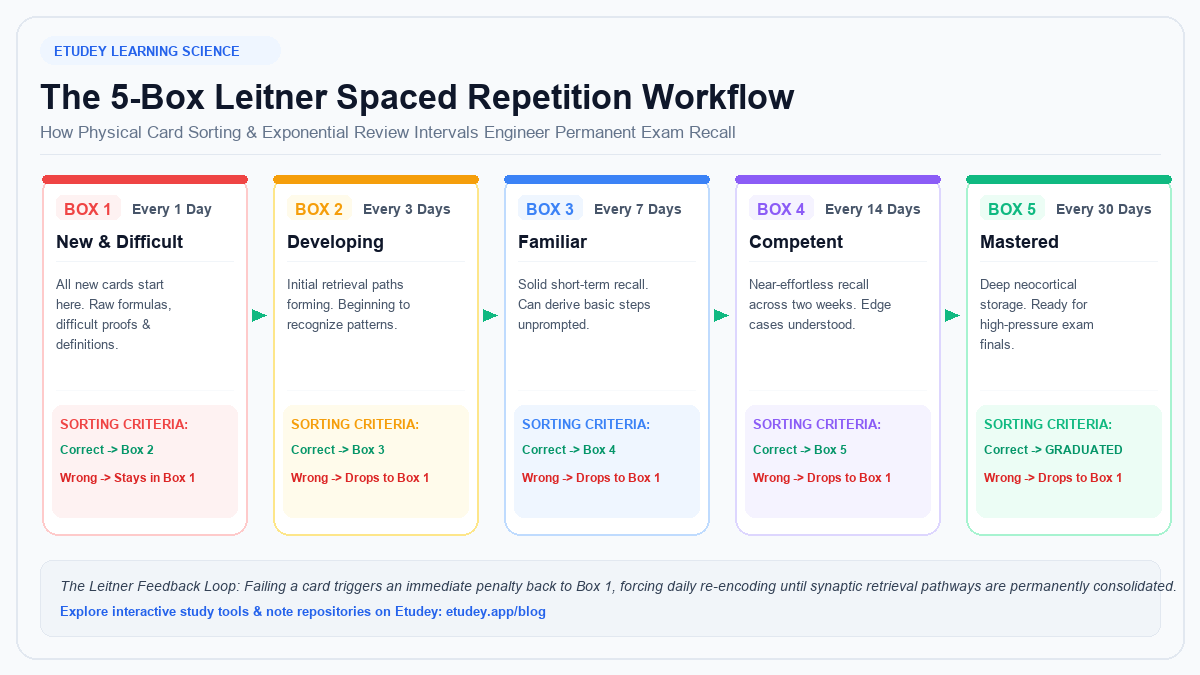
Notice the critical feedback dynamic: cards move forward incrementally on green arrows, but drop back precipitously on red arrows. This asymmetry ensures that an error is never brushed aside. If you stumble on a derivation, the system forces you to rebuild the neural retrieval pathway from the ground up through daily repetitions.
"The genius of Sebastian Leitner's box system lies in the severity of the Box 1 reset penalty. When a student misses a card in Box 4 and experiences that sharp emotional demotion back to Box 1, the brain experiences an intense prediction-error signal. That friction forces the hippocampus to reconstruct the damaged associative pathway with significantly higher synaptic density."
The Neuroscience of Expanding Intervals: Storage Strength vs. Retrieval Strength
Why does reviewing a card every seven or fourteen days cement memory far more effectively than reviewing it every twelve hours?
The answer was formulated by UCLA cognitive neuroscientist Dr. Robert Bjork in his foundational framework of Storage Strength versus Retrieval Strength:
- Retrieval Strength (Access Fluency): Measures how accessible a memory is right now in the present moment. If you read a formula thirty seconds ago, its retrieval strength is near 100%, yet its long-term durability is virtually zero.
- Storage Strength (Consolidated Durability): Measures how deeply integrated the neural trace is within your long-term neocortical networks.
Here is the counter-intuitive biological reality: storage strength only grows when retrieval strength is low.
If you test yourself on a formula while it is still fresh in working memory (high retrieval strength), your brain expends almost zero effort retrieving it. The hippocampus interprets the effortless recall as biologically trivial and expends zero resources reinforcing the synapse.
However, when you wait seven days until the formula has partially faded into the background (low retrieval strength) and force yourself to reconstruct it on Box 3 review day, your brain experiences substantial cognitive friction. That friction triggers Long-Term Potentiation (LTP). The brain registers the effortful struggle as a survival imperative, permanently multiplying the dendritic connections that store that concept.
Step-by-Step Setup: Building Your College Leitner System
You can construct a physical Leitner Box system in your dorm room in twenty minutes using common household items, or manage it digitally via Etudey's free study tools.
Step 1: Constructing the Physical Hardware
Take a standard cardboard shoebox or purchase a long wooden index card file. Using stiff cardboard dividers, create five distinct compartments labeled Box 1 through Box 5.
Pro Tip on Partition Sizing: In Sebastian Leitner's original design, the physical width of the compartments grew progressively larger: Box 1 was roughly 1 cm wide, Box 2 was 2 cm, Box 3 was 5 cm, Box 4 was 10 cm, and Box 5 was 20 cm. This created an automatic spatial feedback loop: if Box 1 began overflowing, the student immediately knew they were adding new cards faster than they were mastering existing ones.
Step 2: Formulating "Atomic Derivation" Flashcards
The single biggest mistake college students make when creating Leitner cards is writing entire textbook paragraphs on the back. A flashcard must be atomic—testing a single concept, derivation step, or boundary condition.
- ❌ Vague & Overloaded: Front: "Explain Operational Amplifiers." Back: [Three pages of circuit theory].
- ✅ Atomic STEM Card 1: Front: "What are the two golden rules of an ideal Op-Amp in negative feedback?" Back: "1. Virtual short: V+ = V-. 2. Infinite input impedance: I+ = I- = 0."
- ✅ Atomic STEM Card 2: Front: "Derive the closed-loop voltage gain for an inverting amplifier from Kirchhoff's Current Law." Back: "I_in = I_f → (V_in - 0)/R_in = (0 - V_out)/R_f → A_v = -R_f/R_in."
Step 3: The 15-Minute Daily Review Routine
Keep your Leitner Box directly beside your study desk. Print out a simple monthly calendar grid and mark which boxes are scheduled for each day:
- Every Single Day: Review Box 1 (typically 15 to 25 cards).
- Tuesdays & Fridays: Review Box 2.
- Sundays: Review Box 3.
- 1st & 15th of the Month: Review Box 4.
- Last Day of the Month: Review Box 5.
During review, never glance at the back of the card until you have actively spoken the answer aloud or derived the equation on a piece of scratch paper. If your derivation is 100% accurate, slide the card into the next box. If you missed a single negative sign or inverted a limit of integration, place it without hesitation into Box 1.
Adapting the Leitner System to Heavy STEM & University Syllabi
While the traditional Leitner Box works brilliantly for factual subjects, university engineering, medicine, and physical sciences require specialized adaptations:
1. Sourcing Verified University Class Notes
Never make flashcards from incomplete, unverified lecture notes. If you missed key derivations due to the university's 75% attendance rush or an unreadable chalkboard, browse verified, peer-uploaded semester notes on the Etudey Notes Platform to ensure your card prompts represent authoritative exam ground truth.
2. Digitizing Handwritten Derivation Cards
In mathematical disciplines, drawing complex circuit schematics, free-body diagrams, and multi-line integral equations by hand on physical cards can be time-consuming. Use Etudey Handwriting Studio to convert handwritten class chalkboards into clean, digital equation sheets that can be printed or organized into digital flashcard decks.
3. Socratic Debugging for Chronic Box 1 Cards
If a card has been trapped in Box 1 for five consecutive days, brute-force repetition has failed. You are suffering from a conceptual gap. Upload the card prompt into Etudey AIgom and command it:
"I am trapped in Box 1 on this Maxwell-Ampere law displacement current derivation. Explain the exact physical intuition for why Ampere's original law failed for charging capacitors, and give me a clear Socratic analogy."
Unlocking the underlying physical intuition allows the card to finally graduate into Box 2.
4. Orchestrating Leitner Sprints on Your Study Kanban
Track your daily Leitner review sessions alongside your weekly coursework using Etudey's free online Study Kanban Board. Add dedicated task cards like "Complete Box 1 & Box 3 Review (20 mins)" to your daily "In Progress" column (subject to your strict WIP limit of 3) to ensure flashcard maintenance never slips through the cracks.
Frequently Asked Questions
What should I do if Box 1 becomes hopelessly overloaded with hundreds of cards?
A bloated Box 1 is a classic symptom of adding cards too quickly without sufficient initial comprehension. When Box 1 exceeds 50 cards, freeze the creation of new flashcards immediately. Institute a "Two-Day Box 1 Purge": spend two days doing nothing except drilling Box 1 in 20-card batches until at least half the deck has graduated to Box 2. Never create flashcards for concepts you have not first understood through deep lecture reading.
Should I demote a card all the way back to Box 1 if I made a tiny silly mistake?
Yes. In university STEM examinations, a "tiny silly mistake"—such as flipping a negative sign or inverting an integration boundary—transforms an entire 10-mark numerical solution into zero. The power of the Leitner system comes from its uncompromising standard. If you allow yourself to promote cards with "minor errors," you re-introduce the illusion of competence and guarantee marks will be lost on the final exam.
How does the physical Leitner Box compare to software algorithms like Anki?
Anki uses a modified version of the SuperMemo SM-2 algorithm, which computes individualized mathematical decay intervals for every single card. While Anki is mathematically more granular, the physical Leitner Box offers distinct psychological advantages: zero screen distraction, spatial and kinesthetic memory anchoring from physically sorting cards, and tangible visual progress as you watch your Box 4 and Box 5 stacks grow taller. Many students find physical Leitner boxes far more motivating and less prone to "digital fatigue."
Can the Leitner system be used for programming languages and data structures?
Absolutely. Software engineering and computer science students use Leitner boxes to master algorithmic time/space complexities, data structure operations (e.g., AVL tree rotations, Dijkstra's algorithm pseudocode), and language syntax quirks. Formulate the front with an algorithmic requirement (e.g., "Write the recursive base case for Depth-First Search on a directed graph") and write the clean code snippet on the back.
What happens when final exams are only one week away and I cannot wait 30 days for Box 5?
When exam crunch time arrives, switch into an Accelerated 3-Box Exam Mode inside the Etudey Academic OS App. Compress the schedule: Box 1 (Twice daily), Box 2 (Daily), and Box 3 (Every 48 hours). Any card that reaches Box 3 twice consecutively is declared exam-ready, allowing you to laser-focus your remaining 48 hours exclusively on stubborn Box 1 and Box 2 deficits.
Automate Your Memory. Dominate Your Exams with Etudey.
Academic success in rigorous university engineering and science programs is not about studying sixteen hours a day until your vision blurs. It is about replacing fragile, chaotic cramming with deterministic cognitive systems. Sebastian Leitner's 5-box algorithm transforms the terrifying forgetting curve into a predictable, compounding engine of academic mastery.
Upgrade your semester toolkit today: unpack tough derivations with Etudey AIgom, digitize handwritten formula sheets with Handwriting Studio, track your daily review sprints on the Study Kanban Board, and explore thousands of peer-verified lecture notes on the free Etudey Academic Operating System.