
Phase diagrams map which crystal structures exist stably across temperature and alloy composition at equilibrium. Using horizontal tie-lines and the inverse Lever Rule—derived directly from mass conservation—materials science students compute exact phase compositions and weight fractions while decoding eutectic cooling pauses and steel microstructures intuitively.
What a Binary Phase Diagram Actually Maps (Sugar-in-Tea Intuition)
Picture stirring table sugar into a glass of iced tea. At fridge temperature (`5 C`), stirring past roughly one spoonful hits a saturation wall: extra sugar crystals drop straight to the bottom as separate solid grains coexisting with saturated liquid tea. Heat that exact same glass on a stove to `90 C`, and all the settled crystals dissolve instantly back into a single uniform liquid phase.
Metallurgy works identically—only replacing sugar-in-water with molten alloys such as Lead-Tin solder, Copper-Nickel, or Carbon dissolved in Iron. A Binary Isobaric Phase Diagram (`1 atm` fixed pressure) charts **Temperature (vertical axis)** against **Alloy Weight Composition % (horizontal axis)**, revealing three fundamental equilibrium facts at every point `(C_0, T)`:
- Which Phases Are Present: Pure single-phase regions (`Liquid L`, solid solution \(\alpha\), solid solution \(\beta\)) or two-phase coexistence regions (`alpha + L`, `beta + L`, `alpha + beta`).
- The Exact Chemical Composition of Each Phase: Inside any two-phase region, the horizontal **Tie-Line** slicing across the point intersects left and right boundary curves to report exact compositions (\(C_{\alpha}\) and \(C_L\)).
- How Much of Each Phase Exists by Weight: Computed quantitatively via the **Inverse Lever Rule**.
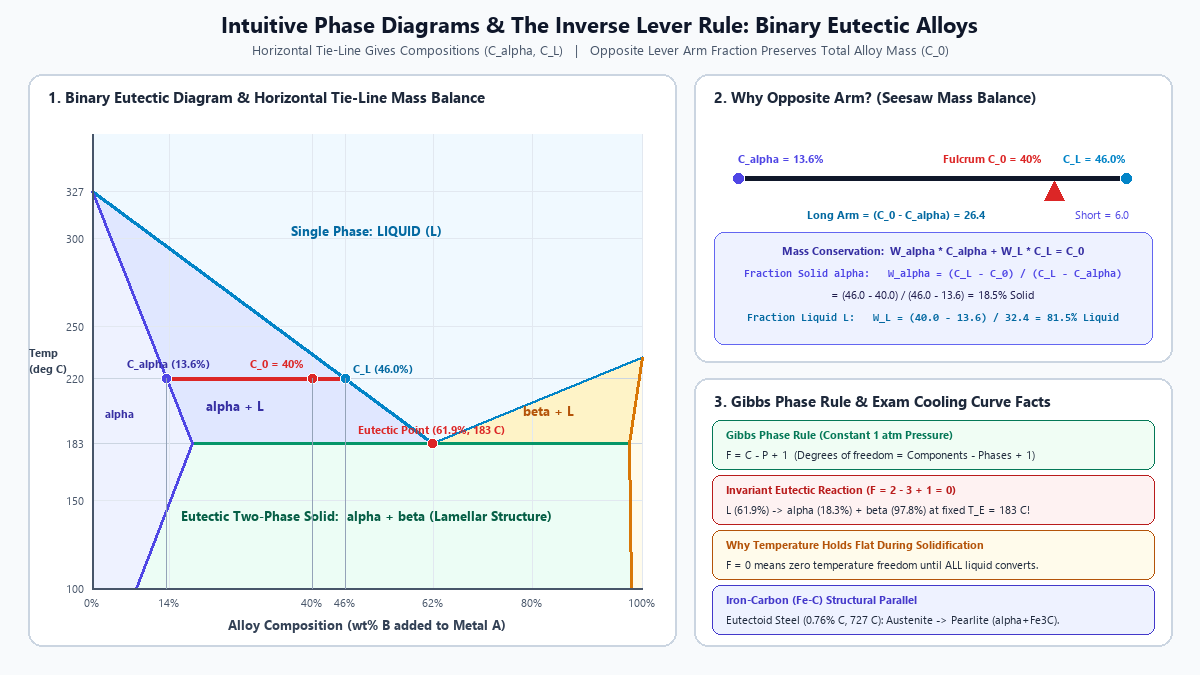
Why the Inverse Lever Rule Uses the OPPOSITE Arm (3-Line Proof)
Ask any mechanical or metallurgical engineering sophomore what trips them up most on their Materials Science midterm, and nine out of ten give the exact same answer: "When finding solid fraction \(W_{\alpha}\), why on earth do we put the RIGHT arm \((C_L - C_0)\) in the numerator instead of the LEFT arm \((C_0 - C_{\alpha})\)?!"
Stop memorizing it backwards! Derive it in 15 seconds directly from conservation of mass (no tricks required):
- Total Mass Adds to 100%: Consider `1 kg` of alloy with bulk composition \(C_0\), split into solid fraction \(W_{\alpha}\) (composition \(C_{\alpha}\)) and liquid fraction \(W_L\) (composition \(C_L\)):
\(W_{\alpha} + W_L = 1 \implies W_L = 1 - W_{\alpha}\) - Conservation of Metal B Atoms: Total mass of Element B in the alloy equals the sum sitting inside phase \(\alpha\) plus phase \(L\):
\(W_{\alpha} C_{\alpha} + W_L C_L = C_0\) - Substitute & Solve: Replace \(W_L\) with \((1 - W_{\alpha})\):
\(W_{\alpha} C_{\alpha} + (1 - W_{\alpha}) C_L = C_0\)
\(W_{\alpha} (C_L - C_{\alpha}) = C_L - C_0 \implies \mathbf{W_{\alpha} = \frac{C_L - C_0}{C_L - C_{\alpha}}}\)
Look visually at the seesaw in Panel 2 of Figure 1: for the alloy average composition (the **fulcrum** \(C_0 = 40\%\)) to sit way over near the liquid end (`C_L = 46.0%`) rather than halfway, the alloy must consist overwhelmingly of liquid (`81.5%` Liquid) and only a small amount of solid (`18.5%` \(\alpha\))—just like a heavy child sitting close to a playground seesaw pivot balancing a light child out on the long opposite lever arm!
Exam Reality Check on Tie-Line Limits: Only apply the Lever Rule inside a two-phase field (`alpha + L` or `alpha + beta`). If `(C_0, T)` lands inside a single-phase region (`Liquid L` alone or `alpha` alone), the fraction is trivially `100%` that single phase and its composition equals bulk `C_0`—never draw a tie-line across single-phase boundaries!
| Question Type / Phase Feature | Where to Read Directly on Diagram | Governing Formula / Rule | Worked Example Check (Figure 1, 40% Alloy at 220 C) |
|---|---|---|---|
| Phase Identities Present | Inspect the exact labeled region enclosing `(C_0, T)` | Check boundary lines enclosing point | Inside \(\alpha + L\) coexistence region |
| Phase Compositions | Draw horizontal tie-line across `(C_0, T)` to left & right walls | Drop vertical projections down to % axis | Solid \(C_{\alpha} = 13.6\%\text{ B}\); Liquid \(C_L = 46.0\%\text{ B}\) |
| Weight Fractions (\(W_{\alpha}, W_L\)) | Measure opposite tie-line arms relative to fulcrum \(C_0\) | \(W_{\alpha} = \frac{C_L - C_0}{C_L - C_{\alpha}}\) | \(W_{\alpha} = \frac{46.0 - 40.0}{46.0 - 13.6} = \mathbf{18.5\%}\) solid; \(81.5\%\) liquid |
| Invariant Eutectic Reaction | Intersection point of Liquidus valleys & Solidus horizontal | \(L(C_E) \xrightarrow{\text{cooling}} \alpha(C_{\alpha E}) + \beta(C_{\beta E})\) | At \(T_E = 183^\circ\text{C}\): \(L(61.9\%) \to \alpha(18.3\%) + \beta(97.8\%)\) |
Decoding Eutectic Solidification, Cooling Curves & Gibbs Phase Rule
Why does pure ice melt sharply at `0 C` while salt-water slush melts across a smeared temperature band—yet a special exact **Eutectic Alloy** (`61.9% Sn / 38.1% Pb`, electronics tin-lead solder) freezes cleanly at a single flat temperature (`183 C`) lower than either pure Lead (`327 C`) or pure Tin (`232 C`)?
**Gibbs Phase Rule** at fixed atmospheric pressure (`P = 1 atm`) gives the exact algebraic explanation:
\(F = C - P + 1\)
Here \(C = 2\) (two metallic components, A and B), \(P\) equals the number of coexisting phases, and \(F\) counts how many independent variables (temperature or composition) can vary freely without destroying a phase:
- Single-Phase Cooling (`L` alone): \(P = 1 \implies F = 2 - 1 + 1 = 2\). Temperature falls rapidly and composition stays fixed at `C_0` (`steep curve on Cooling Curve`).
- Two-Phase Mushy Zone (`alpha + L`): \(P = 2 \implies F = 2 - 2 + 1 = 1\). Once temperature drops incrementally, nature fixes solidus & liquidus compositions rigidly. Freezing releases latent heat gradually, creating a sloped shoulder on the cooling curve instead of a flat line.
- Exact Eutectic Line (\(T_E = 183^\circ\text{C}\)): Three phases coexist simultaneously (`L + alpha + beta`)! Thus \(P = 3 \implies F = 2 - 3 + 1 = \mathbf{0}\) (**Zero Degrees of Freedom**). Temperature locks completely horizontal (**thermal arrest plateau**) until every drop of Liquid transforms cleanly into alternating microscopic plates (**lamellar microstructure**) of \(\alpha\) and \(\beta\)!
Connecting Binary Eutectics to the Iron-Carbon (Fe-C) Diagram
Every mechanical and manufacturing student eventually runs head-first into the famous **Iron–Iron Carbide (\(\text{Fe}-\text{Fe}_3\text{C}\)) phase diagram**—famous for driving lab viva panic with terms like *Austenite*, *Ferrite*, *Cementite*, *Pearlite*, and *Martensite*. Look closely and you will recognize the exact same eutectic physics just shifted slightly lower into solid-state transformations:
- Eutectoid vs. Eutectic: While a Eutectic converts Liquid \(\to\) two Solids (`L -> alpha + beta`, occurring at `4.3 wt% C, 1147 C` in Cast Iron), a **Eutectoid** converts one Solid phase directly into two distinct Solid phases! At **`0.76 wt% C` and `727 C`**, solid face-centered-cubic **Austenite (\(\gamma\))** transforms completely into **Pearlite**—alternating microscopic lamellae of soft body-centered-cubic **Ferrite (\(\alpha\))** and hard brittle **Cementite (\(\text{Fe}_3\text{C}\))**.
- Hypoeutectoid vs. Hypereutectoid Steels: Steels under `0.76 wt% C` form soft *proeutectoid Ferrite* islands first before remaining Austenite converts to Pearlite below `727 C` (ductile structural beams). Steels above `0.76 wt% C` precipitate hard *proeutectoid Cementite* along grain boundaries (wear-resistant cutting edges).
- Where Does Martensite Fit? (Crucial Viva Trap!): Trick question! **Martensite does NOT appear anywhere on the equilibrium \(\text{Fe}-\text{C}\) phase diagram.** Martensite is a non-equilibrium, trapped body-centered-tetragonal (BCT) crystal formed when hot Austenite is quenched violently in cold water before carbon atoms get time to diffuse into Ferrite + Cementite.
Mastering Materials Science goes far faster when you sketch cooling curves and phase tie-lines right next to their microstructures rather than reading dense paragraphs passively. You can scan handwritten phase diagrams and cooling plateaus into clean notes using Handwriting Studio, or challenge AIgom AI Tutor to drill custom Lever Rule weight-fraction numericals directly from your metallurgy PDF slides (see our Editorial & Verification Policy for how technical formulas are verified).
As midterms stack up, organizing chapters like Diffusion, Binary Phase Diagrams, and Heat Treatment cleanly on the Study Kanban Board alongside peer engineering notes in Peer College Notes prevents backlog stress. Pairing visual phase equilibrium rules with our related guides on Approaching Numerical Problems Systematically and Intuitive Thermodynamics links free-energy curves straight to engineering hardware design.
Frequently Asked Questions
Why does the Lever Rule use the opposite tie-line segment for phase weight fraction?
It follows directly from conservation of solute mass (\(W_{\alpha}C_{\alpha} + W_L C_L = C_0\)). Solving algebraically forces \(W_{\alpha} = (C_L - C_0) / (C_L - C_{\alpha})\)—so as bulk composition \(C_0\) moves closer toward solid boundary \(C_{\alpha}\), the opposite liquid segment \((C_L - C_0)\) grows larger, proving solid fraction \(W_{\alpha}\) increases.
What is the difference between a Eutectic and a Eutectoid reaction?
A Eutectic reaction cools a single Liquid into two distinct Solid phases simultaneously (\(L \to \alpha + \beta\)). A Eutectoid reaction occurs entirely in the solid state, converting one solid crystal phase into two new solid phases simultaneously—such as Austenite transforming into lamellar Pearlite (\(\gamma \to \alpha + \text{Fe}_3\text{C}\)) at `0.76 wt% C`.
Why isn't Martensite drawn on the standard Iron-Carbon phase diagram?
The \(\text{Fe}-\text{Fe}_3\text{C}\) diagram represents slow thermodynamic equilibrium where carbon atoms have hours to diffuse. Martensite is a non-equilibrium, super-hard BCT phase created by rapid quenching (captured separately on TTT/CCT isothermal transformation diagrams).
Why do cooling curves show a horizontal flat line at the Eutectic temperature?
At the eutectic temperature, three phases (`Liquid`, `alpha`, and `beta`) coexist simultaneously. By Gibbs Phase Rule (\(F = C - P + 1 = 2 - 3 + 1 = 0\)), degrees of freedom drop to zero—locking temperature stationary until latent heat of solidification finishes converting all eutectic liquid into solid lamellae.
Can the Lever Rule compute volume fraction directly instead of weight fraction?
No—the standard Lever Rule tied to weight-percent (`wt%`) axes outputs mass / weight fraction (`W_alpha` and `W_L`). To find volume fraction (`V_alpha`), you must divide each phase's weight fraction by its physical density (\(\rho_{\alpha}\), \(\rho_L\)) and normalize.
Putting Phase Equilibrium Visuals Into Practice
Once you see Tie-Lines as composition readers, the Inverse Lever Rule as seesaw mass balance, and thermal arrest plateaus as \(F = 0\) Gibbs pauses, both binary eutectic solder curves and steel heat-treatment charts become intuitive immediately. Open Etudey with your Materials Science slides, trace one hypoeutectic cooling sequence plus one Fe-C lever calculation from blank paper, and lock in full marks on exam day.