
Intuitive thermodynamics decodes abstract mathematical state functions into physical mechanisms: internal energy measures microscopic kinetic and chemical bonds, enthalpy accounts for the total energy to create a system plus the atmospheric displacement work (PV), entropy quantifies statistical microstate multiplicity, and Gibbs free energy dictates maximum extractable shaft work.
The Blackboard Nightmare: Why Thermodynamics Feels Like Alphabet Soup
Walk into any undergraduate thermodynamics lecture across mechanical, chemical, aerospace, or electrical engineering, and you will witness a shared academic trauma. By week four of the semester, the chalkboard is covered in a bewildering sea of uppercase and lowercase Greek and Latin symbols:
dU = T dS - P dV | H = U + PV | G = H - TS | A = U - TS
Students frantically copy the derivations into their notebooks. They memorize Maxwell relations, flip endlessly through steam tables and Mollier diagrams, and plug numbers into formulas. Yet if you stop a student in the hallway after class and ask them two simple physical questions—"What actually is enthalpy in plain English?" and "Why does enthalpy have a P times V term added to internal energy?"—nine out of ten will hesitate, look uncomfortable, and murmur: "Uh, it's total heat content... or maybe a state function from Chapter 3."
Standard engineering textbooks (from Cengel & Boles to Van Wylen) present thermodynamics as an axiomatic mathematical fortress. They introduce state functions through differential equations, leaving students with zero visceral, physical intuition for what these quantities actually represent in the real physical world.
Ludwig Boltzmann (Father of Statistical Mechanics, 1877): "The second law of thermodynamics can be proved from the mechanical theory if one assumes that the permutations of the molecular states are equally probable." Thermodynamics is not mysterious magic; it is simply the statistical mechanics of massive numbers of colliding particles obeying basic conservation laws.
To conquer engineering thermodynamics, eliminate exam room anxiety, and build unbreakable mastery, you must strip away the abstract math and rebuild the four foundational state functions from first principles.
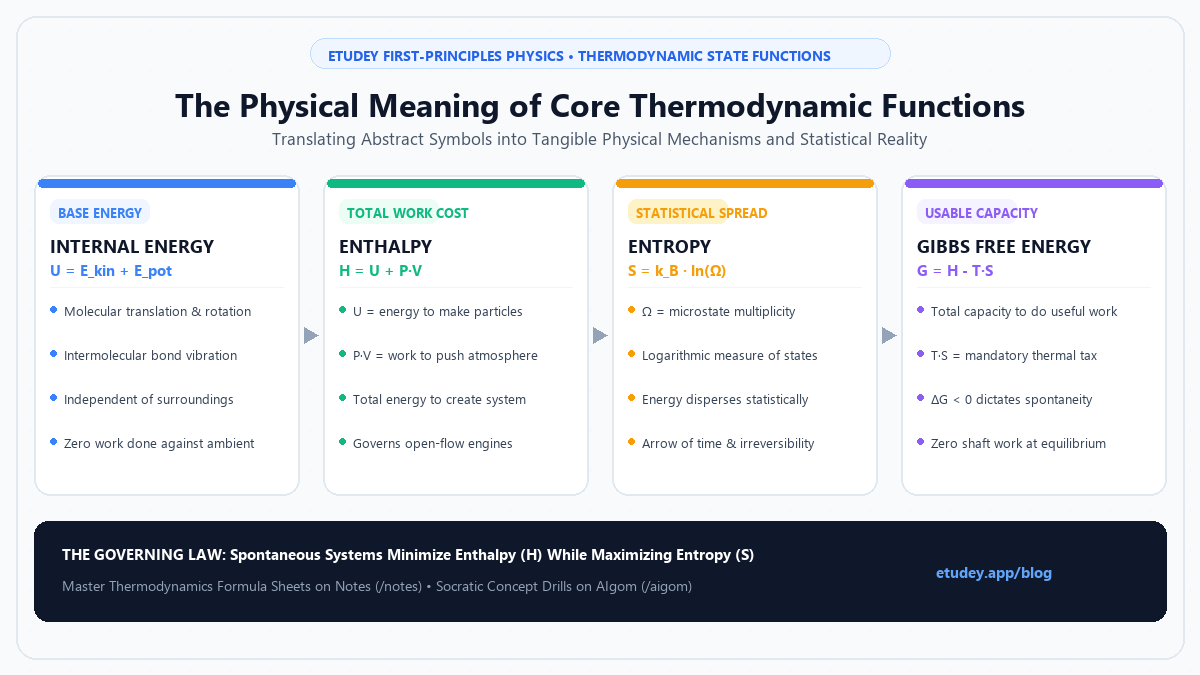
State Function 1: Internal Energy (U) — The Microscopic Base Camp
Imagine you want to create a physical object out of nothing—say, a one-liter container of steam at 150 degrees Celsius. What energy is required?
First, you must create all the constituent molecules ($H_2O$) and give them their thermal motion. This energy stored entirely within the molecular boundaries of the substance is its Internal Energy ($U$).
Internal energy consists of three distinct microscopic reservoirs:
- Translational Kinetic Energy: The chaotic, high-speed linear motion of molecules flying through space and colliding with container walls (this is what a thermometer measures as temperature $T$).
- Rotational & Vibrational Energy: Molecules tumbling end-over-end and chemical bonds stretching and compressing like tiny molecular springs.
- Intermolecular Potential Energy: The electrostatic forces of attraction and repulsion between neighboring molecules (which change dramatically during phase changes from liquid to vapor).
Notice what internal energy ignores: it completely ignores where the system is placed. If you create the steam in an absolute vacuum chamber in deep space, the energy required is purely $U$. But in engineering, we almost never operate in deep space. We operate in an atmosphere with ambient pressure. And that brings us to enthalpy.
State Function 2: Enthalpy (H = U + PV) — The Atmospheric Displacement Tax
Now perform the same thought experiment, but this time, you must create that one-liter volume of steam inside your college engineering laboratory.
The laboratory is not empty space; it is filled with air at an atmospheric pressure $P$ of approximately 101.3 kilopascals (1 atmosphere). To place your one-liter container ($V$) into the room, you cannot simply conjure it into existence. You must physically push 101.3 kPa of surrounding atmospheric air out of the way to make room for your system's volume!
How much mechanical work is required to push back an ambient pressure $P$ to clear a volume $V$? From basic physics:
\text{Work} = \text{Force} \times \text{Distance} = (P \times \text{Area}) \times \text{Distance} = P \times V
Therefore, the total energy bill required to create a system and establish it in an atmosphere with pressure $P$ and volume $V$ is:
H = U + PV
- U: The energy to create the molecules and give them their thermal velocity.
- PV: The "room rent" or "displacement tax" paid to the surrounding atmosphere to carve out space for the system.
Why Engineers Care Obsessively About Enthalpy
In mechanical, chemical, and aerospace engineering, 90% of machines—steam turbines, jet engines, refrigeration compressors, heat exchangers, and chemical reactors—are open-flow systems (control volumes). Fluid continuously enters through a pipe, expands or heats up, and exits through another pipe.
Whenever fluid enters an engine, the upstream fluid behind it must do $P_{in} V_{in}$ flow work to push it into the control volume. When fluid exits, it must do $P_{out} V_{out}$ work to push its way into the downstream pipe.
Because the $PV$ term is automatically handled by the fluid's entry and exit work, engineers can write the Steady Flow Energy Equation (SFEE) purely in terms of enthalpy changes:
\dot{W}_{turbine} = \dot{m} (h_{in} - h_{out})
When steam expands through a power plant turbine, the shaft power generated is literally just the drop in enthalpy! If you are preparing for thermal engineering finals or lab vivas, you can review verified solved Rankine and Brayton cycle numericals in the Etudey Verified Notes Archive.
State Function 3: Entropy (S) — Why "Disorder" is a Fatal Misconception
No scientific concept is more widely misunderstood than entropy. High school textbooks frequently describe entropy as "a measure of disorder or messiness," using analogies like messy bedrooms or shattered teacups.
This analogy is scientifically misleading and ruins an engineering student's ability to solve real problems. A messy bedroom does not have higher thermodynamic entropy than a clean bedroom; a bedroom is a macroscopic collection of static furniture, not a statistical distribution of thermal quanta!
To understand entropy as Ludwig Boltzmann understood it, look at his famous epitaph in Vienna:
S = k_B \ln \Omega
Where $k_B$ is the Boltzmann constant ($1.38 \times 10^{-23} \text{ J/K}$) and $\Omega$ (Omega) is multiplicity: the total number of distinct microscopic arrangements (microstates) that produce the exact same macroscopic state (macrostate).
The Real Physical Meaning of Entropy
Think of thermal energy as a collection of identical marbles, and the atoms of your metal bar as a grid of buckets.
- If all the thermal marbles are concentrated in the first three buckets (a hot spot at one end of the bar), there are very few mathematical ways to arrange that distribution. Multiplicity $\Omega$ is tiny, meaning Entropy is low.
- If the thermal marbles disperse evenly across all buckets (the bar reaches uniform temperature), there are astronomically trillions of ways to swap marbles between buckets while keeping the overall temperature identical. Multiplicity $\Omega$ is gargantuan, meaning Entropy is high.
Entropy is simply a measure of statistical probability. Thermal energy disperses throughout a material not because it "wants to," but because uniformly dispersed energy states possess unimaginably more microstate permutations than concentrated energy states.
Comparison Table: The Four Master Thermodynamic Functions
Here is how the four pillars of engineering thermodynamics compare side-by-side:
| State Function | Governing Equation | Physical Interpretation | Surrounding Boundary Interaction | Primary Engineering Domain |
|---|---|---|---|---|
| Internal Energy (U) | dU = \delta Q - \delta W | Microscopic kinetic, rotational, and chemical bond energy | Isolated or rigid closed containers (Rigid tanks, bomb calorimeters) | Constant volume ($C_v$) batch reactions; ideal gas expansions |
| Enthalpy (H) | H = U + PV | Total energy to create system + push back ambient atmosphere | Constant pressure open flows (Fluid boundary displacement) | Turbines, compressors, boilers, nozzles, chemical combustion |
| Entropy (S) | dS = \delta Q_{rev} / T = k_B \ln \Omega | Logarithmic count of accessible quantum microstates (Multiplicity) | Thermal dissipation; frictional irreversibilities | Carnot efficiency limits, isentropic turbine efficiency, second law audits |
| Gibbs Free Energy (G) | G = H - TS | Maximum capacity to perform non-expansion (shaft/electrical) work | Isothermal, isobaric surroundings (Constant T and P) | Battery electrochemistry, fuel cells, chemical reaction spontaneity |
State Function 4: Gibbs Free Energy (G = H - TS) — The Usable Capacity
Now we arrive at the crowning achievement of American mathematical physicist J. Willard Gibbs: the Gibbs Free Energy function ($G$).
Suppose your chemical reaction or thermodynamic system contains an enthalpy $H$. Can you extract 100% of that enthalpy to turn an electrical generator or drive an electric motor?
The Second Law of Thermodynamics issues an unequivocal, mathematical NO.
Whenever a system operates at an ambient temperature $T$, a fraction of its total energy is irrevocably locked into thermal microstate fluctuations. To satisfy the Second Law, the system must pay a mandatory "thermal entropy tax" to the universe equal to:
\text{Thermal Tax} = T \times S
What remains after subtracting this mandatory thermal tax is the Free Energy—the energy that is truly "free" and available to perform useful non-expansion shaft work:
G = H - TS
The Golden Spontaneity Rule: \Delta G < 0
Why do chemical reactions happen spontaneously? Why does iron rust in air, why do batteries discharge, and why does ice melt at room temperature?
For a process occurring at constant temperature and pressure:
\Delta G = \Delta H - T \Delta S
Every physical and chemical system in nature strives to achieve two competing goals:
- Minimize Enthalpy ($\Delta H < 0$): Release heat and settle into lower-energy, tightly bound chemical configurations (exothermic reactions).
- Maximize Entropy ($\Delta S > 0$): Spread energy across as many quantum microstates as possible (increasing statistical multiplicity).
When $\Delta G < 0$, the process is spontaneous. If you want to stress-test your conceptual grasp of phase equilibria and Gibbs minimization, test your understanding against AIgom, Etudey's Socratic STEM AI study partner, by prompting it: "Cross-examine me on why endothermic reactions can proceed spontaneously at high temperatures."
The 4-Step Intuitive Mastery Protocol for Exam Numericals
When facing a high-weightage numerical problem in an engineering thermodynamics exam, never start by blindly hunting for a formula. Execute this 4-step diagnostic protocol:
- Classify the Boundary: Is the system a Closed System (Control Mass) like a piston-cylinder with no mass transfer, or an Open System (Control Volume) like a nozzle or compressor? If it's closed and rigid, use $U$. If it's open-flow or constant pressure, use $H$.
- Sketch the State Coordinates: Launch your digital canvas in Etudey's Handwriting Studio and sketch the process on both a $P-v$ diagram and a $T-s$ diagram before performing arithmetic. If a turbine is isentropic, the process is a straight vertical line on the $T-s$ plane.
- Check Ideal Gas vs. Steam Table Regimes: If the working fluid is steam or R-134a refrigerant, never use $PV = mRT$! You must look up properties in the saturation tables. If the fluid is air or nitrogen well above its critical temperature, use $dh = C_p dT$.
- Audit Entropy Generation: Calculate $S_{gen}$. If $S_{gen} < 0$, your calculation has violated the Second Law of Thermodynamics. Rework your numerical immediately.
Track your thermodynamic cycle units and chapter milestones systematically across your Etudey Study Kanban Board to ensure no derivation or diagram archetypes are left unpracticed before exam morning.
Frequently Asked Questions
Why does enthalpy have units of energy if it contains a pressure times volume term?
Pressure has units of Force per unit Area (Newtons per square meter: $N/m^2$). Volume has units of cubic meters ($m^3$). When you multiply them together: $(N/m^2) \times m^3 = N \cdot m = \text{Joules}$. A Joule is the standard SI unit of energy and work. Therefore, the term $PV$ is physically identical to mechanical work.
Can entropy ever decrease in an engineering system?
Yes, the entropy of a subsystem can decrease, provided that the entropy of the surroundings increases by an even greater amount. For example, inside your domestic refrigerator, heat is extracted from food, lowering its entropy. However, the compressor discharges work and heat into the kitchen air, creating far more entropy in the surroundings than was removed from the food. The net entropy of the universe ($S_{system} + S_{surroundings}$) always increases.
What is the difference between Enthalpy (H) and Helmholtz Free Energy (A)?
Enthalpy ($H = U + PV$) is the natural state function for systems at constant pressure. Helmholtz Free Energy ($A = U - TS$) is the natural state function for closed systems at constant volume and constant temperature. In chemical and mechanical engineering, most open processes occur under constant atmospheric pressure, making Enthalpy ($H$) and Gibbs Free Energy ($G$) far more commonly used than Helmholtz ($A$).
Why is enthalpy constant across a throttling valve or porous plug (Joule-Thomson effect)?
In an adiabatic throttling device (such as the expansion valve of an air conditioner), no heat is added ($Q = 0$) and no shaft work is extracted ($W = 0$). By applying the First Law to an open control volume, the energy equation simplifies directly to $h_{in} = h_{out}$. While enthalpy remains strictly constant, the pressure drops drastically, causing real gases to either cool down or heat up depending on their Joule-Thomson coefficient.
How do I know whether to use C_p or C_v in thermodynamic derivations?
Use $C_v$ (specific heat at constant volume) whenever you are tracking changes in Internal Energy: $du = C_v dT$. Use $C_p$ (specific heat at constant pressure) whenever you are tracking changes in Enthalpy: $dh = C_p dT$. For an ideal gas, $C_p$ is always larger than $C_v$ by exactly the gas constant $R$ ($C_p - C_v = R$) because heating at constant pressure requires extra energy to perform atmospheric displacement work ($P \Delta V$) as the gas expands.
Stop Memorizing Symbols. Understand the Physics.
Engineering thermodynamics is not an arbitrary collection of mathematical hurdles; it is the fundamental grammar of energy, heat, and physical reality. When you understand that enthalpy accounts for atmospheric displacement and entropy reflects statistical microstate multiplicity, the equations cease to be stressful and become intuitive tools for real-world design.
Review your thermodynamic cycle derivations, organize your formula sheets in the Etudey Student Workspace, and master your technical curriculum from first principles today.