
Database indexes speed up SQL queries from seconds to sub-milliseconds using shallow, high-fanout B+ Trees matched to 4 KB or 16 KB disk pages. Understanding why B+ Trees keep internal nodes key-only, how linked leaves accelerate range scans, and how ACID isolation prevents concurrency anomalies unlocks DBMS exams and backend engineering interviews.
The Unindexed Phonebook Problem: Why \(O(N)\) Table Scans Break Down
Suppose an unindexed university grades table contains 10 million student rows sitting on SSD blocks. You execute one innocent-looking SQL query:
SELECT student_name, gpa FROM grades WHERE roll_no = 'CS2026-4812';
Without an index, the Database Management System (DBMS) engine has zero clue which physical disk page stores CS2026-4812. It must trigger a Sequential Full Table Scan—loading page after page from storage into RAM, inspecting every single tuple one by one, taking \(O(N)\) I/O operations. Run fifty concurrent login or course-registration queries across unindexed foreign keys during registration hour, and disk bandwidth saturates completely.
Now a computer science student asks the natural follow-up question: "We learned Binary Search Trees and Hash Maps in Data Structures 101—why didn't PostgreSQL, MySQL InnoDB, or SQLite just store a classic Binary Search Tree or Hash Table on disk?" The answer comes straight down to hardware physics: RAM latency sits near 100 nanoseconds, whereas random storage page I/O costs 100,000+ nanoseconds. Database engines optimize obsessively for minimizing total disk page reads, not minimizing CPU comparisons.
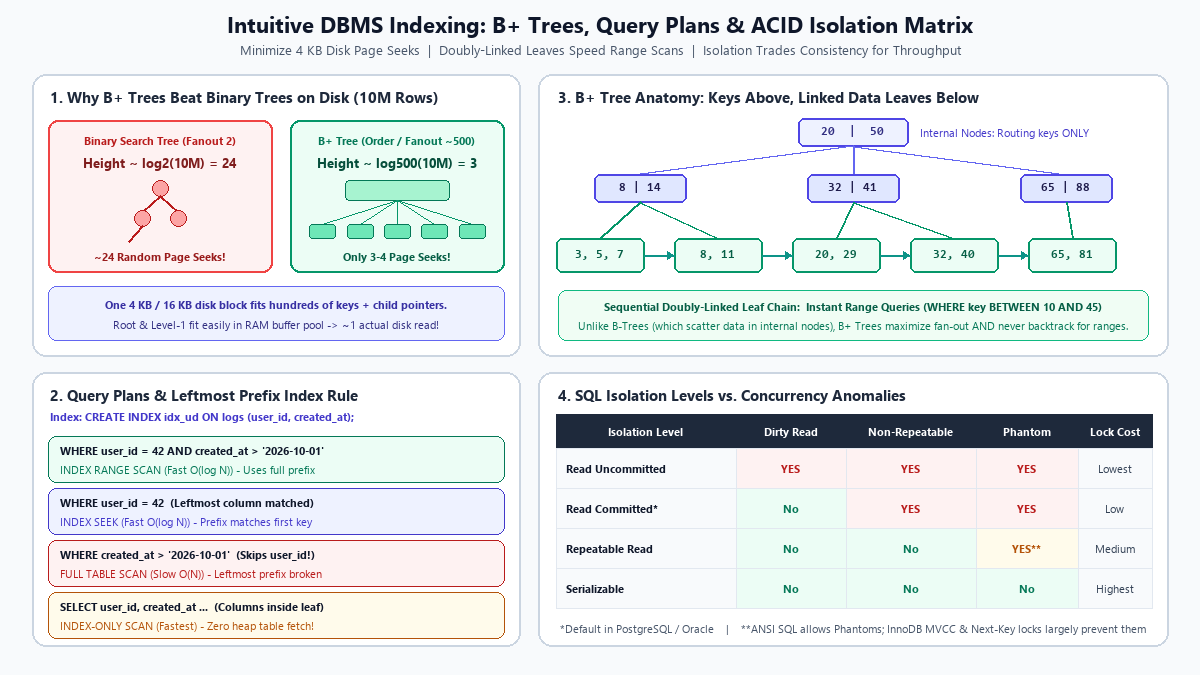
Why B+ Trees Crush Binary Trees & B-Trees on Storage Hardware
When a storage engine reads data from disk or NVMe SSD, it never fetches 8 bytes by itself—the OS reads an entire fixed-size page (typically 4 KB in PostgreSQL or 16 KB in MySQL InnoDB). That hardware constraint shapes the entire geometry of B+ Trees:
- Massive Fan-Out Shrinks Tree Depth: A Binary Search Tree node stores 1 key and 2 child pointers, wasting 99% of a 16 KB disk block! Searching 10 million rows takes \(\lceil \log_2(10^7) \rceil \approx 24\) tree levels—meaning 24 separate random disk hops. By packing 500 keys and 501 child page pointers neatly inside a single 16 KB block, a B+ Tree of height 3 indexes \(500^3 = 125,000,000\) rows cleanly! Better still, the root page and Level-1 pages stay pinned inside RAM's buffer pool, dropping actual cold storage seeks down to 1 or 2 reads.
- B+ Tree vs. B-Tree (Why Separating Keys Matters): Classic B-Trees store actual row payloads (or record pointers) inside both internal nodes and leaf nodes. Storing bulky row records inside upper internal nodes slashes how many routing keys fit per page, making the tree taller. A B+ Tree stores ONLY routing keys and child pointers inside internal nodes and pushes all row data (or tuple pointers) exclusively down to the bottom leaf layer—maximizing branching factor at the top.
- Doubly-Linked Leaf Chain for Instant Range Scans: Every leaf page links directly to its left and right neighbor via sibling pointers. Executing
WHERE score BETWEEN 80 AND 95descends the tree just once to find80, then glides sequentially horizontally across leaf pages until passing95—never backtracking up internal nodes! - Why Hash Indexes Lose on General SQL Workloads: Pure hash indexes achieve \(O(1)\) equality lookups (
WHERE id = 42), yet hashing scrambles sort order completely. Any query asking for>,<,BETWEEN,ORDER BY, or prefixLIKE 'CS%'falls straight back to a brutal Full Table Scan under a hash index.
Clustered vs. Secondary Index Distinction: In MySQL InnoDB, the primary key B+ Tree is a Clustered Index—meaning the actual full row tuple sits directly inside the leaf pages. Every secondary index leaf stores the primary key ID instead of physical disk offsets, requiring a second B+ Tree lookup unless all requested
SELECTcolumns already reside inside the secondary index (a lightning-fast Covering Index / Index-Only Scan).
| Index / Execution Path | Lookup Complexity | Supports Range Queries (<, >, ORDER BY) | Storage / Write Cost Trade-Off | Best Production & Exam Use Case |
|---|---|---|---|---|
| Full Sequential Scan | \(O(N)\) pages read | Yes (reads everything) | Zero extra write/storage overhead | Small tables (<1,000 rows) or reading >25% of rows |
| B+ Tree Index Scan | \(O(\log_B N + K)\) seeks | Yes (doubly-linked leaves) | Extra B+ Tree maintenance on INSERT/DELETE |
General primary keys, foreign keys, timestamps, ranges |
| Covering / Index-Only Scan | \(O(\log_B N)\) (no heap fetch) | Yes (ordered inside leaves) | Slightly wider leaf pages if including extra columns | High-traffic dashboard counts & paginated summaries |
| Hash Index | \(O(1)\) average equality | No (unordered buckets) | Fast point checks; vulnerable to hash collisions | Strict equality key lookups without sorting or ranges |
Reading EXPLAIN Query Plans & The Leftmost Prefix Rule
Even students who understand B+ Trees conceptually frequently create indexes in semester projects and wonder why queries stay sluggish. Inspecting EXPLAIN ANALYZE output immediately reveals two silent traps:
- Breaking the Leftmost Prefix Rule on Composite Indexes: Suppose you declare a multi-column B+ Tree on
(dept_code, semester, gpa). The tree sorts first bydept_code, breaks ties bysemester, and finally sorts bygpa.WHERE dept_code = 'CSE' AND semester = 5→ Fast Index Scan (matches prefix from the left cleanly).WHERE semester = 5 AND gpa > 8.5→ Full Table Scan! Becausedept_codewas skipped,semester = 5entries lie scattered across every single department subtree, rendering the index useless without a prefix match.
- Wrapping Indexed Columns Inside Functions: Writing
WHERE LOWER(email) = 'alice@uni.edu'orWHERE YEAR(created_at) = 2026destroys index usability because the B+ Tree holds rawemailandcreated_atvalues, forcing row-by-row computation—unless you build an explicit functional/expression index. - Write Amplification (Why Indexing Every Column Backfires): Every index is a separate sorted B+ Tree that the engine must update, split, and rebalance atomically whenever rows are inserted, deleted, or updated. Over-indexing write-heavy logging tables degrades write throughput sharply while bloating RAM buffer cache pressure.
For Computer Science and IT students building full-stack projects or preparing DBMS viva answers, mapping out ER schemas and EXPLAIN execution stages visually on a structured workflow board keeps study topics tight—try breaking down Indexing, Normalization, and Query Plans as trackable tasks on our Study Kanban Board alongside shared engineering notes in Peer College Notes.
ACID Transactions & Decoding the 4 SQL Isolation Levels
Indexing solves single-query read speed. Now imagine 500 students simultaneously hitting "Enroll" for the last 2 seats in an elective course while grade reports run concurrently. Without transaction isolation guarantees, overlapping reads and writes corrupt balances and inventory silently. Every DBMS exam tests the ACID properties and the three classic read anomalies:
- Atomicity: All statements inside a transaction succeed together or roll back completely (enforced via Write-Ahead Logging / Undo logs).
- Consistency: Every committed transaction preserves schema invariants (foreign keys,
CHECKconstraints, non-negative balances). - Isolation: Concurrent transactions appear to execute cleanly without exposing half-baked intermediate mutations.
- Durability: Once committed, changes survive sudden power loss via flushed Write-Ahead Log (WAL) disk records.
The 3 Concurrency Read Anomalies
- Dirty Read: Transaction T1 modifies a row but has NOT committed yet; Transaction T2 reads that uncommitted value, and then T1 rolls back—leaving T2 acting on phantom data that never existed!
- Non-Repeatable Read: Inside one transaction T1, reading the same row ID twice returns two different values because T2 modified and committed that row between T1's two reads.
- Phantom Read: T1 executes a range query (
WHERE credits > 3) twice inside one transaction, and a second count returns extra brand-new rows that T2 inserted and committed in between.
Notice how ANSI SQL isolation levels stack like progressive shields (see Figure 1, Panel 4): Read Uncommitted allows all three; Read Committed (the default in PostgreSQL) blocks Dirty Reads; Repeatable Read locks or snapshots existing rows via MVCC (Multi-Version Concurrency Control) to block Non-Repeatable Reads; and Serializable guarantees strict mathematical equivalence to running transactions one by one, preventing even subtle Phantoms and Write Skew anomalies.
When revising B+ Tree node splitting or MVCC snapshot rules for midterms and GATE CS papers, keeping messy hand-drawn tree diagrams neat pays huge dividends—you can digitize handwritten ER diagrams and B+ Tree traces using Handwriting Studio, or quiz yourself on isolation anomalies directly from your lecture slides using AIgom AI Tutor (all platform technical guides follow our Editorial & Verification Policy). Pair this with our guides on Intuitive TCP Congestion Control and OS Deadlocks & Concurrency to unify your core CS Systems revision.
Frequently Asked Questions
Why do databases use B+ Trees instead of AVL or Red-Black binary trees?
AVL and Red-Black trees are balanced strictly for in-memory CPU pointer hops (fanout of 2), producing trees ~24+ levels deep for 10 million rows—forcing two dozen expensive storage block reads per lookup. B+ Trees match storage page sizes (4 KB–16 KB) with hundreds of keys per node, slicing tree depth down to 3–4 page hops.
What is the exact difference between a B-Tree and a B+ Tree?
A B-Tree stores actual data records (or row pointers) in internal nodes as well as leaf nodes, reducing how many keys fit inside upper pages. A B+ Tree stores routing keys exclusively inside internal nodes and places all data pointers inside a doubly-linked leaf layer, delivering higher fan-out and ultra-fast sequential range scans.
What happens during a Dirty Read vs. a Non-Repeatable Read?
A Dirty Read occurs when a transaction reads uncommitted changes written by another active transaction that later rolls back. A Non-Repeatable Read occurs when a transaction reads committed data twice and sees two different values because a concurrent transaction updated and committed that row between the two reads.
When should you intentionally avoid adding an index in SQL?
Avoid indexing very tiny tables (where a single sequential page read beats traversing an index), ultra-low-cardinality boolean/status columns skewed toward one value (where the optimizer picks a full scan anyway), and write-saturated append logs where maintaining extra B+ Trees hurts insert throughput.
How does MVCC allow readers without blocking writers in PostgreSQL or InnoDB?
Instead of locking every row during read queries, Multi-Version Concurrency Control (MVCC) retains timestamped or transaction-ID snapshots of rows. Readers inspect the consistent version valid when their transaction began while concurrent writers create new row versions independently—eliminating read-write lock contention.
Locking In Database Systems Intuition Before Exams
Once you see B+ Trees through the lens of 4 KB storage pages, leftmost-prefix sorting, and linked-leaf range traversal, both SQL query tuning and ACID isolation turn from abstract definitions into concrete engineering intuition. Upload your DBMS slides or handwritten query plans into Etudey, trace one B+ Tree split and one isolation anomaly table cold from memory, and test your understanding well ahead of exam day.