
Taking effective college lecture notes requires replacing frantic verbatim transcription with cognitive filtering and visual spatial organization. By utilizing a 3-zone split-page architecture, establishing shorthand for fast-paced STEM professors, and executing a mandatory 24-hour synthesis review, you transform raw lecture audio into high-yield, exam-ready retrieval cues that eliminate pre-finals panic.
The Verbatim Trap: Why 90% of College Notes Become Incomprehensible Junk
In university lecture halls across engineering, medical, and commerce faculties, students frequently fall into the same trap: frantically transcribing every syllable spoken by the lecturer. They copy slide definitions verbatim, scribble disconnected formulas, and rush to keep up with rapid chalkboard derivations without absorbing core principles.
Three weeks later, when midterm season strikes, these students open their spiral notebooks expecting clarity. Instead, they encounter an impenetrable wall of messy, disjointed text:
- Unprocessed Stenography: Writing at maximum speed disables higher-order processing; working memory is consumed by transcription rather than evaluating physical sense.
- The Illusion of External Storage: Known as cognitive offloading, the mind assumes that capturing words on paper equals mastery, bypassing synaptic encoding entirely.
- Zero Navigational Hierarchy: Flat, unsegmented notes force you to re-read dozens of pages during exam week just to locate a single derivation or formula.
The core realization that transforms struggling undergraduates into top rankers is simple: a lecture is an encoding session, not a publishing press. The objective of lecture attendance is not to replicate a textbook; your textbook already provides exhaustive proofs. Your goal is to capture the structural logic, the lecturer’s unique emphasis, and the intuitive bridges that connect abstract theorems to solvable exam problems.
The Cognitive Science of Note-Taking: Encoding vs. External Storage
Research by Dr. Pam Mueller (Princeton) and Dr. Daniel Oppenheimer (UCLA) demonstrated that students engaging in generative note-taking—summarizing, paraphrasing, and concept mapping—consistently outperform verbatim transcribers on conceptual synthesis and exam problem-solving.
Cognitive science divides note-taking utility into two distinct mechanisms:
- The Encoding Function: The active processing performed in class. Compressing a multi-minute explanation into a succinct statement with an arrow to a dependent variable activates prior knowledge and strengthens neural pathways.
- The Storage Function: The artifact created for revision. While dense prose invites passive re-reading, an artifact structured with recall cues triggers active retrieval, halting forgetting.
The Cognitive Rule of Lecture Capture: Information that costs you mental effort to synthesize during a lecture will stick for weeks; information that you passively copy down like a photocopier will evaporate before you leave the lecture hall door.
The 3-Zone Cognitive Split-Page Architecture: Anatomy of a High-Yield Sheet
To merge optimal encoding with effortless retrieval, you must abandon traditional lined-paper linear notes. Instead, adopt the 3-Zone Cognitive Split-Page Architecture—an evolved, STEM-optimized variation of the classic Cornell Method designed specifically for dense technical courses, mathematical proofs, and fast-paced university syllabi.
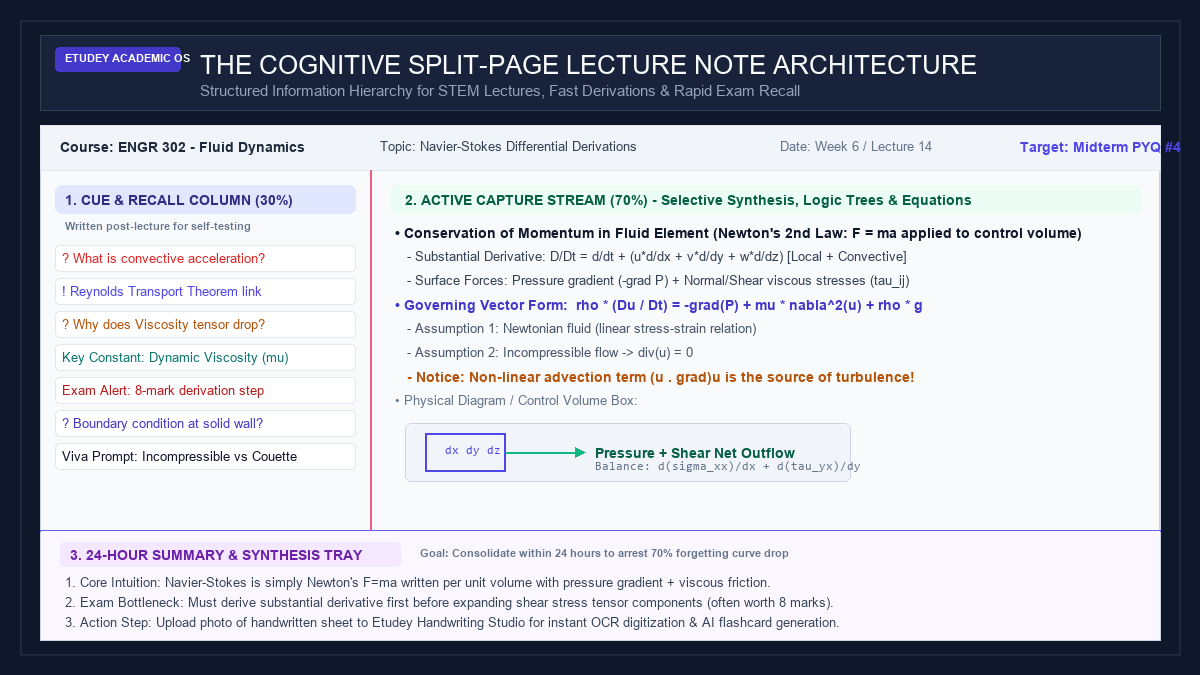
Before lecture begins, rule two lines across your sheet (or set up a digital template) dividing your page into three specialized operational zones (as illustrated in Figure 1 above):
1. Zone A: The Recall Cue & Question Column (Left 30% Width)
Leave this column completely blank during the live lecture. Its magic happens during post-lecture review. Within 24 hours of class, read through your notes and distill every paragraph into:
- Retrieval Questions: Instead of writing "Navier-Stokes equation," write "? Why does the viscous term drop out for inviscid flow?" or "? What are the 3 boundary conditions at a solid wall?"
- Key Constants & Definitions: Write critical variables (e.g., Dynamic Viscosity μ or Fourier's Law).
- Exam & Viva Prompts: Highlight specific traps the professor flagged for midterms or viva voce evaluations.
When exam season arrives, cover the right-hand column with a sheet of paper. Read down your left-hand cue column and attempt to answer every question from memory. You have converted your lecture notes into a built-in active recall flashcard engine.
2. Zone B: The Active Capture Stream (Right 70% Width)
This is where your live in-class capture occurs. Rather than transcribing sentences, capture the conceptual skeleton using structured conventions:
- Indented Logic Trees: Start primary theorems on the left edge; indent subordinate assumptions, secondary proofs, and specific examples beneath them. Indentation visually conveys mathematical hierarchy.
- Verbal Anchors: Pay attention to verbal signposts. Whenever a professor says "The critical takeaway here is...", "Many students fail this derivation because...", or "On the final exam, I expect...", prefix your notes with a bold visual marker (e.g., a star ★ or a double exclamation point !!).
- Bypassing Rote Derivations: If the professor is writing a 40-step textbook algebraic derivation line by line on the chalkboard, do not copy every intermediate step. Write: "Steps 1-12: Expand Taylor series about point x0 (Textbook pg. 142) → Key substitution: u = ωr → Result: Equation 4.12." Focus on the rationale behind the substitution, not the mechanical arithmetic.
3. Zone C: The 24-Hour Synthesis Tray (Bottom 15% Height)
At the bottom of the page, reserve a 2-to-3 inch footer box. Before you go to sleep on the day of the lecture, spend exactly three minutes writing a concise 2-sentence summary answering:
- "What is the single most important physical intuition or theorem introduced on this page?"
- "What problem-solving trap must I avoid when applying this to a numerical question?"
This single three-minute ritual forces your brain to execute semantic consolidation before nocturnal memory pruning begins, dramatically boosting retention.
| Note-Taking Method | Cognitive Load In-Class | Best Used For | Primary Limitation | Exam Revision Speed |
|---|---|---|---|---|
| Split-Page / Cornell | Moderate (Balanced) | STEM lectures, quantitative problem-solving, formula-heavy courses | Requires disciplined post-lecture review to populate cue column | Instant (Built-in active recall self-testing) |
| Hierarchical Outlining | Low (Linear) | History, Law, Humanities, descriptive theory courses | Breaks down completely when lectures lack strict logical order | Moderate (Requires reading full bullet structures) |
| Concept & Mind Mapping | High (Non-linear) | Interdisciplinary subjects, biological pathways, systems architecture | Difficult to execute during rapid, equation-heavy math lectures | Fast (Visual orientation and spatial grouping) |
| Boxing & Modular Blocks | Moderate (Spatial) | Courses with multiple distinct sub-topics per lecture | Time-consuming to draw borders and boxes in real time | Moderate (Clean layout, but lacks active recall cues) |
| Linear Verbatim | Zero (Passive) | Court stenography only | Causes cognitive overload, zero retention, incomprehensible notes | Painfully Slow (Re-reading walls of unindexed text) |
How to Survive Fast-Talking Professors Without Falling Behind
Every university student encounters lecturers who speak at 180 words per minute across 60 dense slides per hour. Attempting comprehensive verbatim capture is futile; success requires rapid prioritization:
1. Master Academic Shorthand & Symbolic Notation
Eliminate standard vowels, articles, and common technical terms. Build an automatic muscle-memory shorthand vocabulary for your major:
- Logical Connectors: Use
∴(therefore),∵(because),→(leads to / yields),↑(increases / rises),↓(decreases / decays),w/(with),w/o(without). - STEM Abbreviations: In computer science, write
fn(function),alg(algorithm),ptr(pointer),O(n)(complexity). In engineering, writeeqn(equation),const(constant),diff(differential),temp(temperature). - Visual Bounding: When an essential equation is finalized, draw a rectangular box around it and append a large asterisk
[*]in the margin.
2. The "Parked Doubt" Protocol (The Parking Lot Box)
When a professor moves too quickly through a conceptual derivation and you get lost at step 4, never freeze or panic. If you stop to analyze step 4 for ten minutes, you will miss steps 5 through 20.
Instead, execute the Parking Lot Protocol. In the top corner of your page, draw a small box labeled [PARKED DOUBTS]. The moment you lose the thread, write: "Lost transition line 3 to 4: how did cosine vanish?" Then immediately snap your attention back to the professor's live explanation. Later that afternoon, paste that exact question into an AI study assistant like AIgom AI Tutor or ask a classmate to clarify the specific gap without sacrificing the rest of the lecture.
3. Capture the Why, Not the What
When professors project a complex slide, they rarely read the bullet points verbatim. They elaborate on the underlying intuition.
Ignore the bullet points on the slide. Those slides are usually uploaded to the college portal anyway. What will never be uploaded is the spoken explanation that makes the slide coherent. Dedicate 90% of your listening attention to capturing the lecturer's spontaneous analogies, boundary caveats, and spoken exam warnings.
Handwritten vs. Digital: What the Evidence Demonstrates for STEM
Learning science demonstrates that optimal note-taking medium depends strictly on cognitive task requirements:
- Physical Pen & Paper: Unmatched for freeform geometry, circuit sketches, and deliberate tactile encoding without notification distraction. However, paper remains unsearchable during midnight revision.
- Laptops & Keyboards: Fast for coding lectures and humanities, but counterproductive for STEM. Typing formulas or diagramming forces severe cognitive drag that breaks comprehension.
- The Modern Hybrid Workflow: Take initial notes by hand for maximum encoding. Then, instead of manual transcription, use OCR platforms like Etudey Handwriting Studio to convert handwritten equations into searchable digital text and study cards.
The 24-Hour Post-Lecture Processing Protocol
Leaving a 60-minute lecture, you retain approximately 75% of discussed concepts. If you leave the notebook closed until the weekend, neural pruning discards up to 65% of those connections by next morning.
To lock information permanently into your long-term memory, implement the 10-Minute Post-Lecture SPRINT (Synthesis, Prompts, Review, Index, Next):
- Minutes 1-3 (Audit & Repair): Scan your active stream. Fix illegible handwriting, complete unfinished abbreviation tags, and circle any formulas that look mathematically ambiguous.
- Minutes 4-7 (Populate the Cue Column): Go through the left margin and write 4 to 6 active recall questions that rigorously interrogate the content in the right column.
- Minutes 8-10 (Fill the Synthesis Tray): Write the two-sentence conceptual summary at the bottom of the page. State the core law, the common exam trap, and the practical application.
While other students are desperately attempting to decipher their chaotic scrawls 48 hours before the exam, your notes are already modular, indexed study guides ready for high-speed active retrieval.
Digitizing and Querying Your Notes: The AI-Powered Study Workflow
Once your notes are structured cleanly on the split-page format, modern AI study systems transform static notebooks into interactive academic operating systems:
- Automated Digitization: Upload smartphone photos of your handwritten notebook pages to Etudey Handwriting Studio. Powered by Google Gemini Vision OCR, it reads messy collegiate handwriting, mathematical superscripts, integrals, and chemical reaction notations with extraordinary accuracy.
- AI-Powered Interactive Questioning: Rather than merely reading over your notes, load them into AIgom AI Tutor. AIgom reads your unique lecture notes, syllabi, and handouts, quizzing you on your specific professor's problem templates and testing your conceptual blind spots with instant explanations.
- Peer Knowledge Sharing: If you missed a lecture or want to see how top rankers organized a difficult subject, search through peer-curated college notes on the Etudey Notes Platform, filtered directly by university, semester, and course code.
- Study Pipeline Tracking: Keep track of which lecture notes have been processed, self-tested, or flagged for revision using the Study Kanban Board, moving topics smoothly from "Lecture Captured" to "Cue Self-Tested" to "Exam Mastered."
Frequently Asked Questions
Should I take lecture notes by hand or type them on a laptop?
For STEM, mathematics, and quantitative engineering courses, always write by hand. Writing by hand allows unrestricted spatial freedom to draw free-body diagrams, chemical mechanisms, circuit topologies, and complex multi-line mathematical proofs without the severe cognitive friction of typing LaTeX or equation editors. For non-quantitative, discussion-heavy humanities courses where speed of text capture matters, typing may be used—provided you actively synthesize rather than transcribe verbatim.
How do I take notes when the professor talks faster than I can write?
Do not try to write full sentences. Adopt shorthand conventions (e.g., using arrows for causality, mathematical symbols for relationships, and standard abbreviations like fn for function or temp for temperature). Most importantly, focus your listening on why the professor is explaining something rather than transcribing slide bullet points. Slides are accessible after class; the professor's spoken conceptual explanations and exam hints are not.
What should I do if I miss an important derivation or slide in class?
Never stop the flow of your note-taking to panic or beg a neighbor while class is ongoing. Draw a small "Parking Lot" box in the margin, write down the missing step (e.g., "Missed step 3 to 4 integration substitution"), and immediately resume following the live lecture. Immediately after class, compare notes with a peer or upload the page to an AI study tutor like Etudey to resolve the gap without losing the rest of the lecture.
How often should I review my lecture notes to prevent forgetting?
Follow the 1-7-30 spaced repetition schedule. Spend 5 to 10 minutes reviewing and populating the cue column within 24 hours of the lecture. Conduct a 3-minute self-test using the cue column at day 7, and a rapid final check at day 30. This halts the Ebbinghaus forgetting curve with less than 20 total minutes of investment per lecture.
How do I organize lecture notes from 5 or 6 different college subjects?
Standardize your layout across all courses using a consistent split-page template. Date and number every page sequentially (e.g., "EE201 - Lec 08 - Page 1/3"). At the end of each week, scan physical sheets into a centralized cloud repository or digital study OS like Etudey Notes, categorized into subject folders with tagged keywords for fast semester exam retrieval.
Conclusion: Turn Lecture Hours Into Academic Leverage
You spend hundreds of hours sitting in lecture halls every semester. If those hours yield nothing more than tired wrists and messy notebooks that gather dust until finals week, you are squandering your single greatest academic asset.
Stop acting as a passive human recording device. Tomorrow morning, rule a red margin down the left side of your page. Isolate the core axioms, leave room for recall questions, capture the spoken rationale behind the equations, and execute a 5-minute review before sleep. By turning your lecture notes into an active cognitive instrument, you will conquer tough university syllabi, master complex derivations, and walk into final exams with unbreakable confidence.