
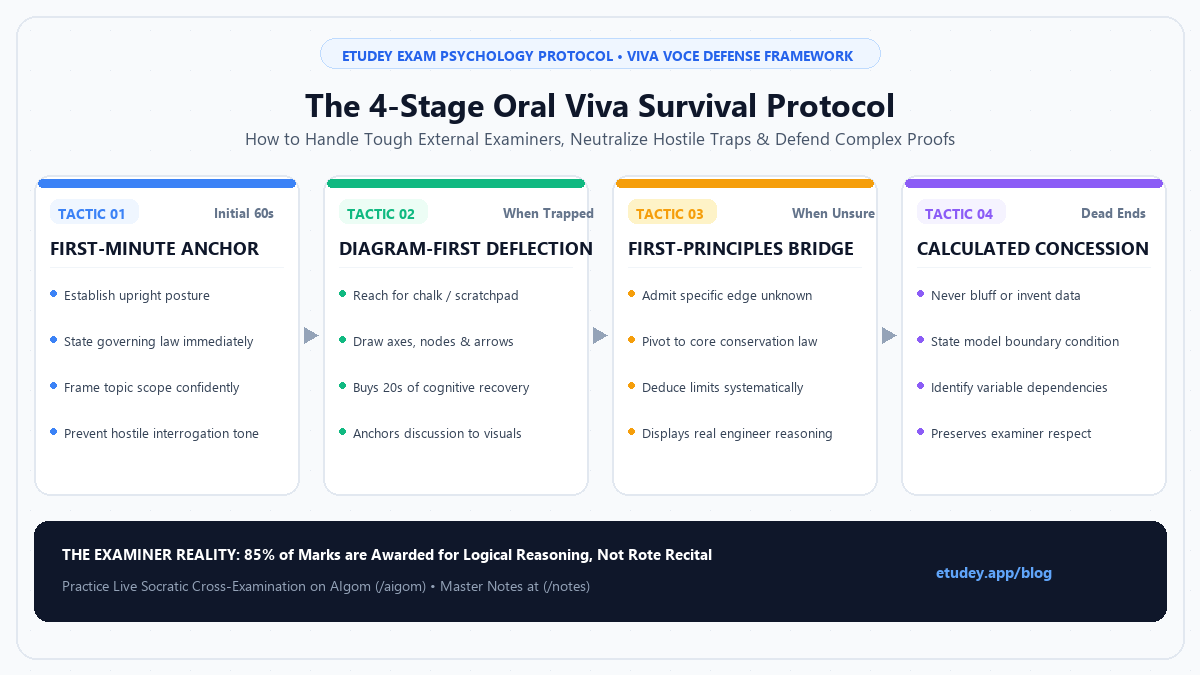
The oral viva survival playbook in STEM centers on cognitive anchoring, non-verbal composure, and the first-principles recovery bridge. When confronted by tough external examiners or unexpected theoretical cross-questioning, success depends on steering inquiries toward core physical laws, utilizing blackboard diagrams to buy cognitive processing time, and demonstrating methodical engineering reasoning rather than reciting rehearsed answers.
The Corridor of Dread: Why Oral Vivas Terrify Even 9.0 CGPA Students
It is 10:45 AM outside Lab 302. Thirty engineering undergraduates in stiff, freshly pressed formal clothes stand in a silent, tense queue along the corridor. Every five minutes, a classmate emerges through the frosted glass door looking bewildered, pale, or completely demoralized. The whispers pass down the line like wildfire: "He’s asking derivations from Chapter 8... he grilled Sharma on boundary layers... he didn’t even look at the lab manual!"
The oral viva voce is arguably the most psychologically distressing evaluation in all of higher education. In a written semester examination, you have three uninterrupted hours, quiet margins to scratch rough work, and complete privacy to process difficult questions. If you blank out on Question 4, you simply skip to Question 5.
In an oral viva, however, there is zero buffer. You sit eighteen inches across a desk from a senior professor or external university examiner who has been teaching the subject for thirty years. Every furrow of their brow, every heavy sigh, and every quiet tap of their red pen registers directly on your central nervous system. Under this acute social evaluation stress, the amygdala triggers a fight-or-flight cascade, draining blood from the prefrontal cortex and locking your working memory into a catastrophic freeze state.
Daniel Kahneman & Amos Tversky (Anchoring Heuristic, 1974): "Human evaluators make rapid, disproportionately sticky baseline judgments within the first sixty seconds of interaction. Subsequent evidence is filtered through that initial anchor." In a viva, the examiner decides whether you are competent or unprepared before you finish your second sentence.
Inside the External Examiner's Mind: What Are They Actually Testing?
The most pervasive myth among university students is that external examiners exist to humiliate them or catch them on trivial minutiae. To survive and excel in an oral defense, you must understand the professor's perspective and constraints:
- They Are Mentally Exhausted: External examiners frequently evaluate sixty to ninety students back-to-back in a single day. By 11:30 AM, they are bored to tears by identical, robotic recitations of textbook definitions. When a student speaks with genuine physical intuition and original phrasing, it is an enormous psychological relief.
- They Do Not Care About Pure Syntax: Anyone can memorize the exact formula for transient thermal conductivity. The examiner is not testing your optical memory; they are testing whether you possess structural engineering intuition. If the physical conditions change, do you know which term in the equation explodes to infinity?
- They Despise Bluffs Above All Else: The quickest way to fail an oral viva is to pretend you know an answer when you don't. External professors have spent decades in research; they can spot fabricated buzzwords within three syllables. Bluffs signal intellectual dishonesty, which immediately triggers aggressive cross-examination.
The 4 Examiner Archetypes and How to Counter Them
Every external examiner fits into one of four distinct psychological archetypes. Identifying their persona within the first ninety seconds lets you tailor your verbal defense strategy:
1. The Formula Purist
Profile: Obsessed with rigorous mathematical precision, exact SI units, coordinate systems, and sign conventions. They will interrupt you to ask: "Is that plus or minus? Why is there a factor of two in the denominator?"
Counter-Strategy: Never state a result without specifying the governing assumptions. Always state units aloud (e.g., "The magnetic flux is measured in Webers, which is volt-seconds").
2. The Industry Pragmatist
Profile: Usually an experienced consultant or former industry researcher. They despise pure theory and care only about physical realities, safety margins, manufacturing costs, and real-world failure modes. They will ask: "Where does this circuit actually blow up in the field?"
Counter-Strategy: Relate equations to physical hardware. Mention tolerances, thermal runaway, parasitic capacitance, or material fatigue limits.
3. The Socratic Tormentor
Profile: Soft-spoken, polite, but relentlessly probes deeper with every answer. If you answer correctly, they immediately follow up with: "And why does that happen? And what proves that? And what if the temperature drops to absolute zero?"
Counter-Strategy: Do not panic when they keep digging. Socratic cross-questioning is actually a compliment—it means they find you competent enough to stress-test your limits. Stay calm, retreat to first principles, and state the boundary conditions of your model.
4. The Impatient Speed-Runner
Profile: Constantly checking their watch, flipping through your lab record without reading, firing rapid-fire questions: "Define impedance. Next. What is Barkhausen criterion? Next."
Counter-Strategy: Give crisp, one-sentence declarative definitions immediately followed by the governing formula. Avoid long conversational windups.
Comparison: The Fragile Student Bluff vs. The Elite Engineering Defense
Notice how a master student handles difficult or trap questions compared to an average student:
| Examiner Prompt | The Fragile Student Bluff (Triggers Fails) | The Elite Engineering Defense (Wins Respect) |
|---|---|---|
| "Why is the efficiency of this Carnot cycle strictly under 60%?" | "Uh, because of friction and heat losses in the pipes and environmental resistance..." (Vague hand-waving) | "From the Second Law, Carnot efficiency is strictly 1 - (Tc / Th). In our setup, heat rejection occurs at ambient 300K, requiring an infinite source temperature to reach 100%." |
| "What happens to the output if I replace this capacitor with an inductor?" | "The voltage will... increase? No, decrease. It will change the frequency." (Guessing and watching examiner's eyes) | "Since capacitor impedance is 1/(jωC) while inductor impedance is jωL, the phase angle shifts by 180 degrees, transforming our low-pass filter into a high-pass response." |
| "Derive the stability criterion for this feedback loop right now." | Freezes in place, stares at desk, mumbles: "I forgot the exact formula from the textbook." | "May I use the blackboard? I will set the open-loop gain transfer function denominator to 1 + Aβ = 0 and solve for the pole locations in the left half-plane." |
| "What is the exact dielectric constant of PTFE at 10 GHz?" | "I think it is around 8.5... or maybe 12.3?" (Fabricating numbers) | "I don't recall the exact empirical value at 10 GHz from memory, sir. However, for non-polar fluoropolymers, it typically ranges between 2.0 and 2.2, with minimal dielectric loss." |
Tactic 1: The First-Minute Anchoring Heuristic
Human psychology dictates that first impressions carry an overwhelming weight in oral evaluations. When you walk into the viva room, execute these three non-verbal anchors before uttering a single word:
- Physical Posture: Walk in with your spine straight, shoulders back, and hands resting comfortably on your lap or the table edge. Never slouch, hunch, or cross your arms defensively over your chest.
- Eye Contact & Greeting: Look the examiner directly in the eye, smile gently, and say: "Good morning, Professor [or Sir/Ma'am]." Do not sit until you are invited to sit.
- The Opening Sentence Anchor: When they ask: "So, what experiment or topic did you prepare today?", never say: "Anything in Unit 1 is fine." That shows passivity. Instead, offer a confident, framed response: "I have thoroughly analyzed the transient response of second-order RLC systems and operational amplifier active filters." This immediately steers the upcoming questions into territory where you are deeply prepared.
Tactic 2: The Diagram-First Deflection (Buying Cognitive Time)
When an examiner asks a difficult, complex question that catches you off-guard, your natural physiological impulse is to blurt out a panicked guess within one second. Resist this impulse at all costs. Silence feels like an eternity to you, but to the professor, a 3-second pause looks like thoughtful deliberation.
The most powerful tool in your survival arsenal is the Diagram-First Deflection:
- Ask for permission to sketch: "May I draw the circuit diagram [or free-body schematic] on the board / scratchpad to explain the reasoning, Sir?"
- Nine times out of ten, the examiner will nod and hand you the chalk or marker.
- While you stand up and draw the coordinate axes, component nodes, and variable arrows, your brain gets 15 to 25 golden seconds of uninterrupted cognitive recovery time. The adrenaline spike subsides, and your working memory comes back online.
- Once the diagram is drawn, your explanation becomes infinitely easier because you can physically point to components rather than constructing abstract mental sentences in mid-air.
If you want to refine your speed at sketching accurate, publication-grade schematics under pressure, practice daily derivations using Etudey's Handwriting Studio, where you can instantly test your ability to draw circuit architectures and vector models from memory.
Tactic 3: The "First-Principles Bridge" When You Genuinely Don't Know
What happens when the examiner asks about an obscure theorem, a bizarre edge case, or a formula you completely blanked on?
Most students freeze and say nothing, or they bluff and get annihilated. Elite engineering students deploy the First-Principles Bridge. This 3-step verbal maneuver demonstrates immense intellectual maturity:
Step 1: The Transparent Boundary Concession
Acknowledge the gap immediately and cleanly without groveling: "I do not recall the exact closed-form expression for that specific boundary condition, Sir."
Step 2: The Pivot to First Principles
Immediately pivot to the underlying physical or mathematical foundation: "However, from fundamental conservation of energy [or Kirchhoff's Laws / Newton's Second Law], we know that as this parameter increases..."
Step 3: The Asymptotic Limit Deduction
Deduce the behavior at extreme limits (zero and infinity): "If frequency approaches zero, the capacitor acts as an open circuit, meaning the output must drop to zero. If frequency approaches infinity, the inductive reactance dominates. Therefore, this must behave as a bandpass filter."
Even if you did not remember the exact textbook formula, the external examiner will award you 80% to 90% of the question's marks. Why? Because you demonstrated how a genuine engineer thinks under uncertainty: by isolating governing laws and deducing boundary limits.
Tactic 4: Surviving the Final Year Project & Capstone Viva
Final year major project vivas carry enormous weight (often 4 to 8 academic credits) and involve a panel of multiple external evaluators. Project defense vivas differ fundamentally from lab course vivas:
- Acknowledge Limitations Proactively: Never claim your machine learning model or hardware prototype has "100% accuracy" or "zero flaws." External examiners will instantly tear that claim apart. Instead, state your engineering constraints upfront: "Our prototype achieves 92% accuracy under controlled lighting conditions, but drops in low-light environments due to sensor noise." Examiners love students who understand their system's operating envelope.
- Know Your Hardware & Code Down to the Pinout: If you built an IoT system or web application, be prepared for questions like: "Why did you choose an ESP32 instead of an STM32 microcontroller? Why did you use WebSockets instead of REST polling?" Never answer: "Because the YouTube tutorial used it." Always justify design decisions with trade-offs: cost, latency, power consumption, or memory footprint.
- Review Peer Project Vivas: Prepare for the common trap questions that external examiners in your university repeatedly ask by reviewing syllabus-vetted notes in the Etudey Verified Notes Archive.
The 48-Hour Viva Preparation Protocol: Simulating the Heat
You cannot prepare for an oral exam purely by reading books silently in bed. Reading is an input process; oral examination is high-pressure output generation.
To build unshakeable oral fluency before viva day, you must simulate the interrogation environment:
- Socratic AI Viva Grilling with AIgom: Open AIgom, Etudey's Socratic AI Study Partner. Set your prompt to: "Act as an intimidating university external examiner in Fluid Mechanics. Ask me one tough viva question at a time. Do not reveal the answer. Interrupt me if I use vague buzzwords, and test my understanding of boundary conditions." Practice speaking your answers aloud using voice typing.
- The Mirror Whiteboard Drill: Stand in front of a mirror or whiteboard. Set a 60-second timer. Force yourself to explain one core derivation from your syllabus aloud without touching notes. Notice your filler words ("um", "like", "you know") and eliminate them.
- Organize Topic Milestones on Kanban: Map out your mandatory experiments, circuit diagrams, and mathematical derivations systematically across your Etudey Study Kanban Board to ensure no blind spots remain before exam morning.
Frequently Asked Questions
What should I do if an external examiner is visibly hostile or angry?
Never match an examiner's aggression or become argumentative. Hostility from an external examiner is often a psychological stress test to see whether you crumble under pressure, or simply a byproduct of their fatigue. Maintain a calm, neutral tone of voice, keep your posture upright, and respond strictly to the technical substance of their question. If you maintain composure and demonstrate steady reasoning, they will quickly soften and award high marks for professionalism.
How do I answer if two examiners disagree with each other during my project defense?
This is a classic high-stakes scenario. When Examiner A and Examiner B begin debating a design choice among themselves, stay silent and listen carefully. When they turn to you for resolution, do not take sides. Instead, validate both engineering perspectives by highlighting the trade-offs: "Professor A is completely correct that approach X minimizes computational latency, while Professor B's observation correctly highlights that approach Y reduces power consumption. In our application, we prioritized latency because..."
Is it okay to ask the examiner to repeat or rephrase a confusing question?
Yes, absolutely. Asking for clarification is a sign of precision, not weakness. You can say: "Excuse me Sir, could you clarify whether you are referring to the steady-state response or the transient phase?" This shows that you understand the nuanced layers of the problem and prevents you from answering the wrong question.
What if my mind completely blanks out due to acute anxiety?
If you experience a severe freeze state, do not sit in paralyzed silence. Take a deliberate, deep physiological sigh (a long inhale through the nose followed by a sharp top-off inhale and a slow exhale through the mouth). Take a sip of water if available. Then say honestly: "Pardon me, Sir, my mind briefly blanked on that term. May I take ten seconds to write down the governing equation on this scratchpad?" Taking physical action with a pen immediately resets prefrontal cortex function.
How much does body language and formal dress code actually affect viva marks?
Studies in academic evaluation psychology demonstrate that non-verbal cues (clean formal attire, upright posture, steady eye contact, and measured vocal cadence) account for up to 30% of the examiner's subjective evaluation. Examiners perceive a well-groomed, poised student as inherently more disciplined and trustworthy, making them far more forgiving when you encounter difficult technical questions.
Stop Panicking. Start Anchoring.
An oral viva examination is not an ambush; it is a technical conversation between engineers. When you replace passive memorization with the First-Principles Bridge and diagram-driven communication, external examiners cease to be terrifying adversaries and become professional colleagues assessing your reasoning.
Step into the viva room with your head high, anchor the room in the first minute, and turn your next oral defense into your highest academic score. Simulate your next viva with AIgom, review vetted peer resources in the Etudey Workspace, and conquer your semester finals.