
The blurting method is an active recall revision technique where students study a topic, close all materials, and rapidly write down every fact, formula, and diagram from memory onto blank scratch paper. By combining open-ended free recall with a forensic red-ink gap audit, it dismantles the illusion of competence and dramatically accelerates exam retention.
The Illusion of Fluency: Why Passive Revision Destroys Exam Day Recall
Consider a study ritual enacted in college dormitories every semester: exams are five days away, and you sit with an engineering textbook, highlighters, and three hundred lecture slides. You read Chapter 6 on Control Systems for the fourth time. The prose feels familiar; the transfer functions seem intuitive; the diagrams look obvious. A wave of reassuring confidence washes over your brain: "I've got this. I understand this chapter."
Fast forward to the examination hall. The invigilator distributes the question paper. Question 3 asks: "Derive the steady-state error for a Type 1 system subjected to a parabolic input and plot the root locus."
Your pulse accelerates. Your mind goes completely blank. You vividly remember the page where the root locus was printed; you recall the blue subheading and the boxed formula on the bottom right. But you cannot reproduce the mathematical proof. Your hand hovers frozen over the blank answer sheet.
This agonizing failure is not caused by low intelligence or bad luck; it is caused by the Illusion of Fluency.
Cognitive neuroscience distinguishes between two fundamentally separate memory processes:
- Recognition Memory: When looking at notes or textbooks, your visual cortex recognizes patterns that were previously encoded. Because the sensory data is physically present, processing requires virtually zero metabolic energy. Your brain interprets this lack of cognitive friction as mastery.
- Generative Free Recall: In an examination, zero external prompts exist. Your frontoparietal control network must independently search long-term memory, reconstruct the associative pathways, assemble the logical steps, and motor-derive the proof on blank paper.
When you spend 80% of your revision time reading summaries, underlining lines, and skimming solved examples, you are training recognition. But university exams exclusively test generative recall. You are practicing for an Olympic swimming sprint by lying on your couch watching Olympic swimming. To ace university exams, you must practice the exact cognitive motor action required in the exam hall: pulling raw knowledge onto blank paper.
The Cognitive Science of Free Recall: Why Blurting Outperforms Flashcards
While the term "blurting" originated as a viral trend across student study communities, its underlying mechanics are rooted in over a century of empirical cognitive psychology: unconstrained free recall.
Most students who attempt active recall rely heavily on digital flashcard software like Anki or Quizlet. While flashcards are effective for learning isolated vocabulary or medical terms, they suffer from a severe structural limitation when applied to complex higher education, engineering, and scientific coursework: the atomization trap.
A flashcard presents a single cue and demands a single atomic answer (e.g., "What is Ohm's Law? V = IR"). But university exams rarely test isolated facts. An engineering exam question asks you to integrate five concepts simultaneously: identifying thermal boundary conditions, applying partial differential equations, calculating Reynolds numbers, and deriving fluid pressure profiles.
This is where blurting demonstrates its decisive cognitive superiority:
- Associative Network Activation: Blurting does not test isolated data points; it forces your brain to recall the relationships between ideas. When you write a blank-sheet dump, you must decide what concept comes first, how the formula connects to the physical system, and where edge-case assumptions apply.
- Metacognitive Calibration: On flashcards, students frequently flip the card, see the answer, and rationalize: "Oh yeah, I basically knew that." On a blank sheet of scratch paper, there is zero room for self-deception. What is on the page was retrieved; what is missing was forgotten.
- Dual Coding and Motor Anchoring: Formulated by psychologist Allan Paivio in 1971, Dual Coding Theory shows that memory improves when verbal information is paired with visual-spatial representations. Blurting on physical paper engages motor-kinesthetic neural loops, drawing circuits and writing equations simultaneously.
| Revision Technique | Cognitive Process | Prep Time Required | Complex STEM Derivations | Illusion of Competence | Exam Simulation Fidelity |
|---|---|---|---|---|---|
| Passive Re-Reading | Visual Recognition | Zero (Instant) | Extremely poor (0% retention) | Severe (False sense of mastery) | Completely detached |
| Digital Flashcards | Cued Recall | Heavy (Hours making cards) | Moderate (Atomizes proofs) | Low to moderate | Moderate (Isolated facts) |
| Mind Mapping | Structural Categorization | Moderate | Poor for mathematical proofs | Moderate | Low (Non-linear) |
| The Blurting Method | Generative Free Recall | Zero (Blank paper only) | Exceptional (Full derivations) | Zero (Exposes all gaps) | Exact match to exam conditions |
The 4-Step Blurting Method Protocol: From Blank Paper to Exam Mastery
Blurting is not an unstructured scribble; it is a systematic, iterative protocol governed by four distinct phases. Executed properly, a 45-minute blurting block delivers more neural retention than five hours of passive highlighting.
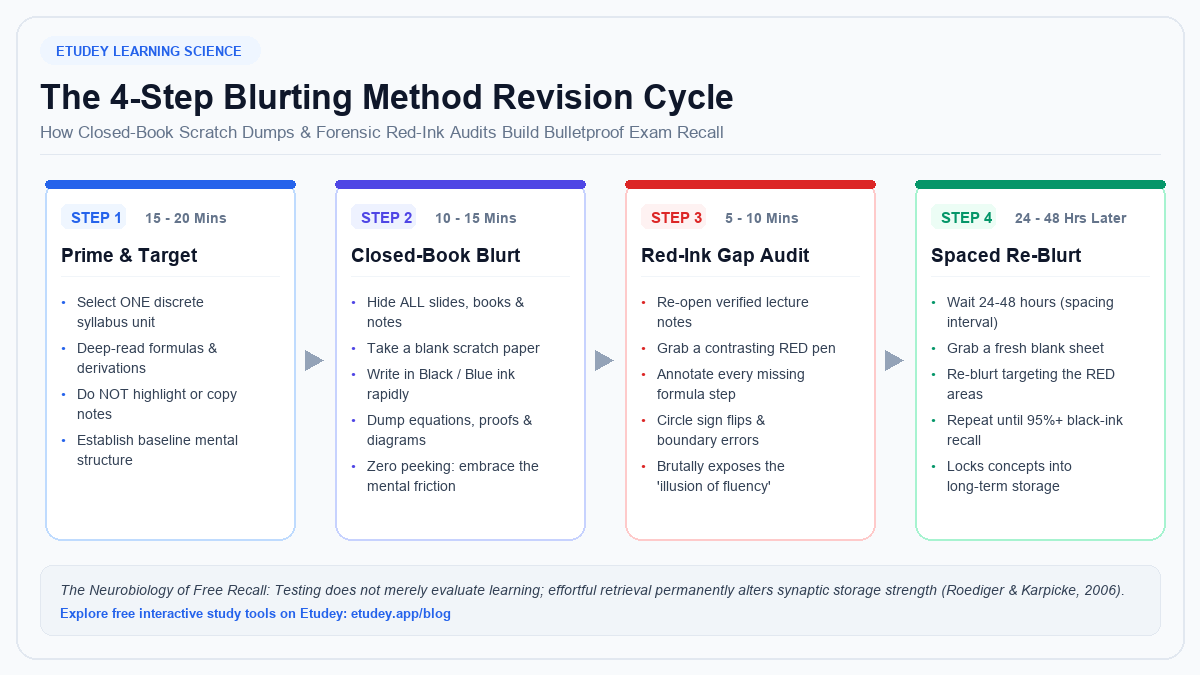
Phase 1: Prime & Target (15–20 Minutes)
The biggest mistake students make with blurting is trying to dump an entire textbook chapter at once. Your working memory can only handle discrete, coherent chunks. Select a single modular syllabus topic: for example, "MOSFET Small-Signal High-Frequency Model" or "Carnot Engine Second Law Derivation."
Spend fifteen minutes reading your verified lecture notes or primary textbook. Focus entirely on the logical connective tissue: why does step A lead to step B? What are the initial assumptions? Do not highlight or rewrite notes. Read with active analytical interrogation.
Phase 2: The Closed-Book "Blurt" (10–15 Minutes)
Push your textbooks, slides, and phone completely out of reach. Take a clean sheet of blank A4 scratch paper and a black or blue pen. Set a timer for 10 to 12 minutes.
Start writing. Dump everything you can recall about that topic onto the paper as rapidly as possible:
- Write governing formulas and definition statements.
- Draw circuit schematics, free-body diagrams, and block diagrams from memory.
- Derive mathematical equations step by step.
- List boundary conditions, units, and edge-case exceptions.
The Golden Rule of Blurting: When your mind hits a wall, do not look at your notes. Sit in the uncomfortable silence for sixty seconds. Force your prefrontal cortex to search its associative pathways. That subjective struggle is the exact neurochemical trigger that drives synaptic consolidation.
Phase 3: The Forensic Red-Ink Gap Audit (5–10 Minutes)
The magic of blurting happens in Phase 3. Put your black pen down and pick up a bright red pen. Re-open your lecture notes and compare your scratch dump against the source material line by line.
Annotate your blurt sheet aggressively in red ink:
- Omissions: Write down every skipped derivation step, missing variable, or omitted assumption in red ink directly where it belongs.
- Inversions: Circle sign flips (e.g., writing a plus instead of a minus in a Laplace transform) in red.
- Fuzzy Logic: If an explanation was hand-wavy or vague, write the exact causal rationale in red.
"The red-ink audit is where neuroplasticity occurs. The stark visual contrast between your black-ink recall and your red-ink omissions provides immediate, unfiltered metacognitive feedback. Your brain registers the red ink as an error-prediction discrepancy, dopamine drops, and the hippocampus flags those specific missing coordinates for prioritized encoding."
Phase 4: The Spaced Re-Blurt (24–48 Hours Later)
Keep your red-annotated blurt sheet as a temporary diagnostic record. Do not re-study the black-ink material—you already own that knowledge. Your sole focus for the next 48 hours is mastering the red ink.
Twenty-four to forty-eight hours later, grab a fresh, blank sheet of paper and repeat Phase 2. You will find that previously missed steps now flow effortlessly into black ink. Continue this cycle until your blurt sheet requires zero red-ink corrections.
How to Blurt for Complex STEM, Engineering & Mathematical Subjects
While blurting is widely used in medicine and law for vocabulary and anatomical pathways, applying it to engineering, physics, and advanced mathematics requires specialized tactical adjustments:
1. Derivation Prompt Cards
Instead of a broad topic, start your scratch sheet with a single prompt at the top: "Derive Maxwell's Equations in differential form from Gauss's, Faraday's, and Ampere's Laws." Leave the rest of the page completely blank. Force your motor memory to execute the vector calculus cross products and surface integrals without referencing cheat sheets.
2. Reconstruct Handwritten Lecture Scribbles
If your class notes are messy, unreadable, or disorganized, use Etudey Handwriting Studio to transcribe handwritten classroom chalkboards into clean, searchable digital text and formula reference sheets. Use these digitized notes as your authoritative ground truth during Phase 3 red-ink audits.
3. Socratic AI Debugging for Persistent Gaps
If you repeatedly miss the same conceptual step across three blurting sessions, you do not have a memory problem—you have a comprehension breakdown. Upload the problem statement into Etudey AIgom and ask:
"In this Thermodynamic Rankine cycle derivation, I keep forgetting why the pump work term can be neglected in low-pressure calculations. Explain the exact physical and mathematical rationale in first principles."
Resolving the underlying conceptual rationale ensures the step will stick on your next blurt.
4. Sourcing Verified College Question Patterns
To ensure your blurt topics match what professors actually examine, cross-reference university past year questions (PYQs) on the Etudey Notes Database. Tailor your blurting sessions to the high-weightage derivation patterns that appear consistently in semester finals.
5. Orchestrating Blurt Sprints on Your Study Kanban
Coordinate your active recall schedule using Etudey's free online Study Kanban Board. Create subject-color-coded sticky notes for each syllabus unit and move them across active verification stages:
- To Do (Backlog): Units waiting for initial blurt testing.
- In Progress (Active Blurt Sprint — WIP: 2): Units currently undergoing the 4-phase cycle with active red-ink audits.
- Done (Zero-Red Retention): Topics where a closed-book blurt achieved ≥ 95% accuracy with zero red-pen omissions.
Frequently Asked Questions
Is blurting more effective on physical paper or on a digital tablet?
Physical paper offers distinct cognitive advantages over smooth glass screens. Friction between a pen and rough paper stimulates tactile sensory feedback (haptic anchoring), which enhances motor memory encoding. However, if you use a tablet with a paper-feel screen protector, digital blurting works wonderfully because you can quickly duplicate templates, color-code in red ink, and export snapshots directly to your Etudey Student Account.
How do I deal with feeling demoralized when my blurt sheet is covered in red ink?
Reframe the red ink entirely: every red mark on your scratch paper is an exam-day disaster that you prevented in the safety of your study room. If your blurt sheet were 100% black ink on your first try, you would have wasted twenty minutes testing material you already know. Red ink is not a badge of failure; it is a treasure map of the exact points you need to study to jump from a C to an A.
How is the Blurting Method different from the Feynman Technique?
The Feynman Technique focuses on conceptual comprehension and simplification: explaining a difficult idea in simple, analogy-rich language as if teaching a child. Blurting focuses on retrieval volume, structural completeness, and execution fidelity: proving you can rapidly reconstruct complex formulas, multi-step proofs, and precise technical jargon under timed, closed-book conditions. The two methods complement each other perfectly: use Feynman to understand; use Blurting to retain.
How many topics should I blurt in a single study session?
Because genuine free recall is metabolically demanding on the brain, limit yourself to two or three blurt cycles per session (roughly 90 minutes total). Attempting to blurt six complex topics in a row leads to cognitive exhaustion, causing your retrieval accuracy to plummet due to mental fatigue rather than lack of knowledge.
Can blurting be used for semester exams when I only have 24 hours left?
Yes—in fact, blurting is the single most effective emergency study protocol available. When facing a 24-hour deadline, passive re-reading will guarantee failure because memory decay will occur overnight. Instead, identify the top 10 most recurring PYQ derivations, execute a 15-minute blurt on each, conduct an aggressive red-ink audit, and review only the red sheets the morning of the exam.
Stop Highlighting Notes. Start Dominating Exams with Etudey.
Top engineering and STEM scholars do not possess magical photographic memories. They simply refuse to waste precious hours on passive study illusions. By grabbing a blank sheet of scratch paper, confronting the discomfort of free recall, and auditing knowledge gaps in bold red ink, you transform fragile familiarity into bulletproof exam mastery.
Supercharge your academic comeback today: transcribe lecture derivations with Handwriting Studio, spar with Socratic AI on AIgom, track your blurt sprints on the Study Kanban Board, and access verified university notes on the free Etudey Academic Operating System.