
Finite automata model computation with fixed, bounded memory—reading strings symbol by symbol across discrete states. Although NFAs appear more powerful because they can branch across multiple guesses or take empty epsilon jumps, subset construction proves DFAs and NFAs recognize the exact same class of regular languages.
What a Finite Automaton Actually Computes: States as Memory
Most students start Theory of Computation memorizing five-tuples (Q, Sigma, delta, q0, F) without grasping what a state physically represents. Strip away the notation and think of a state as the machine's entire working memory. Unlike a Turing Machine with an infinite tape or a Pushdown Automaton with a stack, a finite automaton has zero auxiliary scratchpad—no counters, no arrays, no recursion depth.
Every time a transition arrow fires on an input character, the automaton updates what it remembers about the prefix seen so far:
- In a lexer or compiler tokenizer: States track whether you are currently inside a quoted string literal, an identifier, or a multiline comment.
- In a binary divisibility checker: Each state simply stores
remainder mod kseen so far, updating cleanly on each incoming bit. - In pattern matching (
regex): States remember how many characters of a target suffix like01have matched consecutively.
Once you read each circle as "the specific summary of past input I need right now," building state diagrams stops feeling like guesswork—just as state-compression thinking simplifies dynamic programming or digital circuit design in our Boolean algebra and Karnaugh map guide.
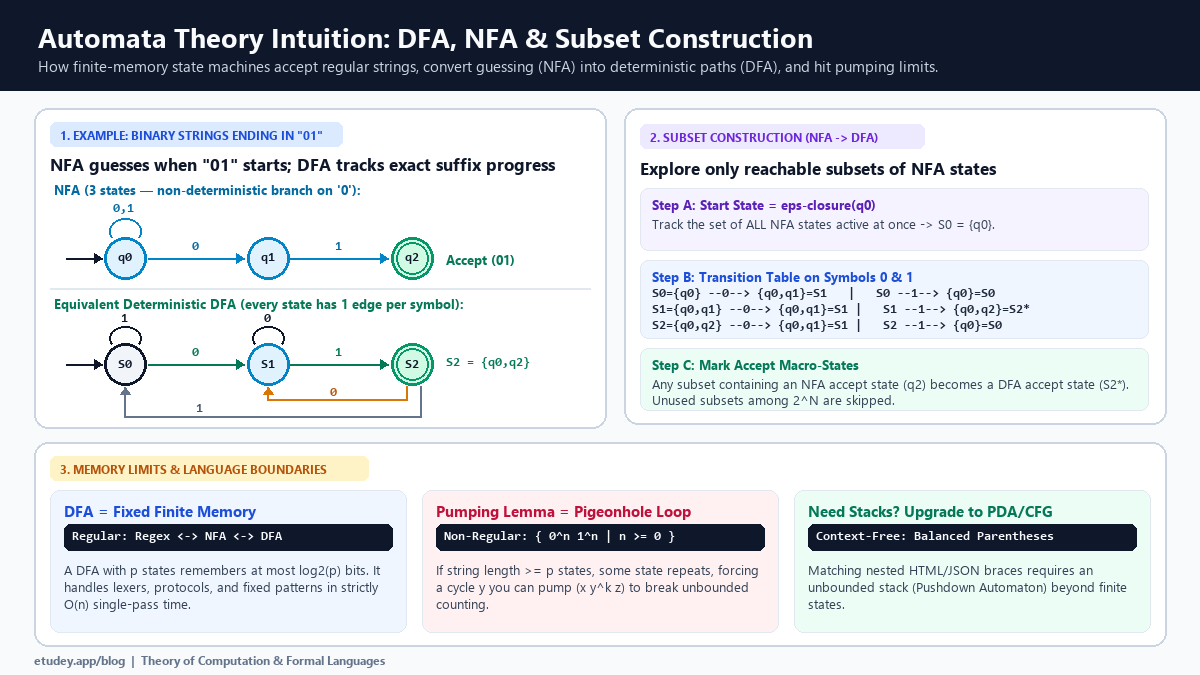
DFA vs. NFA: Determinism vs. Parallel "Lucky Guessing"
Why teach two finite machine models if both recognize regular languages? Because humans design patterns non-deterministically, while CPUs execute deterministically.
Deterministic Finite Automaton (DFA): One Arrow Per Symbol
From every state q and every alphabet symbol a in Sigma, a DFA must define exactly one outgoing transition delta(q, a). There is zero ambiguity and zero lookahead: reading an n-character string executes exactly n steps in strictly O(n) single-pass time and O(1) runtime memory.
Nondeterministic Finite Automaton (NFA): Guessing & Epsilon Moves
An NFA relaxes three strict constraints simultaneously:
- Multiple paths: One state can sprout two outgoing arrows labeled with the same character (for instance,
q0both stays onq0and branches toq1upon reading'0'). - Dead branches allowed: An NFA can omit transitions for invalid symbols; if a branch gets stuck with no valid arrow, that specific execution path quietly dies without disqualifying other surviving paths.
- Free
epsilonjumps: An NFA may move alongepsilontransitions without consuming any input character at all.
The acceptance rule makes NFAs astonishingly compact: an input string is accepted if at least one computational path lands inside an accept state when the string finishes—as though an infallible oracle always picked the luckiest fork at every branch point.
Subset Construction Step-by-Step: Converting NFA to DFA
Wait: if an NFA can fork exponentially across paths, why doesn't it solve harder problems than a DFA? Michael Rabin and Dana Scott proved in 1959 that any N-state NFA can be simulated deterministically by tracking the set of all currently active NFA states as a single macro-state inside a DFA.
Instead of following one coin flip, your DFA puts a pebble on every NFA state reachable right now and moves all pebbles simultaneously on each new input character. While the worst-case subset space has size 2^N, exam problems rarely touch more than 3 to 6 reachable subsets when you explore lazily from the start state:
- Compute the start macro-state
S0: Start witheps-closure({q0})—that is,q0plus every state reachable via zero or moreepsilon-only arrows. - Expand outgoing edges for each symbol
a: For any discovered macro-stateS, collect every statedelta(q, a)reachable across allqinS, then takeeps-closure(...)of the union. If that resulting set hasn't appeared yet, give it a fresh DFA state label (such asS1) and enqueue it. - Handle the empty subset
{}honestly: If reading symbolaproduces zero surviving NFA branches, create a sink/trap stateDead = {}with self-loops on every alphabet character so the DFA transition function stays total. - Mark accepting macro-states: Any subset containing at least one original NFA accept state becomes a DFA accept state.
A DFA simulates an NFA not by guessing the future, but by maintaining the exact subset of all active NFA worlds simultaneously—proving bounded branching adds convenience, not computational power.
Worked Trace: Strings Ending in "01"
Notice how cleanly our diagram tracks strings over {0, 1} ending in 01. The NFA needs only q0 --(0)--> q1 --(1)--> q2* plus a 0,1 self-loop on q0. Running lazy subset construction:
- Start at
S0 = {q0}. Reading1keeps us in{q0}(S0). Reading0splits across both paths into{q0, q1}(S1). - From
S1 = {q0, q1}, reading0returns{q0, q1}(S1again—a consecutive zero resets our partial0prefix!). Reading1activatesq0plus transitionsq1 -> q2, yielding{q0, q2}(S2). - Because
S2contains accepting stateq2,S2is accepting. FromS2, reading0lands back in{q0, q1} = S1, while reading1falls back to{q0} = S0. Only 3 subsets out of2^3 = 8were even reachable!
Sketching these subset tables neatly by hand on blank grid paper or inside Handwriting Studio stops missing-closure slips—often the #1 point deduction on Automata midterm questions.
Automata Models Compared: Regular vs. Context-Free vs. Turing
Automata exams routinely ask you to classify which machine architecture is minimal for a given language. Comparing memory capability alongside closure properties keeps the Chomsky hierarchy crisp:
| Automaton / Grammar | Memory Model | Language Class | Canonical Example | Decidable Equivalence? |
|---|---|---|---|---|
| DFA / NFA / Regex | Finite states only (O(1) bits) |
Regular Languages | Strings ending in 01; email tokens |
Yes (via DFA minimization) |
| Deterministic PDA | Finite states + 1 LIFO stack (deterministic) | Deterministic Context-Free | {0^n 1^n | n >= 0}; programming parsers |
Yes (decidable, proved by Senizergues) |
| Non-deterministic PDA / CFG | Finite states + 1 LIFO stack (branching) | Context-Free Languages | Even-length palindromes w w^R |
No (undecidable whether L(G1)=L(G2)) |
| Turing Machine (TM) | Unbounded read/write tape | Recursively Enumerable | {a^n b^n c^n}; general programs |
No (Halting Problem & Rice's Theorem) |
The Pumping Lemma: Why Finite Memory Cannot Count Unbounded Pairs
Once you internalize that a p-state DFA owns only p distinguishable memory snapshots, proving a language like L = {0^n 1^n | n >= 0} is not regular becomes pure Pigeonhole common sense—no mysticism needed.
Suppose toward contradiction that some DFA with p states recognizes {0^n 1^n}. Feed it the string w = 0^p 1^p (length 2p). While scanning just the first p zeros, the machine visits p + 1 state snapshots (start state plus p transitions). By the Pigeonhole Principle, at least one state must repeat inside that initial 0^p prefix!
That repeated state creates a loop y composed purely of 1 <= |y| <= p zeros inside w = x y z. Because DFAs cannot count how many times they traverse a cycle, pumping that cycle once extra (x y^2 z) produces strictly more zeros than ones (0^(p+|y|) 1^p)—which the DFA is forced to accept even though it violates 0^n 1^n! Contradiction proved cleanly in four lines.
3 Classic Mistakes That Break Pumping Lemma Proofs on Exams
- Choosing
nas a fixed constant instead of relative top: Always pick a test string parameterized cleanly in terms of the unknown pumping lengthp(e.g.,0^p 1^p), because the adversary pickspfirst. - Forgetting the two length conditions: You do not get to choose how
w = x y zsplits! Only assume|xy| <= pand|y| >= 1, then prove that every valid split breaks underi = 0ori = 2. - Using the Pumping Lemma to prove a language IS regular: It is strictly a necessary condition, not sufficient—use a concrete DFA, NFA, or Regular Expression to prove regularity constructively!
Real-World Applications & Study Workflow
Regular expressions inside Python, grep, compiler scanners (Lex/Flex), and network packet inspectors compile directly to NFAs/DFAs—where naive backtracking engines can even suffer exponential ReDoS stalls unless converted via Thompson construction and DFA caching (just as safe hashing avoids DoS slowdowns in our hash tables and collision guide).
To lock in Automata Theory before semester finals, break your syllabus down by construction drills—DFA synthesis, epsilon-NFA conversion, Myhill-Nerode minimization, CFG parsing, and Pumping proofs—tracking weak problem types on a Study Kanban Board, testing counterexample reasoning against an AI study companion, and saving annotated transition traces inside your structured course notes or unified Etudey study workspace. Learn how our CS and engineering tutorials are vetted in our editorial policy.
Frequently Asked Questions
Can every NFA be converted into an equivalent DFA?
Yes. By the Rabin-Scott powerset (subset) construction theorem, every NFA with N states has an equivalent DFA recognizing the exact same regular language, using at most 2^N macro-states (and typically far fewer reachable states in practice).
When is a language guaranteed to be non-regular?
Whenever recognizing it requires remembering an unbounded integer count or nested structure across arbitrarily long prefixes—such as balanced parentheses {0^n 1^n} or prime lengths {a^k | k is prime}. You prove non-regularity formally using either the Pumping Lemma for regular languages or the Myhill-Nerode theorem (showing infinitely many distinguishable prefixes).
What is the difference between |xy| <= p and |y| >= 1 in the Pumping Lemma?
|y| >= 1 guarantees the pumped cycle is non-empty (at least one state-repeating loop step exists), while |xy| <= p ensures that the repeated state occurred within the first p symbols—pinning y strictly inside a predictable prefix like 0^p.
Why do programming-language regex engines sometimes run slowly compared to DFAs?
Traditional backtracking engines evaluate regex branches recursively with backreferences (which exceed regular languages), risking exponential O(2^n) stalls on nested quantifiers like (a+)+b. Pure Thompson NFA simulation or compiled DFAs guarantee linear O(n) matching time per character.
How do you minimize a DFA quickly for exams?
First delete any states unreachable from q0. Then partition states into Accepting vs. Non-Accepting groups (Hopcroft / table-filling partition refinement) and repeatedly split any group whose members transition into different equivalence classes on any input symbol until partitions stabilize.