
A galvanic cell converts spontaneous chemical energy into electrical work by physically separating oxidation and reduction across two half-cells connected by an external wire and a salt bridge. Using Gibbs free energy and the Nernst equation, you can predict cell voltage at any concentration cleanly.
Why Separating a Redox Reaction Creates Voltage
Drop a solid zinc strip directly into a blue copper(II) sulfate solution in one beaker, and chemistry happens immediately: metallic zinc dissolves into colorless Zn2+ ions while reddish copper plates onto the strip. Because zinc transfers electrons straight to copper ions on contact, all free energy escapes wastefully as heat—zero useful electrical work is captured.
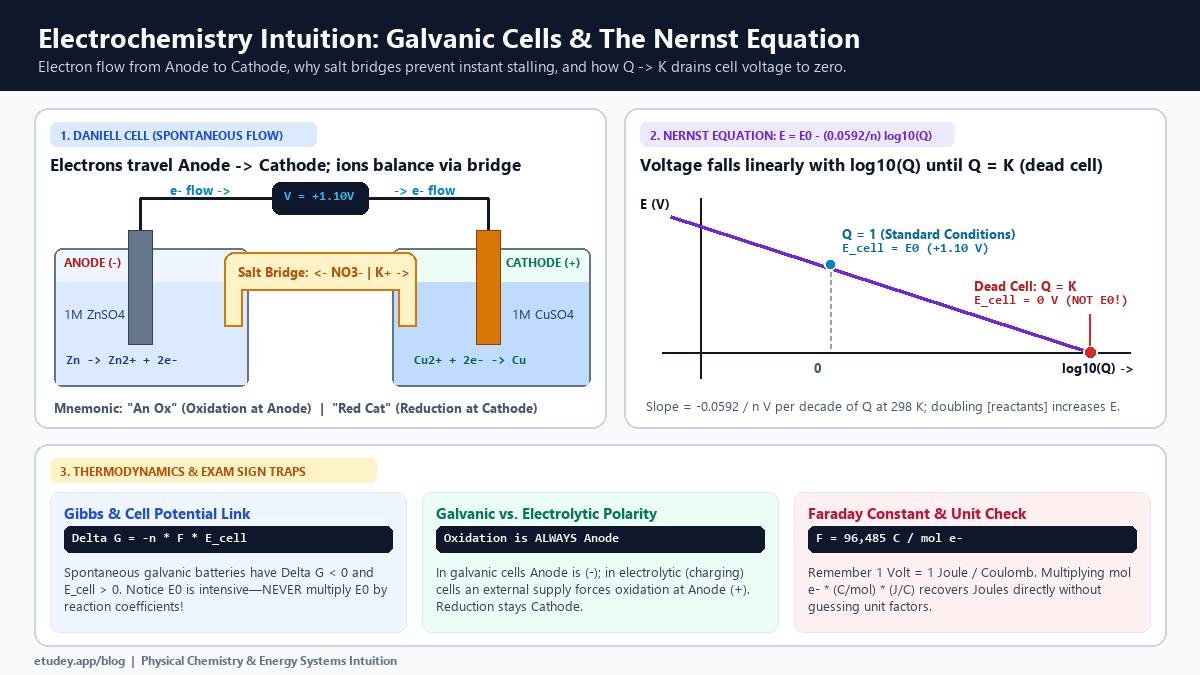
A galvanic (voltaic) cell intercepts those electrons by forcing oxidation and reduction into physically separate compartments connected by a conductive wire:
- Anode half-cell (Oxidation): Metallic
Znloses two electrons to becomeZn2+(aq), sending electrons up into the external wire. - Cathode half-cell (Reduction): Dissolved
Cu2+(aq)ions accept incoming electrons from the copper bar and plate onto it as solidCu(s). - The Salt Bridge (Charge Neutrality): Within microseconds, producing positive
Zn2+without balancing anions would charge the left beaker positive and repel any further electron flow. An inert salt bridge (such asKNO3) migratesNO3-toward the anode andK+toward the cathode so both solutions remain electrically neutral.
The Non-Negotiable Sign Conventions That Trip Up Exams
Students frequently memorize "+ equals cathode" only to panic in electroplating or lithium-ion battery charging questions where electrode polarity flips. Anchor your intuition to chemical reactions first and electrical signs second:
- "An Ox" and "Red Cat" never change: Oxidation always occurs at the Anode; Reduction always occurs at the Cathode—whether the cell is discharging spontaneously (galvanic) or being driven backward by a charger (electrolytic).
- Electrons always travel Anode to Cathode externally: Because electrons carry negative charge out of the anode in a spontaneous galvanic cell, the anode is labeled
(-)and the cathode(+). During charging (electrolytic), an external power supply forces electrons out of the positive terminal, turning the cathode(-)and the anode(+). - Never multiply standard reduction potentials (
E0): When balancing electrons across two half-reactions—say doubling a silver reduction2 Ag+ + 2e- -> 2 Ag—you multiply stoichiometric coefficients, never the voltageE0 = +0.80 V. Why? Because voltage is energy per unit charge (1 V = 1 J / C)—an intensive property like temperature or density!
Checking unit cancellations (J/C * C/mol * mol = J) catches missing n multipliers automatically, mirroring the dimensional sanity checks outlined in our engineering dimensional analysis guide.
Deriving Cell Potential From Standard Tables Without Confusion
Standard reference tables always list half-reactions written as reductions (Reactant + e- -> Product). Rather than memorizing conflicting subtraction rules, use the standard formula grounded directly in reduction tables:
E0_cell = E0_red(cathode) - E0_red(anode)For the classic Daniell cell at standard 1 M concentrations and 298 K:
- Copper reduction:
Cu2+ + 2e- -> Cu(s)hasE0_red = +0.34 V. - Zinc reduction:
Zn2+ + 2e- -> Zn(s)hasE0_red = -0.76 V. - Higher potential wins the reduction role: Because
+0.34 V > -0.76 V, copper acts as the cathode and zinc oxidizes at the anode, givingE0_cell = +0.34 V - (-0.76 V) = +1.10 V.
Notice what happens if you flip the sign of the anode potential manually and subtract—you double-count the minus sign and get -0.42 V! Either write E0_red(cathode) - E0_red(anode) strictly using raw table values, OR explicitly add E0_red + E0_ox after reversing one reaction. Never mix both conventions in the same problem.
Why Batteries Die: Gibbs Energy & The Nernst Equation
Standard cell potential E0_cell describes an artificial snapshot where every dissolved ion begins at exactly 1.0 M and gases sit at 1 bar. The instant a battery begins powering your circuit, reactants get consumed and products accumulate—changing the reaction quotient Q.
Thermodynamics connects electrochemical work directly to Gibbs free energy (see our intuition breakdown in thermodynamics enthalpy and entropy):
Delta G = -n * F * E_cellHere n is moles of electrons transferred in the balanced overall equation, and F = 96,485 C / mol e- is Faraday's constant. Substituting the non-standard thermodynamic relation Delta G = Delta G0 + R T ln(Q) and dividing both sides by -nF produces the celebrated Nernst Equation:
E_cell = E0_cell - (R * T) / (n * F) * ln(Q)Converting natural logarithm to base-10 at standard room temperature (T = 298.15 K) yields the classic exam shortcut:
E_cell = E0_cell - (0.0592 V / n) * log10(Q)A dead battery still has its exact original E0_cell listed in the textbook—what reaches zero is E_cell itself, because the reaction quotient Q has climbed until Q = K at chemical equilibrium.
Two Common Nernst Scenarios Tested in Chemistry & Viva Exams
- Case A — Boosting voltage by tuning concentrations: Raising reactant ion concentration (e.g. pushing
[Cu2+] = 2.0 Mwhile keeping[Zn2+] = 0.01 M) makesQ = [Zn2+] / [Cu2+] = 0.005 < 1. Sincelog10(0.005) < 0, subtracting a negative number increasesE_cellcleanly above+1.10 V. - Case B — Concentration Cells (same metal on both sides!): If both beakers contain copper electrodes—one dipped in dilute
0.01 M Cu2+and the other in concentrated1.0 M Cu2+—E0_cellis literally0.00 V! Yet entropy drives the cell spontaneously to equalize concentrations (dilute side oxidizes to addCu2+, concentrated side reduces to removeCu2+), generating measurable Nernst voltage purely from the concentration ratio!
Galvanic vs. Electrolytic vs. Equilibrium States Compared
Keep these three electrochemical regimes separated cleanly whenever solving numerical problems or explaining lab curves during viva questioning:
| Cell Regime | Delta G Sign |
E_cell Sign |
Reaction Progress (Q vs K) |
Anode / Cathode Charge |
|---|---|---|---|---|
| Galvanic (Discharging Battery) | Delta G < 0 (spontaneous) |
E_cell > 0 V |
Q < K (moves forward) |
Anode (-), Cathode (+) |
| Dead Cell / Equilibrium | Delta G = 0 |
E_cell = 0 V |
Q = K (zero net current) |
Equalized (ln K = nFE0 / RT) |
| Electrolytic (Charging / Plating) | Delta G > 0 (externally driven) |
E_cell < 0 V (needs voltage source) |
External DC reverses flow | Anode (+), Cathode (-) |
Balancing Redox Half-Reactions Cleanly Under Time Pressure
Before plugging n into Faraday's law or the Nernst equation, you need an error-free value for electrons transferred. Writing half-reactions systematically avoids fractional coefficient mistakes:
- Split the net ionic equation into separate oxidation and reduction half-reactions.
- Balance all elements other than Oxygen and Hydrogen first.
- Balance Oxygen atoms by adding
H2Omolecules; then balance Hydrogen atoms by addingH+ions. (If the problem specifies basic solution, add equalOH-to both sides at the end to neutralizeH+into water!) - Balance electric charge on each half-reaction using electrons (
e-), then scale both equations until electrons lost match electrons gained—and that matched count is your exactn.
Practicing full half-reaction balances and sketching beaker polarity diagrams directly inside Handwriting Studio builds real exam muscle memory. When reviewing lab viva prep alongside dense Physical Chemistry chapters, organize reaction sheets inside your study notes, schedule practice sets on a Study Kanban Board, quiz tricky concentration-cell variations with an AI study tutor, or manage your full exam prep inside the Etudey workspace. For details on how our STEM guides are verified, visit our editorial policy.
Frequently Asked Questions
Why do solids like Zn(s) and Cu(s) disappear from the reaction quotient Q?
In thermodynamics, pure solids and pure liquids have constant thermodynamic activity defined as 1, regardless of how thick the metal electrode bar is. As a result, Q includes only aqueous ion molarities and gas partial pressures, so carving a wider zinc plate increases battery capacity (total charge) without raising initial voltage.
How do you find the equilibrium constant K from E0_cell?
Set E_cell = 0 and Q = K inside the Nernst equation: 0 = E0_cell - (RT / nF) ln K, which rearranges to ln K = (n * F * E0_cell) / (R * T), or log10(K) = (n * E0_cell) / 0.0592 at 298 K. Even modest positive voltages correspond to enormous equilibrium constants!
What happens physically if you pull out the salt bridge mid-experiment?
The voltmeter instantly drops to 0.00 V and current stops completely. Without counter-ion migration from the salt bridge, positive charge accumulates immediately in the anode beaker and negative charge accumulates in the cathode beaker, building an internal electrostatic barrier that halts electron flow.
Why is n = 2 for the Daniell cell even if you double the beaker volume?
n represents the stoichiometric moles of electrons transferred per 1 mole of the written balanced chemical reaction (Zn + Cu2+ -> Zn2+ + Cu transfers 2 electrons per formula unit), not the physical number of moles sitting in your flask. Voltage E_cell is intensive and independent of beaker size.
How does a rechargeable lithium-ion battery switch between galvanic and electrolytic behavior?
During discharge (powering your laptop), lithium ions intercalate spontaneously toward the higher-potential cathode—acting as a galvanic cell (Delta G < 0). When you plug in a charger applying voltage slightly above the cell's open-circuit potential, electrons and lithium ions are pushed backward—converting the cell temporarily into an electrolytic system until full.