
Calculus is not an arbitrary catalog of algebraic rules and derivative tables; it is the universal mathematical language of change and accumulation. By visualizing differentiation as local zoom sensitivity and integration as dimensional stacking, students bypass rote formula memorization, intuitively derive fundamental theorems, and master university engineering mathematics from first principles.
The Rote Memorization Trap in University Mathematics
Walk into any first-year university lecture hall during a calculus tutorial, and you will witness an alarming intellectual tragedy. Professors write pages of dense Greek symbols, epsilon-delta limit proofs, and trigonometric substitutions on the chalkboard. In response, anxious students fill notebook pages with mechanical memorization drills:
- “The derivative of sin(x) is cos(x), but the derivative of cos(x) is −sin(x).”
- “The power rule says bring the exponent down and subtract one.”
- “Integration by parts is u times v minus the integral of v du.”
When students rely purely on symbolic pattern matching, their understanding remains fragile. Under the stress of semester exams, a single forgotten minus sign or unfamiliar integrand causes complete cognitive paralysis. Worse, when encountering physical applications in fluid mechanics or electromagnetism, they cannot translate physical reality into differential equations.
Sir Isaac Newton and Gottfried Wilhelm Leibniz did not invent calculus by manipulating algebraic strings on paper. They developed calculus to solve urgent physical and geometric problems: planetary orbits, optical curvature, and gravitational pull.
To truly master calculus, you must stop treating symbols as grammar rules and start seeing them as geometric operations in space.
“Calculus is fundamentally about two complementary operations: breaking a complex, changing shape into infinite microscopic pieces (differentiation), and recombining those pieces to reconstruct the whole (integration). Master the geometry, and the algebra solves itself.”
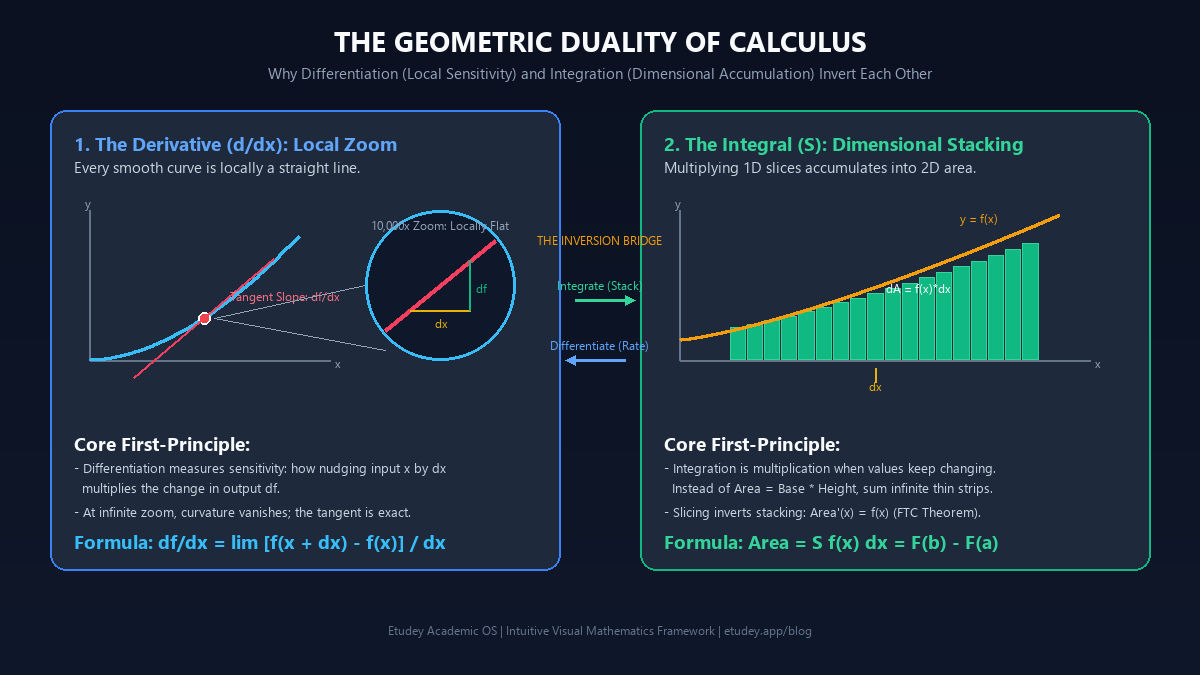
1. The Derivative: Infinite Zoom and Local Sensitivity Analysis
In high school, students are taught that the derivative represents the “slope of the tangent line.” While mathematically true, this definition often feels sterile and disconnected from physical intuition.
A vastly superior mental model is the Microscope Principle:
Imagine placing any continuous, smooth curve under an ultra-high-magnification microscope. If you zoom in by a factor of ten, the curve softens. If you zoom in by a factor of one thousand, the curvature almost disappears. If you zoom in by an infinite factor (as Δx approaches zero), the curve becomes a perfectly straight line.
This is the core axiom of differential calculus: smooth curves are locally linear. Because the curve is locally straight under infinite zoom, its behavior at that exact point can be described by a single constant multiplier: the derivative.
The Sensitivity Analysis Perspective
Think of the derivative df / dx as a scaling factor or sensitivity dial answering a core question:
“If I nudge the input variable x by a microscopic nudge dx, by what multiple does the output f(x) respond?”
Mathematically, this relationship is simply: df ≈ f′(x) • dx.
- If f′(x) = 5, nudging the input rightward by 0.001 units causes the output to jump upward by 0.005 units (a 5x amplifier).
- If f′(x) = 0, the output is momentarily stationary and immune to small input nudges (which is why setting the derivative to zero finds optimal peaks and valleys).
- If f′(x) = −2, nudging the input forward causes the output to drop backward at twice the speed.
Deconstructing the Product Rule Geometrically
Consider the product rule: d(u • v) / dx = u • (dv/dx) + v • (du/dx). Instead of chanting this formula, visualize a rectangle whose width is u and height is v with area A = u • v.
If both sides grow slightly (width by du, height by dv), the added area comprises:
- A thin horizontal strip at the top: Area = u • dv
- A thin vertical strip on the right: Area = v • du
- A tiny microscopic corner: Area = du • dv
As nudges shrink toward zero, the corner square du • dv is a second-order infinitesimal (e.g., 0.001 × 0.001 = 0.000001), rendering it negligible compared to first-order strips. Divide by dx, and the product rule emerges naturally: dA/dx = u(dv/dx) + v(du/dx). The mystery evaporates through geometry.
2. The Integral: Dimensional Slicing and Stacking
If differentiation breaks a system down to observe local sensitivity, integration is the art of dimensional assembly.
Students are told that integration calculates the “area under a curve.” While geometrically convenient, this definition obscures what integrals actually do in physical sciences.
An integral is simply multiplication when one of the factors is continuously changing:
- Distance = Velocity × Time (if velocity never changes).
- Work = Force × Distance (if force remains constant).
- Mass = Density × Volume (if material density is uniform).
In the real universe, nothing remains constant. A rocket burns fuel, so its mass drops continuously as it accelerates. A gas expands inside a cylinder, so pressure shifts at every millimeter.
To multiply when values continuously change, slice the problem into infinite microscopic intervals dx so narrow that f(x) has no time to change across the slice. Within that microscopic window, arithmetic holds: dA = f(x) • dx. Then, sum all infinite slices together: ∫ f(x) dx.
The Dimensional Ladder
Integration is a dimensional ladder elevating geometric objects up one spatial dimension:
- Integrate 0D points along a line → You construct a 1D length.
- Integrate 1D parallel line segments across a width → You construct a 2D area.
- Integrate a stack of 2D cross-sectional disks along a height → You construct a 3D cylinder volume.
Every time you integrate with respect to a spatial variable dx, you multiply by a unit of length (meters), lifting the dimensional exponent by one.
Systematic Comparison: Differentiation vs. Integration
To cement these concepts into an intuitive schema, examine how the two core pillars of calculus mirror and invert each other:
| Conceptual Dimension | Differential Calculus (d/dx) | Integral Calculus (∫ dx) | Physical Relationship |
|---|---|---|---|
| Primary Geometric Action | Local zooming; measuring slope of tangent | Dimensional slicing and volumetric stacking | Inverse operations |
| Core Question Answered | “How fast is this changing right now?” | “How much has accumulated over time?” | Rate vs. Total Cumulative Effect |
| Kinematics Domain | Position → Velocity → Acceleration | Acceleration → Velocity → Position | Derivatives strip time; Integrals accumulate time |
| Dimensional Effect | Reduces spatial dimension by one (divides by dx) | Increases spatial dimension by one (multiplies by dx) | Units change from m² → m or m → m² |
| Failure Mode / Singularity | Sharp corners, vertical tangents, discontinuities | Asymptotic infinite areas, non-integrable poles | Local non-smoothness vs. Global divergence |
3. The Inversion Bridge: The Fundamental Theorem of Calculus
Why are differentiation and integration inverse operations? To most undergraduates, the fact that finding the slope of a curve inverts the area under the curve seems like an arbitrary coincidence. It is an unavoidable geometric truth.
Let A(x) represent the cumulative area under f(t) from 0 to x.
If we advance the right boundary by a tiny nudge dx, how much does the area increase?
The newly added area dA is a tall, thin rectangular strip with width dx and height f(x):
dA ≈ f(x) • dx &implies; dA / dx = f(x)
The instantaneous rate at which area accumulates is exactly equal to the height of the curve. Differentiating the area function recovers the original height function. This is the Fundamental Theorem of Calculus: slicing inverts stacking.
4. Intuitive Tactics for Conquering College Calculus Exams
When preparing for university midterms and semester exams in STEM, replace mechanical memorization with these three intuition-first tactics:
Tactic 1: The Dimensional & Unit Sanity Check
Whenever you derive a formula or calculate an integral on an exam, check the units of your differential dx. If your integrand f(x) is velocity (m/s) and you integrate with respect to time dt (seconds), your result must have units of (m/s) • s = meters (distance). If your final expression has units of m/s², you made an algebraic error before submitting your booklet.
Tactic 2: Test Extreme Boundary Cases
When deriving generalized formulas, test edge cases where the answer is geometrically obvious:
- What happens when x = 0? Does the slope flatten or blow up as expected?
- What happens as x → ∞? Does the accumulated area converge to a finite ceiling or grow linearly?
- If the function is completely flat (f(x) = C), does your integral reduce to the simple area of a rectangle (C • Δx)?
Tactic 3: Sketch Before Symbolizing
Never dive into algebraic manipulation without drawing a coordinate sketch. If a problem asks you to calculate the volume of a solid of revolution, draw the 2D cross-section, sketch a representative washer or shell with width dx, and write the volume of that single slice before writing the integral sign. Grounding algebra in a physical diagram prevents 90% of index and sign errors.
Accelerating Mathematical Mastery with the Etudey Platform
Developing geometric mathematical intuition requires interactive practice, continuous error feedback, and verified reference solutions. Platforms like Etudey provide the tools to build first-principles math mastery:
- Socratic Mathematical Interrogation: When stuck on a difficult calculus proof or multidimensional integral, open AIgom Tutor. Rather than dumping raw symbolic steps, AIgom asks Socratic questions about boundary limits, coordinate transforms, and physical meaning to guide you to the solution.
- Digitizing Handwritten Derivations: Practice sketching curves and solving calculus problems by hand on paper, then photograph your work using the Etudey Handwriting Studio. The multimodal math OCR recognizes handwritten integrals, Greek variables, and coordinate axes, digitizing your derivations into clean text.
- Verified Past-Paper Solutions: Cross-reference your calculus problem sets against university exam archives in the Etudey Verified Notes Archive. Review top-ranker step-by-step solutions to master the exact presentation and marking criteria expected by departmental evaluators.
- Structured Practice Pacing: Schedule dedicated 90-minute calculus problem-solving blocks using Etudey Emergency Exam Mode, and organize your syllabus modules using the Etudey Study Kanban to ensure every mathematical topic is mastered before exam week.
Frequently Asked Questions
Why do university professors emphasize formal epsilon-delta proofs over geometric intuition?
Formal epsilon-delta proofs provide rigorous mathematical foundations and prevent edge-case paradoxes (such as pathological non-differentiable continuous functions). However, pedagogical research demonstrates that students who build strong geometric intuition first master formal rigor far more effectively than those forced to manipulate abstract inequalities without a visual mental model.
What is the intuitive geometric explanation of the Chain Rule?
Think of the Chain Rule as coupled gear ratios. If Gear A rotates Gear B twice as fast (dy/du = 2), and Gear B rotates Gear C three times as fast (du/dx = 3), then how fast does Gear A rotate Gear C? You simply multiply the gear ratios: dy/dx = (dy/du) • (du/dx) = 2 × 3 = 6. The Chain Rule is rate amplification through an intermediate transmission variable.
Why is writing 'dx' at the end of an integral essential, not just decoration?
The dx term is not an administrative bookend; it represents the physical width of the infinitesimal slice. Writing ∫ f(x) without dx is like calculating the area of a rectangle by specifying only the height without multiplying by the base. Furthermore, in u-substitution and multivariable calculus, transforming dx into du or r dr dθ accounts for the geometric stretch factor of the coordinate system.
What is the physical meaning of Integration by Parts?
Integration by Parts is the integral version of the Product Rule. Geometrically, it represents calculating the area of a large rectangular bounding box (u • v) and subtracting the area of the complementary sideways region (∫ v du) to isolate the desired area under the curve (∫ u dv). It allows you to trade a difficult integral for an easier one by shifting differentiation from one factor to another.
How does this geometric intuition apply to multivariable calculus (gradients, curls, divergences)?
The exact same first principles scale into higher dimensions: A Gradient (∇f) is the compass pointing in the direction of steepest local slope. A Divergence (∇ • F) measures whether a point acts as a microscopic fluid fountain (positive source) or drain (negative sink). A Curl (∇ × F) measures whether a microscopic paddle wheel placed in the vector field would spin. Once you visualize the geometry, vector calculus ceases to be intimidating.
Conclusion: From Formula Memorizer to Mathematical Thinker
Mathematics is not an endurance test of how many arbitrary formulas your brain can retain under pressure. It is an art of perception—the ability to see simple, elegant geometric relationships operating beneath the surface of complex physical systems.
When you view derivatives as local zoom sensitivity dials and integrals as dimensional stacking engines, the anxiety of collegiate mathematics dissolves. You no longer fear forgotten formulas on exam day because you possess the intellectual tools to re-derive them from first principles on scratch paper.
On your next problem set, close the formula sheet. Draw the curve, zoom in on the slope, slice the area, and experience the profound beauty of intuitive calculus.