
Why does 11 come before 10 in a Karnaugh map, and why do the four corners form a single group? A Karnaugh map is not a mechanical grid—it is an n-dimensional hypercube projected onto a 2D surface using Gray Code. By ensuring a Hamming distance of one between adjacent cells, Boolean algebra visually simplifies without algebra errors.
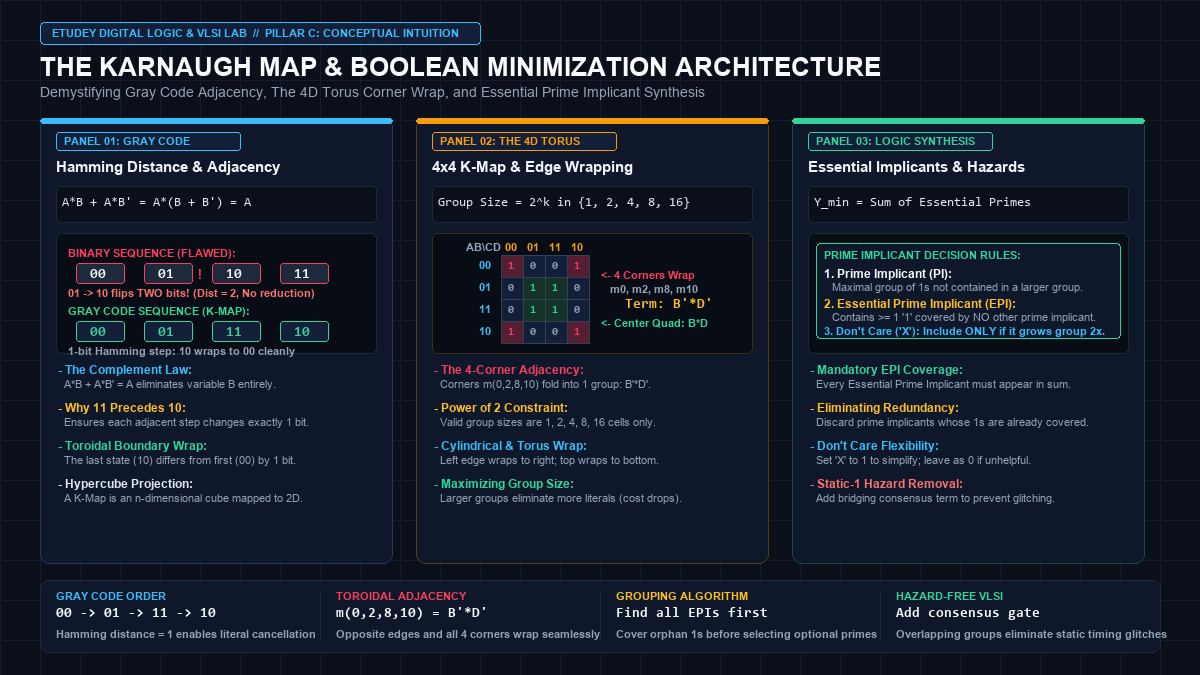
Figure 1.0: The complete Karnaugh map architecture—from 1-bit Gray code Hamming transitions to 4-variable toroidal corner wrapping and essential prime implicant extraction.
1. The Frustration of Boolean Algebra & The Mechanical Trap
Every engineering student taking Digital Logic Design, Switching Theory (STLD), or Computer Architecture encounters the same early-semester nightmare: simplifying complex Boolean expressions by hand. You are given a monstrous algebraic function containing six product terms:
\[ F = \bar{A}\bar{B}\bar{C}\bar{D} + \bar{A}\bar{B}C\bar{D} + A\bar{B}\bar{C}\bar{D} + A\bar{B}C\bar{D} + \bar{A}B\bar{C}D + \bar{A}BCD \]You apply Boolean postulates line by line. You factor out terms, invoke De Morgan’s laws, search desperately for consensus pairs (\( AB + \bar{A}C + BC = AB + \bar{A}C \)), and use the idempotent rule (\( X + X = X \)) to duplicate terms. After fifteen minutes of agonizing algebraic manipulation across two sheets of paper, you produce an answer—only to lose ten marks on the exam because you dropped a single complement bar (\( \bar{B} \)) on line four. Even worse, you have no immediate way of verifying whether your result is truly the minimal cost implementation or whether a hidden literal could have been eliminated.
In 1953, telecommunications engineer Maurice Karnaugh at Bell Telephone Laboratories recognized that humans are fundamentally visual pattern-recognition engines, not symbolic algebraic processors. In his landmark paper, The Map Method for Synthesis of Combinational Logic Circuits, Karnaugh revolutionized computer hardware design by transforming symbolic Boolean simplification into a visual puzzle of geometric adjacency.
Yet in university classrooms, the Karnaugh Map (K-Map) is frequently taught as a set of arbitrary, robotic recipes: "Write 00, 01, 11, 10 across the top; circle groups of 1s in powers of two; wrap around the edges." When students memorize rules without understanding the geometric topology underneath, they freeze when edge cases arise: they miss the four-corner group, fail to leverage Don't Care conditions, or create redundant loops that introduce catastrophic timing glitches into physical VLSI chips.
2. The Core Mystery: Why Does 11 Precede 10? (Gray Code & Hamming Distance)
The single most universal question asked by engineering students learning K-maps is: "Why are the coordinates ordered 00, 01, 11, 10 instead of normal binary counting 00, 01, 10, 11?"
To understand the genius of this arrangement, let us observe what happens if we stubbornly construct a map using natural binary counting order:
The Fatal Flaw of Natural Binary Order
Consider moving from column 1 (\( 01 \)) to column 2 (\( 10 \)) in natural binary counting. How many bits change?
- The first bit changes from \( 0 \to 1 \).
- The second bit changes from \( 1 \to 0 \).
Both bits flip simultaneously! In digital communications and coding theory, the number of differing bits between two binary words is called the Hamming Distance (\( d_H \)). In natural binary, the transition from \( 01 \) to \( 10 \) has a Hamming distance of \( d_H = 2 \).
Why is a Hamming distance of 2 fatal to geometric logic simplification? Look at the foundational theorem of Boolean minimization: the Complement Law:
\[ A B + A \bar{B} = A (B + \bar{B}) = A \cdot 1 = A \]This identity states that two minterms can combine to eliminate a variable if and only if they differ by exactly ONE literal (Hamming distance \( d_H = 1 \)). The variable that appears in both true and complemented forms (\( B \) and \( \bar{B} \)) cancels out, leaving the invariant literal \( A \).
If neighboring cells on a grid differed by two variables (\( d_H = 2 \)), placing them side-by-side would provide zero algebraic cancellation! You could look at two adjacent 1s on paper, but you could not combine them.
To solve this, Maurice Karnaugh utilized Frank Gray's Reflected Binary Code (Gray Code). Gray code guarantees that every single step in the sequence differs from its predecessor by exactly one bit:
| Transition | Binary States | Bit That Flips | Hamming Distance (\( d_H \)) | Geometric Status |
|---|---|---|---|---|
| 00 → 01 | AB → A B' | Second bit (\( 0 \to 1 \)) | 1 | Adjacent |
| 01 → 11 | A B' → A B | First bit (\( 0 \to 1 \)) | 1 | Adjacent |
| 11 → 10 | A B → A' B | Second bit (\( 1 \to 0 \)) | 1 | Adjacent |
| 10 → 00 (Wrap) | A' B → A' B' | First bit (\( 1 \to 0 \)) | 1 | Cyclic Wrap Adjacent |
Now observe the final row of the table above: what is the Hamming distance between the last state (\( 10 \)) and the very first state (\( 00 \))? Exactly one bit flips! Gray code is inherently cyclic. This mathematical property means the rightmost edge of a Karnaugh map is geometrically adjacent to the leftmost edge. The map does not stop at its borders—it wraps around continuously!
"A Karnaugh map is not a matrix of numbers. It is a 2D projection of an n-dimensional Boolean hypercube, where physical proximity represents a Hamming distance of one." — Maurice Karnaugh, The Map Method for Synthesis of Combinational Logic Circuits (Transactions of the AIEE, 1953)
3. The Geometric Reality: From a 4D Hypercube to a 2D Torus
To truly master Karnaugh maps, you must visualize what the grid actually represents in higher-dimensional geometry:
- 2 Variables (\( A, B \)): A 2-variable Boolean space has \( 2^2 = 4 \) states. Geometrically, this is a square with 4 vertices. Each vertex connects to two neighbors, differing by 1 bit.
- 3 Variables (\( A, B, C \)): A 3-variable space has \( 2^3 = 8 \) states. Geometrically, this is a 3D Cube. Each vertex connects to 3 orthogonal neighbors. When we unfold the 8 vertices onto a \( 2 \times 4 \) grid on flat paper, the two ends must roll up to touch, forming a cylinder.
- 4 Variables (\( A, B, C, D \)): A 4-variable space has \( 2^4 = 16 \) states. Geometrically, this is a 4-Dimensional Hypercube (a Tesseract)! Each vertex connects to 4 mutually orthogonal neighbors.
How do mathematicians flatten a 4-dimensional hypercube onto a two-dimensional sheet of paper? By cutting along coordinate planes and laying out a \( 4 \times 4 \) grid. But in the original 4D space, the edges never ended!
When you wrap the left column (\( CD = 00 \)) to meet the right column (\( CD = 10 \)), the grid forms a horizontal cylinder. When you wrap the top row (\( AB = 00 \)) to meet the bottom row (\( AB = 10 \)), you bend the cylinder around and connect its ends together. In topology, bending a cylinder into a closed loop creates a Torus (a mathematical donut)!
The Four-Corner Mystery Solved
Students often view the rule "all four corners of a 4-variable K-map can be circled together" as an arbitrary trick. But on a torus, the four corners are not separated at all—they meet at a single physical vertex!
Corner Minterms: m0 (0000), m2 (0010), m8 (1000), m10 (1010)
Notice what happens across these four corners:
- Variable \( A \) changes (\( 0 \) in m0, m2; \( 1 \) in m8, m10) → \( A \) cancels out!
- Variable \( B \) is invariant: it is \( 0 \) across all four corners → \( \bar{B} \) is preserved.
- Variable \( C \) changes (\( 0 \) in m0, m8; \( 1 \) in m2, m10) → \( C \) cancels out!
- Variable \( D \) is invariant: it is \( 0 \) across all four corners → \( \bar{D} \) is preserved.
m0 + m2 + m8 + m10 = B' * D'
Four minterms containing four variables each (16 total literals) collapse into a single two-literal term: \( \bar{B}\bar{D} \). In Boolean algebra, proving this requires twelve lines of factoring. On a K-map, you circle the four corners in three seconds.
4. The 5 Iron Rules of K-Map Grouping
To guarantee that your visual grouping yields the true minimal Boolean expression without syntax errors or redundant hardware gates, follow these five unbreakable rules:
- The Power-of-Two Law: Every valid group must contain exactly \( 2^k \) cells: \( 1, 2, 4, 8, \text{ or } 16 \) cells. You can never form a group of 3, 5, 6, 7, 10, or 12 cells. Why? Because each power of two cancels out exactly one binary variable:
- Group of 1 cell (\( 2^0 \)): Eliminates 0 variables (keeps all 4 literals).
- Group of 2 cells (\( 2^1 \)): Eliminates 1 variable (keeps 3 literals).
- Group of 4 cells (\( 2^2 \)): Eliminates 2 variables (keeps 2 literals).
- Group of 8 cells (\( 2^3 \)): Eliminates 3 variables (keeps 1 literal).
- Group of 16 cells (\( 2^4 \)): Eliminates all 4 variables (output \( F = 1 \), a constant wire).
- Rectangular Geometry Only: Groups must be rectangular or square (e.g. \( 1\times 1, 1\times 2, 2\times 1, 2\times 2, 1\times 4, 4\times 1, 2\times 4, 4\times 2, 4\times 4 \)). Diagonal groupings, L-shapes, or T-shapes are strictly illegal because their cells do not share a single common variable.
- The Maximization Imperative: Always make groups as large as physically possible. If a '1' can be part of a group of 4, never leave it in a group of 2. Larger groups eliminate more variables, reducing physical transistor counts and logic gate fan-in.
- Overlapping Is Encouraged: A '1' that is already part of one group can be included in another group if doing so allows the second group to double in size. Because \( X + X = X \), reusing a minterm is completely free in Boolean algebra.
- Toroidal Wrapping: Always inspect the outer perimeter. Left edges wrap to right edges, top edges wrap to bottom edges, and all four corners wrap together.
5. Terminology Mastery: Implicants, Primes, and Essentials
In university grading rubrics, students often lose points not on the final expression, but on formal definitions. Memorize this hierarchy:
1. Implicant
Any single minterm (a '1') or valid rectangular grouping of \( 1 \)s on the map.
2. Prime Implicant (PI)
A group of \( 2^k \) ones that cannot be absorbed into any larger valid group. If you have a group of two 1s, and you could have expanded it into a group of four by combining with adjacent 1s, your group of two is not a Prime Implicant.
3. Essential Prime Implicant (EPI)
A Prime Implicant that covers at least one '1' that is covered by NO other Prime Implicant. In other words, this group owns an "orphan" minterm. Every single Essential Prime Implicant must be included in your final minimal expression; omitting an EPI means your circuit will fail to produce an output of 1 for that specific input combination.
4. Redundant Prime Implicant
A Prime Implicant whose every single '1' is already covered by other Essential Prime Implicants. Including a redundant prime implicant adds cost, silicon area, and power consumption without changing the truth table.
6. The Secret Weapon: Don't Care Conditions (\( d \) or \( X \))
In real-world computer systems, certain input combinations are physically impossible or intentionally ignored. For example, in a Binary Coded Decimal (BCD) to 7-Segment Display decoder, the circuit processes digits 0 through 9 (\( 0000_2 \) to \( 1001_2 \)). The binary combinations 10 through 15 (\( 1010_2 \) to \( 1111_2 \)) will never occur because decimal numbers do not have digits greater than 9.
We represent these invalid inputs as Don't Care conditions (\( d \) or \( X \)). To a hardware engineer, an 'X' represents immense flexibility:
The Golden Rule of Don't Cares
- Include an 'X' as a 1 if and only if it enables an existing group of 1s to double in size (e.g., turning a pair of 2 into a quad of 4, or a quad of 4 into an octet of 8).
- Leave an 'X' as a 0 if it does not help expand a group of 1s. You do NOT need to cover all 'X' cells!
- Never form a group consisting purely of 'X's! Circle only groups that contain at least one true '1'.
7. VLSI Glitch Elimination: Static Hazards in Combinational Logic
Minimizing logic on paper is only half the battle. In physical integrated circuits, electrical signals travel through silicon at a finite speed. Logic gates take a few picoseconds or nanoseconds to propagate an output (known as propagation delay \( t_{pd} \)).
Consider two adjacent groups of 1s on a K-map that do not overlap. When an input variable switches between these two groups, one AND gate turns OFF while the other AND gate turns ON. If the gate turning ON is slightly slower than the gate turning OFF due to wire delay, both inputs to the final OR gate momentarily drop to 0 for a fraction of a nanosecond!
This momentary dropout from \( 1 \to 0 \to 1 \) is called a Static-1 Hazard. In a synchronous microprocessor, this glitch can falsely trigger a clock flip-flop or corrupt a memory register.
How do we eliminate hazards? By looking at the K-map! Whenever two adjacent 1s are covered by two separate prime implicants, add a redundant "consensus" group that bridges the boundary. While mathematically redundant, this bridging gate holds the output high during the transition, guaranteeing glitch-free silicon performance!
8. K-Map Decision Framework vs. Quine-McCluskey
When should you use visual Karnaugh maps versus algorithmic tabular methods? Review this engineering decision matrix:
| Method | Variable Limit | Execution Medium | Key Advantage | Primary Vulnerability |
|---|---|---|---|---|
| 2 to 3 Variable K-Map | 2 – 3 variables | Paper / Whiteboard | Instant visual inspection; zero calculation overhead. | Trivial; limited to basic combinational blocks. |
| 4-Variable K-Map | 4 variables (16 cells) | Paper / Canvas | Sweet spot of human visual pattern recognition. | Students miss 4-corner or edge-wrap groups. |
| 5-Variable K-Map | 5 variables (32 cells) | Dual 4x4 Grids | Compares two overlapping 4x4 planes (\( A=0, A=1 \)). | High cognitive load; difficult 3D spatial alignment. |
| Quine-McCluskey (Tabular) | 6 to 12+ variables | Computer Algorithm / EDA | Systematic, programmable, guaranteed exact global minimum. | NP-hard exponential tabular explosion by hand. |
9. Step-by-Step Exam Protocol: Solving 4-Variable K-Maps
When solving university exam questions, follow this rigorous 5-step minimization algorithm:
The 5-Step Logic Minimization Protocol
- Construct the Grid: Draw a \( 4 \times 4 \) grid. Label rows with variables \( AB \) and columns with variables \( CD \). Write the Gray code labels: \( 00, 01, 11, 10 \) across both axes.
- Plot Minterms and Don't Cares: Populate cells with '1' for given minterms \( \sum m(\dots) \) and 'X' for don't cares \( \sum d(\dots) \). Fill all remaining empty cells with '0'.
- Identify Orphan 1s & Essential Prime Implicants: Search for any '1' that can only be grouped in one possible maximal way. Form its prime implicant immediately and mark it as an Essential Prime Implicant (EPI).
- Cover Remaining 1s with Maximal Primes: If any 1s remain uncovered after step 3, select the minimum number of largest available prime implicants (octets or quads) to cover them. Leverage 'X's if they help.
- Extract Terms & Check Literal Redundancy: Read the invariant variables for each group. For variables that remain constant:
- Constant 0 → Write complemented variable (\( \bar{A} \)).
- Constant 1 → Write uncomplemented variable (\( A \)).
- Variable changes between 0 and 1 → Discard (it cancels out).
Worked Exam Example
Minimize the following Boolean function in minimal Sum of Products (SOP) form:
\[ F(A, B, C, D) = \sum m(0, 2, 5, 7, 8, 10, 13, 15) \]Let us execute the protocol step-by-step:
- Plot Minterms:
- Row 00 (\( AB=00 \)): 1s at column 00 (m0) and column 10 (m2).
- Row 01 (\( AB=01 \)): 1s at column 01 (m5) and column 11 (m7).
- Row 11 (\( AB=11 \)): 1s at column 01 (m13) and column 11 (m15).
- Row 10 (\( AB=10 \)): 1s at column 00 (m8) and column 10 (m10).
- Identify Groups:
- Group 1 (Center Quad): Look at minterms \( m(5, 7, 13, 15) \). They form a compact \( 2 \times 2 \) square in the center. Row \( AB \) has \( B=1 \) constant (\( A \) flips). Column \( CD \) has \( D=1 \) constant (\( C \) flips). This quad evaluates to: \( B D \).
- Group 2 (The Four Corners): Look at minterms \( m(0, 2, 8, 10) \). They sit on the four corners of the grid! Row \( AB \) has \( B=0 \) constant (\( A \) flips). Column \( CD \) has \( D=0 \) constant (\( C \) flips). This quad evaluates to: \( \bar{B} \bar{D} \).
- Verify Coverage: Are all eight 1s covered? Yes: \( 4 + 4 = 8 \). Are there any redundant groups? None.
- Final Minimized SOP Expression: \[ F = BD + \bar{B}\bar{D} = (B \odot D) \quad \text{(An XNOR gate!)} \]
An eight-term function with 32 literals simplifies down to a single two-input XNOR gate. You can verify Boolean algebraic simplifications and truth tables instantly using Etudey's AIgom Problem Solver.
10. Integrating Digital Logic Mastery with the Etudey Platform
Mastering digital logic requires transitioning smoothly from theoretical truth tables to geometric K-map groupings and physical circuit schematics:
- Grid-Snapping Canvas in Handwriting Studio: Draw 4x4 and 5x5 K-maps with clean alignment grids, color-code prime implicant loops, and draw logic gate schematics directly on your tablet.
- Step-by-Step Logic Verification in AIgom: Check whether your grouped SOP or POS expression matches the canonical minterm expansion and detect unhandled static hazards.
- Curated Theorem Vault in Interactive Notes: Consolidate Boolean identities, Shannon expansion theorems, and finite state machine transition matrices into an indexed digital notebook.
- Track Lab Milestones on Etudey Kanban: Organize Verilog HDL simulation checkoffs, breadboard wiring tasks, and midterm exam sprints with visual workflow tracking.
11. Frequently Asked Questions (FAQ)
Why can K-map groups only contain powers of two (1, 2, 4, 8, 16) cells?
Each power of two cancels out exactly one binary variable through the Boolean complement identity \( X + \bar{X} = 1 \). A group of 2 cells cancels 1 variable; a group of 4 cancels 2 variables; a group of 8 cancels 3 variables. Groups of 3, 5, or 6 cells cannot be factored into symmetric complement pairs, making it mathematically impossible to eliminate a single variable completely without residual literals.
What is the difference between an Essential Prime Implicant and a regular Prime Implicant?
A Prime Implicant is any maximal rectangular grouping of 1s that cannot be enlarged further. An Essential Prime Implicant (EPI) is a prime implicant that contains at least one '1' that is not covered by any other prime implicant. All EPIs are strictly mandatory in the minimal Boolean expression, whereas non-essential prime implicants may be omitted if other groups already cover their terms.
Can a Karnaugh map produce multiple equally valid minimized expressions?
Yes. When a function has cyclic prime implicants without clear essential coverage, multiple distinct combinations of prime implicants may cover all 1s with the exact same literal count and gate cost. Both expressions represent minimal-cost implementations with identical truth tables.
How do you find Product of Sums (POS) from a Karnaugh map instead of SOP?
To find the minimal Product of Sums (POS), circle the zeros (0s) instead of the ones, which yields the minimal SOP expression for \( \bar{F} \). Then, apply De Morgan's theorem to invert the result, or directly read the cells by treating a constant 0 as the uncomplemented variable and constant 1 as the complemented variable in a sum term.
Why do Karnaugh maps become impractical for 6 or more variables?
A 6-variable K-map requires 64 cells, typically represented as four separate 4x4 grids requiring complex 3D spatial alignment between planes. Beyond 6 variables, human visual pattern recognition breaks down completely. For large variable counts, engineers use computer-automated algorithms like the Quine-McCluskey method or Espresso heuristic logic minimizers.
Master Digital Logic & Computer Architecture with First-Principles Clarity
Eliminate silly algebraic mistakes. Draw K-map grids, derive glitch-free combinational circuits, and verify your logic lab problem sets using Etudey's dedicated engineering tools.