
Mastering organic chemistry requires abandoning brute-force reaction memorization and embracing electrostatic electron flow. By tracking electron-rich nucleophiles attacking electron-deficient electrophiles, obeying strict curved-arrow formalisms, evaluating pKa thermodynamic equilibrium, and resolving steric hindrance, students predict reaction mechanisms intuitively and eliminate exam anxiety across Organic Chemistry 1 and 2.
The Organic Chemistry Weed-Out Myth: Why 90% of Students Study Chemistry Completely Backwards
In undergraduate universities across the globe, few courses carry a reputation as fearsome as Organic Chemistry (often colloquially known simply as "Orgo"). For pre-medical, pharmacy, chemical engineering, biology, and chemistry majors, Organic Chemistry 1 and 2 serve as the primary institutional weed-out bottleneck. National failure and withdrawal rates frequently hover between 30% and 50%, with midterm score averages routinely dropping below 50%.
Yet, the widespread panic surrounding Organic Chemistry is built on a fundamental misunderstanding of what the discipline actually is. In high school and general chemistry, students succeed primarily through two methods: mathematical formula plug-and-chug (such as stoichiometry or equilibrium calculations) or rote memorization of descriptive facts. When these students enter Organic Chemistry, they instinctively apply the same brute-force strategy: they purchase massive stacks of flashcards, attempting to memorize 350 separate reactions, complete with reagents, catalysts, and products, as disconnected visual facts.
By week six of the semester, this memorization strategy collapses under its own weight:
- The Reagent Substitution Crisis: You memorized that Reagent A reacts with Substrate B to form Product C. But on the exam, the professor replaces the methyl group with an isopropyl group, adds an electron-withdrawing nitro substituent on an aromatic ring, or changes the solvent from acetone to water. Because you memorized the outcome rather than the underlying mechanism, your flashcard knowledge is rendered completely useless.
- Curved Arrow Paralysis: Exam rubrics award 70% of partial credit to curved-arrow reaction mechanisms. Students draw arrows pointing from positive charges to negative charges, originate arrows from atomic nuclei instead of electron pairs, or violate the octet rule on carbon atoms—instantly losing entire question blocks.
- The Four-Way Competition Trap: When presented with an alkyl halide and a nucleophile, students freeze trying to guess whether the reaction proceeds via \(S_N1\), \(S_N2\), \(E1\), or \(E2\), unable to weigh nucleophile strength against steric hindrance and temperature.
Top-performing chemists and medical scholars understand that Organic Chemistry is not a catalog of reactions to memorize; it is a logical system of electrostatic electron flow. If you master four core physical principles, you can predict the mechanism and product of an unfamiliar reaction you have never seen before in your life.
The Fundamental Principle of Organic Chemistry: All Chemistry Is Electrostatics
Every single reaction in Organic Chemistry 1 and 2—from the simplest acid-base proton transfer to the most complex multi-step aldol condensation or Suzuki cross-coupling—is governed by one universal truth of physics:
"Opposite electrical charges attract; like electrical charges repel. In organic chemistry, electron-rich species (nucleophiles and Lewis bases) seek out and attack electron-poor species (electrophiles and Lewis acids). If you can identify where the highest electron density resides and where the lowest electron density resides in a reaction flask, you have already solved 80% of the mechanism."
— David Klein, Organic Chemistry as a Second Language
Electrons are small, highly mobile, negatively charged subatomic particles. Protons in atomic nuclei are heavy, fixed, positively charged centers. Because electrons are light and repulsive to one another, regions of high electron density are inherently unstable unless stabilized by nuclear positive charge or resonance delocalization. Therefore, electrons will always flow from areas of high negative charge density toward areas of positive charge deficit. That is the entire foundation of organic reaction mechanisms.
The 4-Pillar Electron Flow Protocol
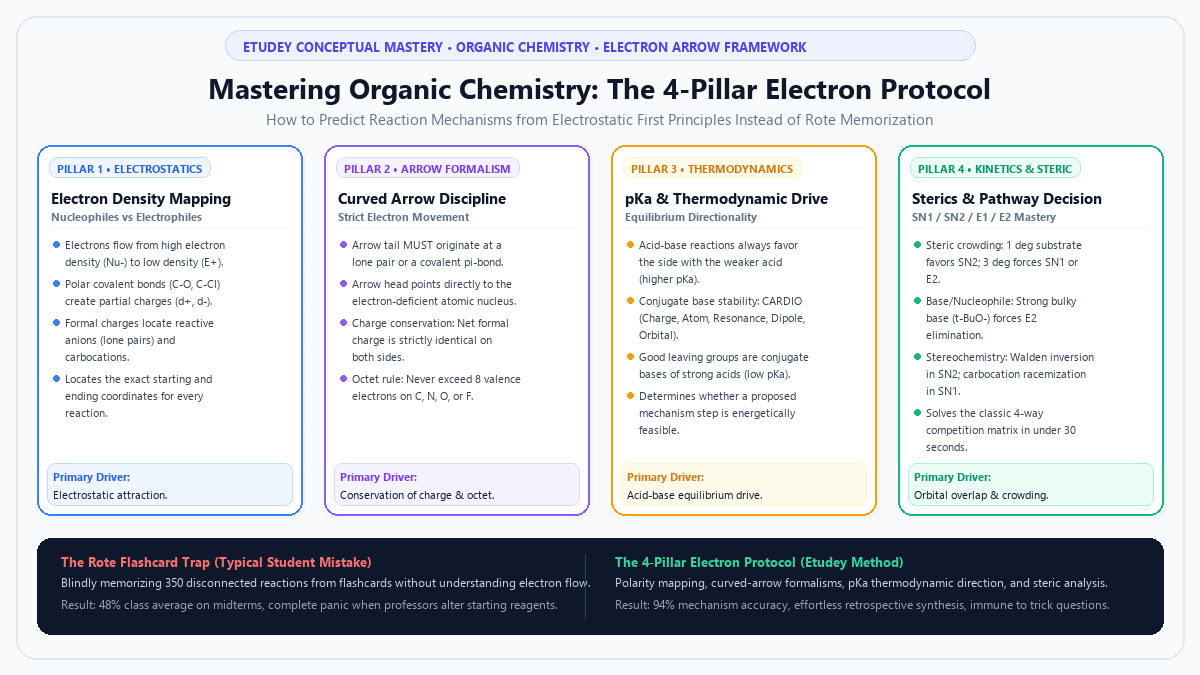
To master Organic Chemistry without drowning in flashcards, replace mechanical memorization with the 4-Pillar Electron Flow Protocol whenever analyzing an exam reaction:
Pillar 1: Electron Density & Polarity Mapping (Nucleophiles vs Electrophiles)
Before drawing a single arrow, inspect the starting materials and map their electrostatic charge distribution across two categories:
- The Nucleophile (Nu: / Lewis Base): An electron-rich atom possessing high negative charge density. Nucleophiles come in three distinct forms:
- Full Negative Formal Charge (Anions): Hydroxide (\(\text{OH}^-\)), Alkoxide (\(\text{RO}^-\)), Cyanide (\(\text{CN}^-\)), Grignard carbon (\(\text{R}^- \text{MgBr}^+\)). These are aggressive, potent nucleophiles.
- Neutral Lone Pairs: Amines (\(\text{RNH}_2\)), Alcohols (\(\text{ROH}\)), Water (\(\text{H}_2\text{O}\)). Moderately nucleophilic.
- Electron-Rich \(\pi\)-Bonds: Alkenes (\(\text{C}=\text{C}\)), Alkynes (\(\text{C}\equiv\text{C}\)), Benzene rings. The loosely held \(\pi\)-electrons act as nucleophilic clouds.
- The Electrophile (\(E^+\) / Lewis Acid): An electron-deficient atom possessing a full or partial positive charge, desperately seeking electron density:
- Full Positive Charge (Carbocations): A carbon with only three bonds and an empty p-orbital (\(\text{R}_3\text{C}^+\)). Highly reactive; attacks immediately.
- Partial Positive Charge (\(\delta^+\)): Carbon atoms bonded to highly electronegative heteroatoms (Oxygen, Chlorine, Bromine, Nitrogen). In a carbonyl group (\(\text{C}=\text{O}\)), oxygen pulls electron density toward itself via induction, leaving the carbonyl carbon with a massive \(\delta^+\) electrophilic hotspot.
Your task is simple: find the best nucleophile on the page and find the best electrophile on the page. They are guaranteed to react.
Pillar 2: Curved Arrow Discipline & The Law of Octet Conservation
Curved arrows are the formal mathematical syntax of organic chemistry. Professors grade mechanisms rigorously based on arrow precision. Memorize and enforce these three non-negotiable rules:
- The Tail Must Start at Electrons: A curved arrow represents the physical movement of a pair of electrons. Therefore, the tail of the arrow must originate directly from a lone pair or a covalent bond (\(\pi\) or \(\sigma\)). Never start an arrow from a plus sign (\(+\)) or a neutral atom label. Positive charges cannot move!
- The Head Points to the Destination Nucleus: The arrowhead points directly to the specific atomic nucleus where the new bond will form, or to the electronegative atom that will receive the electron pair as a new lone pair.
- The Strict Octet Limit (Second-Row Elements): Carbon, Nitrogen, Oxygen, and Fluorine have only four valence orbitals (\(2s, 2p_x, 2p_y, 2p_z\)). They can NEVER have more than 8 valence electrons. If a curved arrow attacks a carbon that already has four bonds (such as a carbonyl carbon or an alkyl halide), another bond must break simultaneously (e.g., pushing the \(\pi\)-electrons up to oxygen, or expelling a halide leaving group). A five-bonded "Texas Carbon" is an automatic zero on exam papers.
- Conservation of Net Formal Charge: In every elementary mechanism step, the algebraic sum of formal charges on the left side of the reaction arrow must strictly equal the algebraic sum of formal charges on the right side. If your reactants have a net charge of \(-1\), your products must have a net charge of \(-1\).
Pillar 3: The pKa Acid-Base Driving Force (The CARDIO Heuristic)
Over 50% of the steps in complex organic mechanisms are proton transfers (acid-base reactions). A mechanism step will only occur if it is thermodynamically feasible. The direction of equilibrium in any acid-base step is governed by the pKa values of the species involved:
\[\text{Equilibrium always favors the side with the WEAKER acid (the HIGHER } pK_a \text{ value).}\]
If you memorize five benchmark \(pK_a\) values, you can predict the thermodynamic feasibility of almost any reaction:
- Carboxylic acids (\(\text{RCOOH}\)): \(pK_a \approx 4 - 5\)
- Protonated amines / alcohols (\(\text{RNH}_3^+, \text{ROH}_2^+\)): \(pK_a \approx -2 \text{ to } 0\)
- Alcohols & Water (\(\text{ROH}, \text{H}_2\text{O}\)): \(pK_a \approx 15 - 16\)
- Ketone/Aldehyde \(\alpha\)-hydrogens: \(pK_a \approx 19 - 20\)
- Alkanes (\(\text{CH}_4\)): \(pK_a \approx 50\)
The CARDIO Stability Heuristic
To evaluate conjugate base stability and leaving group quality without looking up numbers, use the acronym CARDIO:
- Charge: A neutral conjugate base is vastly more stable than a negatively charged species.
- Atom Electronegativity & Size: Across a row in the periodic table, negative charge is stabilized on more electronegative atoms (\(\text{C}^- < \text{N}^- < \text{O}^- < \text{F}^-\)). Down a column, atomic size dominates: iodide (\(\text{I}^-\)) is vastly more stable than fluoride (\(\text{F}^-\)) because its large diffuse electron cloud disperses charge.
- Resonance: Delocalizing a negative charge across multiple electronegative atoms via resonance dramatically stabilizes a conjugate base (e.g., acetate resonance vs. ethoxide).
- Dipole / Induction: Nearby electronegative atoms pull electron density through \(\sigma\)-bonds, stabilizing adjacent negative charges.
- Orbital Hybridization: Negative charge held in an sp-orbital (50% s-character, held closer to the positive nucleus) is much more stable than in \(\text{sp}^2\) (33%) or \(\text{sp}^3\) (25%). This is why terminal alkynes (\(pK_a \approx 25\)) are far more acidic than alkanes (\(pK_a \approx 50\)).
The Golden Rule of Leaving Groups: Good leaving groups are the stable conjugate bases of strong acids (low \(pK_a\)). This is why iodide (\(\text{I}^-\)), bromide (\(\text{Br}^-\)), and tosylate (\(\text{OTs}^-\)) are excellent leaving groups, whereas hydroxide (\(\text{OH}^-\)) is a terrible leaving group and must be protonated to water (\(\text{H}_2\text{O}\)) before it can depart.
Pillar 4: Steric Hindrance & The SN1 / SN2 / E1 / E2 Decision Matrix
The single most notorious topic in Organic Chemistry 1 is the 4-way competition between substitution and elimination. Students panic because four different reaction pathways compete for the same alkyl halide starting material. However, the outcome is deterministically dictated by two variables: Steric Crowding of the Substrate and Strength/Basicity of the Reagent.
| Substrate Degree | Strong Nucleophile / Strong Base (e.g. \(\text{OH}^-, \text{EtO}^-\)) | Strong Nucleophile / Weak Base (e.g. \(\text{I}^-, \text{CN}^-, \text{RS}^-\)) | Weak Nucleophile / Strong Base (e.g. \(\text{t-BuO}^-\)) | Weak Nucleophile / Weak Base (e.g. \(\text{H}_2\text{O}, \text{EtOH}\)) |
|---|---|---|---|---|
| Primary (\(1^{\circ}\)) | \(S_N2\) Major (E2 minor unless bulky base). | \(S_N2\) Exclusively (Clean backside attack). | E2 Exclusively (Bulky base forces deprotonation). | No Reaction (Too unreactive at room temp). |
| Secondary (\(2^{\circ}\)) | E2 Major (Steric barrier prevents \(S_N2\)). | \(S_N2\) Exclusively (Walden inversion of configuration). | E2 Exclusively (Steric crowding + strong base). | Slow \(S_N1\) / E1 Mixture (Solvolysis; racemization). |
| Tertiary (\(3^{\circ}\)) | E2 Exclusively (\(S_N2\) completely blocked by sterics). | \(S_N1\) Exclusively (Stable carbocation forms). | E2 Exclusively (Rapid elimination; Zaitsev/Hofmann). | \(S_N1\) / E1 Mixture (Heat favors E1 elimination). |
The mechanics are visually intuitive:
- \(S_N2\) requires an unhindered backside attack. The nucleophile must approach the carbon atom from exactly \(180^{\circ}\) opposite the leaving group. If bulky methyl groups flank the carbon (tertiary substrate), the nucleophile physically cannot reach the antibonding \(\sigma^*\) orbital. Thus, tertiary substrates NEVER undergo \(S_N2\).
- E2 requires anti-periplanar geometry. The \(\beta\)-hydrogen and the leaving group must lie in the exact same plane pointing in opposite directions (\(180^{\circ}\) dihedral angle) for orbital overlap to form the new \(\pi\)-bond. In cyclohexane rings, this requires both groups to be diaxial.
- \(S_N1\) and E1 require stable carbocations. The leaving group leaves on its own first, forming a flat \(\text{sp}^2\) carbocation. Because tertiary carbocations are stabilized by hyperconjugation and alkyl induction, \(S_N1\)/E1 occurs rapidly on tertiary substrates, but never on primary substrates.
The 5-Step Retrosynthesis Framework: How to Deconstruct Multi-Step Synthesis Problems
The final exam boss in Organic Chemistry is Multi-Step Synthesis: starting with a simple 2-carbon alkene, synthesize a complex target molecule requiring four sequential reactions. Most students stare at the starting material and try to guess forward, quickly hitting an algebraic wall.
Professional organic chemists use Retrosynthetic Analysis: working backwards from the target molecule to the starting material in structured phases:
- Count the Carbons: Compare the total carbon count of the target molecule to your available starting materials. If the target has 6 carbons and your starting material has 3, you must perform a Carbon-Carbon bond-forming reaction (e.g., Grignard addition, acetylide alkylation, or Aldol reaction).
- Identify the Functional Group at the Core: Look at the key functional group in the target (is it an alcohol, carboxylic acid, epoxide, or amine?). What reaction introduced that group in the final step? (e.g., An alcohol can be synthesized from a ketone via \(\text{NaBH}_4\) reduction, or from an alkene via hydroboration-oxidation).
- Locate the Disconnection Point: Mentally cleave the key Carbon-Carbon bond adjacent to the functional group. What synthetic equivalents (synthons) would be required to form that bond?
- Verify Stereochemistry and Regiochemistry: Does the target have a trans-relationship (anti-addition) or cis-relationship (syn-addition)? Markovnikov or anti-Markovnikov? Select reagents that enforce the required geometric selectivity (e.g., \(\text{OsO}_4\) for syn-dihydroxylation vs. \(\text{mCPBA}\) followed by aqueous acid for anti-dihydroxylation).
- Write the Forward Reaction with Solvents: Once the backward path connects to your starting materials, write out the complete forward sequence, specifying exact reagents, catalysts, and temperatures (e.g., \(\text{PCC}, \text{CH}_2\text{Cl}_2\) instead of vague oxidizers).
The Top Four Exam Pitfalls That Destroy Organic Chemistry Grades
- Forgetting Carbocation Rearrangements: Whenever a mechanism generates a secondary (\(2^{\circ}\)) carbocation adjacent to a tertiary or quaternary carbon, it WILL rearrange via a 1,2-hydride shift or 1,2-methyl shift to form a more stable tertiary carbocation. Forgetting this rearrangement guarantees the wrong product.
- Drawing Curved Arrows from Nuclei: Starting an arrow from the letter "H" instead of the \(\text{C}-\text{H}\) bond or lone pair is an immediate point deduction on university exams. Practice clean arrow discipline using the Etudey Handwriting Studio.
- Confusing Acidic vs Basic Mechanism Conditions: In an acidic reaction mechanism, you can NEVER form a strongly basic intermediate (like \(\text{OH}^-\) or \(\text{RO}^-\)). Every intermediate must be positive or neutral. In a basic reaction mechanism, you can NEVER form a strongly acidic intermediate (like \(\text{R}-\text{OH}_2^+\) or carbocations). Every intermediate must be negative or neutral.
- Ignoring Stereochemical Inversion in \(S_N2\): An \(S_N2\) displacement on a chiral carbon produces 100% inversion of configuration (Walden Inversion): (R) becomes (S), and wedge becomes dash. Drawing retention of stereochemistry loses full marks.
Frequently Asked Questions
Is it really possible to pass Organic Chemistry without memorizing reactions?
You cannot completely eliminate memorization—you must know reagent names (e.g., that \(\text{NaBH}_4\) is a hydride source and \(\text{PCC}\) is a mild oxidizer). However, by mastering the 4-Pillar Electron Flow Protocol, you reduce the volume of brute-force memorization by over 80%. Instead of memorizing 300 disconnected reactions, you learn 5 core mechanistic archetypes: Nucleophilic Attack, Loss of a Leaving Group, Proton Transfer, Rearrangement, and Electrophilic Addition. Every single exam reaction is simply a combination of these five steps.
How should I structure my study time each week for Organic Chemistry?
Follow the 30/70 Practice Rule. Spend only 30% of your study time reading textbook chapters or rewatching lectures. Spend the remaining 70% of your time actively drawing reaction mechanisms and working unattempted textbook end-of-chapter problems. Organic chemistry is a performance skill—identical to playing the piano or playing chess. You cannot learn it by watching someone else solve problems; your hand must practice pushing electrons across paper.
What is the fastest way to master chair cyclohexane conformations?
Build a 3D physical molecular model kit. Holding a plastic model in your hands makes it immediately obvious why bulky substituents (like tert-butyl or isopropyl groups) must occupy equatorial positions to avoid severe 1,3-diaxial steric clash. Once you physically twist a model through a chair flip, drawing the parallel lines on digital paper in Handwriting Studio becomes effortless.
How can I verify if my proposed synthesis route is correct before an exam?
Use AIgom as your personal organic synthesis tutor. Paste your proposed reaction sequence into AIgom and ask: "Does this multi-step synthesis have competing side reactions or incompatible functional groups?" AIgom will immediately point out if an organometallic Grignard reagent will be prematurely quenched by an acidic alcohol proton, or if an oxidation step will inadvertently destroy another functional group on the molecule.
Where can I find verified reaction roadmaps and Previous Year Questions (PYQs)?
Visit the Etudey Notes Archive and search for your university’s Organic Chemistry 1 and 2 course codes. You will find high-scoring peer reaction sheets, curated reagent summary matrices, and step-by-step solved mid-semester exam papers that reflect the exact grading standards of top chemistry departments.
Conquer Organic Chemistry with Etudey
Say goodbye to reaction panic, flashcard burnout, and low exam scores. Master electron pushing, curved-arrow mechanisms, and multi-step synthesis with Etudey's free digital handwriting canvas, verified chemistry notes, and step-by-step AI derivation tutor.