
The Zettelkasten method for STEM adapts Niklas Luhmann’s slip-box note-taking framework for technical rigor by converting linear lecture notes into interconnected, atomic concept cards. By anchoring cards to governing mathematical laws, cross-linking proofs across subjects, and maintaining Maps of Content, engineering students eliminate notebook clutter and build a durable, lifelong technical memory graph.
The Spiral Notebook Graveyard: Why Linear Technical Notes Fail
Look under the desk or on the bottom bookshelf of any engineering or science senior graduating from university. You will find a tragic, dusty monument to wasted academic labor: twelve to twenty thick, spiral-bound notebooks stacked in chronological order.
There is a notebook for First-Year Engineering Physics, another for Linear Algebra & Calculus, a third for Analog Electronics, a fourth for Signals & Systems, and another for Control Engineering.
Each notebook contains hundreds of pages of hand-copied equations, vector diagrams, and professor blackboard scribbles. Yet if that same student is preparing for a technical job interview, a master's thesis, or their final-year capstone design review, they will almost never open those notebooks again.
Why? Because traditional student notebooks are what computer scientists call write-only memory (WOM). They are chronological logs of what was said in a classroom on a specific Tuesday morning in September 2024. They have zero searchability, zero cross-indexing, and no mechanism for connecting related mathematical ideas across different semesters.
When you take notes in rigid, subject-segregated notebooks, you force your brain into artificial silos. You treat the Fourier Transform taught in your math course as an entirely separate entity from the Fourier Transform used in digital signal processing, communications theory, and image processing.
Niklas Luhmann (Pioneering Sociologist & Zettelkasten Creator): "One cannot think without writing. The slip-box is not a passive archive for storing thoughts; it is an active communication partner. Each new note must connect to existing notes, allowing knowledge to compound organically over decades."
To break free from the notebook graveyard and build an interconnected academic second brain that actually compounds in value across your entire college degree, you must implement the STEM-Adapted Zettelkasten Method.
Why the Humanities Zettelkasten Fails Engineers and Scientists
In the late 20th century, German sociologist Niklas Luhmann used a physical cabinet filled with 90,000 index cards (the *Zettelkasten*, German for "slip-box") to publish over 70 books and 400 academic papers. In recent years, productivity influencers have popularized Zettelkasten using apps like Obsidian, Roam, and Notion.
However, if an engineering or physics student follows standard internet advice, their Zettelkasten will catastrophically collapse within three weeks.
Traditional Zettelkasten advice is designed for humanities scholars: you read a philosophy book, extract a witty quotation or qualitative idea, write a short summary note, and link it to other philosophical concepts.
In STEM, however, knowledge is fundamentally different:
- Mathematical Rigor: Concepts are not vague prose opinions; they are exact mathematical equalities with strict boundary constraints ($t > 0$, $Re(s) < 0$, frictionless flow).
- Hierarchical Prerequisites: You cannot simply "free-associate" Navier-Stokes equations with fluid drag without having differential calculus and vector field divergence firmly established as precursor cards.
- Visual Dependency: Technical understanding relies heavily on circuit schematics, free-body diagrams, state machine transitions, and Bode plots that cannot be captured in plain markdown text alone.
To make Zettelkasten work for technical disciplines, we must adapt Luhmann's framework specifically for equations, proofs, and physical schemas.
Comparison: Spiral Notebooks vs. Folder Trees vs. STEM Zettelkasten
Observe how student knowledge behaves across different storage paradigms:
| Dimension | Traditional Spiral Notebooks | Hierarchical Folder Trees (Notion / Google Drive) | STEM Zettelkasten Knowledge Graph |
|---|---|---|---|
| Organizational Logic | Purely chronological; tied to class schedule | Siloed by subject folder (e.g., /Semester4/Math/) |
Networked by concept & mathematical relationship |
| Cross-Subject Synergy | Zero; notes live in separate paper physical binders | Poor; requires duplicating files across folders | High; one concept card links across math, circuits & code |
| Mathematical Precision | High on paper, but impossible to search or index | Low; painful LaTeX rendering in rigid text trees | Rigorous atomic cards with formulas, units & derivations |
| Longevity | Discarded or forgotten after final exams | Forgotten in nested folders; "out of sight, out of mind" | Compounds across all 8 semesters into a lifelong second brain |
| Exam Hall Recall | Fragile rote memorization; vulnerable to blanks | Shallow skimming; weak procedural muscle memory | Unbreakable; associative neural pathways mirror graph links |
The 3-Tier STEM Zettelkasten Architecture
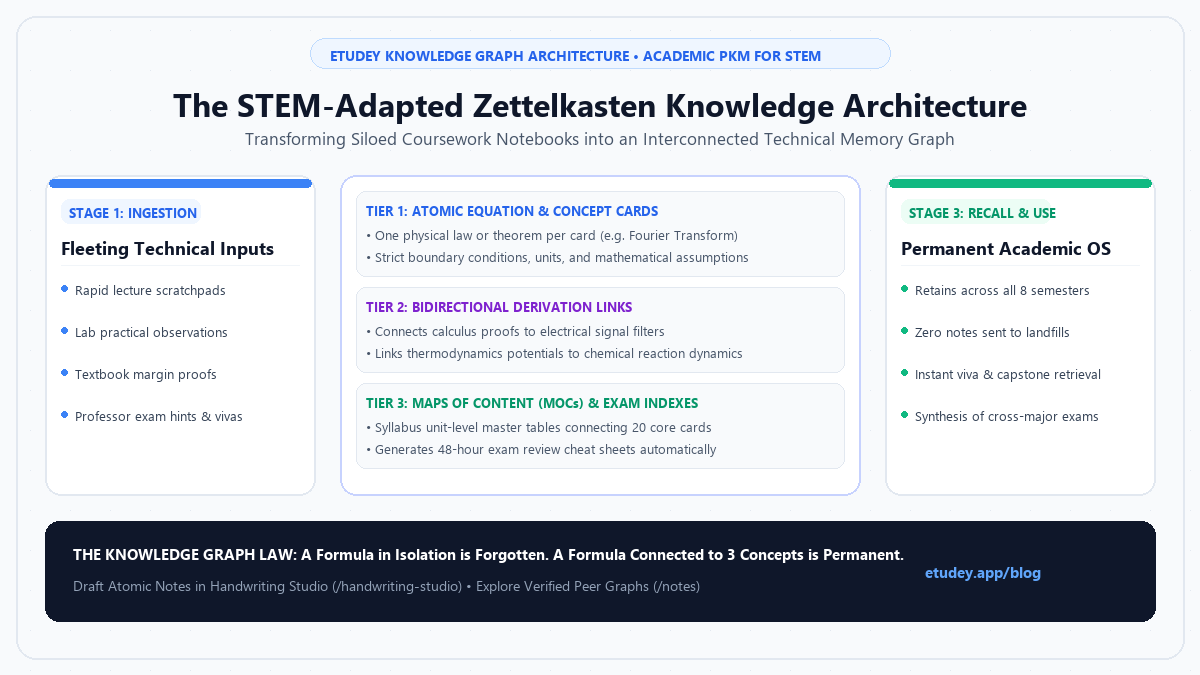
To implement a high-yield technical slip-box, your note-taking pipeline must be divided into three distinct operational tiers:
Tier 1: Atomic Concept Cards (One Invariant per Card)
The core principle of Zettelkasten is atomicity. An atomic card does not try to summarize an entire 60-minute lecture on "Electromagnetism." Instead, it captures exactly one physical mechanism, one mathematical law, or one algorithm.
Every STEM Atomic Card must strictly contain five standardized fields:
- The Formal Title & Identifier: (e.g.,
[[Gauss's Law for Magnetism]]). - The Master Governing Equation: Rendered in clean mathematical notation (e.g., $\nabla \cdot \mathbf{B} = 0$).
- The Plain-Language Mechanism: A two-sentence physical explanation devoid of jargon: "Magnetic field lines never start or terminate on isolated point charges; they always form closed continuous loops. This mathematically proves that isolated magnetic monopoles do not exist in classical electrodynamics."
- The Boundary Constraints & Units: Where does the model break down? (e.g., "Valid for macroscopic continuum mechanics; does not apply to quantum monopole hypotheses.").
- Bidirectional Links: Connections to precursor and downstream cards.
If you want to sketch complex vector fields or hand-drawn derivations onto your atomic cards, you can draft and digitize them smoothly using Etudey's Handwriting Studio.
Tier 2: The Derivation Bridge (Linking Math to Application)
The true magic of the STEM Zettelkasten happens in the links. In a humanities slip-box, you link notes based on thematic resonance. In a STEM slip-box, you link notes based on mathematical derivation and physical causality:
- Prerequisite Links (Upward):
[[Gauss's Law for Magnetism]]links upward to its mathematical foundation:[[Divergence Theorem (Calculus III)]]. - Application Links (Downward): It links downward to practical engineering applications:
[[Magnetic Vector Potential]]and[[Transformer Core Saturation]]. - Analogous Links (Sideways): It links horizontally to its electrostatic twin:
[[Gauss's Law for Electrostatics (\nabla \cdot \mathbf{E} = \rho / \epsilon_0)]], explicitly noting the contrast (electric fields have scalar sources; magnetic fields do not).
When you review your notes before an exam, you are not staring at isolated formulas; you are traversing a rich web of logical dependencies. To see how top-performing engineering students structure their interconnected notes, explore syllabus-aligned graphs in the Etudey Verified Notes Archive.
Tier 3: Maps of Content (MOCs) & Exam Dashboards
As your slip-box grows to hundreds of atomic cards, you need high-level navigational dashboards. In Zettelkasten terminology, these are called Maps of Content (MOCs).
An MOC is a single index note dedicated to a university course or syllabus unit—for instance: [[MOC - Digital Signal Processing Unit 3]].
Instead of containing raw notes, the MOC contains a structured table linking the fifteen atomic cards required for that unit in logical pedagogical order:
- Core Transform:
[[Discrete Fourier Transform (DFT)]] - Algorithmic Optimization:
[[Radix-2 Decimation-in-Time FFT]] - Filter Design Bridge:
[[Butterworth vs Chebyshev Analog Prototypes]] - Finite Word-Length Effects:
[[Coefficient Quantization Noise]]
During exam week, your MOC serves as the ultimate 48-hour revision cheat sheet. You open the MOC, click through the atomic cards to test your active recall, and immediately spot any weak links in your conceptual foundation. Track your card review cycles directly using the Etudey Study Kanban Board.
The 4-Step Daily Workflow for STEM Undergraduates
How do you maintain a Zettelkasten without letting it consume three hours of your evening after an exhausting 8:30 AM to 5:00 PM college day? Deploy the 15-Minute Daily Conversion Cadence:
- During Class (Capture Fleeting Notes): Use a simple pad or digital scratchpad to capture equations, professor emphasis cues, and derivations as raw notes. Do not worry about neatness during lecture; speed and completeness are all that matter.
- The Evening Deconstruction (15 Mins): Open your fleeting notes from the day. Identify the two or three fundamental concepts introduced.
- Create Atomic Cards: Spend 5 minutes per card writing the governing equation, physical intuition, and boundary conditions.
- Cast 3 Links: For every new card created, force yourself to link it to at least three existing cards in your system (one prerequisite, one application, and one cross-disciplinary bridge).
If you are unsure how to connect an abstract mathematical formula to other subjects, query AIgom, Etudey's Socratic AI Study Partner, with the prompt: "What are three unexpected engineering applications or cross-subject prerequisites for this mathematical concept?"
Frequently Asked Questions
Should I build my STEM Zettelkasten on physical index cards or digitally?
While Niklas Luhmann used physical paper cards in the 1960s, a digital knowledge graph is vastly superior for modern STEM students. Digital platforms allow instant search across thousands of cards, seamless LaTeX math rendering ($E = mc^2$), embedded circuit diagram images, and bidirectional hyperlinking (backlinks) that physical paper cards cannot duplicate without tedious manual indexing.
How does Zettelkasten help with semester exams where professors test long 10-mark derivations?
Long derivations are simply chains of atomic steps. When you study a 10-mark derivation linearly, you try to memorize twenty lines of algebra as a single massive chunk, which frequently leads to exam blankouts. In Zettelkasten, the derivation is broken down into its three constituent lemmas (e.g., Lemma 1: Boundary condition setup, Lemma 2: Coordinate transformation, Lemma 3: Integration). Because you understand the atomic links between each lemma, you can reconstruct the complete 10-mark proof smoothly from first principles.
How long does it take before the Zettelkasten starts paying dividends?
Most students experience the first breakthrough around card 50 (typically four to five weeks into the semester). At that threshold, new lecture topics will begin connecting directly to cards you created a month ago. Instead of feeling like you are learning a brand-new, overwhelming topic from scratch, you will realize: "Oh, this new electrical filter is just the harmonic oscillator I already modeled in physics!" Learning speed accelerates exponentially.
What is the difference between an Atomic Concept Card and a traditional Flashcard?
A traditional flashcard (like Anki or Quizlet) is a closed, isolated prompt-and-response pair designed for brute-force rote repetition (e.g., Front: "Define Ohm's Law", Back: "V = IR"). An Atomic Zettelkasten card is a networked node: it contains the deep physical intuition, the mathematical derivation, and explicit hyperlinks connecting it to surrounding concepts. Flashcards test isolated facts; Zettelkasten builds structural engineering comprehension.
How do I organize my Zettelkasten when studying for six different engineering subjects at once?
Do not create six separate databases or siloed folders! Keep all your cards in a single, unified knowledge vault. The power of Zettelkasten lies precisely in discovering unexpected cross-pollination between subjects. Use Maps of Content (MOCs) and course tags to group cards by syllabus unit when studying for a specific midterm, while allowing the underlying cards to interlink freely across your entire academic universe.
Stop Archiving Paper. Start Building Your Graph.
Your college degree is not a disjointed series of sixteen-week hurdles to be cleared and forgotten. It is the gradual construction of a unified, highly sophisticated engineering mind.
Ditch the disposable spiral notebooks. Start distilling your technical lectures into atomic, interconnected concept cards, organize your academic universe in the Etudey Student Workspace, and build a technical second brain that serves you for the rest of your career.